Tsukumogami
Tsukumogami · The Tool Yokai — A Spirit Dwelling in a Hundred-Year-Old Object
Names in Other Languages
 츠쿠모가미한국어
Tsukumogami · 기물 요괴 — 백 년 묵은 도구에 깃든 영혼
 付喪神日本語
Tsukumogami · 器物の妖怪 — 百年を経た道具に宿る魂
 付喪神繁體中文
Tsukumogami · 器物妖怪 — 棲於百年器具之魂
 TsukumogamiDeutsch
Tsukumogami · Der Werkzeug-Yokai — Ein Geist, der in einem hundertjährigen Gegenstand wohnt
 TsukumogamiFrançais
Tsukumogami · Le yokai des objets — Un esprit habitant un objet centenaire
 TsukumogamiEspañol
Tsukumogami · El yokai de los objetos — Un espíritu que habita un objeto centenario
 TsukumogamiPortuguês
Tsukumogami · O yokai dos objetos — Um espírito que habita um objeto centenário
 TsukumogamiPolski
Tsukumogami · Yokai przedmiotów — duch zamieszkujący stuletni przedmiot
 ЦукумогамиРусский
Tsukumogami · Ёкай предметов — дух, обитающий в столетнем предмете
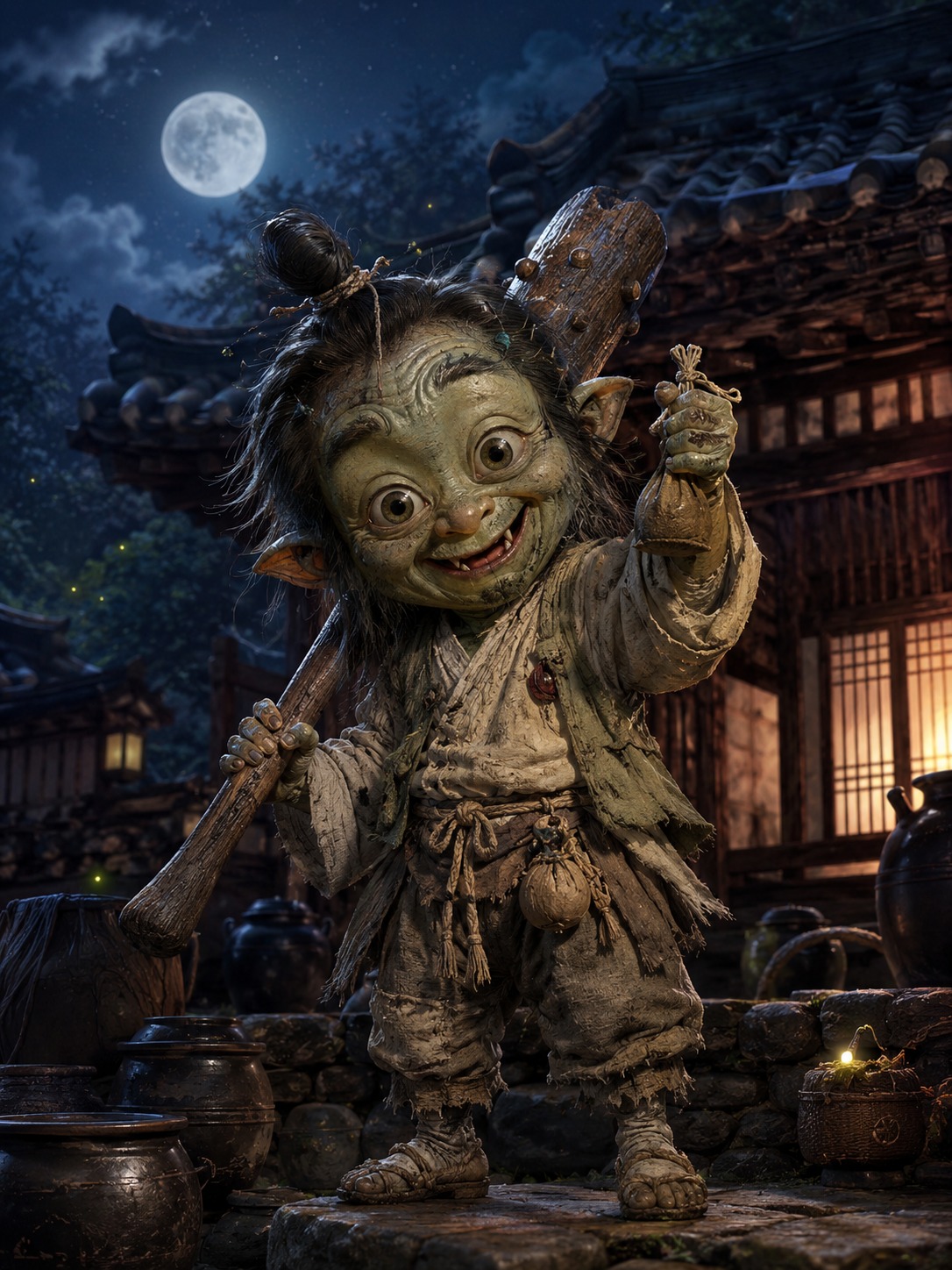
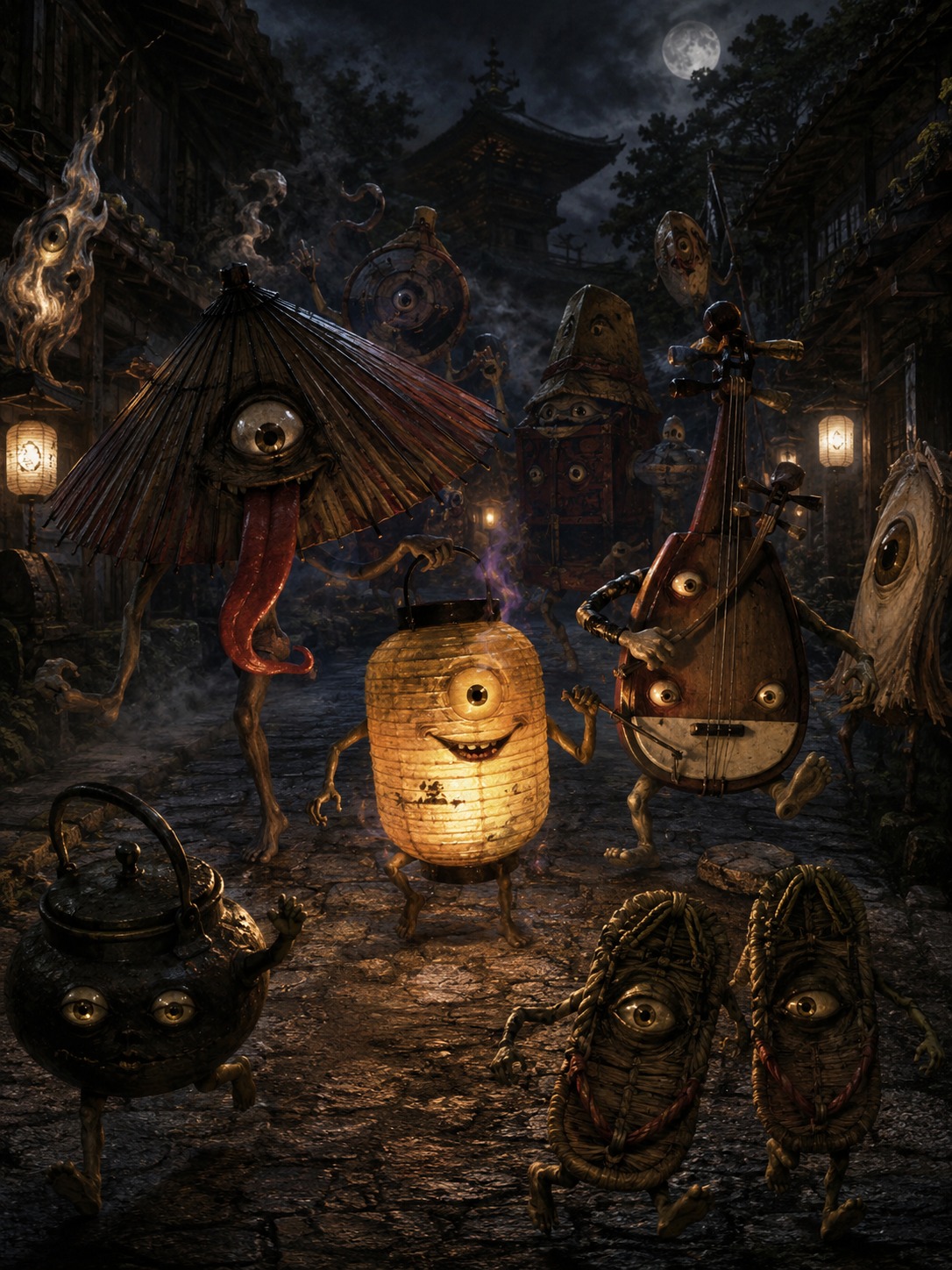
The Tsukumogami (Japanese tsukumogami, 'tool kami') is the Japanese object-yokai born when a household tool has been in use for nearly ninety-nine years and acquires a soul. The etymology lies in Japanese tsukumo (ninety-nine), the indigenous animist belief from the Heian period (794-1185) that any tool surviving ninety-nine years gains consciousness and emotion. The canonical iconography is the Hyakki Yagyo (Night Parade of a Hundred Demons) procession of personified umbrellas, paper lanterns, straw sandals, kettles, lutes, mallets of fortune, and biwa lutes, which acquire eyes, arms, and legs to march at night. The Muromachi-period scroll Tsukumogami-ki (c. late fifteenth century) and the sixteenth-century Hyakki Yagyo Emaki scrolls fixed the visual canon, and Toriyama Sekien's Edo-period Gazu Hyakki Yagyo series (from 1776) systematised nearly one hundred tsukumogami types in an encyclopaedic catalogue. The motif of carelessly discarded tools harbouring resentment and avenging themselves on the living settled the figure as the iconographic condensation of the distinctively Japanese mottainai ethic of frugality and respect for objects.
Origin
The iconographic origin is the indigenous Japanese animist belief of the Heian period (794-1185): the Yaoyorozu no Kami doctrine that eight million spirits inhabit every thing in nature was extended to manufactured tools, giving rise to the belief that a tool that has been used for ninety-nine years acquires a soul. The etymology tsukumo (ninety-nine) reflects a numerological logic that consciousness emerges at the threshold immediately before the centenary. The most decisive text is the short illustrated scroll Tsukumogami-ki of the mid-Muromachi period (estimated late fifteenth century): tools carelessly discarded during the year-end soot-clearing (susu-harai) become enraged, transform into yokai, and join the Hyakki Yagyo procession to attack people by night, before being placated by a Shingon Buddhist homa rite. This narrative fixed the canonical iconography of the tsukumogami. The fourteenth-century Shigisan Engi scroll and the sixteenth-century Hyakki Yagyo Emaki (the version held by Shinju-an of Daitoku-ji in Kyoto is the most famous) are the visual canon, and the Edo-period Toriyama Sekien's four-volume series — Gazu Hyakki Yagyo (1776), Konjaku Gazu Zoku Hyakki (1779), Konjaku Hyakki Shui (1781), and Gazu Hyakki Tsurezure Bukuro (1784) — classified nearly one hundred tsukumogami as an encyclopaedic catalogue.
Features
- A tool that has been in use for ninety-nine years acquires a soul and transforms
- Everyday objects such as umbrellas, paper lanterns, kettles, lutes, and straw sandals as the body
- Eyes, arms, and legs sprout from the body and the object moves autonomously
- Joins the Night Parade of a Hundred Demons and marches the streets after dark
- Resentment of discarded tools or sheer mischievousness
- Pacified by a Shingon Buddhist homa rite or by reverent disposal in the deep mountains
Stories
From the Heian and Muromachi periods, the tsukumogami became the central constituent of the Hyakki Yagyo iconography of illustrated scrolls. The most decisive visual canon is the sixteenth-century Hyakki Yagyo Emaki held at Shinju-an, Daitoku-ji, Kyoto — the personified procession of umbrellas, paper lanterns, biwa lutes, and kettles marching at night became the prototype of all subsequent tsukumogami representations. The Edo-period Toriyama Sekien's four-volume series — Gazu Hyakki Yagyo (1776), Konjaku Gazu Zoku Hyakki (1779), Konjaku Hyakki Shui (1781), and Gazu Hyakki Tsurezure Bukuro (1784) — catalogued nearly one hundred tsukumogami including the Kasa-obake (umbrella yokai), Chochin-obake (paper lantern yokai), Biwa-bokuboku (lute yokai), Boroboroton (futon yokai), and Bake-zori (straw-sandal yokai). Mizuki Shigeru's manga GeGeGe no Kitaro (from 1968) revived the tsukumogami in modern manga, and Miyazaki Hayao's Spirited Away (2001) introduced Japanese spirit iconography to the world. Hamada Yoshikazu's manga Tsugumomo (from 2007) and Fujiwara Kaori's light novel series Kakuriyo no Yadomeshi established the tsukumogami as a canonical figure of modern light novels and anime.
Weakness
The weaknesses of the tsukumogami are: (1) physical destruction of the object body — when the host object is broken, the soul disperses and the yokai is annihilated; (2) the Shingon Buddhist homa pacification rite — the canonical resolution of Tsukumogami-ki, in which a Shingon priest pacifies and brings all tsukumogami to enlightenment through the homa fire rite; (3) reverent disposal rites (kuyo) — respectful enshrinement in the deep mountains or a shrine, with offerings of gratitude, dissolves the resentment and the object reverts to non-life; (4) Shinto purification rites — purification using salt, holy water, and the tamagushi sakaki branch sends the soul to the next realm. The Japanese custom of doll-pacification (ningyo kuyo) — annual rites held on 14 October at Meiji Jingu in Tokyo, Awashima Jinja in Wakayama (held on 3 March), and Hattori Tenmangu in Osaka — survives as a living folk rite that prevents tsukumogami emergence pre-emptively in the twenty-first century. About two hundred shrines and temples across Japan perform doll-pacification rites.
Cultural Significance
The tsukumogami is not merely a yokai but the visual condensation of indigenous Japanese animist belief and the mottainai ethic. The Yaoyorozu no Kami belief that eight million spirits inhabit every thing in nature, extended to manufactured tools, generated a uniquely Japanese object-ethic in which carelessness toward tools incurs resentment and reverent use brings blessing. This message is consistent from the Muromachi-period Tsukumogami-ki to Toriyama Sekien's Edo-period catalogues. In 2005, the Kenyan environmentalist Wangari Maathai (Nobel Peace Prize laureate 2004) adopted the mottainai spirit as the central concept of her environmental movement during a visit to Japan, launching the 'Mottainai Campaign' and introducing mottainai at the United Nations Environment Programme conference as the Japanese expression of the 4R ethic (Reduce, Reuse, Recycle, Respect), globalising it as a term of environmental ethics. The Japanese doll-pacification custom continues into the twenty-first century at Meiji Jingu in Tokyo (14 October each year), Awashima Jinja in Wakayama (3 March), and Hattori Tenmangu in Osaka, as a living folk rite of tsukumogami belief. The faceless figure, the river deity, and the soot sprites in Miyazaki Hayao's Spirited Away (2001) are modern revivals of the tsukumogami iconography of object spirits.
In Popular Culture
- Shigisan Engi Emaki (twelfth century) — visual precursor of Japanese anthropomorphic tool scrolls
- Tsukumogami-ki, Muromachi period (late fifteenth century) — decisive literary and iconographic canon of the tsukumogami
- Hyakki Yagyo Emaki, sixteenth century — visual canon, the Shinju-an copy at Daitoku-ji being the most famous
- Toriyama Sekien, Gazu Hyakki Yagyo (1776) — Edo-period encyclopaedic catalogue of the tsukumogami
- Toriyama Sekien, Gazu Hyakki Tsurezure Bukuro (1784) — canonical classification of nearly one hundred tsukumogami
- Mizuki Shigeru, GeGeGe no Kitaro (from 1968) — modern manga revival of the tsukumogami
- Miyazaki Hayao, Spirited Away (2001) — globalisation of the object-spirit iconography
- Hamada Yoshikazu, Tsugumomo (from 2007) — canonical figure of modern light novels and anime
Trivia
The etymology tsukumo is an archaic Japanese word for ninety-nine, the year immediately before the centenary; the numerological logic that a soul emerges at the threshold one year before a tool reaches its centenary combined with native animism produced the tsukumogami concept. Tsukumo is also a poetic expression for the colour of human hair: in Heian-period waka, the white hair of an old person was called tsukumogami (ninety-nine hair), giving rise to a homophonic relationship. The Muromachi-period scroll Tsukumogami-ki was composed as a moral tract warning against the Japanese custom of carelessly discarding tools at setsubun (the eve of spring), the year-end soot-clearing (susu-harai), and the scholarly consensus (the Japanese folklorist Komatsu Kazuhiko) holds that it was also religious propaganda for the efficacy of the Shingon homa rite. In the twenty-first century, the largest doll-pacification rite is held annually at Hattori Tenmangu in Osaka on 14 October, where about thirty thousand dolls are pacified and burned; the number of dolls offered has been rising every year since 2017. In 2014, the Japanese Ministry of the Environment formally adopted the mottainai spirit as an official slogan of its environmental ethics.