Dokkaebi
Dokkaebi · The Korean Goblin — A Capricious Spirit of Mischief and Wealth
Names in Other Languages
 도깨비한국어
Dokkaebi · 한국 도깨비 — 장난과 재물의 변덕스러운 정령
 トッケビ日本語
Dokkaebi · 韓国の妖怪 — 悪戯と財物の気まぐれな精霊
 獨腳鬼繁體中文
Dokkaebi · 韓國妖怪 — 惡作劇與財物的善變精靈
 DokkaebiDeutsch
Dokkaebi · Der koreanische Kobold — Ein launischer Geist des Schabernacks und Reichtums
 DokkaebiFrançais
Dokkaebi · Le gobelin coréen — Un esprit capricieux de malice et de richesse
 DokkaebiEspañol
Dokkaebi · El duende coreano — Un espíritu caprichoso de travesura y riqueza
 DokkaebiPortuguês
Dokkaebi · O duende coreano — Um espírito caprichoso de travessura e riqueza
 DokkaebiPolski
Dokkaebi · Koreański goblin — kapryśny duch psot i bogactwa
 ТоккэбиРусский
Dokkaebi · Корейский гоблин — капризный дух озорства и богатства
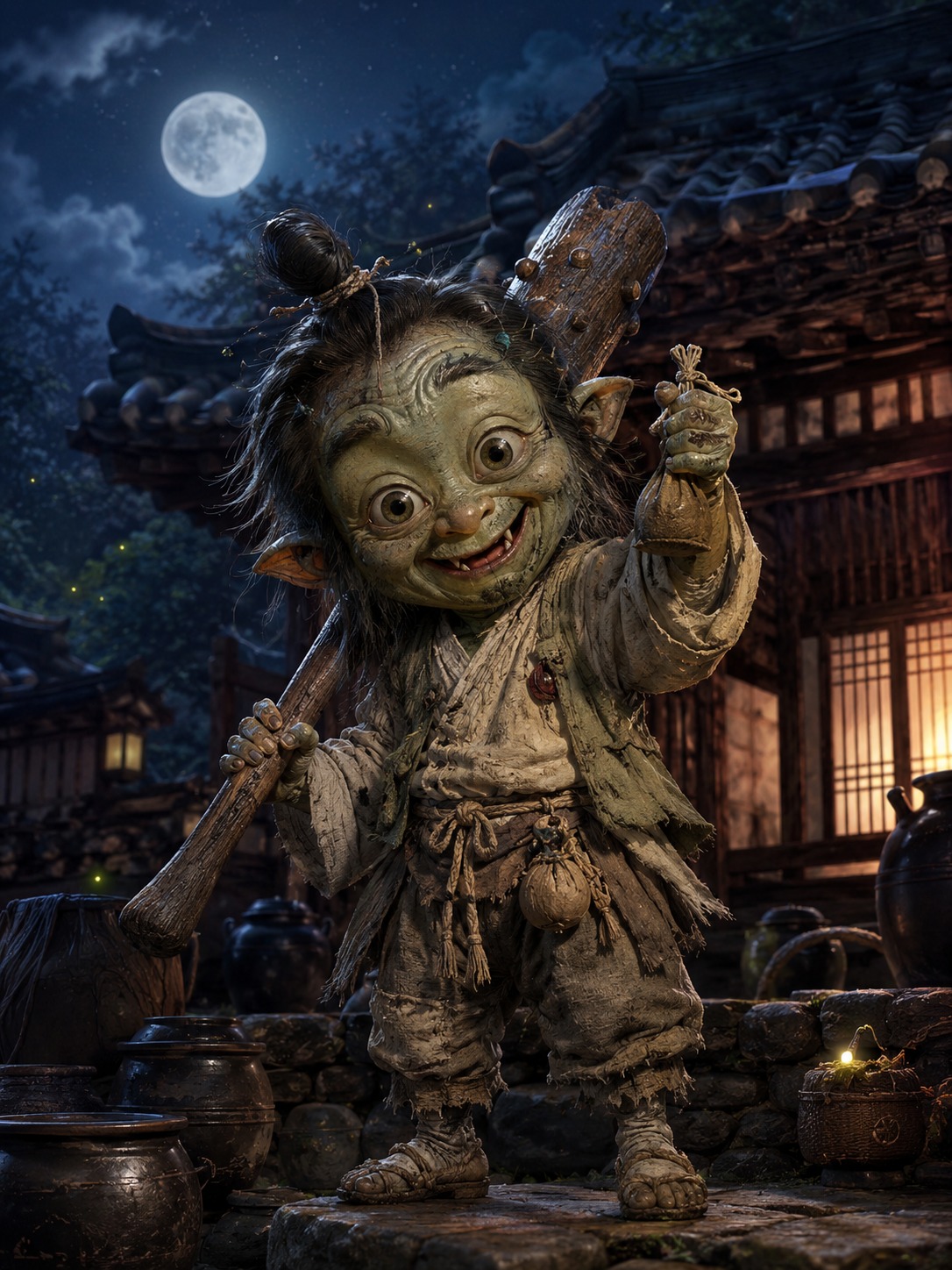
The Dokkaebi (Korean Dokkaebi) is the representative spirit-yokai of Korean folklore, born when a spirit takes up residence in an old household tool or in a broom, pestle, or fire-poker that has been stained with human blood, and it is the decisive iconographic figure of Korean indigenous animism. The earliest text is the entry Tohwanyeo and Bihyeongnang in Book One of the Memorabilia of the Three Kingdoms (Samguk Yusa) compiled by Iryeon (1206-1289) in 1281: the soul of the late King Jinji of Silla (reigned 576-579) had carnal congress with the maiden Tohwanyeo and begat a son, Bihyeongnang, who commanded a band of dokkaebi spirits to build a bridge in one night. This narrative is the canonical Korean origin of the dokkaebi iconography. Canonical tools are the dokkaebi-bangmangi (wish-fulfilling magic club) and the dokkaebi-gamtu (cap of invisibility), and the dokkaebi loves buckwheat-jelly and rice-wine, enjoys wrestling and tricks, and honours promises and repayment. The 1942 study Researches on Korean Folktales by Son Jin-tae demonstrated that the dokkaebi, before being overlaid by the horned imagery of the Japanese oni during the colonial period, was originally a hornless humanoid figure. The 2016 tvN television drama Dokkaebi (Goblin), broadcast from December 2016 to January 2017, globalised the dokkaebi as a K-drama canon.
Origin
The iconographic origin is Korean indigenous animism: a belief in object-spirits in which long-used household tools, or brooms, pestles, and fire-pokers stained with human blood, become dokkaebi by being inhabited by a spirit, combined with Korean shamanism (musok) to form the figure. The decisive text is the Tohwanyeo and Bihyeongnang entry in Book One of the Memorabilia of the Three Kingdoms (Samguk Yusa), compiled by the monk Iryeon (1206-1289) in 1281: the twenty-fifth king of Silla, King Jinji (reigned 576-579), was deposed and died, but his soul lay with the maiden Tohwanyeo and begat a son, Bihyeongnang, who nightly commanded a band of dokkaebi spirits to perform labour outside the royal palace, building the bridge of Sinwon-sa in a single night and bringing one dokkaebi named Gildal into the royal harem. This is the canonical Korean record of the dokkaebi. Iryeon is presumed to have transcribed oral Silla legends in the late thirteenth century. Joseon-period texts such as Seong Hyeon's Yongjae Chonghwa (late fifteenth century) and the anonymous Cheonggu Yadam (early nineteenth century) systematised dokkaebi folktales, and canonical iconography such as the dokkaebi-bangmangi, the dokkaebi-gamtu, dokkaebi-wrestling, and the love of buckwheat-jelly settled in the oral tradition of the Joseon period.
Features
- Born when a spirit takes up residence in a long-used object or in a blood-stained broom or pestle
- Wish-fulfilment by the dokkaebi-bangmangi — the canonical magic club of 'Bring forth gold!'
- Invisibility power when wearing the dokkaebi-gamtu (cap of invisibility)
- Capricious nature that loves wrestling, tricks, and wagers
- Loves buckwheat-jelly and rice-wine and honours promises and repayment
- A canonical comical weakness: turning leftward in a wrestling match exposes its vulnerability
Stories
Settled as a core character of Joseon-period oral folktales, the dokkaebi became the central motif of canonical tales such as Heungbu-jeon, Kongjwi and Patjwi, The Dokkaebi-gamtu, and The Old Man with a Wen. The Old Man with a Wen — in which a dokkaebi mistakes a singing old man's wen for the source of his beautiful voice and rewards him with gold and silver in exchange for removing it, but when a greedy neighbour imitates the song the dokkaebi catches the deceit and attaches the first old man's wen to him as well, leaving him doubly wenned — is the canonical didactic tale of the dokkaebi. From the 1980s, the dokkaebi-bangmangi and dokkaebi-gamtu were settled as canonical children's iconography in Korean fairy tales and school textbooks. The tvN drama Goblin (Dokkaebi: The Lonely and Great God), broadcast from 2 December 2016 to 21 January 2017 (written by Kim Eun-sook, directed by Lee Eung-bok, starring Gong Yoo as Kim Shin, Lee Dong-wook as the Grim Reaper, and Kim Go-eun as Ji Eun-tak), reinterpreted the dokkaebi as a tragic hero of eternal life, achieving an average rating of 12.8 percent and a peak of 20.5 percent — the highest in the history of Korean cable television drama — and was broadcast in over a hundred countries via Netflix, establishing the dokkaebi in the global K-content canon. It won seven categories at the 2017 Baeksang Arts Awards, including Best Drama, Best Director, and Best Screenplay.
Weakness
The dokkaebi's weaknesses are: (1) horse blood — in Korean folklore the dokkaebi extremely abhors horse blood, and red cloth smeared with horse blood or amulets made from horse blood are canonical apotropaic devices; (2) buckwheat — the dokkaebi loves buckwheat-jelly and buckwheat noodles, but the motif also exists in which buckwheat scattered from a bowl makes the dokkaebi vanish instantly; (3) the rule of promise and wager — the dokkaebi is rigidly bound by promises once made and by the rules of wrestling and wagering, and many folktales exploit this rigidity to outwit the dokkaebi; (4) leftward turning — when wrestling a dokkaebi, turning leftward exposes its vulnerability, allowing a human to triumph; this is the canonical comical weakness; (5) cock-crow at dawn — being nocturnal, the dokkaebi vanishes instantly when the rooster crows, leaving only the broom or pestle in which it had resided. In the 2016 tvN drama Goblin, the conceit that only the dokkaebi's bride (Kim Go-eun as Ji Eun-tak) can pull the sword embedded in the chest of the immortal dokkaebi Kim Shin — a modern variation of the original weakness motif — became canonical.
Cultural Significance
The dokkaebi is not merely a yokai but a cultural canon at the crossroads of Korean indigenous belief, national identity, and the representational politics of Japanese colonial rule. During the colonial period (1910-1945), Japanese scholars identified the dokkaebi with the Japanese oni, depicting it as horned and clad in a tiger skin, an iconography that was disseminated through school-textbook illustrations of the 1920s and 1930s and distorted Korean popular imagery of the dokkaebi. The 1942 publication Researches on Korean Folktales by Son Jin-tae (1900-?) academically demonstrated the iconographic difference between the Korean dokkaebi and the Japanese oni — that the Korean dokkaebi was originally a hornless, hairy humanoid that loved buckwheat-jelly — and it stands as the canonical Korean folkloristic study. Kim Yeol-gyu (1932-2013) carried this forward in The Mythology of the Korean People (1988), and Park Eun-bong in dokkaebi folklore studies (1996). The global success of the 2016 tvN drama Goblin, written by Kim Eun-sook and directed by Lee Eung-bok, was the decisive event in the canonisation of the Hallyu K-drama tradition, reviving Korean folkloric dokkaebi iconography in twenty-first-century global popular culture. The Korean Cultural Heritage Foundation's 2020 initiative to inscribe the dokkaebi as intangible cultural heritage and the National Folk Museum of Korea's 2023 special exhibition on the dokkaebi led the scholarly and popular re-establishment of dokkaebi iconography.
In Popular Culture
- Iryeon, Memorabilia of the Three Kingdoms (Samguk Yusa), Book One, Tohwanyeo and Bihyeongnang (1281) — earliest textual record of the dokkaebi
- Seong Hyeon, Yongjae Chonghwa (late fifteenth century) — early-Joseon systematisation of dokkaebi folktales
- Cheonggu Yadam (early nineteenth century) — decisive canon of late-Joseon dokkaebi folktales
- The Old Man with a Wen, oral tradition — canonical didactic tale of the dokkaebi in the Joseon period
- Son Jin-tae, Researches on Korean Folktales (1942) — scholarly distinction between Korean dokkaebi and Japanese oni
- Kim Yeol-gyu, The Mythology of the Korean People (1988) — modern canon of dokkaebi folkloristics
- tvN drama Goblin (Dokkaebi: The Lonely and Great God) (2016) — globalisation of dokkaebi iconography as K-content
- Netflix worldwide broadcast of Goblin (2017) — global canonisation of dokkaebi iconography
- National Folk Museum of Korea special exhibition on the dokkaebi (2023) — scholarly and popular re-establishment
Trivia
The etymology of the word dokkaebi is unclear, but its earliest appearance in Hangul is in chapter 7 of the Songs of the Dragons Flying to Heaven (Yongbi Eocheonga, 1447) — as 'dotgabi' — proving that the dokkaebi was already a settled vernacular figure in fifteenth-century Korea. The dokkaebi Bihyeongnang in Iryeon's thirteenth-century Memorabilia of the Three Kingdoms is the son of the ghost of King Jinji (reigned 576-579) by the maiden Tohwanyeo, and the motif of the soul of a dead king commerce with the living was combined with the later object-spirit aspect of Korean dokkaebi belief and transformed. The Korean folklorist Son Jin-tae's 1942 academic rebuttal of the Japanese scholar Takahashi Toru's colonial-period identification of dokkaebi with oni in Researches on Korean Folktales is a decisive event in the history of Korean folkloristics. The OST 'Stay With Me' (by Chanyeol and Punch) from the 2016 tvN drama Goblin ranked first on Korean music charts and first on the Billboard World Digital Songs chart, and its seven wins at the 2017 Baeksang Arts Awards remain the most-decorated record in the history of Korean cable television drama. The 2020 Toronto International Film Festival's Hallyu special exhibition and the 2023 Korean Art exhibition at the Metropolitan Museum of Art in New York established dokkaebi iconography as a global exhibition canon.