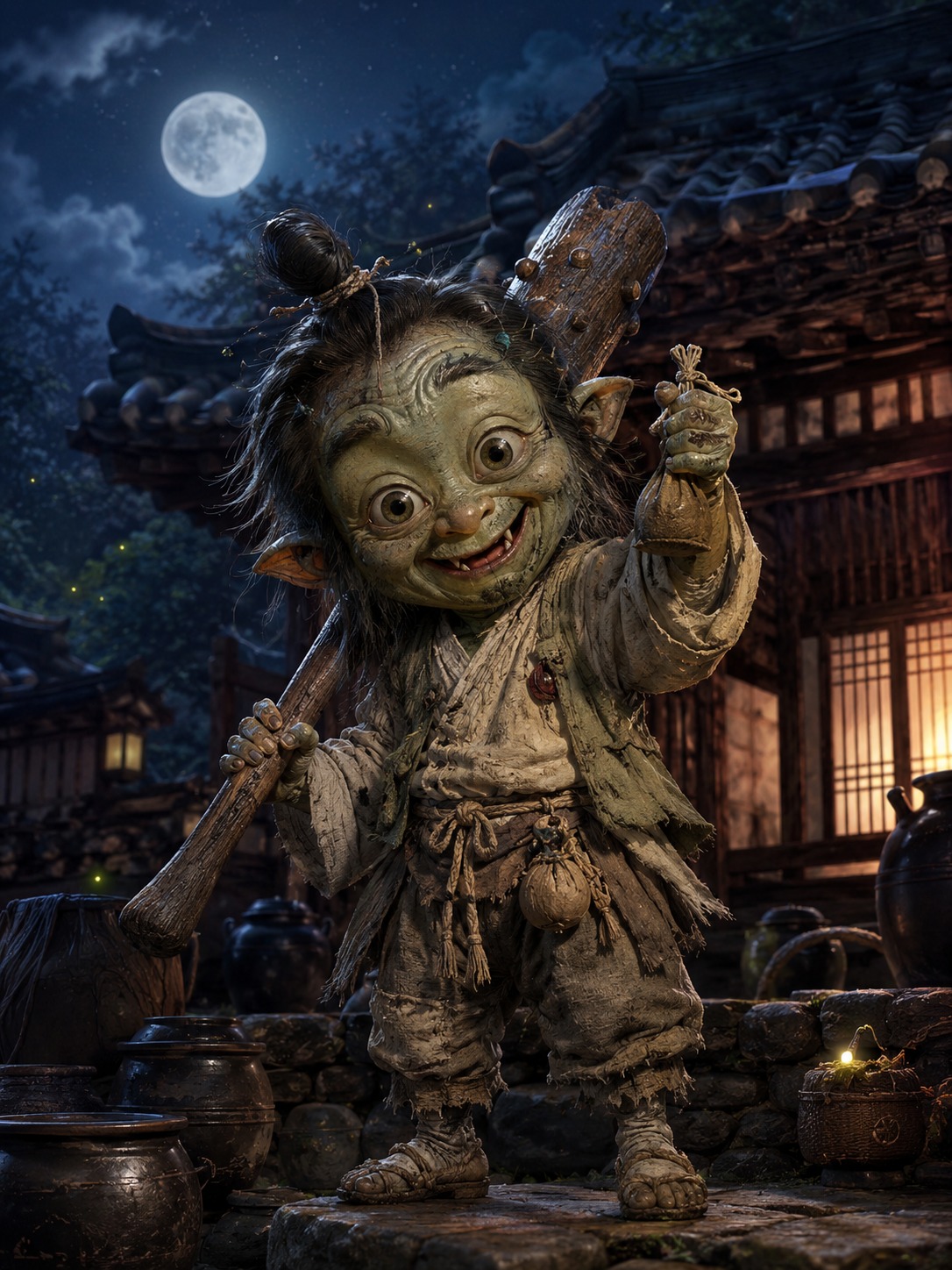
Oni
Oni · The Japanese Demon — A Horned, Hulking Man-Eating Ogre
Names in Other Languages
 오니한국어
오니한국어Oni · 일본의 귀신 — 뿔 달린 거구의 식인 도깨비
 鬼日本語
鬼日本語Oni · 日本の鬼 — 角を持つ巨体の食人鬼
 鬼(日本)繁體中文
Oni · 日本之鬼 — 生角之巨軀食人鬼
 OniDeutsch
Oni · Der japanische Dämon — Ein gehörnter, kolossaler menschenfressender Oger
 OniFrançais
Oni · Le démon japonais — Un ogre cornu et colossal mangeur d'hommes
 OniEspañol
Oni · El demonio japonés — Un ogro cornudo y colosal comehombres
 OniPortuguês
Oni · O demônio japonês — Um ogro chifrudo e colossal comedor de homens
 OniPolski
Oni · Japoński demon — rogaty, kolosalny ludożerczy ogr
 ОниРусский
Oni · Японский демон — рогатый, исполинский людоедский огр
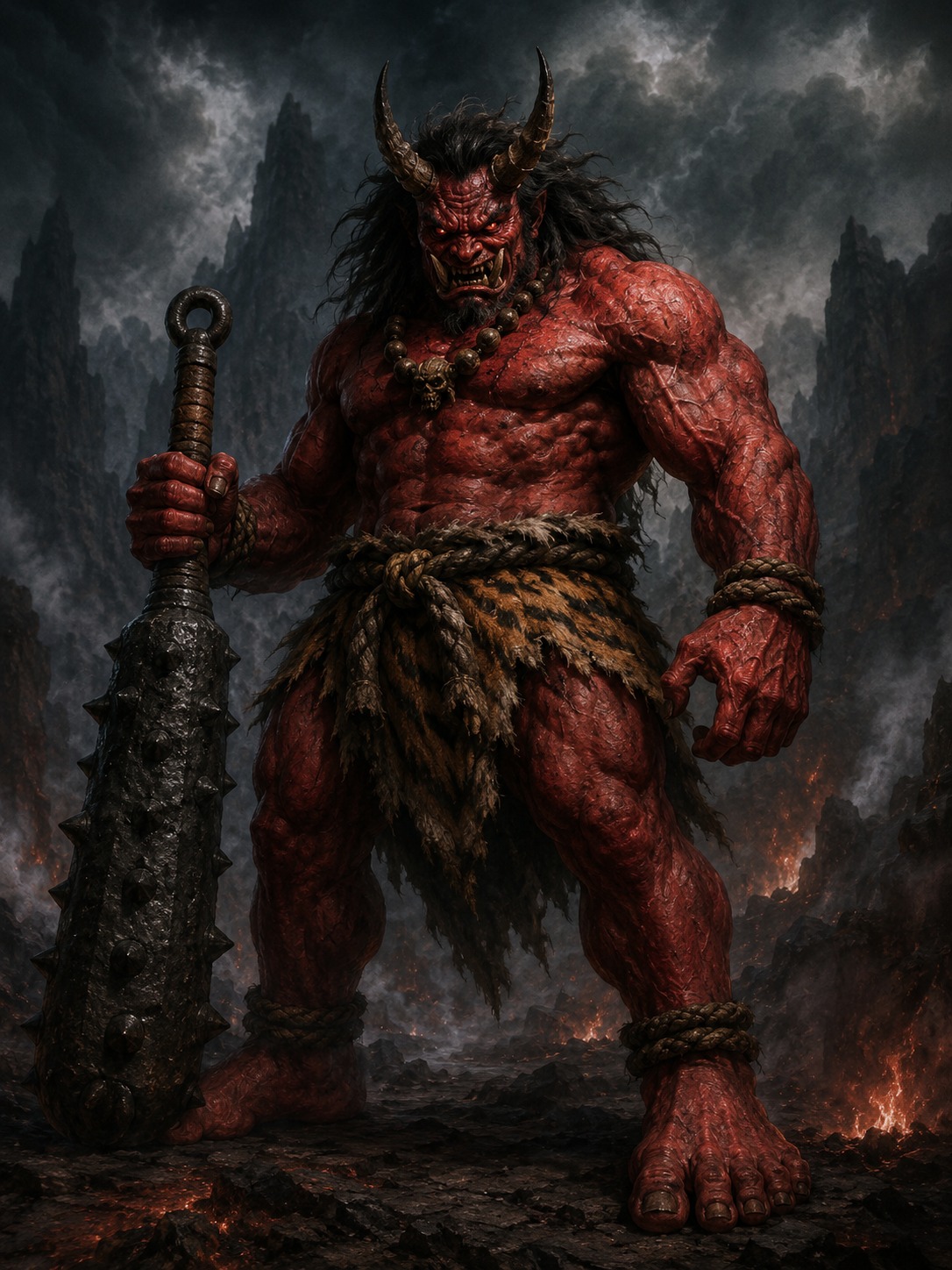
The Oni (Japanese oni) is the gigantic and ferocious demon of Japanese tradition, the canonical iconographic figure of Japanese yokai distinguished by red or blue skin, horns on its head, sharp tusks, a tiger-skin loincloth (torainu fundoshi), and a wielded iron club, the kanabo. The etymology combines the Chinese ideogram 'gui' (the soul of the dead) with the Japanese indigenous root 'on' ('to hide'), per the canonical hypothesis of the eighteenth-century Japanese dictionary Wakun no Shiori compiled by Tanigawa Kotosuga. The iconographic origin is a composite of (1) the Chinese 'gui' belief, (2) the hell-wardens of Indian Buddhism (the ox-headed and horse-headed naraka-pala), and (3) the indigenous Japanese mountain-spirit belief. The most decisive Japanese text is the depiction of mountain spirits in the eighth-century Kojiki (712) and Nihon Shoki (720), and the canonical heroic narrative is the Shuten-doji story in the eleventh- and twelfth-century Konjaku Monogatarishu — in which Minamoto no Yorimitsu (948-1021) leads the Four Heavenly Kings including Watanabe no Tsuna to slay the oni Shuten-doji of Mount Oe in Tanba Province and present his head to the imperial court. The 2016-2020 Japanese manga Demon Slayer (Kimetsu no Yaiba) by Koyoharu Gotouge established the twenty-first-century global canon of oni iconography.
Origin
The iconographic origin is a composite of (1) the Chinese ideogram 'gui' (the soul of the dead) belief, (2) the hell-wardens of Indian Buddhism (naraka-pala), and (3) the indigenous Japanese mountain-spirit belief. The earliest Japanese sources are the depictions of mountain spirits (yama no rei) in the early-eighth-century Kojiki (712) and Nihon Shoki (720), and during the Heian period (794-1185), the Chinese-introduced Buddhist belief in the realms of hell combined with the indigenous mountain-spirit cult to produce the modern oni iconography — horned, tusked, and wielding an iron club. The decisive Heian canon is the Shuten-doji story in the eleventh- and twelfth-century Konjaku Monogatarishu, in which Minamoto no Yorimitsu (948-1021) leads the Four Heavenly Kings including Watanabe no Tsuna to slay the oni Shuten-doji of Mount Oe in Tanba Province and present his head to the imperial court: the decisive canon of the oni-slaying heroic narrative. Variants of the oni — Ushioni, Onibaba, Hashihime — were systematised in the Otogizoshi short-story collections of the Muromachi period (1336-1573) and in the Gazu Hyakki Yagyo (1776) of the Edo-period Toriyama Sekien (1712-1788). The canonical Japanese folktale Momotaro — in which the boy Momotaro, born of a peach, defeats the oni of Onigashima with his dog, monkey, and pheasant companions — settled in Edo-period oral tradition.
Features
- Red or blue skin and horns on the head
- Sharp tusks and the immense strength of a giant body
- Tiger-skin loincloth and the iron club (kanabo)
- Dwelling in mountains and hell, devouring humans
- Iconography as a hell-warden who punishes sinners
- Simple and arrogant, easily deceived by cunning
Stories
The decisive canon of oni iconography is twofold: the Shuten-doji story in the eleventh- and twelfth-century Konjaku Monogatarishu, and the Edo-period folktale Momotaro, in which the boy Momotaro, born of a peach, defeats the oni of Onigashima with his dog, monkey, and pheasant companions. These became the prototypes of all subsequent Japanese oni representations. In the Muromachi-period Otogizoshi short story Issun-boshi, in which the diminutive hero Issun-boshi seizes the oni's wish-granting mallet (uchide no kozuchi) and becomes a giant, the oni-slaying narrative is also canonical. The Gazu Hyakki Yagyo of the Edo-period Toriyama Sekien (1776) — cataloguing oni variants such as Ushioni, Onibaba, and Hashihime — established the visual canon. In February 2016, Demon Slayer (Kimetsu no Yaiba) by Koyoharu Gotouge began serialisation in Weekly Shonen Jump, concluding in May 2020 at twenty-three volumes with one hundred and fifty million copies in print; the eponymous television anime by Ufotable, directed by Haruo Sotozaki, began in April 2019; the theatrical film Demon Slayer: Mugen Train, released on 16 October 2020, set the record for Japanese film box office (40.4 billion yen) and a global box office of 507 million US dollars, the highest-grossing Japanese film in history. The franchise expanded with Season 2 Entertainment District Arc (December 2021), Hashira Training Arc (April 2024), and the Infinity Castle Trilogy films from 2025.
Weakness
The oni's weaknesses are: (1) bean-throwing (mamemaki) — the Japanese canonical folk ritual on the 3 February setsubun of throwing roasted soybeans while chanting 'Oni wa soto, fuku wa uchi' ('Demons out, fortune in') is the most decisive iconography of expelling the oni; (2) sardine head and holly — the setsubun talisman hiiragi iwashi (a sardine head skewered on a holly branch) hung at the door to keep the oni out is canonical; (3) the Buddhist Dharma — in the Heian Shuten-doji legend, the canon that Minamoto no Yorimitsu could slay Shuten-doji only by the protection of Yakushi Nyorai (the Medicine Buddha) and Hachiman; (4) the cunning and divine tools of heroes — the canon of defeating the oni with companions and tools such as Momotaro's kibidango millet-dumplings and Issun-boshi's needle-sword; (5) simplicity and arrogance — the canon of the Japanese folktale that simple oni are easily deceived by the cunning of heroes. In the 2016-2020 Demon Slayer, the weaknesses of the oni were modernised — sunlight, wisteria flowers, and the nichirinto (a sunlight-absorbing steel sword) — and the climactic narrative in which the final boss Muzan Kibutsuji has fled from sunlight for a thousand years and is annihilated by sunlight exposure at the hands of the nichirinto corps became the twenty-first-century canon.
Cultural Significance
The oni is not merely a Japanese yokai but the central iconographic figure of Japanese religion, folklore, and national identity. The hell-warden iconography of the Heian Buddhist belief in the realms of hell, through Muromachi and Edo folkloric canonisation, settled as the representation of the 'inside and outside' boundary of the Japanese ethnos. The mamemaki bean-throwing custom of the Japanese setsubun rite — performed every 3 February at the Senso-ji in Asakusa, Tokyo, the Heian Jingu in Kyoto, the Kasuga Taisha in Nara, and about eighty thousand shrines and temples nationwide, and registered as an Intangible Cultural Heritage of Japan — is the living folk ritual of oni belief. The 2016-2020 Demon Slayer by Koyoharu Gotouge was the decisive box-office event in the history of Japanese manga, anime, and film: the 40.4 billion yen Japanese box-office of the 2020 theatrical film Mugen Train (overtaking, after twenty-three years, the 26.2 billion yen Japanese box-office record of Titanic), the global 507 million US dollars box-office, and the 2021 Golden Globe Best Foreign Language Film nomination — the first Japanese animated film so nominated — established oni iconography as a twenty-first-century global content canon. The 2017 Tokyo National Museum special exhibition The Transformation of the Oni and the 2023 Demon Slayer special illustration exhibition at the Metropolitan Museum of Art in New York positioned oni iconography as a global exhibition canon.
In Popular Culture
- Kojiki and Nihon Shoki (712-720) — etymological origin of the Japanese indigenous mountain spirit
- Konjaku Monogatarishu, Shuten-doji (eleventh-twelfth century) — decisive canon of the oni-slaying heroic narrative
- Issun-boshi, Muromachi Otogizoshi — Otogizoshi oni canon
- Momotaro, Edo oral tradition — decisive canon of the Japanese folktale oni
- Toriyama Sekien, Gazu Hyakki Yagyo (1776) — Edo-period oni iconography catalogue
- Setsubun mamemaki rite — living Japanese folk oni rite
- Koyoharu Gotouge, Demon Slayer (2016-2020) — twenty-first-century global oni canon
- Ufotable, anime Demon Slayer (from 2019) — Japanese animation oni canon
- Theatrical Demon Slayer: Mugen Train (2020) — Japanese film box-office record
Trivia
The Sino-Japanese ideograph for oni, 'gui', first appeared in Chinese oracle bone script of the fourteenth-eleventh centuries BC with the meaning 'soul of the dead', one of the oldest Chinese ideographs, and the Japanese reading 'oni' is canonically derived in the eighteenth-century Wakun no Shiori of Tanigawa Kotosuga (1709-1776) from 'on' (to hide) — originally meaning 'spirit hidden in the mountains'. The mamemaki custom of Japanese setsubun, deriving from the ninth-century Heian-period imperial-court rite tsuina under Emperor Uda (reigned 887-897), is performed every 3 February at about eighty thousand shrines and temples across Japan, and the mamemaki at the Senso-ji in Asakusa, Tokyo, draws about one hundred thousand visitors annually. Demon Slayer: Mugen Train, released in Japanese theatres on 16 October 2020, set the Japanese box-office record at 40.4 billion yen (about 370 million US dollars), overtaking after twenty-three years the 26.2 billion yen Japanese box-office of the American film Titanic of 1997, and its global box-office of 507 million US dollars placed it first in the 2020 global box-office of the MPAA — the highest-grossing manga-original Japanese animated film in history. The same film's 2021 Golden Globe Best Foreign Language Film nomination was the first ever for a Japanese animated film, and in 2024 the Japanese Ministry of Foreign Affairs selected Demon Slayer as one of the official representative works of Japanese cultural diplomacy.