Kappa
Kappa · The Japanese Water Yokai — A River Prankster With Power in a Head-Dish
Names in Other Languages
 갓파한국어
갓파한국어Kappa · 일본 물의 요괴 — 머리 접시에 힘을 담은 강의 장난꾸러기
 河童日本語
河童日本語Kappa · 日本の水の妖怪 — 頭の皿に力を宿す川のいたずら者
 河童繁體中文
Kappa · 日本水之妖怪 — 頭頂盤中藏力的河中頑童
 KappaDeutsch
Kappa · Der japanische Wasser-Yokai — Ein Flussschelm mit Macht in einer Kopfschale
 KappaFrançais
Kappa · Le yokai aquatique japonais — Un farceur des rivières au pouvoir dans une coupelle crânienne
 KappaEspañol
Kappa · El yokai acuático japonés — Un bromista de los ríos con poder en un platillo craneal
 KappaPortuguês
Kappa · O yokai aquático japonês — Um brincalhão dos rios com poder num pratinho craniano
 KappaPolski
Kappa · Japoński yokai wodny — rzeczny psotnik z mocą w czaszowej miseczce
 КаппаРусский
Kappa · Японский водяной ёкай — речной проказник с силой в темянной чаше
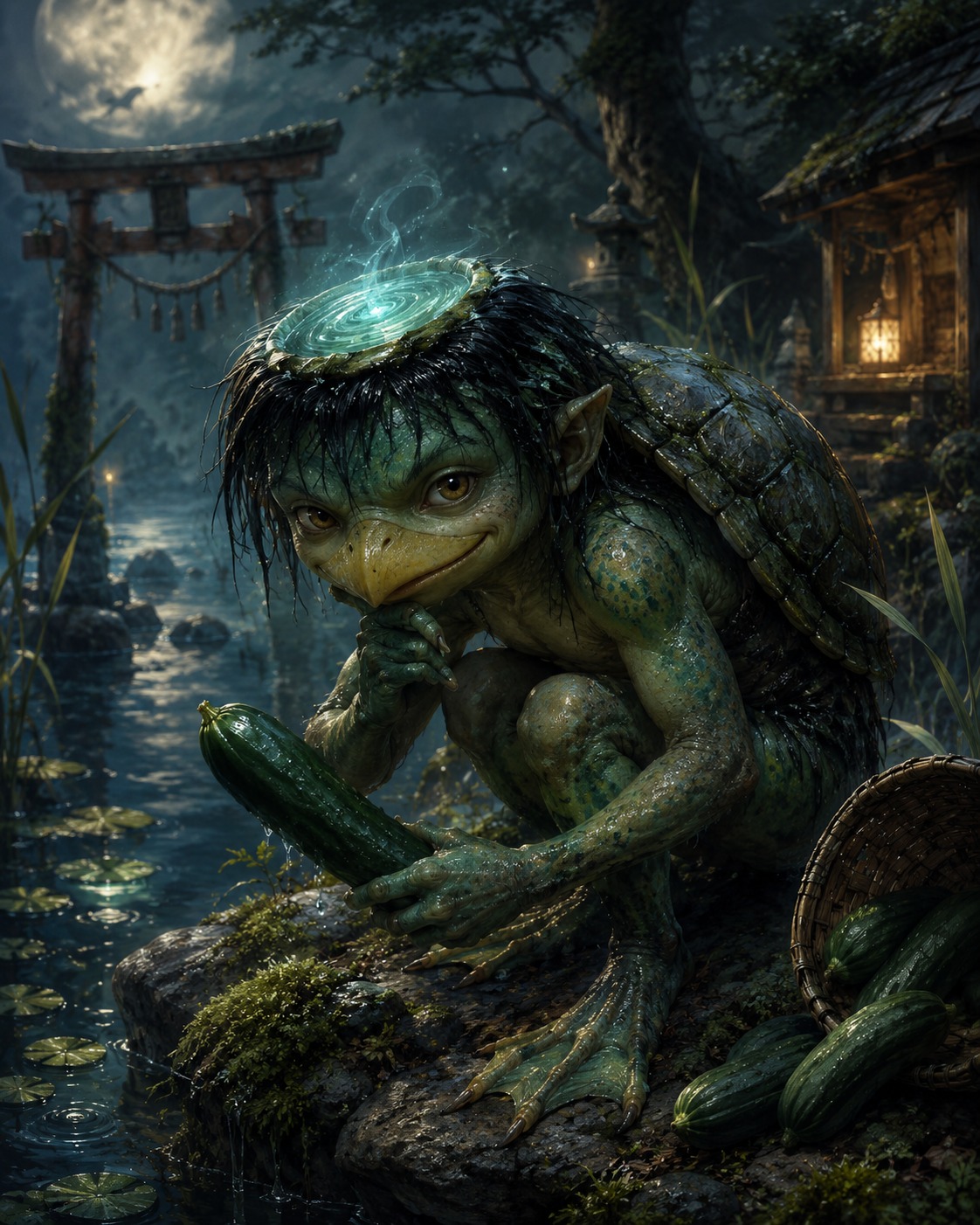
The Kappa (Japanese Kappa, 'river child') is the water yokai that dwells in the rivers and ponds of Japan, the canonical iconographic figure of Japanese water-deity (suijin) belief, child-sized in build, with a turtle shell (kora), webbed hands and feet, and a water-holding plate (sara) on the crown of its head. The Sino-Japanese characters Kawa-warabe ('river child') correspond to the Japanese vernacular Kawako (river child), Kawataro (river boy), and many regional names. The iconographic origin is the fusion of Japanese indigenous water-deity belief with the drowning lore of riversides and ponds. The decisive textual source is the section in book 40 of the encyclopaedia Wakan Sansai Zue compiled in 1712 by Terajima Ryoan, which systematised the Kappa as the canonical figure with a beak, turtle shell on the back, and plate on the crown. The visual canon was established in the yokai catalogue Gazu Hyakki Yagyo (1776) of Toriyama Sekien (1712-1788). The decisive modern canon is Kunio Yanagita's (1875-1962) Tono Monogatari of June 1910 — seventeen Kappa folktales of the Tono region in Iwate Prefecture — which established the Japanese folkloristic Kappa canon, and Keiichi Hara's 2007 animated film Summer Days with Coo (Kappa no Ku to Natsuyasumi), released on 28 July 2007, settled the popular canon of twenty-first-century global Kappa iconography.
Origin
The iconographic origin is the fusion of Japanese indigenous water-deity (suijin) belief with the drowning lore of rivers and ponds. The social experience of drownings in rivers and ponds across Japan — the real occurrence of children's swimming accidents every summer — was interpreted as the wrath of the water-deity or the prank of the water-yokai, giving rise to the Kappa iconography. The earliest textual record is the 'water marvel' (suikai) entry in book 40 of the first comprehensive Japanese encyclopaedia Wakan Sansai Zue compiled in 1712 by Terajima Ryoan, which settled the canonical figure of Kawataro (river boy) with a turtle shell on the back, a plate on the crown, and a beaked mouth. In the 1776 Yokai catalogue Gazu Hyakki Yagyo of Toriyama Sekien, the Kappa was established as a visual canon — about ninety centimetres in height, blue skin, turtle shell and webbed limbs, water plate on the crown. The 1809 Toen Shosetsu of Takizawa Bakin (1767-1848) compiled Edo-period Kappa folktales. The regional names of the Kappa across Japan number around eighty — Kawataro in Kyushu, Enko in Shikoku, Kawako in Western Japan, Mentsuchi in Tohoku, Medochi in Tohoku, Karapa in Kagoshima, Kijimuna in Okinawa — varying by region but sharing the same canonical iconography. The decisive modern canonisation is Kunio Yanagita's (1875-1962) Tono Monogatari of June 1910, the canonical text of Japanese folkloristics: seventeen Kappa folktales of the Tono region of Iwate Prefecture, transcribed by Sasaki Kizen (1886-1933) and edited by Yanagita. The Kappa-buchi (Kappa Pool) behind Joken-ji temple in the city of Tono settled as the decisive sacred site of Japanese Kappa belief.
Features
- Child-sized build with blue or green skin
- Turtle shell (kora) and webbed hands and feet
- Water-holding plate (sara) on the crown of the head
- Loses its strength when the water on the plate dries up
- Loves sumo wrestling and cucumbers (kyuri)
- Canonical disposition of always repaying courtesy
Stories
The 1712 Wakan Sansai Zue and Toriyama Sekien's 1776 Gazu Hyakki Yagyo established the Kappa visual canon, the 1809 Toen Shosetsu of Takizawa Bakin is the decisive Edo-period Kappa folktale canon, and Kunio Yanagita's 1910 Tono Monogatari is the decisive Japanese folkloristic Kappa canon. Shigeru Mizuki's (1922-2015) manga Kappa no Sanpei (Sanpei the Kappa) first serialised in 1962 established the manga Kappa canon, and the Studio Ghibli animation Pom Poko (Heisei Tanuki Gassen Ponpoko, released 24 August 1996, directed by Isao Takahata, 1935-2018) included Kappa. The decisive contemporary cinematic canon is Keiichi Hara's (b. 1959) 2007 animated film Summer Days with Coo (Kappa no Ku to Natsuyasumi), released on 28 July 2007 — the friendship between Coo, a child Kappa who slept in an Edo-period river and awoke in modern Tokyo, and the human boy Koichi Uehara — the decisive popular canon of twenty-first-century Kappa iconography. The film won the audience prize at the 2007 Annecy International Animation Film Festival and the Best Animation Award at the 2008 Tokyo Anime Award. The Japanese conveyor-belt sushi chain Kappa Sushi (founded in 1979) and the Japanese automobile magazine Kappa have established the Kappa iconography as a central mascot of twenty-first-century Japanese popular culture.
Weakness
The Kappa's weaknesses are: (1) the water on the crown plate — the source of the Kappa's strength is the water held in the plate (sara) on the crown, and the canonical Japanese motif that when this water dries up or spills, it immediately loses its strength and is subdued by humans; (2) a polite bow — the decisive canonical weakness in Japanese folklore: when a person makes the Kappa bow politely, the Kappa, also bound to courtesy, bows along, spilling the water from its crown; (3) the absolute keeping of courtesy and promise — the canonical disposition of the Japanese Kappa, that it cannot break a promise once made, and the motif that the Kappa, being unable to break its promise with a person who has shown it courtesy, helps that person; (4) cucumbers (kyuri) — the canonical favourite food of the Kappa; the Japanese folktale that throwing a cucumber makes the Kappa release a person to eat it; (5) iron and deer-antler — the regional Japanese canon in some areas that the Kappa fears iron and deer-antler; (6) saliva and sand — the decisive weakness in the Tono canon that throwing saliva or sand into the Kappa's plate pollutes the water in the plate and weakens the Kappa. In Kunio Yanagita's 1910 Tono Monogatari, when meeting a Kappa, after making it bow politely and spill the water from its plate, the Kappa is subdued and writes a pledge never to entice people again — a narrative that is the decisive canon of Kappa weakness.
Cultural Significance
The Kappa is not merely a horror yokai but the canonical iconographic figure of the Japanese yokai canon that traverses Japanese indigenous water-deity belief, Kunio Yanagita's 1910 folkloristics, Shigeru Mizuki's 1960s manga, and twenty-first-century global Japanese animation and the popular-cultural mascot. The social experience of real children's swimming-drowning accidents every summer in Japan, interpreted as the wrath of the water-deity or the prank of the Kappa, was condensed into the Kappa iconography from the social-historical experience of Japanese rural society, and Kunio Yanagita's 1910 Tono Monogatari, the canonical text of Japanese folkloristics, was the decisive event by which twentieth-century Japanese academia re-established the Kappa as the canonical case of indigenous belief. The Kappa-buchi (Kappa Pool) behind Joken-ji temple in Tono City, Iwate Prefecture, was designated by the Japanese government as an intangible cultural heritage in 2010 (the 100th anniversary of Yanagita's Tono Monogatari transcription) and is the decisive sacred site of Japanese Kappa belief; every year from June to September, the Tono City Tourism Office issues a 'Kappa Capture Permit' (Kappa Hokaku Kyokasho, 220 yen) by which one can fish for the Kappa at the Kappa-buchi, a fixture of the intangible cultural heritage combined with the Japanese tourism industry. Keiichi Hara's 2007 Summer Days with Coo — winner of the Audience Prize at the Annecy International Animation Film Festival and the Best Animation Award at the Tokyo Anime Award — was the decisive event by which Japanese animation's Kappa iconography became twenty-first-century global canon. The Japanese restaurant chain Kappa Sushi (founded in 1979, presently about 300 stores in Japan) and the Kappa as a Japanese children's manga character since the 1980s have settled as the decisive mascot of twenty-first-century Japanese popular culture.
In Popular Culture
- Terajima Ryoan, Wakan Sansai Zue (1712) — textual canonisation of the Kappa
- Toriyama Sekien, Gazu Hyakki Yagyo (1776) — Edo Kappa visual canon
- Takizawa Bakin, Toen Shosetsu (1809) — Edo Kappa folktale canon
- Kunio Yanagita, Tono Monogatari (1910) — decisive Japanese folkloristic Kappa canon
- Shigeru Mizuki, Kappa no Sanpei (1968) — Japanese manga Kappa canon
- Isao Takahata, Pom Poko (1994) — Ghibli Kappa appearance
- Keiichi Hara, Summer Days with Coo (2007) — decisive global Japanese-animation Kappa canon
- Tono City Kappa-buchi, Kappa Capture Permit (2010) — Japanese intangible cultural heritage Kappa tourism
- Kappa Sushi restaurant chain (founded 1979) — Japanese popular-culture Kappa mascot
Trivia
The Sino-Japanese characters Kawa-warabe combine 'river' and 'child', meaning 'river child', and are originally the Sino-Japanese transliteration of the Japanese vernacular Kawako (river child) or Kawataro (river boy). The regional names of the Kappa in Japan number around eighty — Kawataro in Kyushu, Enko in Shikoku, Kawako in Western Japan, Mentsuchi in Tohoku, Medochi in Tohoku, Karapa in Kagoshima, Kijimuna in Okinawa, etc. — varying by region but sharing the same canonical iconography. The 119 tales of Kunio Yanagita's Tono Monogatari of June 1910 — the seventeen Kappa folktales of the Tono region of Iwate Prefecture transcribed by Sasaki Kizen and edited by Yanagita — are the decisive canon of Japanese folkloristics, and the Kappa-buchi (Kappa Pool) of the Tono region is the decisive sacred site of Japanese Kappa belief. Tono City issues a Kappa Capture Permit (220 yen) every year from June to September, with a promised prize of 10 million yen for catching a live Kappa, an established intangible-cultural-heritage case of Kappa marketing of the Japanese tourism industry. Keiichi Hara's 2007 Summer Days with Coo — at 138 minutes, released in South Korean cinemas in April 2008 — won the Audience Prize at the Annecy International Animation Film Festival and the Best Animation Award at the Tokyo Anime Award, and earned about 500 million yen at the Japanese box office. The Japanese conveyor-belt sushi chain Kappa Sushi (founded 1979) operates about 300 stores in Japan as of 2024, holds third place in the Japanese conveyor-belt sushi market share, and uses the Kappa character as its restaurant mascot, a case of the settling of Kappa iconography in Japanese popular culture.