Cheonyeo-gwisin
Cheonyeo-gwisin · The Grudge-Bound Maiden Ghost — A Korean Spirit Wandering With Unresolved Han
Names in Other Languages
 처녀귀신한국어
Cheonyeo-gwisin · 한 맺힌 처녀의 원귀 — 풀지 못한 한을 안고 떠도는 한국의 귀신
 処女幽霊日本語
Cheonyeo-gwisin · 恨を抱いた処女の怨霊 — 解けぬ恨を抱いてさまよう韓国の幽霊
 處女鬼繁體中文
Cheonyeo-gwisin · 含恨處女之怨鬼 — 懷未解之恨遊蕩之韓國鬼魂
 Cheonyeo-gwisinDeutsch
Cheonyeo-gwisin · Der grollgebundene Jungfrauengeist — Ein koreanischer Geist, der mit ungelöstem Han umherirrt
 Cheonyeo-gwisinFrançais
Cheonyeo-gwisin · Le fantôme de la vierge liée au grief — Un esprit coréen errant avec un han non résolu
 Cheonyeo-gwisinEspañol
Cheonyeo-gwisin · El fantasma de la doncella atada al agravio — Un espíritu coreano que vaga con un han no resuelto
 Cheonyeo-gwisinPortuguês
Cheonyeo-gwisin · O fantasma da donzela presa à mágoa — Um espírito coreano que vaga com han não resolvido
 Cheonyeo-gwisinPolski
Cheonyeo-gwisin · Duch dziewicy związanej krzywdą — koreański duch błądzący z nierozwiązanym han
 Чхонё-квисинРусский
Cheonyeo-gwisin · Призрак девы, связанной обидой — корейский дух, блуждающий с неразрешённым хан
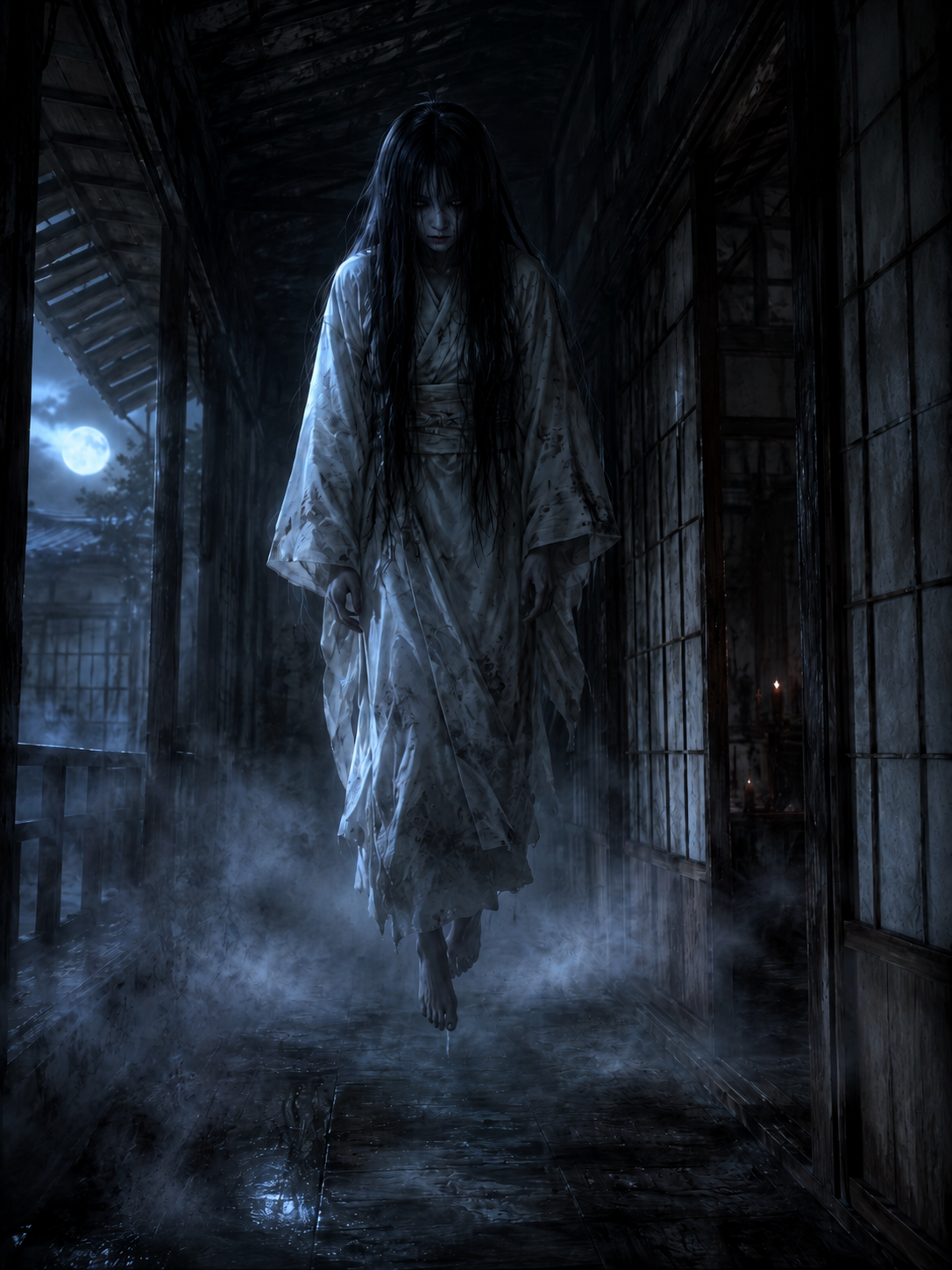
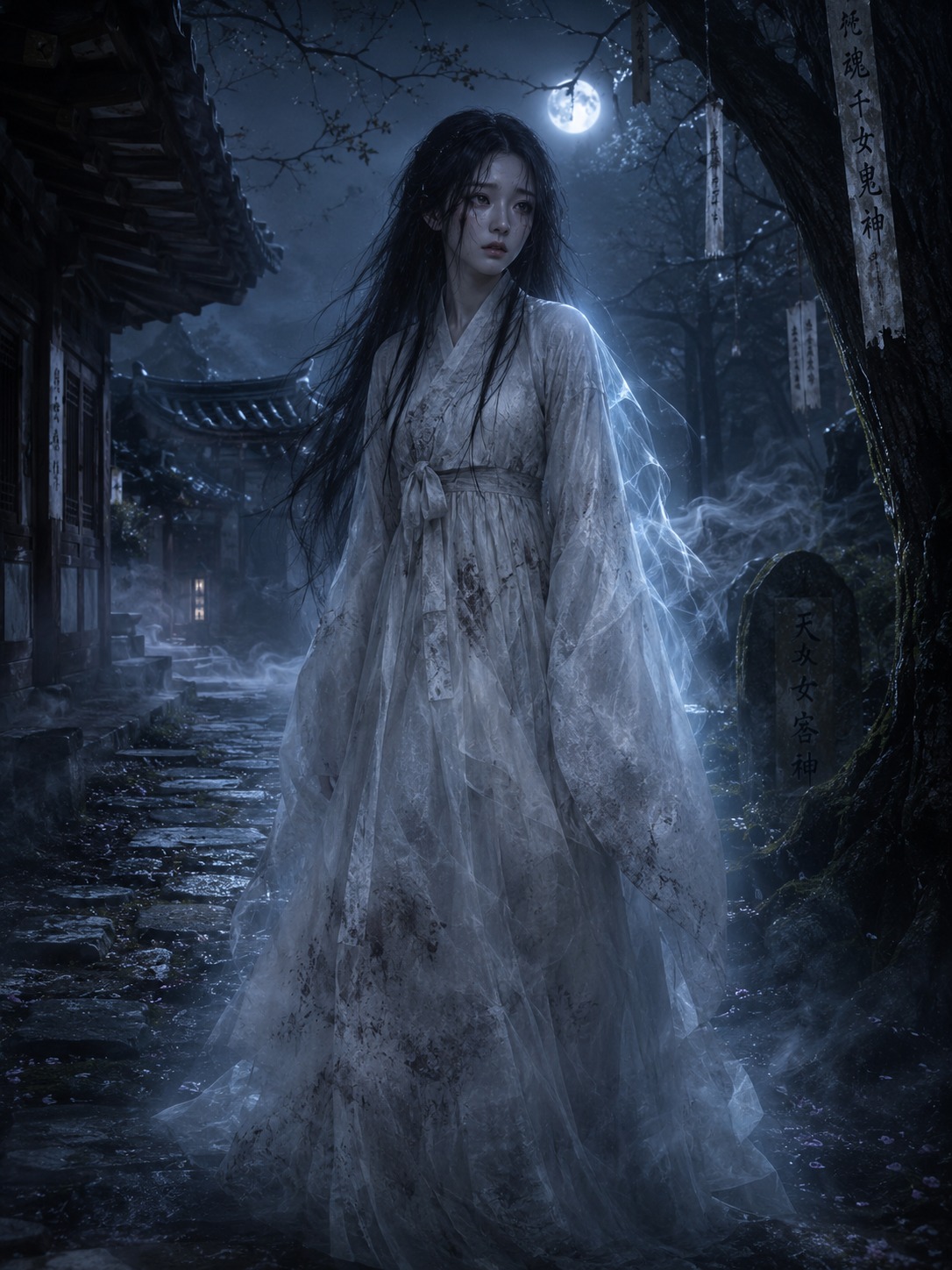
The Cheonyeo-gwisin (Korean Cheonyeo-gwisin, 'maiden ghost') is the avenging spirit of a woman who has died unmarried, harbouring han (resentful sorrow), the canonical iconographic figure of Korean horror identified by a white mourning robe (sobok), long, untied black hair, and a pale bloodless face. Also called sonkaksi (the wife who has been lost), the term is composed of the Sino-Korean characters for cheonyeo (maiden) and gwisin (ghost). The iconographic origin lies in the combination of the Confucian conjugal worldview and Korean shamanism (musok) of the Joseon period (1392-1910): the belief that the wandering soul of an unmarried woman roams the nine springs (gucheon), and the doctrine of haewon (the resolution of grievance) by which the wandering spirit attains nirvana only when its han is resolved. The decisive literary canon is the late-Joseon classical Chinese novel The Story of Janghwa and Hongnyeon (Janghwa Hongnyeon-jeon) of the seventeenth and eighteenth centuries — in which the sisters Janghwa and Hongnyeon of Cheolsan in Pyeongan Province are falsely accused by their stepmother, die unjustly, become Cheonyeo-gwisin, and appeal to the new magistrate Jeong Dong-u, who resolves their grievance — establishing the decisive canon of Cheonyeo-gwisin iconography. The 1977 KBS television anthology series Legends of the Hometown (Jeonseol-ui Gohyang) established the canonical Korean horror television, and Park Ki-hyung's 1998 film Whispering Corridors (Yeogo Goedam) and Kim Jee-woon's 2003 film A Tale of Two Sisters (Janghwa, Hongnyeon, starring Im Soo-jung and Moon Geun-young) settled the twenty-first-century global canon of Korean horror Cheonyeo-gwisin iconography.
Origin
The iconographic origin is the combination of the Confucian conjugal worldview of the Joseon period (1392-1910) and Korean shamanism. Joseon Confucianism prescribed the Three Followings (samjong-jido — following father, husband, then son) as the female lifecourse, and the belief settled that the unmarried woman, having no descendant to perform ancestral rites, becomes after death a wandering ownerless spirit (mujugohon) drifting in the nine springs. The shamanic Korean belief that the spirit harbouring han cannot depart the world of the living combined with this to produce the decisive origin of Cheonyeo-gwisin iconography. The decisive literary canon is the late-Joseon classical Chinese novel The Story of Janghwa and Hongnyeon (Janghwa Hongnyeon-jeon) of the seventeenth and eighteenth centuries: in Cheolsan, Pyeongan Province, the daughters Janghwa and Hongnyeon of Bae Mu-yong, after the death of their mother and the arrival of the stepmother Heo, are falsely accused — Janghwa is killed and Hongnyeon takes her own life — and the two Cheonyeo-gwisin appear in succession before the new magistrate of Cheolsan, who, in the figure of Jeong Dong-u, resolves the case and grants their grievance dissolution. The classical Chinese text compiled around 1818 by Pak Jae-hyeong and the late nineteenth-century Korean vernacular editions are the Joseon canon, and the scholarly view (Im Hyeong-taek, Im Jae-hae) that the work is based on a real seventeenth-century incident in Cheolsan, Pyeongan Province is the consensus. The late-fifteenth-century Yongjae Chonghwa of Seong Hyeon (1439-1504), the sixteenth-century Paegwan Japgi of Eo Suk-gwon, and the early-nineteenth-century anonymous Cheonggu Yadam systematise Cheonyeo-gwisin folklore in the Joseon compendia.
Features
- White mourning robe (sobok) and long, untied black hair
- Pale bloodless face and sorrowful eyes
- Deep han of marriage and bonds left unfulfilled
- The yearning for one who will recognise the han
- Not indiscriminate malice but an appeal of grievance
- Decisive iconography of nirvana through haewon (resolution of grievance)
Stories
The classical Chinese novel The Story of Janghwa and Hongnyeon and the oral folktales of the Joseon period established the literary canon of the Cheonyeo-gwisin, and the 1969 film The Public Cemetery under the Moon (Wolha-ui Gongdong Myoji) directed by Kwon Cheol-hwi, the founding work of Korean horror cinema, established the cinematic visual canon. From the first broadcast in July 1977 of the KBS 1TV anthology series Legends of the Hometown until 1996, the annual summer Cheonyeo-gwisin special — white mourning robe, untied long black hair, pale face, blood-rimmed lips — established the decisive visual canon of Korean horror television. Park Ki-hyung's film Whispering Corridors (Yeogo Goedam), released on 30 May 1998 (starring Lee Mi-yeon and Kim Gyu-ri) — in which the spirit of a student who has committed suicide haunts a girls' high school — became the decisive canon of Korean K-horror, and Kim Tae-yong's 1999 sequel Memento Mori (starring Park Ye-jin and Lee Young-jin) followed. Kim Jee-woon's film A Tale of Two Sisters (Janghwa, Hongnyeon), released on 13 June 2003 (starring Im Soo-jung, Moon Geun-young, and Yeom Jeong-a) — a modern adaptation of the seventeenth-century Janghwa Hongnyeon-jeon — became the opening film of the Busan International Film Festival and completed the decisive canon of Korean horror; the Warner Brothers Hollywood remake The Uninvited (released 2009) established the global canon. The 2010 tvN series Gumiho: Tale of the Fox's Child and Na Hong-jin's 2016 film The Wailing extended the twenty-first-century Cheonyeo-gwisin canon.
Weakness
The Cheonyeo-gwisin's weaknesses are: (1) haewon (the resolution of grievance) — since the seventeenth-century Janghwa Hongnyeon-jeon canon, the Cheonyeo-gwisin departs to nirvana without resentment the moment her han is revealed and resolved, the decisive weakness, the core of Korean shamanism's haewon doctrine; (2) empathic recognition of han — unlike the Japanese vengeful spirit who spreads indiscriminate curses, the canon is that the Cheonyeo-gwisin softens before a sincere person who recognises and would resolve her han, a Korean emotional canon; (3) appeal to truth and justice — like Magistrate Jeong Dong-u of Janghwa Hongnyeon-jeon, the canon that the Cheonyeo-gwisin weakens before a listener who hears her story and realises justice; (4) sacred talismans and shamanic rite — Korean shamanic canon that the spirit-resolution rite (jin-ogi-gut) of the female shaman (mudang) and talismans pacify the Cheonyeo-gwisin; (5) the cock-crow at dawn — Korean folkloric canon that the nocturnal Cheonyeo-gwisin vanishes instantly when the rooster crows; (6) posthumous marriage (yeonghon gyeolhon) — the canonical Korean shamanic weakness that the rite of yeonghon gyeolhon (myeonghon, marriage of souls) marries the unmarried Cheonyeo-gwisin to another unmarried departed soul posthumously, resolving her grievance and sending her away. In Kim Jee-woon's 2003 A Tale of Two Sisters, the decisive finale of Korean horror became canonical when the sisters' story is revealed and the truth comes out.
Cultural Significance
The Cheonyeo-gwisin is not merely a horror icon but the canonical iconographic figure of Korean culture, in which the female oppression of Joseon Confucian society and the haewon doctrine of Korean shamanism are condensed. As a product of the Joseon Confucian systems of female oppression — the Three Followings, the Seven Grounds for Divorce — the socio-institutional violence that the unmarried woman would not be saved even after death and would wander congealed into the Cheonyeo-gwisin iconography. From the Korean folklorist Son Jin-tae's (1900-?) 1942 Researches on Korean Folktales, which analysed the Cheonyeo-gwisin as the decisive case of the combination of Korean shamanism and Confucianism, Kim Yeol-gyu's (1932-2013) 1988 The Mythology of the Korean People and Im Jae-hae's 1996 The World of Korean Folklore and Tradition established the folkloristic canon. The global box-office of Park Ki-hyung's 1998 Whispering Corridors and Kim Jee-woon's 2003 A Tale of Two Sisters was the decisive event of the establishment of Korean K-horror canon: their reception at the 1999 Tokyo International Film Festival and the 2003 Busan International Film Festival was the decisive event by which Korean horror became global canon. The 2007 Warner Brothers Hollywood remake The Uninvited (2009) is the first case of K-horror entering an American major-studio remake, and Na Hong-jin's 2016 The Wailing, invited to the non-competition section of the Cannes Film Festival, expanded the global canon of Korean horror. Since 2020, the Korean horror series Sell (2021), Hellbound (2021), and All of Us Are Dead (2022) on Netflix are cases of the digital-age adaptation of Cheonyeo-gwisin iconography.
In Popular Culture
- Memorabilia of the Three Kingdoms, Kim Hyeon Gamho (1281) — etymological precursor of female vengeful spirit
- Yongjae Chonghwa (late fifteenth century) — early-Joseon Cheonyeo-gwisin folklore
- Cheonggu Yadam (early nineteenth century) — late-Joseon Cheonyeo-gwisin canon
- The Story of Janghwa and Hongnyeon (Janghwa Hongnyeon-jeon, seventeenth-eighteenth century) — decisive literary canon of Cheonyeo-gwisin
- Kwon Cheol-hwi, The Public Cemetery under the Moon (1969) — origin of the Korean horror film Cheonyeo-gwisin
- KBS Legends of the Hometown (1977-1996) — decisive visual canon of Korean horror television
- Park Ki-hyung, Whispering Corridors (1998) — decisive canon of K-horror
- Kim Jee-woon, A Tale of Two Sisters (2003) — decisive twenty-first-century Korean horror canon
- Na Hong-jin, The Wailing (2016) — Cannes Film Festival global canon of Korean horror
Trivia
The alternate name sonkaksi for Cheonyeo-gwisin combines son (lost) and kaksi (wife), meaning 'the wife who has been lost', a canonical term first appearing in nineteenth-century Joseon compendia. The Story of Janghwa and Hongnyeon, based on a real seventeenth-century incident in Cheolsan, Pyeongan Province, is classified among the four great tragic novels of the Korean classical canon (with Chunhyang-jeon, Simcheong-jeon, Heungbu-jeon, by some scholarly accounts), and more than one hundred variant editions survive into the late nineteenth century. The visual canon of the Korean Cheonyeo-gwisin — white mourning robe, untied long black hair, pale face, blood-rimmed lips — was established in the makeup of the early KBS Legends of the Hometown in 1977, and Park Ki-hyung's 1998 Whispering Corridors and Kim Jee-woon's 2003 A Tale of Two Sisters modernised it and established it as the global K-horror canon. Park Ki-hyung's 1998 Whispering Corridors drew 600,000 Korean filmgoers, a large opening for the Korean film market of the time, and became the start of Korean K-horror, and Kim Jee-woon's 2003 A Tale of Two Sisters drew 3.18 million Korean filmgoers and exported to twenty-five countries, setting the all-time Korean horror box-office record. The Uninvited (released 30 January 2009, directed by the Guard brothers Charles and Thomas, starring Elizabeth Banks), the American Warner Brothers remake acquired in 2007, debuted at number one in the American box office, and stands as the first successful American major-studio remake of a K-horror film. Since the 2020s, the global success of Netflix's Korean horror series — 2021 Hellbound topping the chart in 23 countries — has proven that Cheonyeo-gwisin iconography is a central canon of twenty-first-century global horror.