Onryo
Onryo · The Japanese Vengeful Ghost — A Cursing Specter Returned in Grudge
Names in Other Languages
 원귀한국어
원귀한국어Onryo · 일본 원혼 — 한을 품고 돌아온 저주의 망령
 怨霊日本語
怨霊日本語Onryo · 日本の怨霊 — 恨みを抱いて還る呪いの亡霊
 怨靈(日本)繁體中文
Onryo · 日本怨靈 — 懷恨而歸的詛咒亡靈
 OnryoDeutsch
Onryo · Der japanische Rachegeist — Ein fluchender Geist, im Groll zurückgekehrt
 OnryoFrançais
Onryo · Le fantôme vengeur japonais — Un spectre maudissant revenu dans la rancune
 OnryoEspañol
Onryo · El fantasma vengador japonés — Un espectro maldiciente regresado en rencor
 OnryoPortuguês
Onryo · O fantasma vingador japonês — Um espectro amaldiçoante retornado em rancor
 OnryoPolski
Onryo · Japoński mściwy duch — przeklinająca zjawa powracająca w urazie
 ОнрёРусский
Onryo · Японский мстительный дух — проклинающий призрак, вернувшийся в обиде
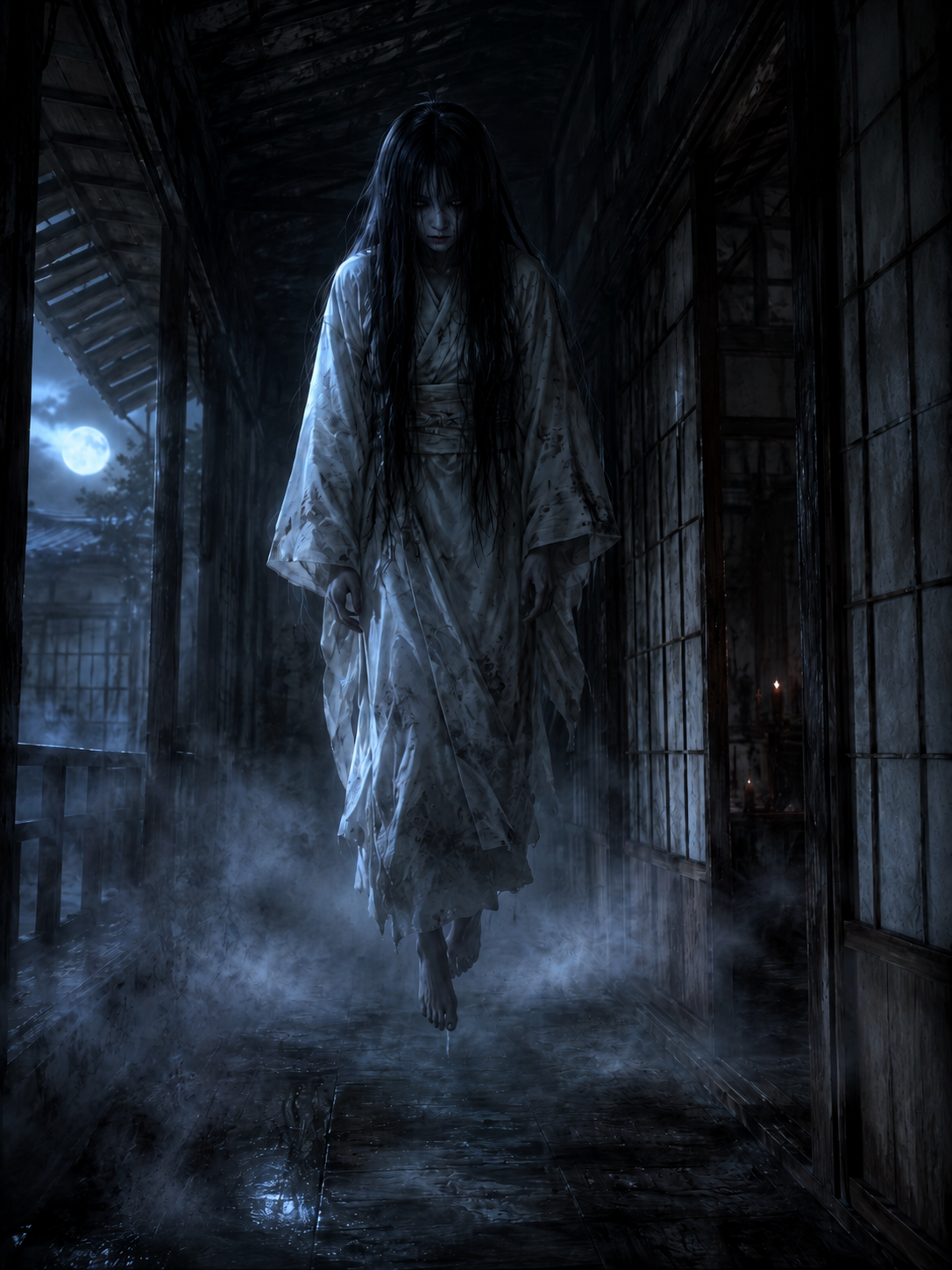
The Onryo (Japanese onryo, 'vengeful spirit') is the Japanese vengeful ghost born of injustice and deep resentment, dealing calamity to the living. The kanji combine on ('grudge, resentment') with ryo ('spirit'), giving 'spirit of grudge'. The canonical iconography is a white shinishozoku (burial robe), tangled long black hair, pale face, and resentful eyes. The defining trait that distinguishes the onryo from other East Asian ghosts is that the curse spreads not only to those who wronged the spirit but to unrelated bystanders. The iconographic origin lies in the goryo cult of the ninth-century Heian period, in which the politically defeated dead returned as vengeful spirits causing natural disasters and plagues; the canonical case is the deification of Sugawara no Michizane (845-903), who returned as an onryo and was placated by the establishment of the Tenmangu shrine system. Tsuruya Nanboku IV's kabuki play Tokaido Yotsuya Kaidan (1825), featuring the female onryo Oiwa, fixed the visual canon, and the modern J-horror canon of Suzuki Koji's novel Ring (1991), Nakata Hideo's film Ring (1998), and Shimizu Takashi's Ju-on (2002) globalised the figure.
Origin
The iconographic origin of the onryo lies in the goryo (vengeful spirit) cult of the ninth-century Heian period, in which the politically defeated dead were believed to return as vengeful spirits causing natural disasters, plagues, and family extinctions. The canonical case is the politician Sugawara no Michizane (845-903), demoted by the Fujiwara clan and dying in exile at Dazaifu; his subsequent identification as the cause of natural disasters led in 919 to the establishment of the Tenmangu shrine in Kyoto and the formal canonisation of the goryo placation rite. The Goryo-e ceremony, first recorded under Emperor Saga in 842, became the standard rite of onryo placation. The Tale of the Heike (Heike Monogatari, thirteenth century) carried the vengeful-spirit motif into the medieval period through the figures of the defeated Taira clan. The Edo-period kabuki canon of four great ghost plays — Tsuruya Nanboku IV's Tokaido Yotsuya Kaidan (1825) featuring Oiwa, Bancho Sarayashiki featuring Okiku, Botan Doro featuring Otsuyu, and Kasanegafuchi featuring Kasane — fixed the visual canon of the female onryo in white burial robes with tangled hair.
Features
- White shinishozoku (Japanese burial robe) and tangled long black hair
- Pale face with resentful eyes
- Footless in classical kabuki and ukiyo-e iconography; footed in modern J-horror
- The curse spreads not only to those who wronged the spirit but to unrelated bystanders
- Modern J-horror: the curse propagates through media such as television and videotape
- Pacified only by resolution of the grievance or formal placation rites
Stories
The visual canon of the onryo was established on the Edo-period kabuki stage. Tsuruya Nanboku IV's Tokaido Yotsuya Kaidan, premiered at the Nakamura-za theatre in July 1825, made Oiwa's white burial robe, tangled hair, and swollen face the decisive visual canon of the Japanese vengeful spirit. Katsushika Hokusai's woodblock print of Oiwa from the 1830s Hyaku Monogatari series and Utagawa Kuniyoshi's kabuki-onryo prints popularised the iconography. Suzuki Koji's 1991 novel Ring (Ringu), Nakata Hideo's 1998 film Ring, and Shimizu Takashi's 2002 Ju-on, together with their American remakes The Ring (Gore Verbinski, 2002) and The Grudge (Shimizu Takashi, 2004), globalised J-horror and made Sadako Yamamura and Kayako Saeki the twenty-first-century canonical onryo figures. The 2017 The Ring sequels, the 2020 American remake The Grudge, and the K-horror film The Wailing (2016) all extend the onryo iconography.
Weakness
The onryo's weakness lies in the resolution of the grievance (kaiwon) and formal placation rites (chinkon). The ninth-century imperial establishment of the Tenmangu shrine in Kyoto in 919 to placate the onryo of Sugawara no Michizane is the canonical model of onryo placation, and the roughly 12,000 Tenmangu shrines across Japan are its ritual descendants. The final placation scene of Oiwa's onryo in Tokaido Yotsuya Kaidan became a kabuki stage tradition. Japanese folk rites such as the segaki of Obon, the offerings of New Year, and individual Buddhist memorial services (shimeyose, kuyo) all serve as onryo-placation rites. Modern J-horror redefined the onryo as essentially unplacatable: in Ring (1998), Sadako's curse continues even after her body is properly retrieved from the well and buried, and in Ju-on (2002), Kayako's curse is bound to the house itself, with avoidance the only possible response, becoming the despair-laden canonical conclusion of J-horror.
Cultural Significance
The onryo is not merely a ghost but the central image of Japanese politico-religious history. The ninth-century Heian goryo cult, in which the politically defeated dead returned as vengeful spirits causing disasters, functioned as a self-legitimating mechanism of Japanese political power; the Tenmangu placation of Sugawara no Michizane is the canonical case of political demotion compensated by divine apotheosis, and the roughly 12,000 Tenmangu shrines across Japan are its institutional legacy. The female onryo of the four great kabuki ghost plays — Oiwa, Okiku, Otsuyu, Kasane — have been read by feminist criticism as the supernatural condensation of Edo-period women's social oppression and patriarchal violence. The global success of Nakata Hideo's Ring (1998) and Shimizu Takashi's Ju-on (2002) established J-horror as a wing of world horror, and Sadako Yamamura and Kayako Saeki became the global canonical figures of twenty-first-century horror iconography. Na Hong-jin's The Wailing (2016) and James Wan's The Curse of La Llorona (2019) bear direct J-horror influence.
In Popular Culture
- Sugawara no Michizane goryo (845-903) — political origin of the Japanese onryo iconography
- Tenmangu shrine, Kyoto (919) — canonical model of onryo placation rite
- The Tale of the Heike (Heike Monogatari, 13th c.) — vengeful spirits of the defeated Taira clan
- Tsuruya Nanboku IV, Tokaido Yotsuya Kaidan (1825) — Oiwa as the kabuki onryo canon
- Katsushika Hokusai, Hyaku Monogatari series featuring Oiwa (1830s) — ukiyo-e visual canon
- Suzuki Koji, novel Ring (1991), Nakata Hideo, film Ring (1998) — globalised Sadako J-horror
- Shimizu Takashi, Ju-on (2002) — Kayako as J-horror canon
Trivia
The kanji for onryo combine on ('grudge, resentment') with ryo ('spirit'), giving onryo, read in modern Japanese as 'on-ryo'. The ninth-century goryo cult elevated Sugawara no Michizane, demoted and dying in exile, into Tenjin, the deity of learning, and the roughly 12,000 Tenmangu shrines across Japan are still visited by students praying for academic success, including the principal Dazaifu Tenmangu in Kyushu. Tsuruya Nanboku IV's 1825 Tokaido Yotsuya Kaidan is among the most frequently restaged works in kabuki history, and the actor playing Oiwa traditionally visits the Oiwa Inari Tamiya Shrine in the Yotsuya district of Tokyo before performance to ward off stage accidents. Nakata Hideo's 1998 Ring exceeded one hundred million US dollars in worldwide box office, an exceptional achievement for Japanese horror, and Gore Verbinski's 2002 American remake The Ring grossed about one hundred and twenty-nine million US dollars in the United States alone, the decisive watershed of the global J-horror wave.