Will-o'-the-Wisp
English Folk Marsh Spirit
Names in Other Languages
 윌 오 더 위스프한국어
Will-o'-the-Wisp · 영국 민담의 늪지 도깨비불
 ウィル・オー・ザ・ウィスプ日本語
Will-o'-the-Wisp — 中位光の精霊
 威羅威斯普繁體中文
Will-o'-the-Wisp — 中位光之精靈
 Will-o'-the-WispDeutsch
Will-o'-the-Wisp — Mittlerer Lichtgeist
 Will-o'-the-WispFrançais
Will-o'-the-Wisp — Esprit de lumière intermédiaire
 Will-o'-the-WispEspañol
Will-o'-the-Wisp — Espíritu de luz intermedio
 Will-o'-the-WispPortuguês
Will-o'-the-Wisp — Espírito de luz intermediário
 Will-o'-the-WispPolski
Will-o'-the-Wisp — Pośredni duch światła
 Блуждающий ОгонёкРусский
Will-o'-the-Wisp — Средний дух света
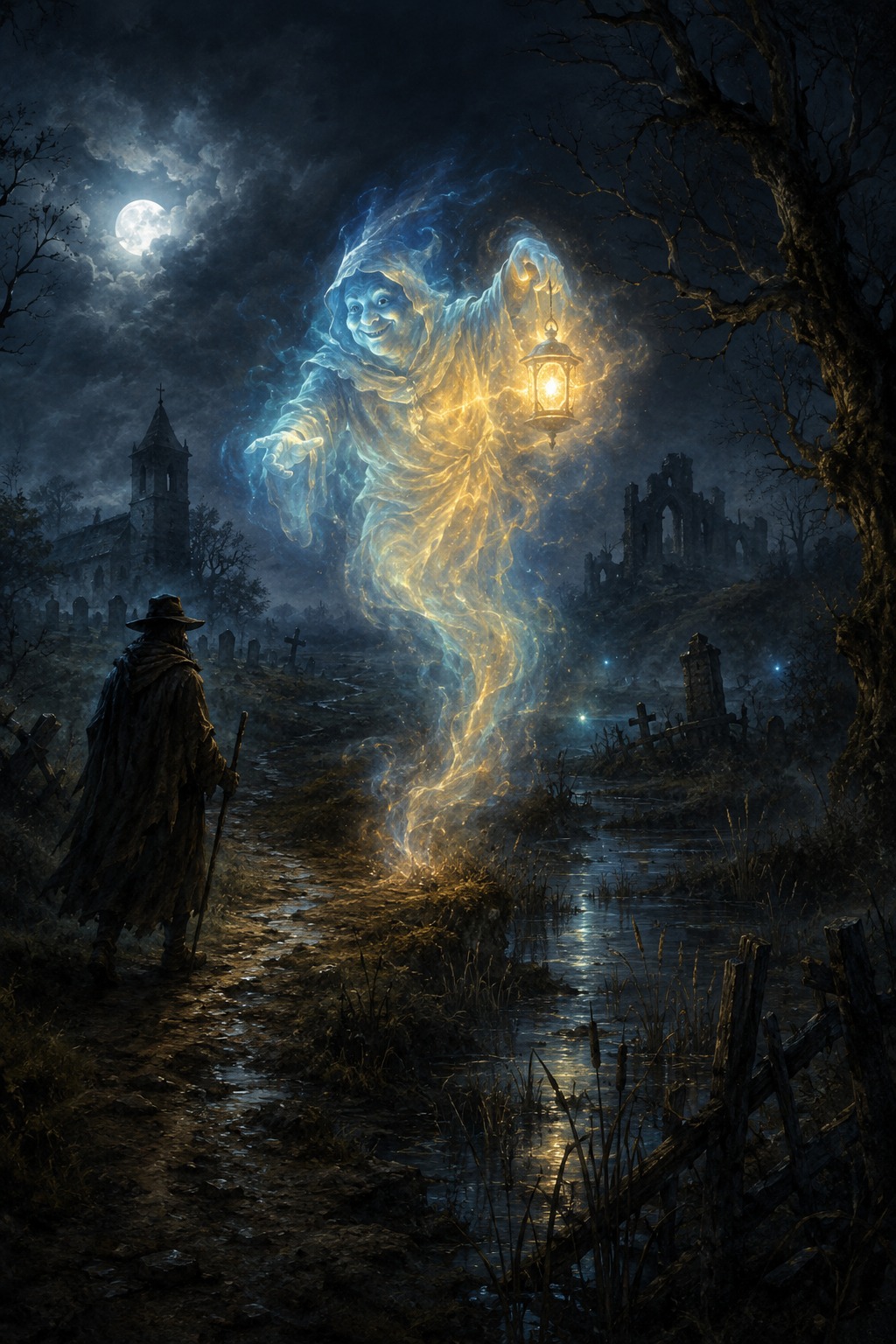
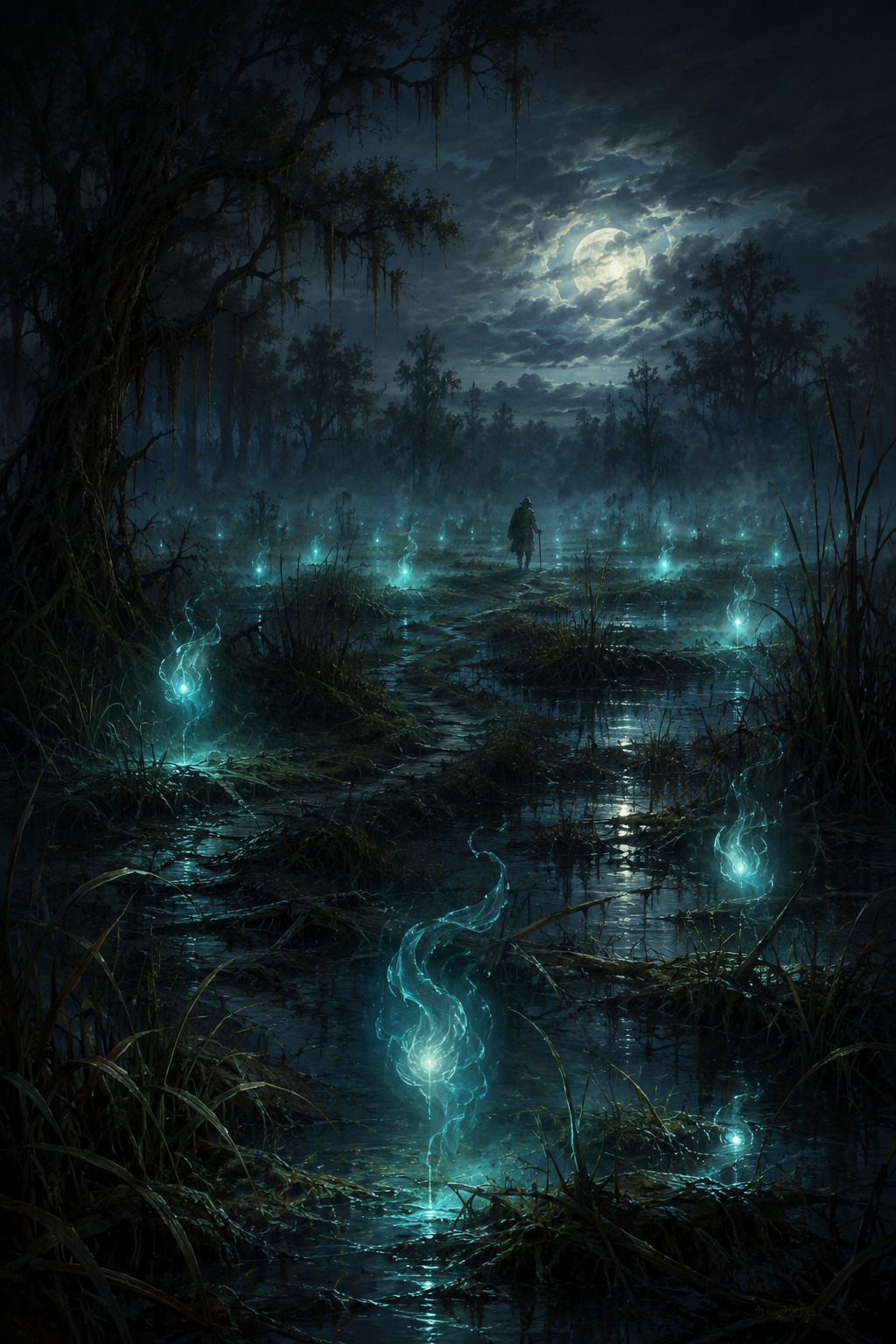
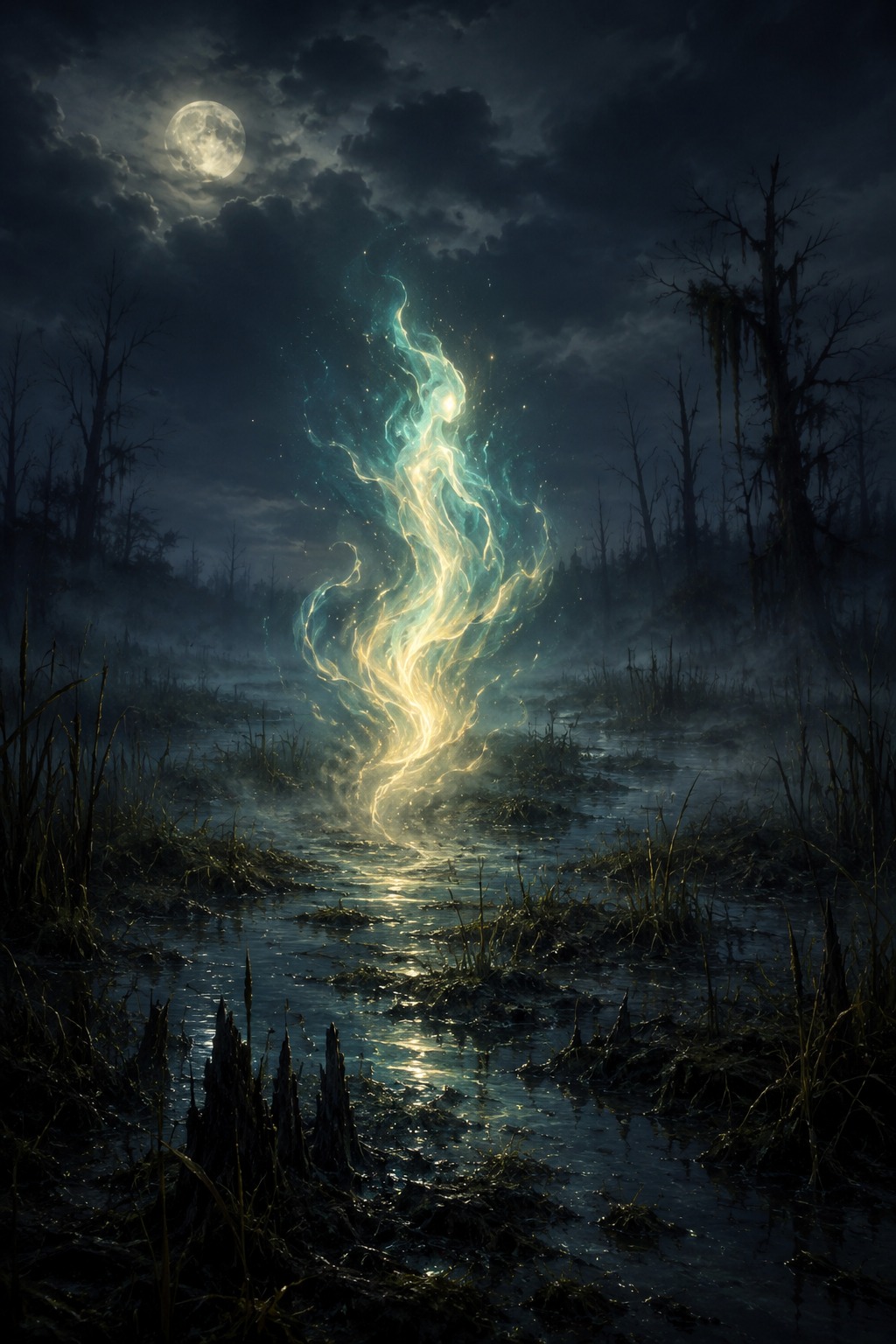
The Will-o'-the-Wisp (English Will-o'-the-Wisp) is the most decisive canonical iconographic spirit of the will-o'-the-wisp (ignis fatuus) of English folklore. The etymology is the English Will of the Wisp ('Will holding a wisp torch'), first attested in English in 1607 — the decisive canonical vocabulary. It appears in marshes, wetlands, and moors at night as a small flickering blue or yellow flame — receding when approached and approaching when receded — luring lost travellers into the marsh to their death — the decisive canonical iconography. The decisive etymological canon is the decisive legend that the evil blacksmith Will (Smith Will) of 16th-century England, rejected from both heaven and hell after death, carries a wisp torch with coal given by the devil and wanders the marshes forever, and the decisive literary canon is line 104 of the twin poem L'Allegro (L'Allegro) of the British poet John Milton (John Milton, 1608-1674) of 1631 — 'led by the Friar's Lantern' — and the fairy tale The Will-o'-the-Wisps Are in Town, Said the Marsh Woman (Lygtemaendene ere i Byen, sagde Mosekonen) of the Danish writer Hans Christian Andersen (Hans Christian Andersen, 1805-1875) published in Copenhagen, Denmark on 7 April 1845 — the decisive Andersen fairy-tale canon. The decisive 21st-century film canon is the Pixar (Pixar) animated film Brave (Brave) released in the USA on 22 June 2012 — in which blue Will-o'-the-Wisps lead the Scottish princess Merida to her fate — the decisive global film canon.
Origin
The iconographic origin combines the natural phosphorescent phenomenon (natural ignition of methane and phosphine gases) of English marshes and wetlands with the 16th-century English evil-blacksmith Will (Smith Will) legend — the decisive canonical adaptation, and the English etymology Will-o'-the-Wisp is the abbreviation of 'Will of the Wisp' (Will holding a wisp torch), first attested in 1607 — the decisive canonical vocabulary. The decisive etymological canon is the decisive legend that the evil blacksmith Will (Smith Will) of 16th-century England, rejected from both heaven and hell after death, carries an everlasting coal (or torch) given by the devil and wanders the marshes forever, and the decisive literary canon is Act 3 Scene 3 of the 1607 play Henry IV Part 1 (Henry IV Part 1) of British Shakespeare (William Shakespeare, 1564-1616) — in which Falstaff (Falstaff) likens the red-nosed Bardolph (Bardolph) to a Will-o'-the-Wisp with 'Thou art our admiral, thou bearest the lantern in the poop, but 'tis in the nose of thee; thou art the Knight of the Burning Lamp' — the decisive English-literary canon. Line 104 of the twin poem L'Allegro (L'Allegro) of John Milton (John Milton, 1608-1674) of 1631 and the short story The Legend of Sleepy Hollow (The Legend of Sleepy Hollow) of the American writer Washington Irving (Washington Irving, 1783-1859) of 1819 — with the Headless Horseman and the Will-o'-the-Wisp — became the decisive Anglo-American literary canon.
Features
- Blue or yellow flame in marshes, wetlands, and moors
- Recedes when approached, approaches when receded
- Lures lost travellers into the marsh
- Tradition that it is the soul of the dead
- No physical body
- Vanishes at dawn
Stories
The English etymology Will-o'-the-Wisp is the abbreviation of 'Will of the Wisp' (Will holding a wisp torch), first attested in 1607 — the decisive canonical vocabulary, and the legend of the evil blacksmith Will (Smith Will) of 16th-century England, rejected from both heaven and hell after death and wandering the marshes forever, is the decisive etymological canon. The decisive English-literary canon is the Falstaff and Bardolph canon of Act 3 Scene 3 of Shakespeare's Henry IV Part 1 of 1607 and the decisive vocabulary canon of 'led by the Friar's Lantern' in line 104 of John Milton's L'Allegro of 1631, and the short story The Legend of Sleepy Hollow (The Legend of Sleepy Hollow) of the American writer Washington Irving (Washington Irving, 1783-1859) of 1819 (collected in The Sketch Book of 1820) is the decisive American-literary canon. The decisive fairy-tale canon is the fairy tale The Will-o'-the-Wisps Are in Town, Said the Marsh Woman (Lygtemaendene ere i Byen, sagde Mosekonen) of Hans Christian Andersen (Hans Christian Andersen, 1805-1875) published in Copenhagen, Denmark on 7 April 1845 — the decisive satirical fairy tale in which will-o'-the-wisps infiltrate human society and deceive people — the decisive 19th-century Andersen fairy-tale canon. The decisive modern canon is the Will-o-the-Wisp (Will-o-the-Wisp) of the 1977 D&D Monster Manual by Gary Gygax of TSR in the USA — consistent through to 5e (5th Edition) of 2014 — and the Pixar (Pixar) animated film Brave (Brave) (directed by Mark Andrews, worldwide box office about 540 million dollars) released in the USA on 22 June 2012 — in which blue Will-o'-the-Wisps lead the Scottish princess Merida to her fate — the 21st-century decisive global film canon.
Weakness
The Will-o'-the-Wisp's weaknesses are: (1) dawn sunlight — the decisive canonical weakness that the will-o'-the-wisp vanishes at the first sunlight of dawn — the decisive canon; (2) firm will and faith — the canon in Milton's 1631 L'Allegro and the English folk canon that if a traveller ignores the will-o'-the-wisp's lure and goes straight, the will-o'-the-wisp's power is dispelled; (3) turning a coat inside out — the decisive English folk canonical weakness that wearing one's clothes inside out breaks the will-o'-the-wisp's illusion and allows return to the original path; (4) sacred prayer — the English Catholic folk canon that the Latin Pater noster (Our Father) makes the Will-o'-the-Wisp vanish; (5) cross and holy water — the decisive canonical weakness against Catholic sacramentals; (6) environmental binding — weakens when leaving marshes and wetlands in the 1977 D&D canon; (7) no physical body — the decisive canon that, being light, it has no physical body and cannot be physically attacked; (8) strong wind — the small flame is weak against the wind. The decisive tragic canonical finale is Washington Irving's 1819 The Legend of Sleepy Hollow — in which Ichabod Crane (Ichabod Crane), pursued by the Headless Horseman lured by the will-o'-the-wisp, vanishes — the decisive 19th-century American-literary canon, and the decisive satirical fairy-tale finale of Andersen's 1845 The Will-o'-the-Wisps Are in Town in which will-o'-the-wisps infiltrate human society and deceive people.
Cultural Significance
The Will-o'-the-Wisp is not merely a will-o'-the-wisp icon but the canonical iconographic figure of the decisive Anglo-American will-o'-the-wisp canon traversing the 1607 Shakespeare's Henry IV Part 1, the 1631 John Milton's L'Allegro, the 1819 Washington Irving's The Legend of Sleepy Hollow, the 1845 Hans Christian Andersen's fairy tale The Will-o'-the-Wisps Are in Town, Said the Marsh Woman, the 1881 William Henderson's Notes on the Folk-Lore of the Northern Counties of England, the 1977 D&D Monster Manual, and the 2012 Pixar's Brave. The decisive etymological canon is the legend that the evil blacksmith Will (Smith Will) of 16th-century England, rejected from both heaven and hell after death, wanders the marshes forever with an everlasting coal given by the devil and lures lost travellers into the marsh. The Falstaff and red-nosed Bardolph canon of Act 3 Scene 3 of British Shakespeare's (William Shakespeare, 1564-1616) Henry IV Part 1 (Henry IV Part 1) of 1607 and the decisive English-literary canon of line 104 of John Milton's (John Milton, 1608-1674) L'Allegro (L'Allegro) of 1631 became the decisive 17th-century English-literary canon, and the short story The Legend of Sleepy Hollow (The Legend of Sleepy Hollow) of Washington Irving (Washington Irving, 1783-1859) published in the USA on 23 June 1819 — collected in The Sketch Book of 1820 — became the decisive canon of 19th-century American literature. The decisive Andersen fairy-tale canon is the fairy tale The Will-o'-the-Wisps Are in Town, Said the Marsh Woman (Lygtemaendene ere i Byen, sagde Mosekonen) of Hans Christian Andersen (Hans Christian Andersen, 1805-1875) published in Copenhagen, Denmark on 7 April 1845, and the decisive 21st-century film canon is the Pixar (Pixar) animated film Brave (Brave) (directed by Mark Andrews, Brenda Chapman, and Steve Purcell, worldwide box office about 540 million dollars) released in the USA on 22 June 2012 — in which blue Will-o'-the-Wisps lead the Scottish princess Merida to her fate.
In Popular Culture
- Shakespeare, Henry IV Part 1 Act 3 Scene 3 (1607) — decisive Falstaff and Bardolph English-literary canon
- John Milton, L'Allegro line 104 (1631) — decisive English-literary canon
- Washington Irving, The Legend of Sleepy Hollow (1819) — decisive American-literary canon
- Andersen, fairy tale The Will-o'-the-Wisps Are in Town (1845) — decisive Andersen fairy-tale canon
- William Henderson, Notes on the Folk-Lore of the Northern Counties of England (1881) — decisive folklore canon
- Bram Stoker, Dracula (1897) — Victorian horror canon
- Gygax, D&D Monster Manual, Will-o-the-Wisp (1977) — decisive fantasy RPG canon
- Pixar, Brave (2012) — decisive 21st-century global film canon
Trivia
The English Will of Will-o'-the-Wisp is the decisive canonical vocabulary derived from the name of the evil blacksmith Will (Smith Will) of 16th-century England, and the English Wisp (wisp torch) is the decisive canonical vocabulary derived from Middle English wisp ('wisp, dry grass'). First attested in English in 1607 — the abbreviation of 'Will of the Wisp' — was established as the decisive canonical vocabulary, and the Latin scientific name Ignis fatuus (Ignis fatuus, 'foolish fire'), the American Jack-o'-lantern, and the English regional names Hobbedy's Lantern (Warwickshire), Peg-a-Lantern (Lancashire), Jenny Burnt-tail (Oxfordshire), Joan-in-the-Wad (Cornwall), Spunkie (Scotland), and Hinky Punk (Somerset, Devon) are the decisive British-American canonical vocabulary. Act 3 Scene 3 of British Shakespeare's (William Shakespeare, 1564-1616) Henry IV Part 1 (Henry IV Part 1) of 1607 — in which Falstaff (Falstaff) likens the red-nosed Bardolph (Bardolph) to a Will-o'-the-Wisp with 'Thou art our admiral, thou bearest the lantern in the poop, but 'tis in the nose of thee; thou art the Knight of the Burning Lamp' — is the decisive English-literary first Shakespeare canon. The short story The Legend of Sleepy Hollow (The Legend of Sleepy Hollow) of Washington Irving (Washington Irving, born 3 April 1783 in New York, died 28 November 1859 in Tarrytown, New York) published by C. S. Van Winkle publishing house in New York, USA on 23 June 1819 — in which the schoolteacher Ichabod Crane (Ichabod Crane) is pursued by the Headless Horseman (Headless Horseman) and vanishes — is the decisive American-literary canon with the will-o'-the-wisp appearing. The fairy tale The Will-o'-the-Wisps Are in Town, Said the Marsh Woman (Lygtemaendene ere i Byen, sagde Mosekonen) of Hans Christian Andersen (Hans Christian Andersen, 1805-1875) published by Reitzel publishing house in Copenhagen, Denmark on 7 April 1845 is the decisive Andersen fairy-tale canon, and the blue Will-o'-the-Wisp of the Pixar (Pixar) animated film Brave (Brave) (directed by Mark Andrews, Brenda Chapman, and Steve Purcell, worldwide box office about 540 million dollars) released in the USA on 22 June 2012 is the 21st-century decisive global film canon.