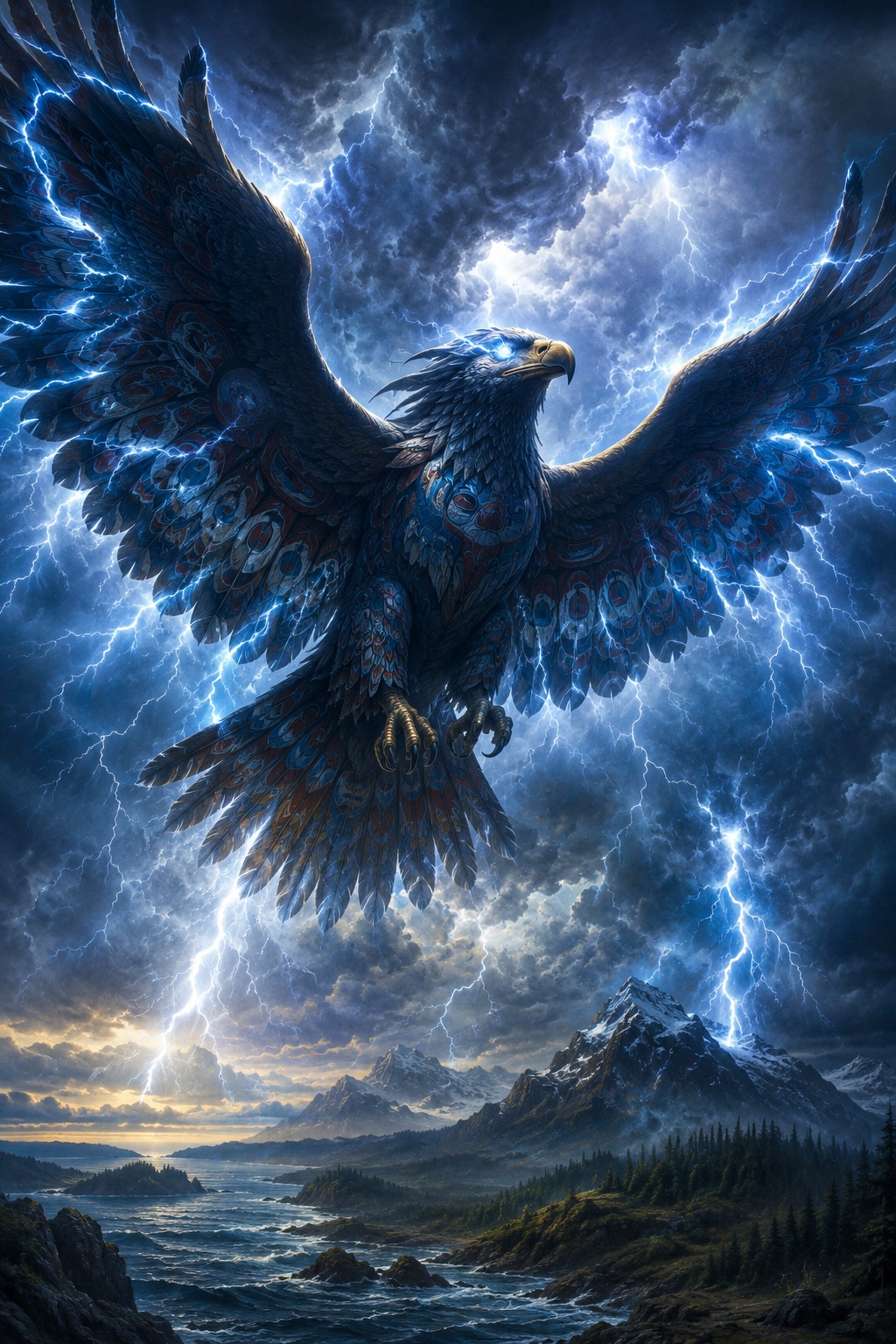
Thunderbird
Thunder Bird of Native American Mythology
Names in Other Languages
 썬더버드한국어
Thunderbird · 북미 원주민 신화의 천둥새
 サンダーバード日本語
サンダーバード — 電気の中位精霊
 雷鳥繁體中文
雷鳥 — 雷電中位精靈
 DonnervogelDeutsch
Donnervogel — Mittlerer Blitzgeist
 Oiseau-tonnerreFrançais
Oiseau-tonnerre — Esprit de la foudre intermédiaire
 Pájaro TruenoEspañol
Pájaro Trueno — Espíritu del rayo intermedio
 Pássaro TrovãoPortuguês
Pássaro Trovão — Espírito do Relâmpago Intermediário
 GromoptакPolski
Gromoptak — Pośredni Duch Błyskawicy
 Громовая ПтицаРусский
Громовая Птица — Средний Дух Молнии
The Thunderbird (English Thunderbird, Algonquian/Ojibwe Animikii, Lakota Wakinyan) is the canonical iconographic figure of the giant bird-form spiritual being — resembling an eagle or condor — that widely appears in Native American mythology, in which the flapping of its wings creates thunder and its eyes shoot lightning — the decisive canon. The etymology is the English Thunderbird ('bird of thunder'), settled as the decisive canonical vocabulary by 1830s American naturalists and folklorists translating the Algonquian/Ojibwe Animikii ('thunderer') and Lakota Wakinyan ('flying sacred') into English. The decisive tribal traditions are (1) the Algonquian/Ojibwe — the decisive Thunderbird canon of the Lake Michigan and Great Lakes region; (2) the Lakota — the decisive Wakinyan canon of the Dakota and Black Hills region; and (3) the Pacific Northwest Coast tribes Haida and Kwakwaka'wakw — the totem-pole-top canon of the coast of British Columbia, Canada. The decisive textual record is the journal of the Lewis and Clark Expedition (Lewis and Clark Expedition) of 1804-1806 — recording the Thunderbird belief of the Indigenous people along the Columbia River — and the decisive English scholarly canonisation of the Ojibwe Animikii canon in the Algic Researches (2 volumes) of the American folklorist Henry Schoolcraft (Henry Rowe Schoolcraft, 1793-1864) of 1849, and the epic The Song of Hiawatha (22 cantos) of the American poet Henry Wadsworth Longfellow (1807-1882) published in the USA on 10 November 1855 is the decisive 19th-century American-literary Thunderbird canon.
Origin
The iconographic origin is the fusion of (1) the decisive Animikii ('thunderer') canon of the Algonquian/Ojibwe of the Lake Michigan and Great Lakes region of the USA, (2) the decisive Wakinyan ('flying sacred') canon of the Lakota of the Dakota and Black Hills region, and (3) the totem-pole-top canon of the Pacific Northwest Coast tribes Haida, Kwakwaka'wakw, and Tlingit of the coast of British Columbia in Canada, Alaska, and Washington State in the USA. The decisive textual record is the decisive journal of the Lewis and Clark Expedition of 1804-1806 — recording the Thunderbird belief of the Indigenous people along the Columbia River from April to November 1805 — and the painting series of the Plains Indians by the American painter George Catlin (George Catlin, 1796-1872) of 1830-1832 and the Algic Researches (2 volumes, New York) of the American folklorist Henry Schoolcraft (Henry Rowe Schoolcraft, 1793-1864) of 1849 decisively canonised the Thunderbird canon of the Ojibwe and other Algonquian peoples in English scholarship. The epic The Song of Hiawatha (22 cantos, 5,500 lines) of the American poet Henry Wadsworth Longfellow (Henry Wadsworth Longfellow, 1807-1882) published by Ticknor and Fields publishing house in Boston, USA on 10 November 1855 — about the Ojibwe mythic hero Hiawatha and the Thunderbird — established the decisive 19th-century American-literary canon, and the 20-volume The North American Indian (The North American Indian) of the American photographer Edward Curtis (Edward S. Curtis, 1868-1952) of 1907-1930 settled the photographic canon.
Features
- Giant bird resembling an eagle or condor
- Thunder from wing-beats, lightning from eyes
- Bringer of rain, god of abundance
- Can transform into human form
- Eternal enemy of the underwater monster Mishipeshu
- Decisive iconography atop totem poles
Stories
The Thunderbird record of the Lewis and Clark Expedition journal of 1804-1806 is the decisive origin, and the Plains Indian painting series of George Catlin of 1830-1832 and the Algic Researches of Henry Schoolcraft of 1849 decisively canonised the Ojibwe Animikii canon in English scholarship. The epic The Song of Hiawatha (22 cantos, 5,500 lines) of Henry Wadsworth Longfellow (1807-1882) published in Boston, USA on 10 November 1855 established the decisive 19th-century American-literary canon — about the Ojibwe hero Hiawatha and the Thunderbird — and the 20-volume photographic collection The North American Indian (The North American Indian) of the American photographer Edward Curtis (Edward S. Curtis, 1868-1952) of 1907-1930 and the 1932 Black Elk Speaks (Black Elk Speaks) of the American writer John G. Neihardt (1881-1973) — recording the visions and Wakinyan canon of the Lakota medicine man Black Elk — became the decisive 20th-century American scholarly canon. The decisive totem-pole canon is the decisive Thunderbird iconography atop totem poles of the Haida, Kwakwaka'wakw, and Tlingit of the British Columbia coast in Canada and the Alaska coast in the USA in the 18th-20th centuries, and the Petroglyph National Monument near Albuquerque, New Mexico (designated in December 1990) is the decisive preserved site of Thunderbird petroglyphs. The decisive 21st-century canon is the Thunderbird 'Frank' of the protagonist Newt Scamander in the Warner Brothers film Fantastic Beasts and Where to Find Them (Fantastic Beasts and Where to Find Them), released in the USA on 18 November 2016 — original screenplay by J. K. Rowling (J. K. Rowling, b. 1965) — in which Frank, escaping from Arizona, regains his own freedom — the decisive canon. The Thunderbird (John Proudstar, first appearing in X-Men #95 in 1975) of the Marvel Comics X-Men series of the USA from 1936 to 2018 and the legendary Pokemon Zapdos (English Zapdos, Pokedex #145) of the Nintendo Pokemon Red and Green released in Japan on 27 February 1996 — Thunderbird-inspired — are 20th-21st-century global adaptation canons.
Weakness
The Thunderbird's weaknesses are: (1) eternal conflict with Mishipeshu — the decisive balance canon in the decisive canon of the Algonquian/Ojibwe that the Thunderbird Animikii and the underwater monster Mishipeshu (Mishipeshu, 'Great Lynx') — the underwater panther of the Great Lakes — are eternal cosmic enemies, and killing one weakens the other; (2) spiritual balance of human society — the natural-harmony canon in the Algonquian canon that the Thunderbird weakens when the spiritual balance of human society is broken; (3) profanation of nature — the decisive canon that human acts that profane nature provoke the Thunderbird's wrath; (4) sacred rituals — the canon that Indigenous Thunderbird rituals and songs call down the Thunderbird's protection; (5) tribal spiritual severance — the decisive environmental canon that the Thunderbird weakens when a tribe forgets Thunderbird belief; (6) the impotence of arrows or weapons — the decisive sacred canon that human arrows or weapons are nearly impotent against the Thunderbird; (7) the duality of the Lakota Wakinyan — the canon in the 1932 Black Elk Speaks that the Wakinyan has the duality of mercy and wrath, being merciful or severe according to human actions; (8) spiritual absence — the decisive canon in the 18th-20th-century totem-pole canon that when Thunderbird belief disappears from tribal territory, the Thunderbird itself vanishes. The decisive canonical finale of Longfellow's 1855 The Song of Hiawatha — in which the Ojibwe hero Hiawatha kills Mishipeshu — is the decisive finale of the 19th-century American-literary Thunderbird-Mishipeshu canon.
Cultural Significance
The Thunderbird is not merely a thunder-bird icon but the canonical iconographic figure of the North-American decisive spiritual-being canon, traversing the Algonquian/Ojibwe Animikii, the Lakota Wakinyan, the Pacific Northwest Coast totem poles, the 1804-1806 Lewis and Clark Expedition journal, the 1830-1832 George Catlin paintings, the 1849 Henry Schoolcraft's Algic Researches, the 1855 Longfellow's The Song of Hiawatha, the 1907-1930 Edward Curtis's The North American Indian, the 1932 Black Elk Speaks, the 1996 Nintendo's Pokemon Zapdos, and the 2016 Warner Brothers' Fantastic Beasts and Where to Find Them film. The decisive Animikii canon of the Algonquian/Ojibwe of the Lake Michigan and Great Lakes region of the USA and the decisive Wakinyan canon of the Lakota of the Dakota and Black Hills region are the decisive canons of Native American belief, and the Thunderbird iconography atop totem poles of the Haida, Kwakwaka'wakw, and Tlingit of the British Columbia coast in Canada and the Alaska coast in the USA — as the decisive canon of 18th-20th-century Pacific Northwest Coast art — has the Thunderbird totem-pole collection of the Royal British Columbia Museum in Victoria, British Columbia, Canada, as the decisive preserved canon. The epic The Song of Hiawatha (22 cantos, 5,500 lines) of Henry Wadsworth Longfellow (1807-1882) published by Ticknor and Fields publishing house in Boston on 10 November 1855 — selling 10,000 copies in the first month and 30,000 copies in the first six months — became the decisive canon of 19th-century American literature, and the 20-volume photographic collection The North American Indian (The North American Indian) of the American photographer Edward Curtis (1868-1952) of 1907-1930 — about 40,000 photographic records of 80 tribes — became the decisive American scholarly canon. The 1932 Black Elk Speaks (Black Elk Speaks) of the American writer John G. Neihardt (1881-1973) — the visions and Wakinyan canon of the Lakota medicine man Black Elk — is the decisive culminating work of the 20th-century American spiritual scholarly canon.
In Popular Culture
- Algonquian/Ojibwe Animikii canon Indigenous belief — decisive origin canon
- Lakota Wakinyan canon Indigenous belief — decisive origin canon
- Haida, Kwakwaka'wakw, Tlingit totem poles (18th-20th centuries) — decisive visual canon
- Lewis and Clark Expedition journal (1804-1806) — decisive textual origin
- George Catlin Plains Indian paintings (1830-1832) — visual canon
- Henry Schoolcraft, Algic Researches (1849) — scholarly canon
- Henry Wadsworth Longfellow, The Song of Hiawatha (1855) — decisive American-literary canon
- Edward Curtis, The North American Indian (1907-1930) — decisive photographic canon
- Black Elk Speaks (1932) — 20th-century decisive spiritual scholarly canon
- Warner Brothers film Fantastic Beasts and Where to Find Them, Frank (2016) — decisive 21st-century global film canon
Trivia
The English etymology Thunderbird — settled as the decisive canonical vocabulary by 1830s American naturalists and folklorists translating the Algonquian/Ojibwe Animikii (animikii, 'thunderer') and Lakota Wakinyan (wakinyan, 'flying sacred') into English — and the English Thunderbird (first attested in 1851), the French Oiseau-tonnerre, and the German Donnervogel are canonical vocabulary. The Algonquian/Ojibwe Animikii (Animikii) is the noun form of the root animik ('thunder') and the decisive canonical vocabulary, and the Lakota Wakinyan (Wakinyan) is the compound of wakan ('sacred, mysterious') and kinyan ('to fly'), meaning 'flying sacred' — the decisive canonical vocabulary. The decisive textual record of the 1804-1806 Lewis and Clark Expedition (Lewis and Clark Expedition) journal — recording the Thunderbird belief of the Indigenous people along the Columbia River from April to November 1805 — is the first decisive English-textual canon of the Thunderbird. The epic The Song of Hiawatha (22 cantos, 5,500 lines) of Henry Wadsworth Longfellow (1807-1882) published by Ticknor and Fields publishing house in Boston, USA on 10 November 1855 — adopting the trochaic-tetrameter metre of the Finnish epic Kalevala — sold 10,000 copies in the first month and 30,000 copies in the first six months and became the decisive canon of 19th-century American literature. The 20-volume photographic collection The North American Indian (The North American Indian) of the American photographer Edward Curtis (Edward S. Curtis, 1868-1952) of 1907-1930 — sponsored by J. P. Morgan (J. P. Morgan) with 75,000 dollars in 1906 — is the decisive photographic record of about 40,000 photographs of 80 tribes, and the totem-pole collection of the Royal British Columbia Museum in Victoria, British Columbia, Canada is the decisive preserved site of the visual canon. The legendary bird Pokemon Zapdos (Japanese Sanda, English Zapdos, Pokedex #145) of the Nintendo Game Boy Pokemon Red and Green released in Japan on 27 February 1996 — Thunderbird-inspired — is the 20th-century global video-game adaptation canon, and the Thunderbird 'Frank' of the Warner Brothers film Fantastic Beasts and Where to Find Them (directed by David Yates, original screenplay by J. K. Rowling, worldwide box office about 814 million dollars) released in the USA on 18 November 2016 is the decisive 21st-century global film canon.