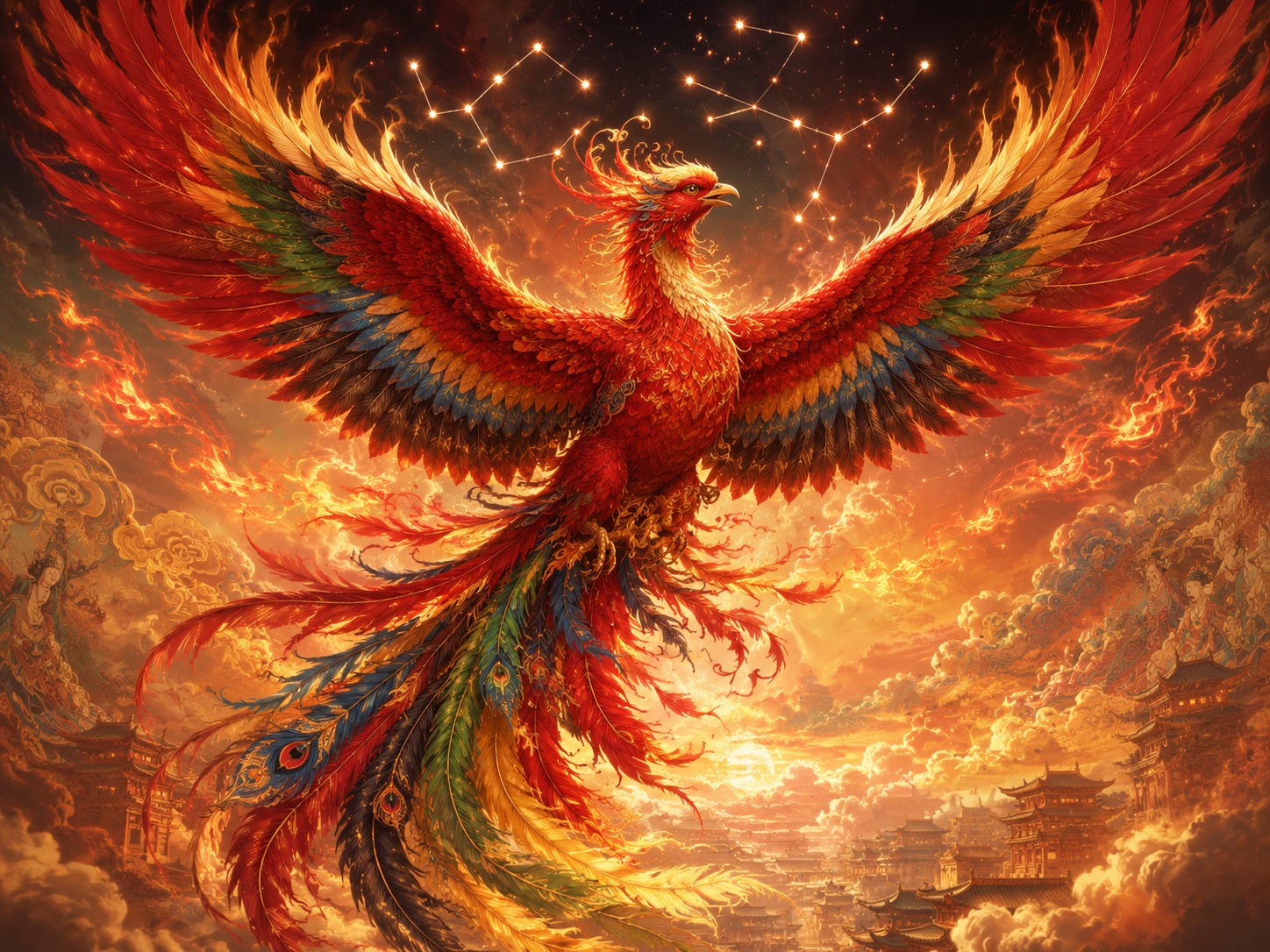
Suzaku
Suzaku · 朱雀 — Sacred Red Bird of the South
Names in Other Languages
 주작한국어
주작한국어Suzaku · 朱雀 — 남방의 신성한 붉은 새
 朱雀日本語
朱雀日本語Suzaku · 朱雀 — 南方の神聖な赤い鳥
 朱雀繁體中文
Suzaku · 南方的神聖朱鳥
 SuzakuDeutsch
Suzaku · 朱雀 — Heiliger Roter Vogel des Südens
 SuzakuFrançais
Suzaku · 朱雀 — Oiseau Rouge Sacré du Sud
 SuzakuEspañol
Suzaku · 朱雀 — Ave Roja Sagrada del Sur
 SuzakuPortuguês
朱雀 · Ave vermelha sagrada do Sul
 SuzakuPolski
Suzaku · 朱雀 — Święty Czerwony Ptak Południa
 СудзякуРусский
Suzaku · 朱雀 — Священная Красная Птица Юга
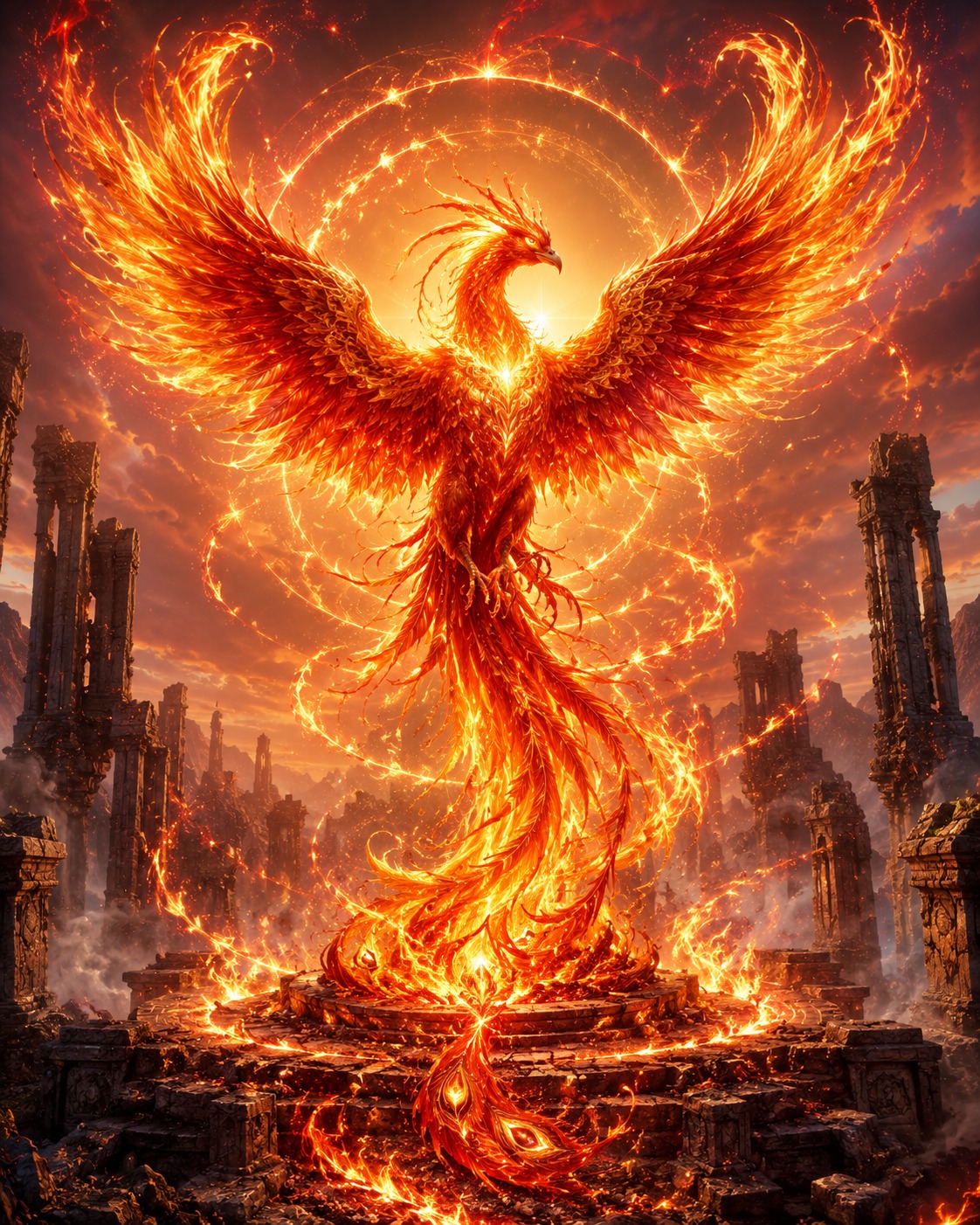
The Suzaku (Chinese Zhuque, Japanese Suzaku, Korean Jujak) is the decisive canonical iconographic figure of the sacred red bird guarding the south in the Four Symbols (Four Guardian Spirits) thought of East Asia. The etymology is the compound of the Chinese characters Zhu ('vermilion, red') and Que ('sparrow, bird') — meaning 'vermilion-coloured bird' — the decisive canonical vocabulary. The Four Symbols are the Azure Dragon (Qinglong) of the east, the Vermilion Bird (Zhuque) of the south, the White Tiger (Baihu) of the west, and the Black Tortoise (Xuanwu) of the north, guarding the four directions, four elements (wood, fire, metal, water), and the southern 7 of the 28 lunar mansions — Jing, Gui, Liu, Xing, Zhang, Yi, Zhen — the decisive canonical iconography. The decisive textual canon is Book of Rites (Liji) Quli Shang of the 2nd-century-BCE Former Han — the four-directional military banner canon — and Shiji Book 27 Tianguanshu of Sima Qian (Sima Qian, 145-86 BCE) of the late 1st century BCE — the 28 lunar mansions astronomical classification — the decisive Han-Chinese canon. The decisive visual canon is the Four Symbols mural of the late-6th-century Goguryeo Gangseo-daemyo Tomb (Gangseo-daemyo, Pyeongan-namdo, Korea) — c. 575-605 — and the Four Symbols murals of the 7th-8th-century Japanese Takamatsuzuka Tomb (Takamatsuzuka kofun, discovered 21 March 1972) and Kitora Tomb (Kitora kofun, discovered 7 November 1983).
Origin
The iconographic origin combines the four-directional astronomical thought and the 28 lunar mansions of the c. 4th-century-BCE Chinese Warring States period with the Han-dynasty yin-yang five-element thought — the decisive canon. The decisive textual canon is Book of Rites (Liji) Quli Shang of the 2nd-century-BCE Former Han — 'Vanguard Vermilion Bird, rearguard Black Tortoise, left Azure Dragon, right White Tiger' — the four-directional military banner canon, and Shiji Book 27 Tianguanshu of Sima Qian (Sima Qian, 145-86 BCE) of the late 1st century BCE — the 28 lunar mansions astronomical classification — the decisive Han-Chinese canon. The 1st-century-Han apocryphal text Chunqiu Yuanmingbao and the 2nd-century-Eastern Han Lunheng of Wang Chong (27-97) systematised the Four Symbols canon, and the Han Four Symbols Mirror (sishen jing) with the Four Symbols in concentric relief is the decisive iconography. The decisive visual canon is the Four Symbols mural of the late-6th-century — c. 575-605 — Goguryeo Gangseo-daemyo Tomb (Gangseo-daemyo, Pyeongan-namdo, Korea) — the decisive Korean canon, and the Four Symbols murals of the 7th-8th-century Japanese Asuka-period Takamatsuzuka Tomb (Takamatsuzuka kofun, discovered 21 March 1972) and Kitora Tomb (Kitora kofun, discovered 7 November 1983) are the decisive Japanese canon.
Features
- Giant vermilion bird with five-coloured plumage
- Guards the southern 7 lunar mansions (Jing, Gui, Liu, Xing, Zhang, Yi, Zhen)
- Divinity of summer, fire, and south
- Part of the Four Symbols four-directional canon
- Han-dynasty Four Symbols Mirror decisive iconography
- Gangseo-daemyo and Takamatsuzuka decisive murals
Stories
Book of Rites (Liji) Quli Shang of the 2nd-century-BCE Former Han — the four-directional military banner canon — and Shiji Book 27 Tianguanshu of Sima Qian of the late 1st century BCE — the 28 lunar mansions astronomical classification — are the decisive origin, and the 1st-century-Han Chunqiu Yuanmingbao systematised the Four Symbols canon. The decisive visual canon is the Four Symbols mural of the late-6th-century Goguryeo Gangseo-daemyo Tomb (Gangseo-daemyo, Pyeongan-namdo, Korea) and the Four Symbols murals of the 7th-8th-century Japanese Asuka-period Takamatsuzuka Tomb and Kitora Tomb, and at the transfer to Heian-kyo (Heian-kyo) on 22 October 794 — the southern main gate Suzakumon and the central north-south boulevard Suzaku-oji (about 84 metres wide) — is the decisive Japanese urban canon. The decisive modern canon is the Zhu Que of the 1985 D&D Oriental Adventures by Gary Gygax of TSR in the USA and the summoned beast Suzaku of Final Fantasy V (Super Famicom, directed by Hironobu Sakaguchi) by Square (Square) released in Japan on 6 December 1992 — the decisive video-game canon — and the Suzaku Seven Stars (Suzaku Shichiseishi) of the 1992 Japanese manga and the 1995-1996 anime Fushigi Yugi (Fushigi Yugi) — the decisive 1990s Japanese manga canon — and the protagonist Suzaku Kururugi of the 2006-2008 Japanese anime Code Geass: Lelouch of the Rebellion (Code Geass) are the decisive 21st-century Japanese canon.
Weakness
The Suzaku's weaknesses are: (1) opposition with the northern Black Tortoise (Xuanwu) — the decisive canonical weakness in the Han yin-yang five-element canon that the southern Suzaku (fire) and the northern Black Tortoise (water) are in fire-water (huoshui) mutual opposition; (2) destruction of four-directional balance — the decisive canon in the Four Symbols canon that if one of the four directions (Azure Dragon, Vermilion Bird, White Tiger, Black Tortoise) is broken, the Suzaku also weakens; (3) lack of Taoist rite — in the Taoist and feng-shui canon, places lacking Suzaku rites see drastic decline in summoning efficiency; (4) strong water flow — in the Han five-element canon, strong water (Black Tortoise) weakens the Suzaku's fire; (5) yin-yang imbalance — in the Han yin-yang canon, the yang (Suzaku) is weakened by strong yin; (6) feng-shui binding — in the Four Symbols canon, when the four directions of a city are improperly arranged, the Suzaku weakens — the 794 Heian-kyo canon; (7) lunar-mansion binding — environmentally bound to the southern 7 lunar mansions (Jing, Gui, Liu, Xing, Zhang, Yi, Zhen); (8) sealing rite — bound by the sealing rite of a powerful Taoist priest in the Taoist canon. The decisive canonical finale is the four-directional guardian Suzaku canon at the southern part of the city in the transfer to Heian-kyo on 22 October 794 — the decisive Japanese feng-shui canon.
Cultural Significance
The Suzaku is not merely a southern-bird icon but the canonical iconographic figure of the decisive East Asian Four Symbols canon, traversing Book of Rites (Liji) of the 2nd-century-BCE Former Han, Shiji of Sima Qian of the late 1st century BCE, the 1st-century-Han Chunqiu Yuanmingbao, the late-6th-century Goguryeo Gangseo-daemyo Tomb mural, the 7th-8th-century Japanese Takamatsuzuka Tomb and Kitora Tomb murals, the 794 Japanese Heian-kyo Suzaku-oji, the 1985 D&D Oriental Adventures, the 1992 Square Final Fantasy V, the 1992 Japanese manga Fushigi Yugi, and the 2006 Japanese anime Code Geass. The four-directional astronomical thought and 28 lunar mansions of the c. 4th-century-BCE Chinese Warring States period combined with the Han-dynasty yin-yang five-element thought became the decisive Four Symbols canon, and the decisive visual canon is the Four Symbols mural of the late-6th-century — c. 575-605 — Goguryeo Gangseo-daemyo Tomb (Gangseo-daemyo, Pyeongan-namdo, Korea) — the decisive Korean canon. The Four Symbols murals of the 7th-8th-century Japanese Asuka-period Takamatsuzuka Tomb (Takamatsuzuka kofun, discovered 21 March 1972) and Kitora Tomb (Kitora kofun, discovered 7 November 1983) are the decisive Japanese canon, and at the transfer to Heian-kyo (Heian-kyo) by Emperor Kanmu (Emperor Kanmu, 737-806) on 22 October 794 — the southern main gate Suzakumon and the central north-south boulevard Suzaku-oji (about 84 metres wide, about 3.8 kilometres long) — is the decisive Japanese urban canon. The decisive modern canon is the Zhu Que of the 1985 D&D Oriental Adventures by Gary Gygax of TSR in the USA and the summoned beast Suzaku of Final Fantasy V (Super Famicom, directed by Hironobu Sakaguchi) by Square released in Japan on 6 December 1992 — the decisive video-game canon.
In Popular Culture
- Book of Rites (Liji) Quli Shang (2nd century BCE) — decisive four-directional banner canon
- Sima Qian, Shiji Book 27 Tianguanshu (late 1st century BCE) — decisive 28 lunar mansions canon
- Han Four Symbols Mirror (sishen jing) (1st-3rd centuries) — decisive iconographic canon
- Goguryeo Gangseo-daemyo Four Symbols mural (late 6th century) — decisive Korean visual canon
- Japanese Takamatsuzuka Tomb Four Symbols mural (7th-8th centuries) — decisive Japanese visual canon
- Japanese Kitora Tomb Four Symbols mural (7th-8th centuries) — decisive Japanese visual canon
- Heian-kyo Suzakumon and Suzaku-oji (794) — decisive Japanese urban canon
- Gygax, D&D Oriental Adventures, Zhu Que (1985) — decisive fantasy RPG canon
- Square, Final Fantasy V, summoned beast Suzaku (1992) — decisive video-game canon
- Watase Yuu manga Fushigi Yugi, Suzaku Seven Stars (1992) — decisive Japanese manga canon
Trivia
The etymology of Suzaku (Zhuque) is the compound of the Chinese characters Zhu ('vermilion, red') and Que ('sparrow, bird') — meaning 'vermilion-coloured bird' — the decisive canonical vocabulary, and the Chinese Zhuque, the Japanese Suzaku, and the Korean Jujak are canonical vocabulary. The Four Symbols are the Azure Dragon (Qinglong, wood) of the east, the Vermilion Bird (Zhuque, fire) of the south, the White Tiger (Baihu, metal) of the west, and the Black Tortoise (Xuanwu, water) of the north, guarding the four directions, four elements, and 28 lunar mansions, and the southern 7 lunar mansions are Jing, Gui, Liu, Xing, Zhang, Yi, and Zhen. Book of Rites (Liji) Quli Shang of the 2nd-century-BCE Former Han — 'Vanguard Vermilion Bird, rearguard Black Tortoise, left Azure Dragon, right White Tiger' — is the four-directional military banner decisive canon, and Shiji Book 27 Tianguanshu of Sima Qian of the late 1st century BCE is the decisive canon of the 28 lunar mansions astronomical classification. The Four Symbols mural of the late-6th-century — c. 575-605 — Goguryeo Gangseo-daemyo Tomb (Gangseo-daemyo, Pyeongan-namdo, Korea) is the decisive Korean canon, and the discovery of the Four Symbols mural of the 7th-8th-century Takamatsuzuka Tomb (Takamatsuzuka kofun) at Asuka Village (Asuka-mura), Nara Prefecture, Japan on 21 March 1972 and the discovery of the Four Symbols mural of the Kitora Tomb (Kitora kofun) at the same village on 7 November 1983 are the decisive Japanese visual canon. At the transfer to Heian-kyo (Heian-kyo) by Emperor Kanmu (Emperor Kanmu, 737-806) on 22 October 794 — the southern main gate Suzakumon and the central north-south boulevard Suzaku-oji (about 84 metres wide and about 3.8 kilometres long) — is the decisive Japanese urban canon, and the summoned beast Suzaku of Final Fantasy V (Super Famicom, directed by Hironobu Sakaguchi) of Square released in Japan on 6 December 1992 and the protagonist Suzaku Kururugi of the Japanese anime Code Geass: Lelouch of the Rebellion (Code Geass) aired in Japan from 5 October 2006 are the decisive 21st-century Japanese canon.