Kagutsuchi
Kagutsuchi · 軻遇突智 — King of the Destructive Flame
Names in Other Languages
 카구츠치한국어
Kagutsuchi · 軻遇突智 — 파괴하는 불꽃의 왕
 軻遇突智日本語
Kagutsuchi · 軻遇突智 — 破壊する炎の王
 軻遇突智繁體中文
Kagutsuchi · 毀滅之炎的王
 KagutsuchiDeutsch
Kagutsuchi · 軻遇突智 — König der Zerstörenden Flamme
 KagutsuchiFrançais
Kagutsuchi · 軻遇突智 — Roi de la Flamme Destructrice
 KagutsuchiEspañol
Kagutsuchi · 軻遇突智 — Rey de la Llama Destructora
 KagutsuchiPortuguês
軻遇突智 · Rei da chama destruidora
 KagutsuchiPolski
Kagutsuchi · 軻遇突智 — Król Niszczącego Płomienia
 КагуцутиРусский
Kagutsuchi · 軻遇突智 — Король Разрушительного Пламени
Kagutsuchi (Kagutsuchi, Hi-no-Kagutsuchi) is the decisive canonical fire god of Japanese mythology. The etymology is the Japanese compound of kagu ('shining, radiant') and tsuchi ('spirit, soul') — meaning 'shining soul' — the decisive canonical vocabulary, and the alias Hi-no-Kagutsuchi ('fire Kagutsuchi') indicates that he is the embodiment of fire — the decisive canon. The decisive textual canon is the Volume 1 of the Kojiki (Kojiki) — the oldest extant Japanese historical chronicle compiled by Ono no Yasumaro (660-c. 723) in the Nara period and presented to the 43rd Empress Genmei (Empress Genmei, 661-721) on 28 January 712 CE — the Japanese creation mythology — the decisive canon, in which the mother goddess Izanami (Izanami) dies of burns while giving birth to Kagutsuchi, and the enraged father god Izanagi (Izanagi) beheads Kagutsuchi with his Totsuka-no-Tsurugi (Totsuka-no-Tsurugi, ten-hand sword) — the decisive tragic mythological canon. The Nihon Shoki (Nihon Shoki) Volume 1 Age of the Gods Upper Chapter, presented by Prince Toneri (Prince Toneri, 676-735) to the 44th Empress Gensho in 720 CE, also decisively records this — the decisive canon. From Kagutsuchi's blood and corpse fragments, dozens of new gods were born — the decisive canon — and Kagutsuchi is enshrined at the Fujisan Hongu Sengen Taisha (Fujisan Hongu Sengen Taisha, Fujinomiya City, Shizuoka Prefecture) — the decisive Japanese volcano-faith canon.
Origin
The iconographic origin is the volcanic nature-worship of the Japanese archipelago in the Yayoi-Kofun period (c. 4th century BCE - 7th century CE), and the decisive textual canon is the Volume 1 of the Kojiki (Kojiki) — the oldest extant Japanese historical chronicle compiled by Ono no Yasumaro (Ono no Yasumaro, 660-c. 723) in the Nara period and presented to the 43rd Empress Genmei (Empress Genmei, 661-721) on 28 January 712 CE — the decisive canon of Japanese creation mythology. The decisive mythological canon is the decisive Japanese creation canon in which Izanagi (Izanagi) and Izanami (Izanami) — the husband-wife gods who gave birth to the Japanese archipelago and the gods — bear Kagutsuchi (Hi-no-Kagutsuchi) as their last child, and the mother Izanami dies of genital burns and the enraged father Izanagi beheads Kagutsuchi with his Totsuka-no-Tsurugi (Totsuka-no-Tsurugi, ten-hand sword) — the decisive tragic mythological canon. From Kagutsuchi's blood and corpse fragments, dozens of new gods (Kuraokami, Kurayamatsumi, Kuramitsuha, Iwasaku, Nesaku, etc.) were born — the decisive canon — and the Nihon Shoki (Nihon Shoki) Volume 1 Age of the Gods Upper Chapter, presented by Prince Toneri (Prince Toneri, 676-735) to the 44th Empress Gensho in 720 CE, also decisively records this.
Features
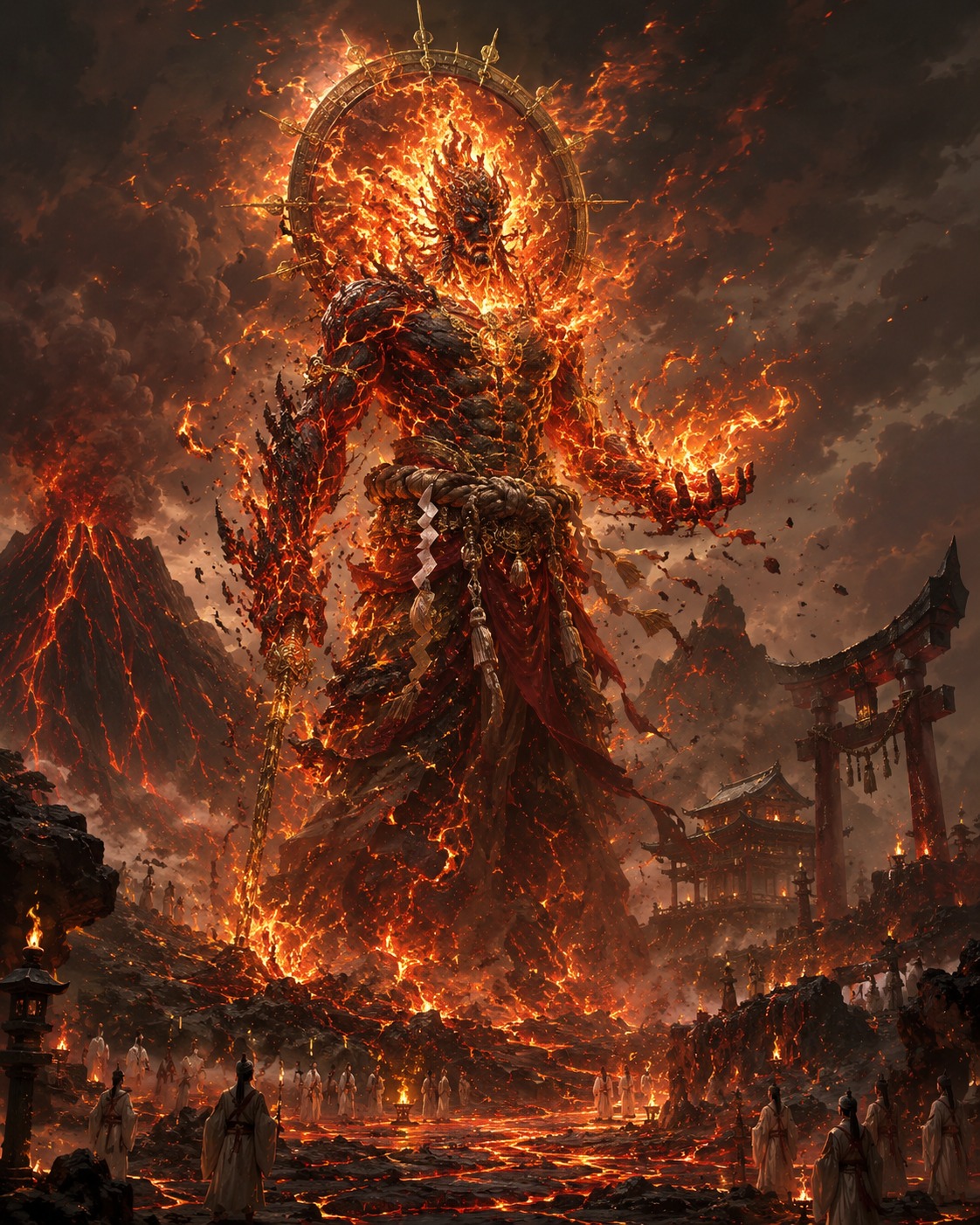
- Giant divine form, body itself a living volcano
- Approach causes surrounding terrain to liquefy into lava
- Paradox of fire creation — killing him births more fire gods
- Guardian of volcanoes, wildfires, metallurgy, and pottery
- Tragic birth that killed his mother Izanami
- Beheaded by Izanagi's Totsuka-no-Tsurugi
Stories
The volcanic nature-worship of the Japanese archipelago in the Yayoi-Kofun period is the decisive origin, and the decisive textual canon is the Volume 1 of the Kojiki of Ono no Yasumaro of 28 January 712 CE and the Nihon Shoki Volume 1 Age of the Gods Upper Chapter of Prince Toneri of 720 CE — the decisive canon of Japanese creation mythology. The Fujisan Hongu Sengen Taisha (Fujisan Hongu Sengen Taisha, Fujinomiya City, Shizuoka Prefecture) — founded c. 706 CE — is the decisive Japanese volcano-faith canon of Kagutsuchi, and the Akiha Shrine (Akiha Shrine, Hamamatsu City, Shizuoka Prefecture) — founded 718 CE, the main shrine of about 800 Akiha shrines nationwide that enshrine Kagutsuchi as their principal deity — is the decisive canon of fire-suppression. Under the 1872 Meiji government's State Shinto nationalisation policy, Kagutsuchi was settled as the canonical god of fire suppression in State Shinto canon, and the Giant Warrior of the 1979 December 26 Japanese manga and the 5 December 1984 Hayao Miyazaki film Nausicaa of the Valley of the Wind (Studio Ghibli) is evaluated as Kagutsuchi-inspired. The decisive 21st-century canon is the boss Kagutsuchi of Shin Megami Tensei IV (Shin Megami Tensei IV) (Atlus, Nintendo 3DS) released in Japan on 22 November 2007 and the boss Kagutsuchi of Shin Megami Tensei: Strange Journey (Shin Megami Tensei: Strange Journey) released in Japan on 19 November 2008 — the decisive video-game canon, and the comparison of the fire giant Surtr of the 17 November 2017 Marvel film Thor: Ragnarok and the Kagutsuchi canon is the 21st-century global adaptation canon.
Weakness
Kagutsuchi's weaknesses are: (1) Izanagi's Totsuka-no-Tsurugi — the most decisive canonical weakness in the Volume 1 of the 712 CE Kojiki canon, in which the father god Izanagi's sacred sword beheads Kagutsuchi to his death — the decisive mythological canon; (2) the water and fertility goddess Mizuhanome — the decisive canon in the 712 CE Kojiki canon that Mizuhanome, the water goddess born from Kagutsuchi's blood, pacifies Kagutsuchi; (3) sealing by sacred shrines — the decisive canon in the Fujisan Hongu Sengen Taisha and Akiha Shrine canon that the dedication rituals and sealing rituals of sacred shrines pacify Kagutsuchi's wrath; (4) impossibility of contract — in the Japanese Shinto canon, Kagutsuchi cannot contract with humans — only interacts through dedication and sealing rituals; (5) yin-yang balance breaking — in the Japanese Shinto yin-yang five-element canon, strong water weakens Kagutsuchi; (6) wrong dedication ritual — the decisive canon in the Japanese Shinto canon that a wrong dedication ritual invokes Kagutsuchi's wrath; (7) mother Izanami — though Kagutsuchi's mother, she died due to his birth — the decisive tragic canon; (8) absence of resurrection — the decisive canon in the 712 CE Kojiki canon that Kagutsuchi does not resurrect. The decisive canonical finale is the Japanese mythological decisive canon of the Volume 1 of the 712 CE Kojiki — dozens of new gods (Kuraokami, Kurayamatsumi, Kuramitsuha, Iwasaku, Nesaku, etc.) are born from Kagutsuchi's blood and corpse fragments — and the decisive Japanese mythological cosmological canon 'creation and destruction are inseparable, and new life is born from death'.
Cultural Significance
Kagutsuchi is not merely a fire-god icon but the canonical iconographic figure of the decisive Japanese fire-god canon, traversing the 28 January 712 CE Ono no Yasumaro's Kojiki, the 720 CE Prince Toneri's Nihon Shoki, the c. 706 CE founded Fujisan Hongu Sengen Taisha, about 800 nationwide shrines, the 1872 Meiji Shinto nationalisation, the 1984 Hayao Miyazaki's Nausicaa of the Valley of the Wind, the 2007 Nintendo's Shin Megami Tensei IV, and the 2017 Marvel film Thor: Ragnarok. The volcanic nature-worship of the Japanese archipelago in the Yayoi-Kofun period (c. 4th century BCE - 7th century CE) settled as the decisive canon in the Volume 1 of the Kojiki — the oldest extant Japanese historical chronicle compiled by Ono no Yasumaro (Ono no Yasumaro, born c. 660, died 6 July 723) of the Nara period of Japan on 28 January 712 CE, and the Nihon Shoki (Nihon Shoki) Volume 1 Age of the Gods Upper Chapter, presented by Prince Toneri (Prince Toneri, 676-735) to the 44th Empress Gensho in 720 CE in the Nara period of Japan, also decisively records this. The decisive canon of Japanese creation mythology is the decisive canon in which the husband-wife gods Izanagi (Izanagi) and Izanami (Izanami) bear the Japanese archipelago and the gods — bearing Kagutsuchi as their last child — and the mother Izanami dies of genital burns — the decisive tragic mythological canon. The Fujisan Hongu Sengen Taisha (Fujisan Hongu Sengen Taisha, Fujinomiya City, Shizuoka Prefecture) — founded c. 706 CE — is the decisive Japanese volcano-faith canon, and the Akiha Shrine (Akiha Shrine, Hamamatsu City, Shizuoka Prefecture, founded 718 CE) — the main shrine of about 800 Akiha shrines nationwide that enshrine Kagutsuchi as their principal deity — is the decisive canon of fire-suppression. The decisive 21st-century canon is the boss Kagutsuchi of Shin Megami Tensei IV (Shin Megami Tensei IV) (Atlus, Nintendo 3DS) released in Japan on 22 November 2007 and Shin Megami Tensei: Strange Journey (Shin Megami Tensei: Strange Journey) released in Japan on 19 November 2008 — the 21st-century decisive video-game canon.
In Popular Culture
- Kojiki Volume 1 (712 CE) — decisive origin canon
- Nihon Shoki Volume 1 Age of the Gods Upper Chapter (720 CE) — decisive chronicle canon
- Fujisan Hongu Sengen Taisha (c. 706 CE) — decisive volcano-faith canon
- Akiha Shrine (718 CE) — decisive fire-suppression-faith canon
- 1872 Meiji Shinto nationalisation — decisive State Shinto canon
- Hayao Miyazaki Nausicaa of the Valley of the Wind (1984) — decisive Japanese film canon
- Atlus Shin Megami Tensei IV (2007) — decisive video-game canon
- Atlus Shin Megami Tensei: Strange Journey (2008) — decisive video-game canon
- Marvel film Thor: Ragnarok (2017) — 21st-century global adaptation canon
- Masashi Kishimoto Naruto (1999-2014) — decisive manga adaptation canon
Trivia
The etymology of Kagutsuchi (Kagutsuchi) in Japanese is the compound of kagu ('shining, radiant') and tsuchi ('spirit, soul') — meaning 'shining soul' — the decisive canonical vocabulary, and the aliases Hi-no-Kagutsuchi ('fire Kagutsuchi') and Homusubi ('spirit that gives birth to fire') are decisive canonical vocabulary. The decisive textual canon is the Volume 1 of the Kojiki (Kojiki) — the oldest extant Japanese historical chronicle compiled by Ono no Yasumaro (Ono no Yasumaro, born c. 660, died 6 July 723) in the Nara period of Japan and presented to the 43rd Empress Genmei (Empress Genmei, 661-721) on 28 January 712 CE — the decisive canon of Japanese creation mythology. The decisive mythological canon is the decisive Japanese creation canon in which the husband-wife gods Izanagi (Izanagi) and Izanami (Izanami) bear the 8 great islands of the Japanese archipelago and the gods — bearing Kagutsuchi as their last child — and the mother Izanami dies of genital burns and the enraged father Izanagi beheads Kagutsuchi with his Totsuka-no-Tsurugi (Totsuka-no-Tsurugi, ten-hand sword) — the decisive tragic mythological canon. From Kagutsuchi's blood and corpse fragments, dozens of new gods — Kuraokami, Kurayamatsumi, Kuramitsuha, Iwasaku, Nesaku, etc. — are born — the decisive canon — and the decisive Japanese mythological cosmological canon 'creation and destruction are inseparable, and new life is born from death'. The Fujisan Hongu Sengen Taisha (Fujisan Hongu Sengen Taisha, Miyacho 1-1, Fujinomiya City, Shizuoka Prefecture) — founded c. 706 CE, main hall rebuilt by Tokugawa Ieyasu in 1604 — is the decisive Japanese volcano-faith canon, and the Akiha Shrine (Akiha Shrine upper shrine, Hamamatsu City, Shizuoka Prefecture, founded 718 CE) — the main shrine of about 800 Akiha shrines nationwide that enshrine Kagutsuchi as their principal deity — is the decisive canon of fire-suppression. The boss Kagutsuchi of Shin Megami Tensei IV (Shin Megami Tensei IV) (Atlus, Nintendo 3DS) released in Japan on 22 November 2007 is the 21st-century decisive video-game canon.