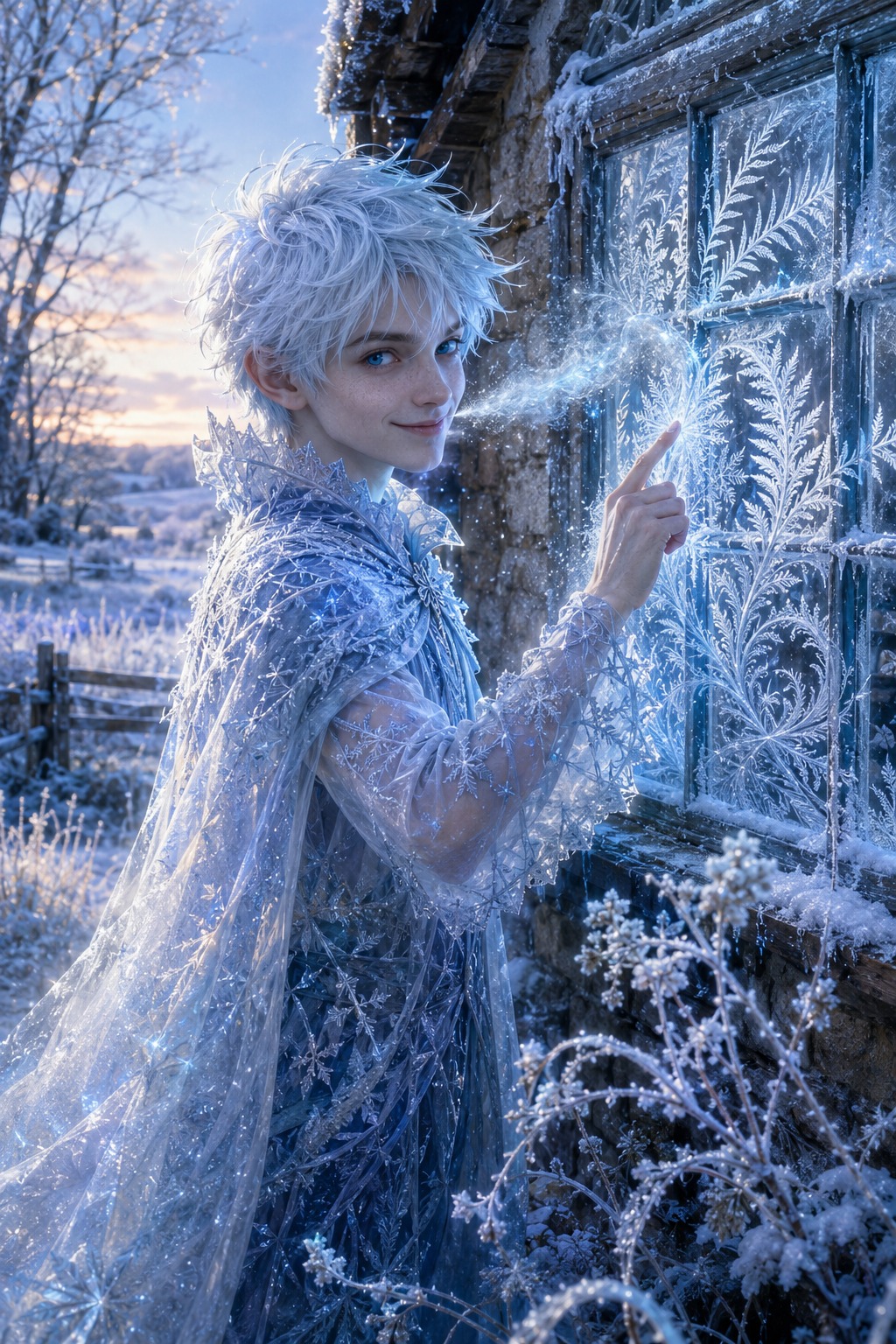
Jack Frost
Personification of Frost in English/Norse Folklore
Names in Other Languages
 잭 프로스트한국어
Jack Frost · 영국·북유럽 민담의 서리 의인화
 ジャック・フロスト日本語
Jack Frost — 下位の氷の精霊
 傑克·弗羅斯特繁體中文
Jack Frost — 低階冰之精靈
 Jack FrostDeutsch
Jack Frost — Niederer Eisgeist
 Jack FrostFrançais
Jack Frost — Esprit de glace inférieur
 Jack FrostEspañol
Jack Frost — Espíritu de hielo inferior
 Jack FrostPortuguês
Jack Frost — Espírito de gelo inferior
 Jack FrostPolski
Jack Frost — Niższy duch lodu
 Джек ФростРусский
Jack Frost — Низший дух льда
Jack Frost is the personified spirit of frost and cold in English and Scandinavian folklore, appearing as a young boy or mischievous old man, the canonical iconographic figure that draws ice-flower patterns (frost ferns) on windows on winter mornings and nips people's noses and toes. The etymology is the combination of the English Jack (a generic male name) and Frost (frost, from Old English forst), and the first decisive textual record of English Jack Frost appears in the 1734 poem A Mountain of Frost in the British London Magazine. The iconographic origin is the fusion of (1) the Norse-mythological frost-giants Jokull ('glacier') and Frosti ('frost') of Chapter 1 of the Halfdanar saga svarta of the Heimskringla of the early-thirteenth-century Icelandic poet Snorri Sturluson (1179-1241), and (2) the Morozko ('Little Frost') and Ded Moroz ('Grandfather Frost') canon in the Russian Folk Tales (Narodnye Russkie Skazki) of the Russian folklorist Alexander Afanasyev (1826-1871) of 1855-1863. The decisive modern canon is the 1944 song The Christmas Song by the American composer Mel Torme (1925-1999) and lyricist Robert Wells (1922-1998) — with the line 'Jack Frost nipping at your nose' — which decisively settled the twentieth-century global Jack Frost canon, and the Jack Frost protagonist of the DreamWorks animated film Rise of the Guardians (released 21 November 2012 in the USA, based on William Joyce) is the twenty-first-century global Jack Frost cinematic canon.
Origin
The iconographic origin is the fusion of (1) the Norse-mythological frost-giant canon of Chapter 1 of the Halfdanar saga svarta of the Heimskringla of the early-thirteenth-century Icelandic poet Snorri Sturluson (1179-1241) and (2) the Morozko canon of Russian Slavic folklore. In Chapter 1 of the Halfdanar saga svarta of Snorri's Heimskringla (c. 1230), the Norse-mythological frost-giant Jokull ('glacier') is the son of his father Kari ('wind') and mother, and along with the grandson Snaer ('snow'), the decisive Norse frost-giant family canon is recorded. The view of the nineteenth-century British folklorist Edward Clodd (1840-1930) is that this Norse-mythological frost-giant canon settled in English folklore as the frost-personification canon through Viking invasions and settlements in Britain in the eighth to eleventh centuries. The Morozko ('Little Frost') tale 95 of the Russian Folk Tales (eight volumes) of the Russian folklorist Alexander Afanasyev (1826-1871) of 1855-1863 — the fairy tale of the stepmother who abandons her stepdaughter in the winter forest and the stepdaughter who, treating Morozko warmly, receives gems — is the decisive text of the Slavic frost canon, and Ded Moroz ('Grandfather Frost') developed from Morozko became the decisive canon of nineteenth-century Russian Santa Claus. The first decisive textual record of English Jack Frost is the 1734 poem A Mountain of Frost in the British London Magazine, and the poem The Frost of 1826 by the American poet Hannah Flagg Gould (1789-1865) — in which Jack Frost comes at night and draws ice patterns on windows — established the decisive English-literary Jack Frost canon of the nineteenth century.
Features
- Form of a young boy or mischievous old man
- Creates frost, ice, and cold
- Draws ice-flower patterns (frost ferns) on windows
- Makes people's noses and fingertips red
- Begins activity when winter comes
- Disappears in the warmth of spring
Stories
The Norse frost-giants Jokull and Frosti canon of Snorri's early-thirteenth-century Heimskringla and the Morozko canon of Afanasyev's 1855-1863 Russian Folk Tales are the decisive origins of the Jack Frost canon, and the 1734 poem A Mountain of Frost in the British London Magazine is the first decisive textual record of English Jack Frost. The 1826 poem The Frost of the American poet Hannah Flagg Gould decisively established the nineteenth-century English-literary Jack Frost canon, and the decisive modern canon is the 1944 song The Christmas Song (Chestnuts Roasting on an Open Fire) of the American composer Mel Torme (1925-1999) and lyricist Robert Wells (1922-1998) — with the line 'Jack Frost nipping at your nose' — which settled the twentieth-century global Jack Frost canon. The first recording of this song by the American singer Nat King Cole (1919-1965) in July 1946 — number one on the Billboard chart for eight weeks — became the twentieth-century American Christmas-carol canon. The stop-motion animated TV film Jack Frost (directed by Paul Fris, voiced by Robert Morse, 49 minutes), broadcast on NBC in the USA on 13 December 1979 by Rankin/Bass Productions, established the twentieth-century American children's Jack Frost canon. The 1998 Warner Brothers film Jack Frost (released 11 December 1998 in the USA, directed by Troy Miller, starring Michael Keaton) is the late-twentieth-century Jack Frost cinematic canon, and the decisive twenty-first-century canon is the Jack Frost (real name Jackson Overland Frost) of the children's book series The Guardians of Childhood by the American author William Joyce (b. 1957) of 2005-2012 and the DreamWorks animated film Rise of the Guardians (released 21 November 2012 in the USA, directed by Peter Ramsey, voiced by Chris Pine as Jack Frost), which became the twenty-first-century global Jack Frost cinematic canon.
Weakness
Jack Frost's weaknesses are: (1) the warmth of spring — the decisive canon in English and Scandinavian folklore that Jack Frost melts and vanishes in the warmth when spring comes — the decisive canon of natural cycle; (2) fire and warm tea — the English folk canon that Jack Frost is weakened by human hearth fire and warm tea; (3) human kindness — the canonical weakness in the Morozko canon of Afanasyev's 1855-1863 Russian Folk Tales that when the stepdaughter treats the cold Morozko warmly, Morozko gives her gems — the canon of melting before kindness; (4) the decisive weakness in Hannah Flagg Gould's 1826 The Frost that Jack Frost vanishes before the warm hearth fire of the human home; (5) the decisive weakness of the night hearth fire and the warmth of family in Mel Torme's 1944 The Christmas Song; (6) the tragic canonical finale of the 1979 Rankin/Bass Jack Frost — that Jack Frost falls in love with the human woman Elisa and wishes to become human but ultimately disappears in spring; (7) the twenty-first-century canonical weakness in the 2012 DreamWorks Rise of the Guardians that Jack Frost is weakened if children do not believe in him; (8) pinch — the decisive iconography in the English-speaking world since the 1944 Christmas Song canon that Jack Frost 'nips' people's noses and toes. The English proverb 'Jack Frost nips with light fingers' is the nineteenth-century English-literary canon.
Cultural Significance
Jack Frost is not merely a frost-spirit icon but the canonical iconographic figure of the Western winter-spirit canon, traversing the Norse-mythological frost-giants Jokull and Frosti of Snorri's thirteenth-century Heimskringla, the first English appearance of Jack Frost in a 1734 British magazine, the 1826 American poem of Hannah Flagg Gould, Afanasyev's 1855 Russian Folk Tales, the 1944 American Christmas Song of Mel Torme, the 1979 Rankin/Bass animation, and the 2012 DreamWorks film. The early-thirteenth-century Heimskringla of Snorri Sturluson (1179-1241) — as the decisive canon of Norse mythology — was written at the Reykholt monastery in Iceland and became the decisive canon of the Norse-mythological frost-giant family (Kari, Frosti, Jokull, Snaer). The Russian Folk Tales (eight volumes, about 600 tales) of Alexander Afanasyev (1826-1871) of 1855-1863 — as the decisive canon of nineteenth-century Russian folklore — is the decisive Slavic folklore canon comparable to the Grimm Brothers' Kinder- und Hausmaerchen (1812-1815), and Ded Moroz settled as the canon of the New Year celebration of the Soviet Union in 1937. The Christmas Song (Chestnuts Roasting on an Open Fire) of Mel Torme (1925-1999) and Robert Wells (1922-1998) of July 1944 — with Nat King Cole's first recording of July 1946 — settled as the most-licensed Christmas song of all time according to the American Recording Industry Association (RIAA), decisively establishing the twentieth-century global Jack Frost canon. The 1998 Warner Brothers film Jack Frost (starring Michael Keaton, worldwide box office about 35 million dollars) and the 2012 DreamWorks Rise of the Guardians (worldwide box office about 306 million dollars) — based on William Joyce — settled the twenty-first-century global Jack Frost cinematic canon, and drew about 300,000 spectators in South Korea the same year.
In Popular Culture
- Snorri Sturluson, Heimskringla, Halfdanar saga svarta (c. 1230) — Norse frost-giants Jokull and Frosti canon
- British London Magazine, poem A Mountain of Frost (1734) — first English appearance of Jack Frost
- Hannah Flagg Gould, The Frost (1826) — American poetic Jack Frost canon
- Afanasyev, Russian Folk Tales, Morozko (1855-1863) — Slavic frost-spirit canon
- Mel Torme and Robert Wells, The Christmas Song (1944) — decisive American Christmas-carol canon
- Nat King Cole, first recording of The Christmas Song (1946) — American record canon
- Rankin/Bass TV film Jack Frost (1979) — American children's canon
- Warner Brothers film Jack Frost, Michael Keaton (1998) — late-twentieth-century cinematic canon
- William Joyce, The Guardians of Childhood book series (2005-2012) — twenty-first-century children's-book canon
- DreamWorks film Rise of the Guardians (2012) — decisive twenty-first-century global cinematic canon
Trivia
The etymology of English Jack — canonised as a generic male name in fourteenth-century England — combined with Frost (Old English forst, 'frost') is the canonical vocabulary, and the first decisive textual record of English Jack Frost is the 1734 poem A Mountain of Frost in the British London Magazine. The Norse-mythological frost-giant Jokull ('glacier') — in Chapter 1 of the Halfdanar saga svarta of the early-thirteenth-century Heimskringla of Snorri Sturluson (1179-1241) — is the son of Kari ('wind') and his mother, and along with the grandson Snaer ('snow') is the decisive Norse frost-giant family canon. The Morozko tale 95 of Alexander Afanasyev's (1826-1871) 1855-1863 Russian Folk Tales — adapted into the 1965 Soviet film Morozko (directed by Aleksandr Rou, drawing about 32 million spectators at the Moscow box office) — became the decisive twentieth-century Russian Jack Frost canon. The Christmas Song, composed and written in about forty-five minutes in July 1944 in Los Angeles, California, USA — in mid-summer 35-degree-Celsius heat — by Mel Torme (1925-1999) and Robert Wells (1922-1998), with Nat King Cole's first recording in July 1946, is the decisive canon of the 1998 RIAA Hall of Fame and 2009 Grammy Hall of Fame inductions. The stop-motion animated TV film Jack Frost broadcast on NBC in the USA on 13 December 1979 by Rankin/Bass Productions (directed by Paul Fris, 49 minutes, composed by Lighton Woods) is the decisive twentieth-century American children's Christmas-TV canon. The Jack Frost (real name Jackson Overland Frost) of the children's book series The Guardians of Childhood (2005-2012) by the American author William Joyce (b. 1957, born in Shreveport, Louisiana) — adapted into the DreamWorks film Rise of the Guardians (directed by Peter Ramsey, voiced by Chris Pine) released on 21 November 2012 in the USA, with worldwide box office of 306 million dollars — became the decisive twenty-first-century global Jack Frost canon.