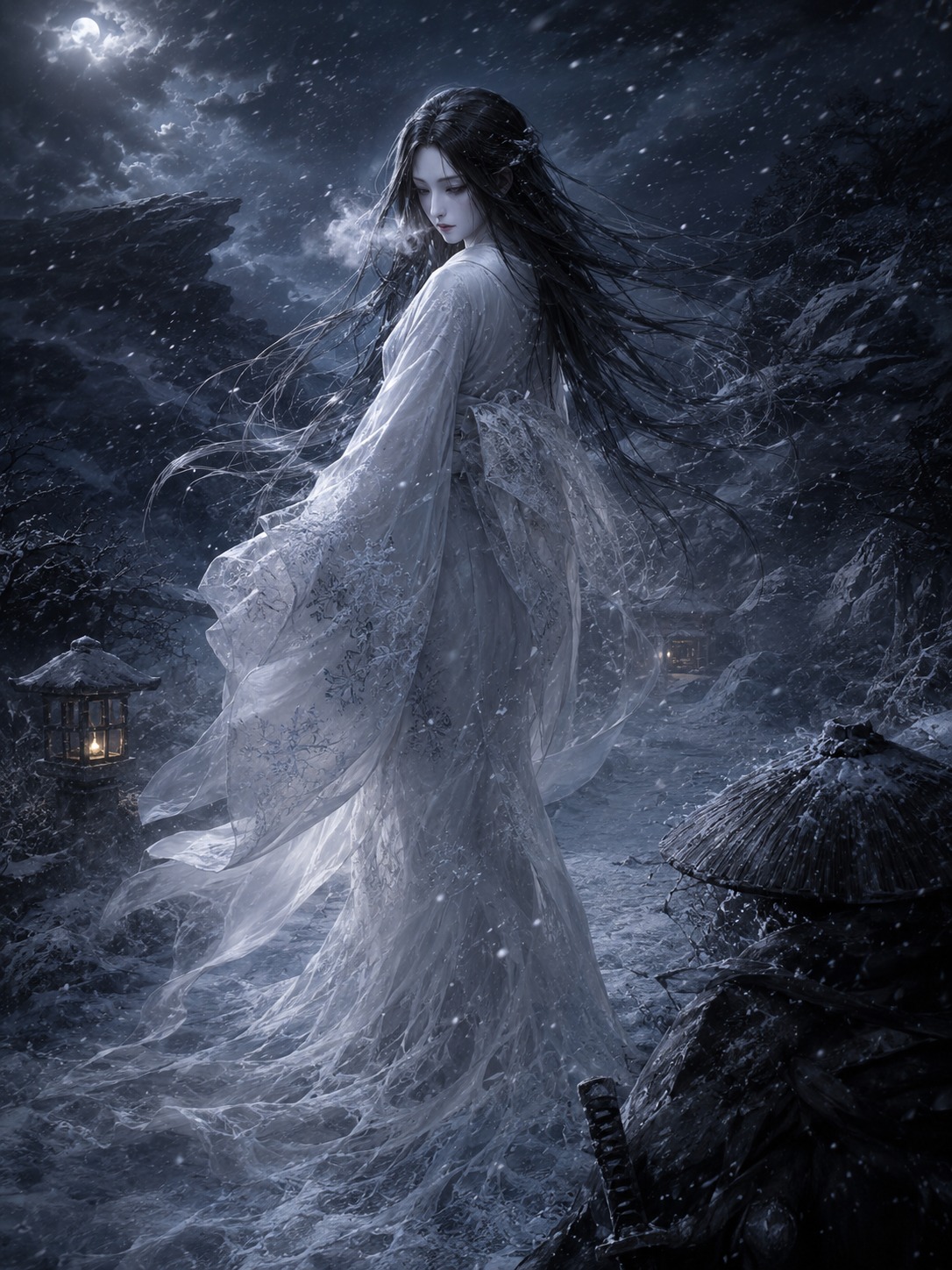
Yuki-onna
Yuki-onna · The Snow Woman — A Cold, Sorrowful Beauty Appearing in the Blizzard
The Yuki-onna (Japanese Yuki-onna, 'snow woman') is the pale female yokai who appears suddenly in the night blizzard, the canonical iconographic figure of the Japanese winter snow-mountain yokai who in white kimono, jet-black hair, and a bloodless face approaches the lost traveller and freezes him to death with her cold breath. The iconographic origin is the fusion of the lethal-cold (toshi) folklore of Japan's heavy-snowfall regions in Tohoku, Chubu, and Hokkaido with mountain-deity (yama-no-kami) belief. The earliest textual record is the Sogi Shokoku Monogatari, a travel account by the renga poet Sogi (1421-1502) of the late Muromachi period (estimated late fifteenth century), describing a tall white-clad woman encountered in the snow mountains of Echigo Province (now Niigata Prefecture). In the Edo period, the Yuki-onna was systematised as a canonical yokai in the yokai catalogue Gazu Hyakki Yagyo (1776) of Toriyama Sekien (1712-1788). The decisive canon is the short story Yuki-Onna in Kwaidan: Stories and Studies of Strange Things, the English-language short-story collection published in April 1904 by Lafcadio Hearn (1850-1904, Japanese name Koizumi Yakumo): the woodcutters Mosaku (the elder) and Minokichi of Musashi Province are trapped in a blizzard and rest in a hut, where the Yuki-onna kills Mosaku but spares the young Minokichi on his promise never to disclose the secret; years later Minokichi marries a woman named Oyuki, who turns out to be the same Yuki-onna, and she vanishes when he breaks the secret. This established the decisive canon of modern Yuki-onna iconography. Masaki Kobayashi's 1965 film Kwaidan, with its Yuki-onna episode, won the Special Jury Prize at the Cannes Film Festival and completed the global canon.