Ogre
Ogre · The Man-Eating Giant — A Dull, Cruel Tyrant of the Wilds
Names in Other Languages
 오우거한국어
Ogre · 식인 거인 — 둔하고 잔혹한 황야의 폭군
 オーガ日本語
Ogre · 食人巨人 — 鈍重で残酷な荒野の暴君
 食人魔繁體中文
Ogre · 食人巨人 — 遲鈍殘酷的荒野暴君
 OgerDeutsch
Ogre · Der menschenfressende Riese — Ein stumpfer, grausamer Tyrann der Wildnis
 OgreFrançais
Ogre · Le géant mangeur d'hommes — Un tyran obtus et cruel des terres sauvages
 OgroEspañol
Ogre · El gigante devorador de hombres — Un tirano obtuso y cruel de las tierras agrestes
 OgroPortuguês
Ogre · O gigante devorador de homens — Um tirano obtuso e cruel das terras agrestes
 OgrPolski
Ogre · Olbrzym pożerający ludzi — tępy, okrutny tyran dziczy
 ОгрРусский
Ogre · Человекоядный великан — тупой, жестокий тиран дебрей
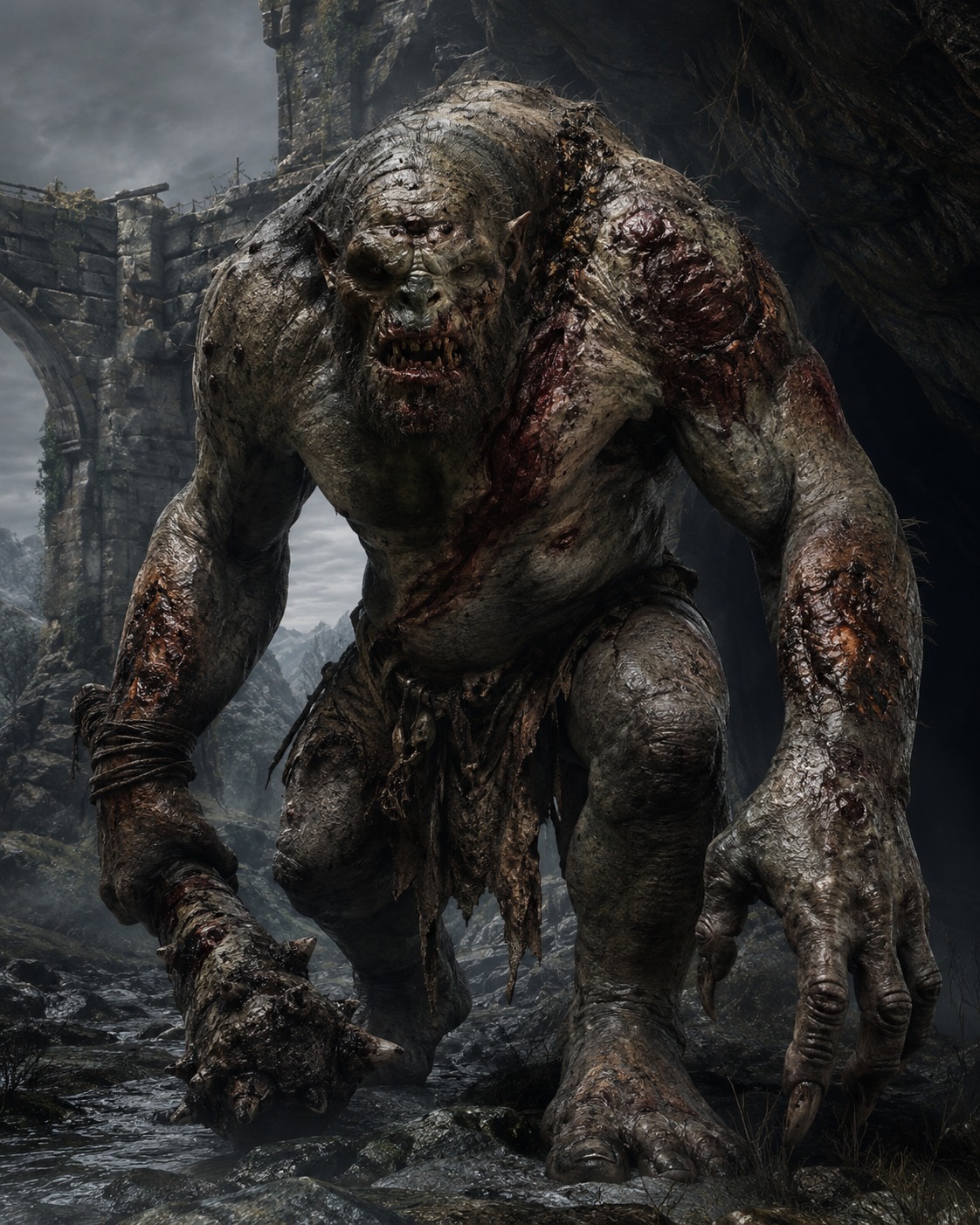
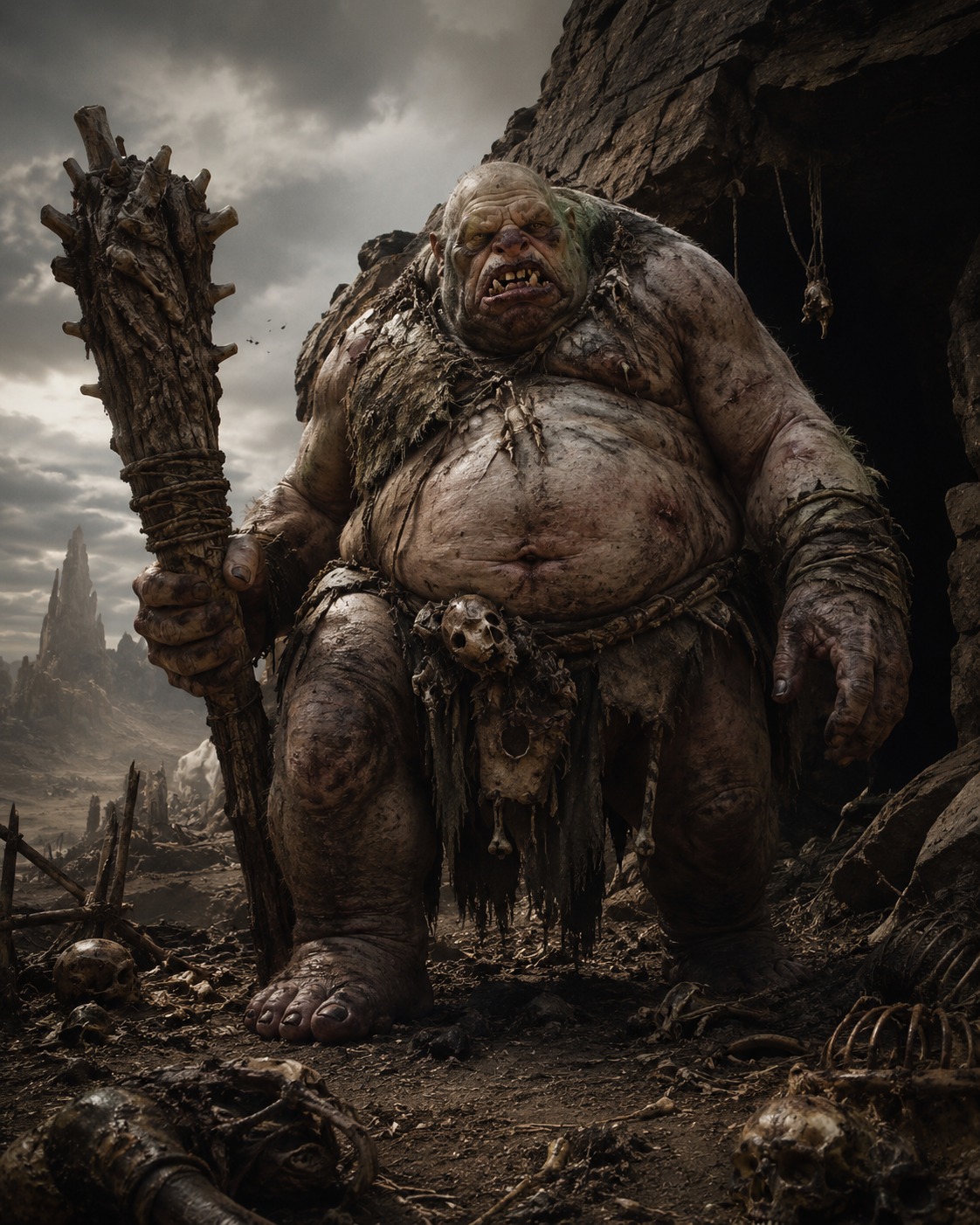
A man-eating giant race standing nine to ten feet tall (roughly 2.7-3 m), thick-hided in grey-green or sallow tones, brutally strong yet slow of wit. Ogres live alone or in small family bands in caves, ruins, and under bridges, swinging tree-trunk clubs and hunting humans, especially children. The figure descends from Giambattista Basile's Neapolitan fairy tale collection (1634-36) and Charles Perrault's tales of 1697, and was crystallised into the standard club-wielding giantkind by Gary Gygax and Dave Arneson's Dungeons & Dragons (1974) and the 1977 Monster Manual.
Origin
Etymologists trace French 'ogre' to Latin Orcus, the underworld deity and punisher of broken oaths attested in Virgil's Aeneid 4.242, Horace, and Petronius' Satyricon. The forms 'huerco' and 'uerco' appear already in Giambattista Basile's Neapolitan-dialect collection Lo cunto de li cunti, posthumously published as Il Pentamerone (Naples, 1634-36). Charles Perrault popularised the spelling 'ogre' in Histoires ou contes du temps passé, avec des moralités (Claude Barbin, Paris, 1697), particularly in 'Le Maître chat ou le Chat botté' (Puss in Boots), 'Le Petit Poucet' (Hop-o'-My-Thumb), and 'La Belle au bois dormant' (Sleeping Beauty). Gary Gygax and Dave Arneson placed the ogre as a club-wielding humanoid in the original 1974 Dungeons & Dragons booklets; the 1977 Monster Manual fixed the canonical nine-to-ten-foot, slow-witted, man-eating profile. The 1976 supplement Eldritch Wizardry introduced the Ogre Mage, lifted directly from the Japanese oni tradition.
Features
- Stature of nine to ten feet (about 2.7-3 m) with thick grey-green or sallow hide
- Tree-trunk clubs, spiked mauls, or other crude bludgeoning weapons
- Slow-witted, lazy, gluttonous, with a compulsive taste for human flesh
- Solitary or small-family dwellings in caves, ruins, and beneath bridges
- A guttural ogre-tongue alongside broken phrases of the common speech
Stories
In European fairy tales the ogre is the dull-witted tyrant overcome by a smaller, cleverer hero: in Puss in Boots the ogre boasts of his shape-shifting and is eaten when he turns into a mouse, while in Hop-o'-My-Thumb he kills his own seven daughters by mistake. In Dungeons & Dragons, Final Fantasy, and most fantasy video games the ogre is the standard mid-low-level giant-kin opponent, slower and hungrier than a troll. Since DreamWorks' Shrek (2001), the figure has also been recast as protagonist in stories about friendship and self-acceptance.
Weakness
Ogres are slow, lazy, and easily tricked. They are vain about their strength, gluttonous to the point of recklessness, and routinely fall for simple stratagems, as the mouse-trick in Puss in Boots demonstrates. Their inability to cooperate leaves them vulnerable to coordinated attack, and some game systems give them weaknesses to sunlight or to consecrated wards.
Cultural Significance
Marc Soriano, in Les Contes de Perrault: culture savante et traditions populaires (Gallimard, 1968), read the ogre's cannibalism as a folk-memory of seventeenth-century French rural famine and child abandonment. William Steig's picture book Shrek! (Farrar, Straus and Giroux, 1990) and the DreamWorks Shrek film (2001) inverted the tradition, turning the ogre into a protagonist; Steig stated that he took the name from the Yiddish 'shrek' (fright). English translations of Japanese folklore routinely render oni as 'ogre', so the two traditions cross-pollinate in modern fantasy.
In Popular Culture
- Giambattista Basile, Lo cunto de li cunti (Naples, 1634-36) — huerco / uerco
- Charles Perrault, Histoires ou contes du temps passé (Claude Barbin, Paris, 1697) — Puss in Boots, Hop-o'-My-Thumb, Sleeping Beauty
- Gary Gygax and Dave Arneson, Dungeons & Dragons original boxed set (TSR, 1974)
- Gary Gygax and Brian Blume, Eldritch Wizardry supplement (TSR, 1976) — Ogre Mage
- Gary Gygax, Advanced Dungeons & Dragons Monster Manual (TSR, 1977)
- Square, Final Fantasy series (1987–) — Ogre as recurring foe
- William Steig, Shrek! (Farrar, Straus and Giroux, 1990)
- DreamWorks Animation, Shrek film series (2001-2010)
Trivia
- Perrault's 1697 ogre in Puss in Boots is a shape-shifting magician who can become a lion or a mouse, unlike the dull bruiser of later tradition.
- Wilhelm Grimm was the first to propose, in the nineteenth century, that the French 'ogre' derives from Latin Orcus.
- The D&D Ogre Mage (1976) was lifted directly from Japanese oni lore; second edition (1989) renamed it Oni outright, and fifth edition (2014) lists it as 'Oni (Ogre Mage)'.
- William Steig stated in interviews that 'Shrek' was taken from the Yiddish 'shrek' / German 'Schreck', meaning fright or terror.