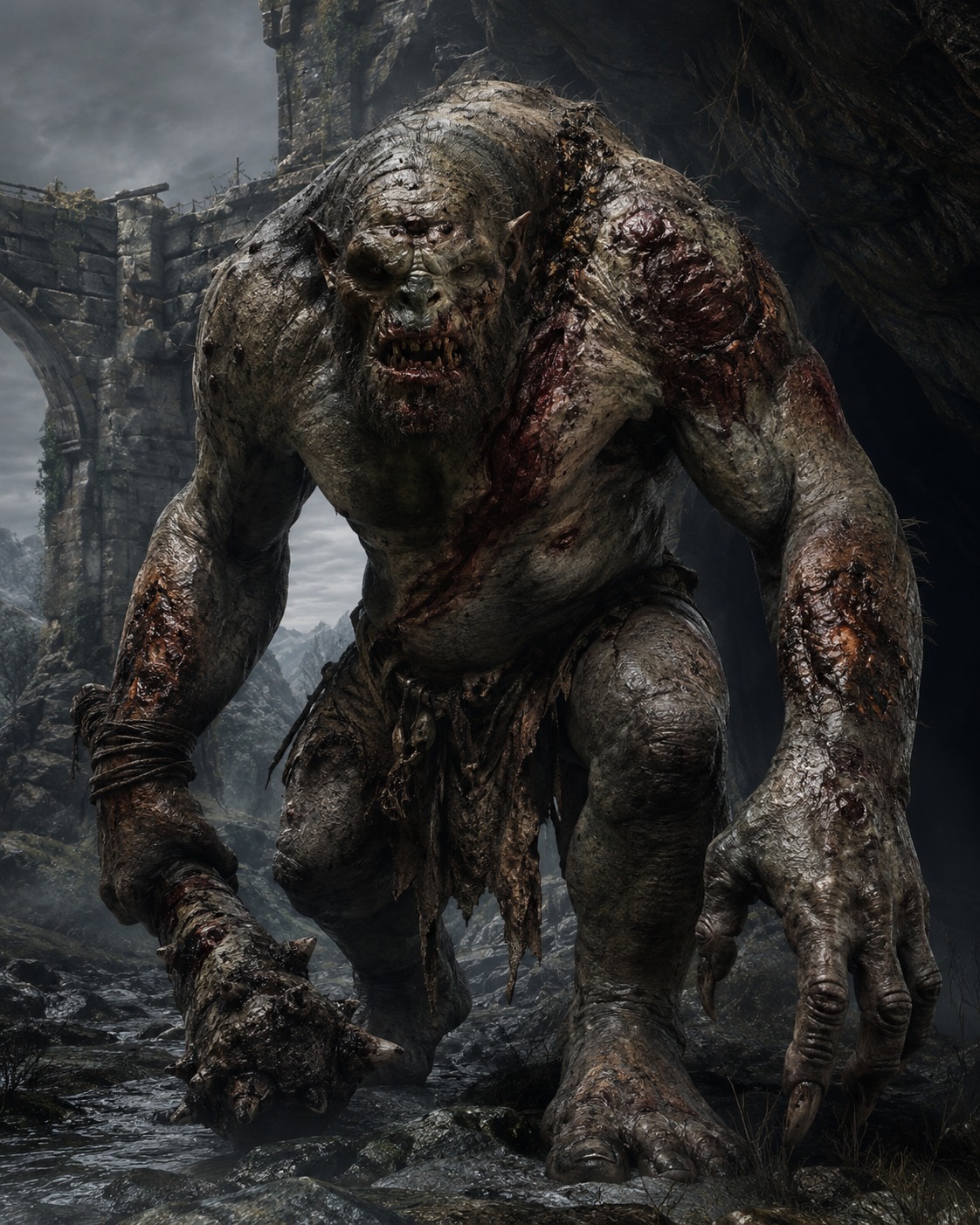
Troll
Troll · The Regenerating Giant — A Savage Race of Tenacious Vitality
Names in Other Languages
 트롤한국어
트롤한국어Troll · 재생의 거인 — 끈질긴 생명력의 야만 종족
 トロル日本語
Troll · 再生の巨人 — 執拗な生命力の野蛮種族
 巨魔繁體中文
Troll · 再生之巨人 — 生命力頑強的野蠻種族
 TrollDeutsch
Troll · Der regenerierende Riese — Eine wilde Rasse zäher Vitalität
 TrollFrançais
Troll · Le géant régénérant — Une race sauvage à la vitalité tenace
 TrolEspañol
Troll · El gigante regenerador — Una raza salvaje de tenaz vitalidad
 TrollPortuguês
Troll · O gigante regenerador — Uma raça selvagem de tenaz vitalidade
 TrollPolski
Troll · Regenerujący się olbrzym — dzika rasa o uporczywej żywotności
 ТролльРусский
Troll · Регенерирующий великан — дикая раса упорной живучести
The troll, from Old Norse 'troll' (proto-Germanic *trullaz, 'magical being, monster'), is a giant of Norse mythology who dwells in mountains, caves and under bridges. The fullest medieval source is Snorri Sturluson's prose 'Edda', Gylfaginning chapter forty-eight (c. 1220), and the 'Þrymskviða' of the Poetic Edda preserved in the Codex Regius manuscript (GKS 2365 4to, c. 1270, Árni Magnússon Institute, Reykjavik), in which trolls are great human-shaped jǫtnar or wicked magicians. The modern fantasy troll — two hundred and thirty to three hundred centimetres tall, green or green-yellow skinned, with long sinewy limbs and the signature trait of astonishing regeneration (severed parts regrow at once) — is the direct invention of Poul Anderson's science-fantasy novel 'Three Hearts and Three Lions' (Doubleday, 1962), chapter eight, in which the hero Holger Danske finds his sword cuts wholly futile against a regenerating troll. Gary Gygax borrowed Anderson's troll wholesale for the D&D original boxed set of 1974 and codified the figure in the 1977 AD&D Monster Manual. In the fifth-edition Monster Manual (2014) the troll is Challenge Rating 5, 84 hit points, AC 15, with three attacks per turn (one bite and two claws) and the Regeneration trait (regain 10 hit points at the start of its turn unless it has taken fire or acid damage during the previous turn). The same iconography runs through the three trolls William, Bert and Tom in J.R.R. Tolkien's 'The Hobbit' (1937), the cave trolls and Olog-hai of 'The Lord of the Rings' (1954-55), the troll tribal cards of 'Magic: The Gathering' (from 1993), the Darkspear and Amani trolls of Blizzard's 'World of Warcraft' (from 2004), and the friendly rock-spirit reinterpretation in Disney's 'Frozen' (2013).
Origin
The direct textual source is Snorri Sturluson's prose 'Edda', Gylfaginning chapter forty-eight (c. 1220), and the 'Þrymskviða' of the Poetic Edda preserved in the Codex Regius (GKS 2365 4to, c. 1270, Árni Magnússon Institute, Reykjavik), where trolls appear as great human-shaped jǫtnar or wicked magicians. The etymology is proto-Germanic *trullaz ('magical being, monster'), and the under-the-bridge troll iconography familiar to modern Anglophone readers was carried into the nineteenth century by the Norwegian folklorists Peter Christen Asbjørnsen (1812-1885) and Jørgen Moe (1813-1882) in 'Norske folkeeventyr' (Christiania, 1841-1844), notably in 'De tre bukkene Bruse' ('The Three Billy Goats Gruff'). The decisive D&D-style attribute of regeneration was, however, invented by Poul Anderson (1926-2001) in 'Three Hearts and Three Lions' (Doubleday, 1962), chapter eight, where Anderson applied the Hydra of Lerna's regrowth-of-severed-parts motif to the Norse troll. Gygax borrowed Anderson's troll into the D&D original boxed set of 1974 and standardised the appearance, Challenge Rating and regeneration mechanics in the 1977 AD&D Monster Manual; he acknowledged the Anderson debt in a 1976 'Strategic Review' interview.
Features
- Two hundred and thirty to three hundred centimetres tall, three hundred to five hundred kilograms
- Green, green-yellow or grey skin, long sinewy limbs, drooping nose
- Regeneration — severed parts regrow at once
- Fifth-edition Challenge Rating 5, 84 hit points, AC 15, three attacks per turn
- Lives under bridges, in caves, in wastelands or swamps, in tribes or alone
- Slow but ferocious and tenacious; eats both the living and the dead
Stories
Functions as the mid-tier gatekeeper monster (Challenge Rating 5) of tabletop role-playing campaigns, and as the standard antagonist of adventure stories in which players must discover the fire-and-acid weakness of the regeneration. The same iconography is borrowed for the three trolls William, Bert and Tom in Tolkien's 'The Hobbit' (turned to stone by sunlight), the cave trolls and Olog-hai of 'The Lord of the Rings', the Darkspear and Amani troll tribes of Blizzard's 'World of Warcraft', the troll tribal cards of 'Magic: The Gathering' (from 1993), and even the friendly stone-trolls of Disney's 'Frozen' (2013).
Weakness
The Regeneration trait does not function against fire and acid damage; injuries taken from those two damage types do not heal, and the Regeneration is suppressed for one turn after such damage (fifth-edition Monster Manual). Consequently a troll must be burned or scorched with acid to be killed outright, and an adventuring party normally needs a caster with Burning Hands or Acid Splash. The troll's slow wits make it easy to trick, and Tolkien's three trolls in 'The Hobbit' chapter two — petrified by the sunlight at dawn — passed on the petrification motif to the D&D Stone Troll, codified as the Petrification weakness in 'Volo's Guide to Monsters' (2016).
Cultural Significance
The figure runs from the Norse jǫtnar tradition through the nineteenth-century Norwegian folklore collection of Asbjørnsen and Moe, was reinvented as the regenerating monster by Poul Anderson's 1962 novel, was standardised by Gary Gygax's D&D in 1974 and has been the canonical 'regenerating savage giant' of Anglophone fantasy ever since. The twenty-first century has reclaimed the troll as a kindly mountain spirit in family films like Disney's 'Frozen' (2013) and Pixar's 'Onward' (2020).
In Popular Culture
Snorri Sturluson's prose 'Edda', Gylfaginning chapter forty-eight (c. 1220), 'Þrymskviða' in the Poetic Edda (Codex Regius, c. 1270), Asbjørnsen and Moe's 'Norske folkeeventyr' (1841-1844), Poul Anderson's 'Three Hearts and Three Lions' (Doubleday, 1962), the trolls William, Bert and Tom in Tolkien's 'The Hobbit' (1937), the cave trolls and Olog-hai of 'The Lord of the Rings' (1954-55), the TSR D&D original boxed set (1974), the AD&D Monster Manual (1977), the fifth-edition Monster Manual (2014), the troll tribal cards of 'Magic: The Gathering' (from 1993), Blizzard's 'World of Warcraft' Darkspear and Amani trolls (from 2004), Disney's 'Frozen' (2013) and Pixar's 'Onward' (2020).
Trivia
The signature D&D troll regeneration trait was not Norse but the invention of Poul Anderson in 'Three Hearts and Three Lions' (1962), chapter eight, where Anderson applied the Hydra of Lerna's regrowth motif to a Norse troll; Gary Gygax acknowledged the debt in a 1976 'Strategic Review' interview. The Tolkien petrification scene in 'The Hobbit' chapter two became the inspiration for the later D&D Stone Troll, formalised as the Petrification weakness in 'Volo's Guide to Monsters' (2016).