Halfling
Halfling · The Little Folk — Peaceful Farming Folk
Names in Other Languages
 하프링한국어
Halfling · 반신족 — 평화로운 소인 농경 종족
 ハーフリング日本語
Halfling · 小人族 — 平和な農耕の小さき民
 半身人繁體中文
Halfling · 小矮人 — 愛好和平的農耕小族
 HalblingDeutsch
Halfling · Das kleine Volk — Friedliches Bauernvolk
 HalfelinFrançais
Halfling · Le petit peuple — Paisible peuple agricole
 MedianoEspañol
Halfling · El pueblo pequeño — Pacífico pueblo agrícola
 HalflingPortuguês
Halfling · O povo pequeno — Pacífico povo agrícola
 NiziołekPolski
Halfling · Mały lud — spokojny lud rolniczy
 ПолуросликРусский
Halfling · Маленький народ — мирный земледельческий народ
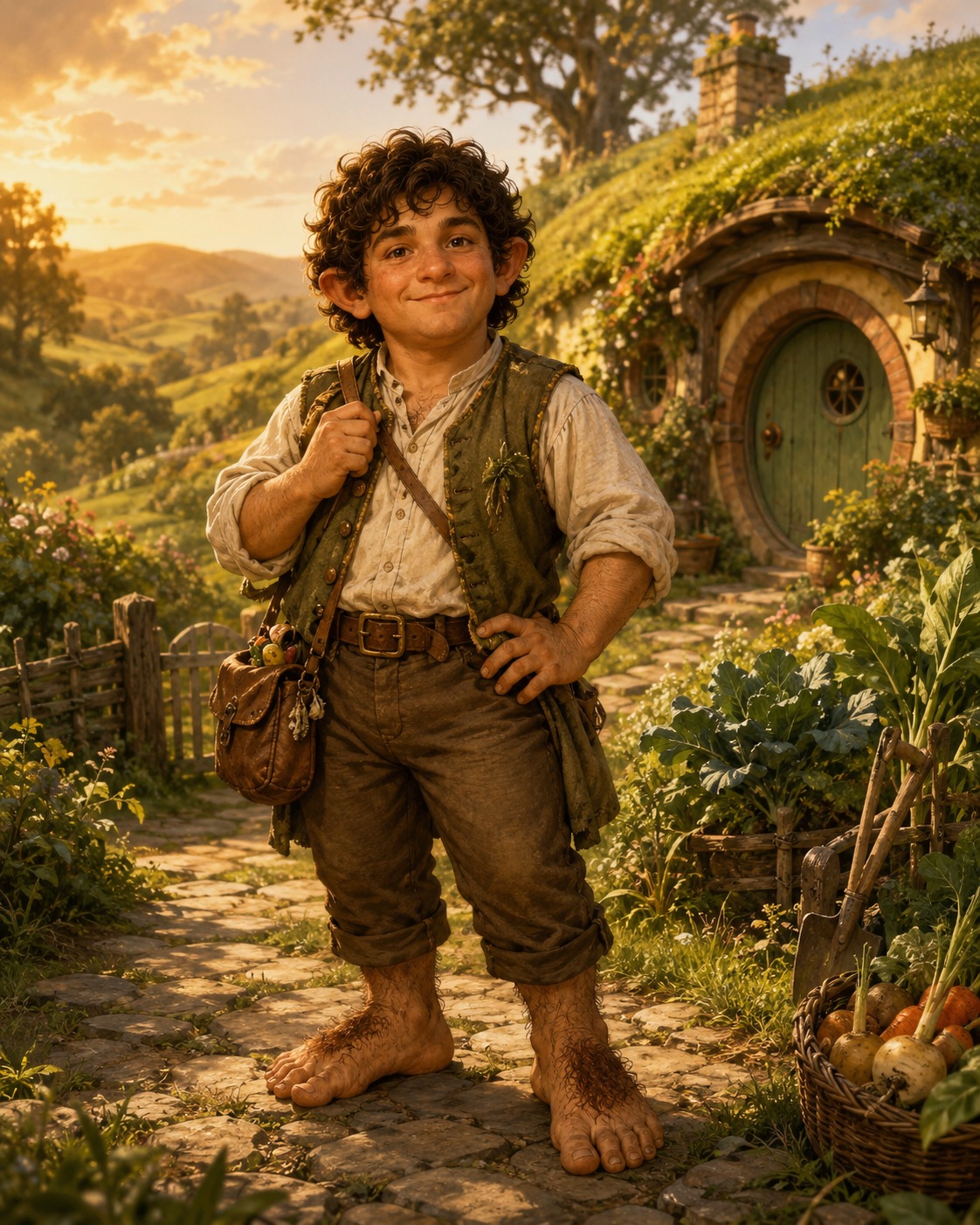
The halfling is the generic D&D name for J.R.R. Tolkien's hobbit, the small humanoid race introduced in 'The Hobbit, or There and Back Again' (George Allen & Unwin, London, 21 September 1937) and 'The Lord of the Rings' (1954-55). The word 'Halfling' itself is Tolkien's own term — in Appendix F of 'The Lord of the Rings', he gives it as the common designation by which Men of Middle-earth called the hobbits, derived from Old English 'half + -ling' ('one half-grown'). After Saul Zaentz's Tolkien Enterprises filed a trademark claim against TSR in July 1977 over the use of 'Hobbit', 'Ent', 'Balrog', 'Mithril' and 'Nazgûl', the AD&D Player's Handbook (1977) renamed Gygax's 1974 'Hobbit' race 'Halfling', and the name has been canonical since. In the fifth-edition Player's Handbook (2014), halflings stand ninety to one hundred and five centimetres tall, weigh eighteen to twenty-two kilograms, and bear curly brown or fair foot-hair on large bare feet with thick leather soles, round faces, curly brown, fair or red hair and an average lifespan of one hundred and fifty years. Their society is built on peaceful farming and herding communities, Shire-style chimney-houses and a famously elaborate seven-meal day (first breakfast, second breakfast, elevenses, luncheon, afternoon tea, dinner, supper). Fifth-edition racial traits are +2 Dexterity, Lucky (reroll natural 1s), Brave (advantage on fear saves) and Halfling Nimbleness (move through larger creatures' spaces), with the two canonical subraces Lightfoot (+1 Charisma, stealth advantage) and Stout (+1 Constitution, poison resistance). The same iconography is visible in the Halfling counties of Warhammer Fantasy (Games Workshop, from 1986) and is locked into modern popular imagination by Peter Jackson's 'Lord of the Rings' trilogy (2001-2003) and 'Hobbit' trilogy (2012-2014).
Origin
The direct source is J.R.R. Tolkien's 'The Hobbit' (George Allen & Unwin, London, 21 September 1937) and 'The Lord of the Rings' (1954-55), Appendix F, the latter explicitly using 'Halfling' as the general appellation by which Men of Middle-earth called the hobbits. Tolkien himself in a 1971 BBC interview and a 1968 'Diplomat' magazine interview acknowledged that the hobbits were inspired by the North Midlands rural farmers of his Warwickshire upbringing. The 1974 TSR Dungeons & Dragons original boxed set introduced the race under the name 'Hobbit', but after Saul Zaentz's Tolkien Enterprises filed a trademark claim in July 1977 over the use of 'Hobbit', 'Ent', 'Balrog', 'Mithril' and 'Nazgûl', the 1977 AD&D Player's Handbook renamed the race 'Halfling' (case settled out of court as 'Tolkien Estate v. TSR Inc.', July 1977). The rename has been carried unchanged through 'Forgotten Realms Adventures' (1989), 'Player's Option: Skills & Powers' (1995) and the fifth-edition Player's Handbook (2014); the latter adds the Ghostwise Halfling (Sword Coast Adventurer's Guide, 2014) and the Lotusden Halfling (Explorer's Guide to Wildemount, 2020) to the canonical Lightfoot and Stout subraces.
Features
- Ninety to one hundred and five centimetres tall, eighteen to twenty-two kilograms
- Curly foot-hair on large bare feet with thick leather soles — never wears shoes
- Round face, curly brown, fair or red hair, average lifespan one hundred and fifty years
- Peaceful farming and herding communities, Shire-style chimney-houses
- Fifth-edition +2 Dexterity, Lucky, Brave and Halfling Nimbleness
- Two canonical subraces — Lightfoot (+1 Charisma, stealth) and Stout (+1 Constitution, poison resistance)
Stories
The canonical race for rogue, bard and survival-specialist character classes in tabletop role-playing games, where their peace-loving philosophy makes them the textbook subject of the 'the smallest one carries the great burden' heroic arc — Bilbo's Lonely Mountain quest, Frodo's Ring-bearing mission. The same iconography is recycled in the Halfling counties of Warhammer Fantasy (Games Workshop, from 1986), in the visually divergent Gnome race of Blizzard's 'World of Warcraft' (from 2004), and most powerfully in Peter Jackson's 'Lord of the Rings' (2001-2003) and 'Hobbit' (2012-2014) trilogies, in which Elijah Wood, Sean Astin, Ian Holm and Martin Freeman gave the modern Halfling its visual canon.
Weakness
Small stature and modest strength leave halflings at a disadvantage in open melee against larger races, and their comfort-loving outlook — the 'hobbit instinct' that resists adventure and change — means it takes time before they step forward in a crisis. Fifth-edition rules do not impose a strength penalty, but the racial profile assumes an average strength of eight to twelve. Bilbo's first adventure at the age of fifty in 'The Hobbit' and Frodo's at fifty in 'The Lord of the Rings' are emblematic of this late awakening.
Cultural Significance
The figure is Tolkien's idealisation of the North Midlands rural farmer of his Warwickshire childhood — the love of peaceful farming, rich food culture and a snug home — which through D&D became the archetype of the 'small ordinary hero' in English-language fantasy. The twenty-first-century iconography is fixed by Peter Jackson's two trilogies; the costume, the foot-hair and the silhouette of Frodo and Bilbo have become the universal visual canon.
In Popular Culture
Bilbo Baggins in J.R.R. Tolkien's 'The Hobbit' (1937), Frodo, Sam, Merry and Pippin in 'The Lord of the Rings' (1954-55), the introduction of 'Halfling' in the AD&D Player's Handbook (1977), 'Forgotten Realms Adventures' (1989), the fifth-edition Player's Handbook (2014), the Ghostwise Halfling of the Sword Coast Adventurer's Guide (2014), the Lotusden Halfling of the Explorer's Guide to Wildemount (2020), the Halfling counties of Warhammer Fantasy (Games Workshop, from 1986) and Peter Jackson's 'Lord of the Rings' (2001-2003) and 'Hobbit' (2012-2014) trilogies.
Trivia
Saul Zaentz's Tolkien Enterprises, which held the 1969 Tolkien film rights, filed a trademark claim against TSR in July 1977 over the use of 'Hobbit', 'Ent', 'Balrog', 'Mithril' and 'Nazgûl'; TSR settled by renaming 'Hobbit' to 'Halfling', 'Ent' to 'Treant' and 'Balrog' to 'Type VI Demon' (later 'Balor') in the 1977 AD&D Monster Manual. This is the best-known trademark-driven rename in the history of D&D race nomenclature.