Fishfolk
Fishfolk · The Deep-Sea Fish People — Wild Tribes of the Abyss
Names in Other Languages
 어인한국어
어인한국어Fishfolk · 심해 어인 — 깊은 바다의 야성적 부족
 魚人日本語
魚人日本語Fishfolk · 深海魚人 — 深い海の野性的部族
 魚人繁體中文
Fishfolk · 深海魚人 — 深海的野性部族
 FischvolkDeutsch
Fishfolk · Das Tiefsee-Fischvolk — Wilde Stämme des Abgrunds
 Hommes-poissonsFrançais
Fishfolk · Le peuple poisson des abysses — Tribus sauvages de l'abîme
 Hombres pezEspañol
Fishfolk · El pueblo pez de las profundidades — Tribus salvajes del abismo
 Povo peixePortuguês
Fishfolk · O povo peixe das profundezas — Tribos selvagens do abismo
 RyboludPolski
Fishfolk · Głębinowy rybolud — dzikie plemiona otchłani
 РыболюдиРусский
Fishfolk · Глубоководный рыбий народ — дикие племена бездны
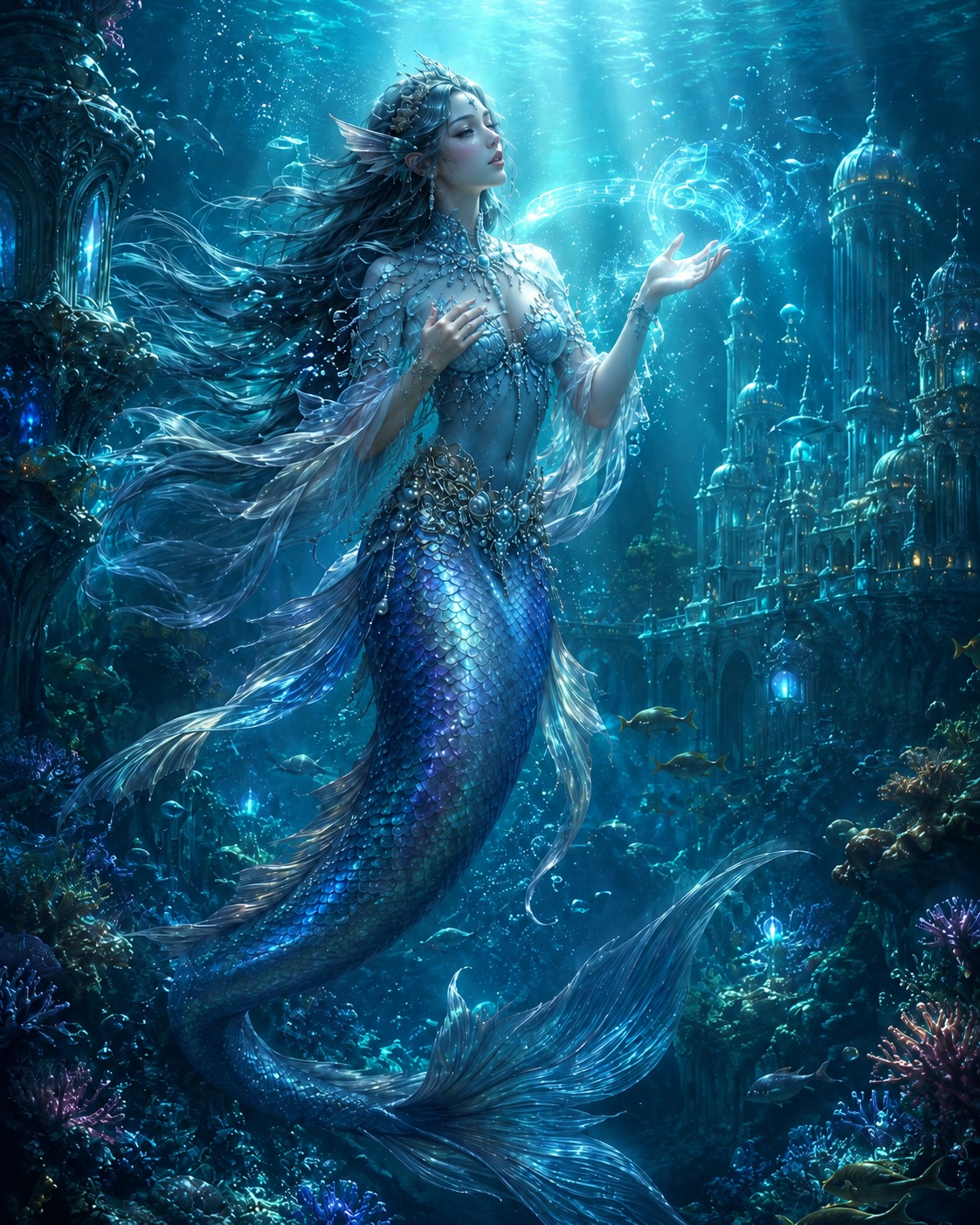
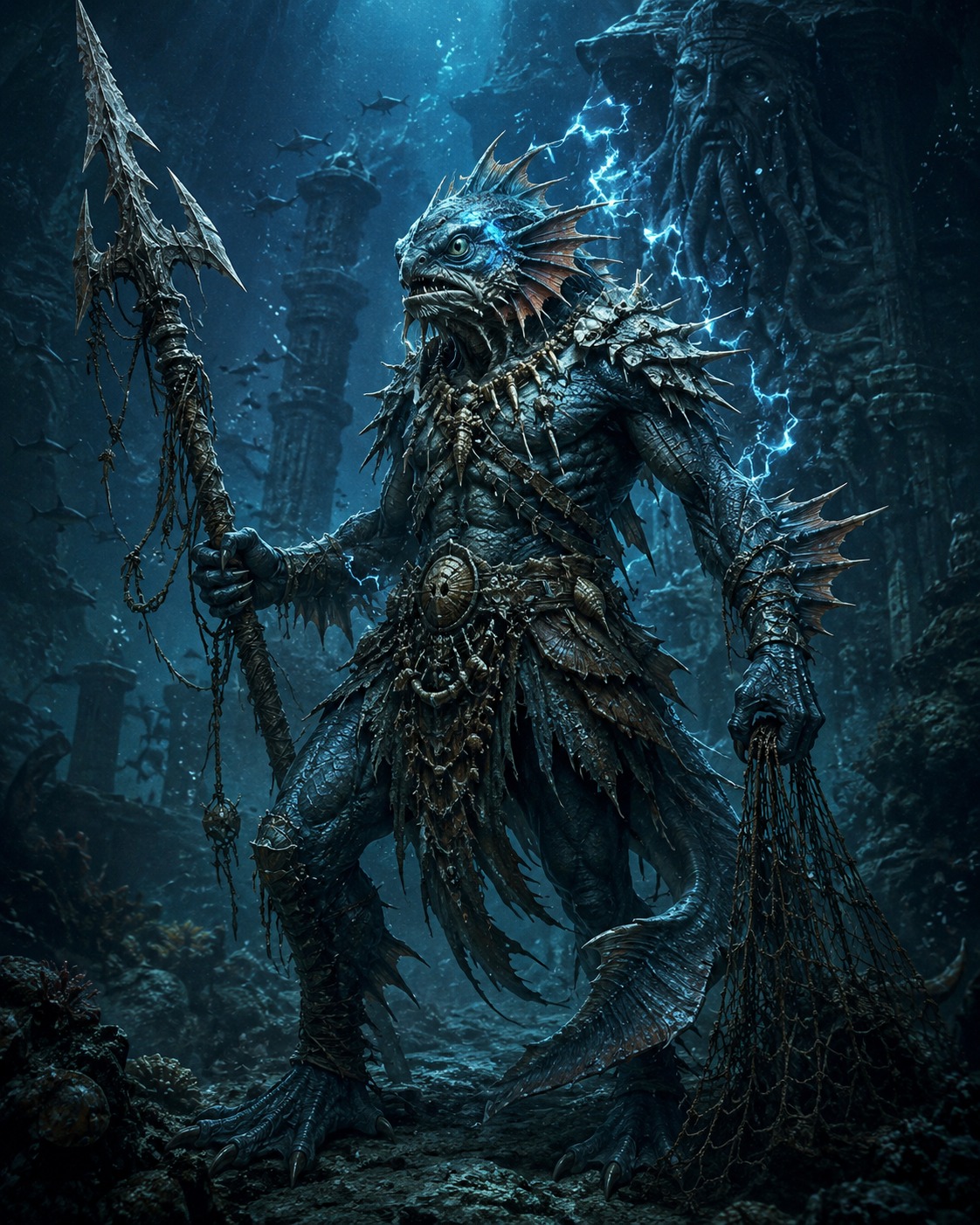
A people of scaled bodies, fins, and gills, more savage and warlike than the elegant merfolk, who hold tribes in lightless trenches and sunken cities. They arm themselves with tridents, harpoons, and abyssal magic and worship ancient gods of storm and tide. The figure descends from the Semitic fish-god Dagon (Ugaritic tablets from Ras Shamra, c. 14th century BCE), was refigured by H. P. Lovecraft's Deep Ones in The Shadow over Innsmouth (Visionary Publishing, 1936), and was given its modern visual canon by the film Creature from the Black Lagoon (Universal Pictures, 1954); Dungeons & Dragons split it into the Sahuagin and the Kuo-toa in the Greyhawk supplement (TSR, 1975) and the Monster Manual (TSR, 1977).
Origin
The religious source of the fishfolk is the Semitic fish-god Dagan or Dagon, first attested as a god of grain and fertility in the Ugaritic tablets of Ras Shamra (near Latakia, Syria, c. 1400 BCE, now in the Louvre and the National Museum of Damascus). Dagon was the chief god of the Philistine cities Ashdod and Gaza, and in 1 Samuel 5:1-7 his statue falls before the Ark of Yahweh, leaving only its hands and head intact. The Renaissance scholar Pierre-Daniel Huet, in his Demonstratio evangelica (Paris, 1700), conjectured that Dagon was a fish-tailed man-god — an iconographic error that took hold in nineteenth-century English scholarship. H. P. Lovecraft's short story Dagon (The Vagrant, November 1919) and his novella The Shadow over Innsmouth (Visionary Publishing, Everett, PA, 1936) crystallised the Deep Ones, a hybrid sea-people of the Massachusetts coast that worship Father Dagon, Mother Hydra, and the dreaming Cthulhu. August Derleth's expansions of the Cthulhu Mythos through Arkham House (from 1939) hardened the canon, and Jack Arnold's film Creature from the Black Lagoon (Universal Pictures, 1954) provided the modern visual vocabulary — scaled skin, gills, webbed feet, clawed hands. Gary Gygax in Dungeons & Dragons Supplement I: Greyhawk (TSR, 1975) and Supplement II: Blackmoor introduced the Sahuagin and the Kuo-toa, and the Advanced Dungeons & Dragons Monster Manual (TSR, 1977) called the Sahuagin 'Sea Devils' — fierce hunters — while the Kuo-toa became the canonical mad-priest fishfolk of the Underdark.
Features
- Scaled skin in greens, greys, purples, or black, with dorsal fins and webbed feet
- Gills along the neck combined with lungs, allowing both aquatic and terrestrial breathing (though drying weakens them)
- Tribes in deep trenches, sunken cities, or underdark lakes: Sahuagin coral palaces, Kuo-toa lake-temples, the deep towns of Lovecraft's Y'ha-nthlei
- Trident, harpoon, net, and abyssal magic of pressure and darkvision
- Ancient fish-gods: Dagon and Mother Hydra (Lovecraft), Sekolah the shark-god (Sahuagin), Blibdoolpoolp the lobster-goddess (Kuo-toa)
Stories
Fishfolk appear as the menace of the deep, the savage raiders of coastal villages, and the isolated relic of an older world. Lovecraft's Innsmouth, in The Shadow over Innsmouth, tells the tragedy of a town whose human-Deep One hybrids transform across generations into fishfolk, a story long read by critics as a metaphor of outsider anxiety and racial fear. The fifth-edition D&D Sahuagin remain the great hazard of the open sea and were promoted to a player race in Volo's Guide to Monsters (2016). Guillermo del Toro's The Shape of Water (Fox Searchlight, 2017) canonised the fish-man as the Academy-Award-winning Asset, and Magic: The Gathering uses the Locathah and Cephalid tribes for the same niche on the card table.
Weakness
Drying is the great weakness — when their skin loses moisture, breath and movement both fail, and the fifth-edition D&D Sahuagin lose half their actions if they go a full day without immersion (Monster Manual 2014, p. 263). They are closed and warlike, and the manic devotion to Dagon, Sekolah, or Blibdoolpoolp blocks rational alliance. Direct sunlight dulls Kuo-toa vision, and pack-dependence makes Deep Ones psychologically vulnerable when separated from the community. Above all, the 'Innsmouth look' motif — that human-fishfolk hybrid children gradually become fishfolk in adulthood — erodes the basis of trust with land allies.
Cultural Significance
The fishfolk tradition runs from Semitic fish-religion through a nineteenth-century scholarly error (the fish-tailed Dagon) to H. P. Lovecraft's early-twentieth-century cosmic horror. Lovecraft modelled Innsmouth on his visits to Marblehead in 1923 and Newburyport in July 1927; his diary, now in the John Hay Library at Brown University, describes the latter as 'a town where decay has stopped time'. Critics, most influentially Donald R. Burleson in H. P. Lovecraft: A Critical Study (Greenwood Press, 1983) and S. T. Joshi in I Am Providence: The Life and Times of H. P. Lovecraft (Hippocampus Press, 2010), have read the Deep Ones as the projection of Lovecraft's nativist and racial fears. Twenty-first-century writers have answered that legacy from a Black American vantage: Victor LaValle in The Ballad of Black Tom (Tor.com, 2016) and Matt Ruff in Lovecraft Country (HarperCollins, 2016, adapted by HBO in 2020) rewrite the Innsmouth motif from outside the original racial framing. In Japan, Hayao Miyazaki's Ponyo (Studio Ghibli, 2008) recasts the fishfolk archetype as a children's fairy tale.
In Popular Culture
- Ugaritic Ras Shamra tablets (c. 1400 BCE, Syria) — earliest direct attestation of Dagon
- 1 Samuel 5:1-7 (compiled c. 6th century BCE) — fall of the Dagon statue at Ashdod
- Pierre-Daniel Huet, Demonstratio evangelica (Paris, 1700) — conjectures a fish-tailed Dagon
- H. P. Lovecraft, Dagon (The Vagrant, November 1919) and The Shadow over Innsmouth (Visionary Publishing, 1936) — Deep Ones
- Jack Arnold (dir.), Creature from the Black Lagoon (Universal Pictures, 1954) — modern visual canon
- Gary Gygax, Dungeons & Dragons Supplement I: Greyhawk (TSR, 1975) and Advanced Dungeons & Dragons Monster Manual (TSR, 1977) — Sahuagin and Kuo-toa
- Wizards of the Coast, Volo's Guide to Monsters (2016) — Sahuagin as a player race
- Guillermo del Toro (dir.), The Shape of Water (Fox Searchlight, 2017) — Academy Award winner
- Victor LaValle, The Ballad of Black Tom (Tor.com, 2016) and Matt Ruff, Lovecraft Country (HarperCollins, 2016) — Black-American reinterpretations
- Hayao Miyazaki (dir.), Ponyo (Studio Ghibli, 2008) — children's reinterpretation of the fishfolk
Trivia
- Israeli archaeologist Moshe Dothan's excavations at Ashdod from 1962 (Area G) uncovered a late Bronze Age temple identified with the Philistine Dagon cult, but no fish-tailed iconography of the god, confirming that the 'fish-tailed Dagon' is an artefact of Pierre-Daniel Huet's 1700 misreading.
- Lovecraft's manuscript diary at the John Hay Library, Brown University, includes a July 1927 entry from Newburyport describing 'a town where decay has stopped time' — generally taken as the seed of Innsmouth.
- Gary Gygax recalled in a Dragon Magazine interview in 1990 (issue 158) that he chose the name Sahuagin specifically because the syllable break 'sa-hu-AH-gin' would be hard to pronounce.
- Designer Mike Hill, in a Toronto International Film Festival interview with Guillermo del Toro in 2017, said the look of the Asset in The Shape of Water was inspired by an alleged 1933 squid-man specimen from the Moroccan coast — later identified as a fake — in the British Museum archives.