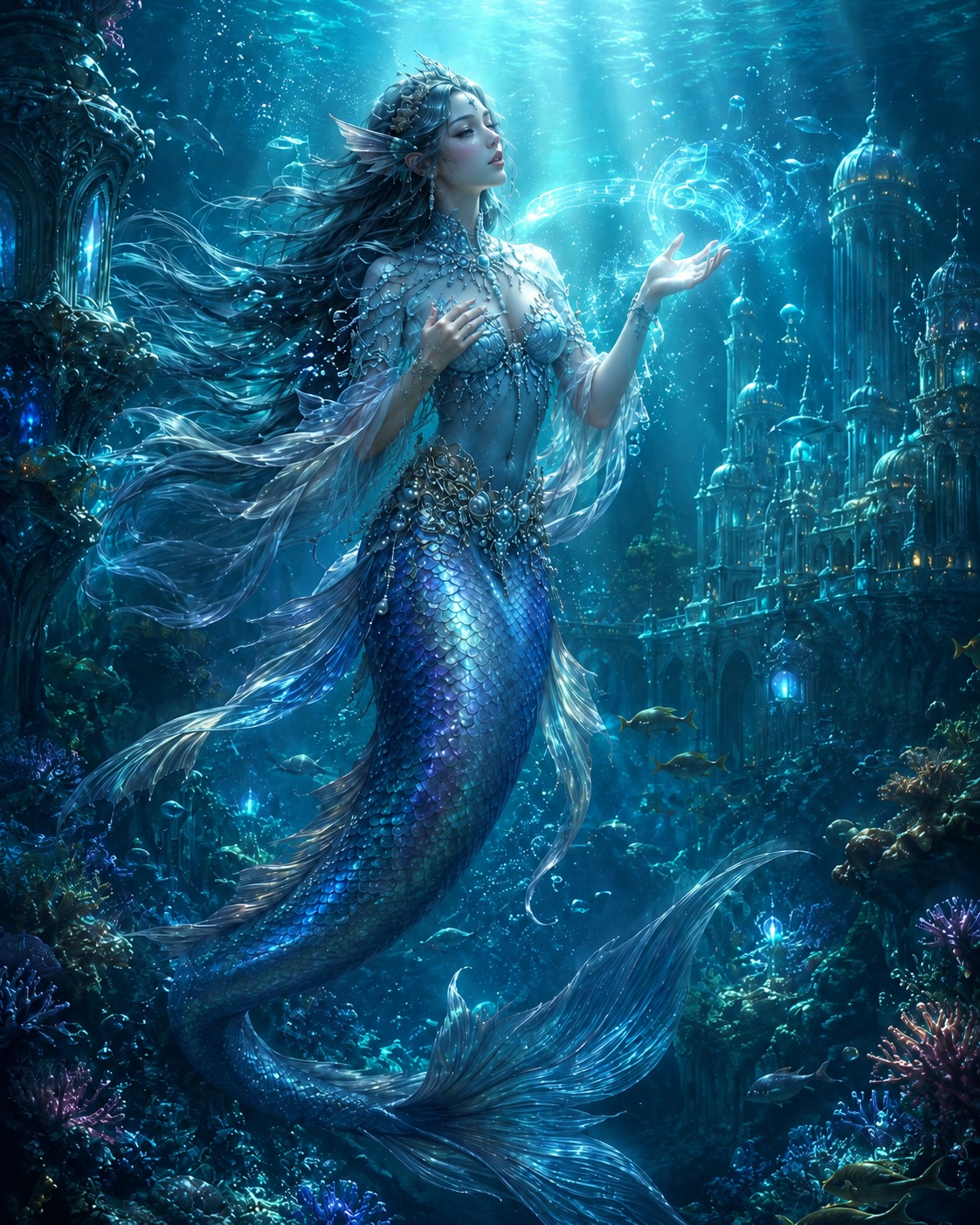
Merfolk
Merfolk · The Sea People — Human Above, Fish Below
Names in Other Languages
 인어한국어
인어한국어Merfolk · 인어족 — 상반신은 사람, 하반신은 물고기인 바다 종족
 人魚日本語
人魚日本語Merfolk · 人魚族 — 上半身は人、下半身は魚の海の種族
 人魚繁體中文
Merfolk · 人魚族 — 上半身為人、下半身為魚的海洋種族
 MeervolkDeutsch
Merfolk · Das Meervolk — Oben Mensch, unten Fisch
 Peuple marinFrançais
Merfolk · Le peuple de la mer — Humain en haut, poisson en bas
 Pueblo marinoEspañol
Merfolk · El pueblo del mar — Humano arriba, pez abajo
 Povo do marPortuguês
Merfolk · O povo do mar — Humano acima, peixe abaixo
 Lud morzaPolski
Merfolk · Lud morza — człowiek u góry, ryba u dołu
 Морской народРусский
Merfolk · Морской народ — человек сверху, рыба снизу
A sea-people with human upper bodies and fishlike tails, raising kingdoms in deep waters or among coral cities, gifted with enchanting song, oceanic magic, and the ability to breathe and move freely beneath the waves. The figure is the crystallisation of a worldwide aquatic-human tradition that runs from the Mesopotamian fish-god Oannes (Berossus' Babyloniaca, 3rd century BCE) through Greek Tritons and Nereids, Japanese ningyo (Nihon Shoki, 720 CE), and Hans Christian Andersen's Den lille Havfrue (C. A. Reitzel, Copenhagen, 1837), down to the modern fantasy roster fixed by Dungeons & Dragons in 1975-77.
Origin
The earliest direct attestation is Oannes, the man-fish who, according to the Hellenistic Babylonian priest Berossus in Babyloniaca (c. 290 BCE, surviving in fragments), rose daily from the Persian Gulf to teach humanity writing and agriculture, returning to the sea at sunset; seventh-century BCE Assyrian reliefs from Nineveh already depict apkallu fish-men. In Greek tradition Triton, son of Poseidon and Amphitrite, appears in Homer's Iliad book 18 alongside the fifty Nereids, while the Sirens, originally bird-women in Homer's Odyssey book 12, were gradually re-imagined as fishtailed in the medieval Latin Physiologus (2nd-4th century) and the bestiaries of the ninth through twelfth centuries. The Nihon Shoki entry for the twenty-seventh year of Empress Suiko (720 CE) records ningyo caught on the coasts of Omi and Settsu. Hans Christian Andersen's Den lille Havfrue, published in Eventyr, fortalte for Born vol. 1 no. 3 (C. A. Reitzel, Copenhagen, 1837), fixed the modern merfolk story of self-sacrifice and the longing for an immortal soul, and the Disney animated film The Little Mermaid (1989) made that image canonical. Gary Gygax introduced 'merfolk' as a standard race in the Dungeons & Dragons Greyhawk supplement (TSR, 1975) and the Monster Manual (TSR, 1977).
Features
- Human torso joined to a fish tail, usually single but sometimes twin in older art
- Enchanting song and illusion magic alongside command of ocean elements
- Underwater respiration, swimming speeds described at thirty to forty knots, pressure tolerance
- Cities in trenches, reefs, and undersea caverns: Triton's palace, Andersen's sea-king's hall, D&D Olynth, Magic: The Gathering's Atlantean realms
- Their own aquatic tongues, classically Old Greek-derived or in D&D the Aquan dialect
Stories
In antiquity merfolk were givers of civilisation (Oannes) or numinous inhabitants of the sea (the Nereids); in medieval bestiaries they served as moral symbols of vanity and temptation. After Andersen, nineteenth- and twentieth-century literature turned them into tragic voices for the gulf between the sea and humankind, the cost of love, and the question of the soul. Since Disney's 1989 film the image is broadly popular, and Dungeons & Dragons, Magic: The Gathering, and Final Fantasy treat merfolk as the standard race of an undersea kingdom and as guides or companions in submarine adventures. The older predatory mode — Homer's Sirens luring sailors to wreck — survives in horror and dark-fantasy variants.
Weakness
Out of water, merfolk weaken in breath and movement, and the bargain for legs in Andersen's tale exacts both excruciating pain at every step and the loss of voice. The gulf with land peoples produces social, reproductive, and cultural isolation, and the very song, beauty, and scales that make them remarkable make them targets for human hunters and alchemists. From the Nihon Shoki onward, catching or eating merfolk is widely treated as an ill omen across both Eastern and Western traditions.
Cultural Significance
After the industrial revolution the mermaid became a favoured Victorian subject for sea, woman, and otherness, exemplified by John William Waterhouse's A Mermaid (1900, Royal Academy of Arts, London). The Japanese legend of Yao Bikuni, a nun who lived eight hundred years after eating ningyo flesh, is commemorated at Kuin-ji temple in Obama, Fukui Prefecture. Andersen, in a letter to Henriette Hanck in 1836, explained that Den lille Havfrue mirrored his unrequited love for Edvard Collin, linking the self-sacrifice motif to his own identity. The Disney 1989 ending, which replaces Andersen's tragic dissolution into sea foam with a wedding, has been argued over ever since.
In Popular Culture
- Berossus, Babyloniaca (c. 290 BCE, fragmentary) — Oannes
- Homer, Iliad book 18 and Hesiod, Theogony 240-264 — Triton, the fifty Nereids
- Physiologus (2nd-4th c. Greek) and medieval Latin bestiaries — mermaid as moral emblem
- Nihon Shoki (720 CE), entry for year 27 of Empress Suiko — ningyo on the coasts of Omi and Settsu
- Hans Christian Andersen, Den lille Havfrue in Eventyr, fortalte for Born (C. A. Reitzel, Copenhagen, 1837)
- L. Frank Baum, The Sea Fairies (Reilly & Britton, Chicago, 1911)
- Gary Gygax, Dungeons & Dragons Supplement I: Greyhawk (TSR, 1975) and Monster Manual (TSR, 1977)
- Walt Disney Pictures, The Little Mermaid (dir. Ron Clements and John Musker, 1989)
- Wizards of the Coast, Magic: The Gathering Alpha (1993), Lorwyn (2007), and Ixalan (2017) — Merfolk tribe
Trivia
- Berossus' Greek 'Oannes' transliterates the Sumerian Uan / Adapa, named in cuneiform tablets dating back to around 1900 BCE.
- Homer's Odyssey book 12 gives no physical description of the Sirens beyond their voice; the fishtailed Siren is first explicit in the seventh-century Latin Liber Monstrorum.
- The closing turn of Andersen's story, in which the mermaid earns a soul by three hundred years' service, was added after the 1837 draft because of religious sensitivities Andersen anticipated.
- The Little Mermaid statue in Copenhagen harbour (Edvard Eriksen, 1913) uses the face of the ballerina Ellen Price, who declined to pose nude, and the body of Eriksen's wife Eline.