Firbolg
Firbolg · The Gentle Giant — A Reclusive Race of Giant Lineage Hidden in Forests
Names in Other Languages
 피르볼그한국어
Firbolg · 온화한 거인 — 숲에 은둔하는 거인 혈통의 종족
 フィルボルグ日本語
Firbolg · 温和な巨人 — 森に隠棲する巨人血統の種族
 菲爾博格繁體中文
Firbolg · 溫和巨人 — 隱居森林之巨人血統種族
 FirbolgDeutsch
Firbolg · Der sanfte Riese — Eine zurückgezogene Rasse von Riesenblut, in Wäldern verborgen
 FirbolgFrançais
Firbolg · Le doux géant — Une race recluse au sang de géant, cachée dans les forêts
 FirbolgEspañol
Firbolg · El gigante apacible — Una raza reclusa de linaje gigante oculta en los bosques
 FirbolgPortuguês
Firbolg · O gigante gentil — Uma raça reclusa de linhagem gigante oculta nas florestas
 FirbolgPolski
Firbolg · Łagodny olbrzym — odosobniona rasa olbrzymiego rodu ukryta w lasach
 ФирболгРусский
Firbolg · Кроткий великан — затворническая раса великаньего рода, сокрытая в лесах
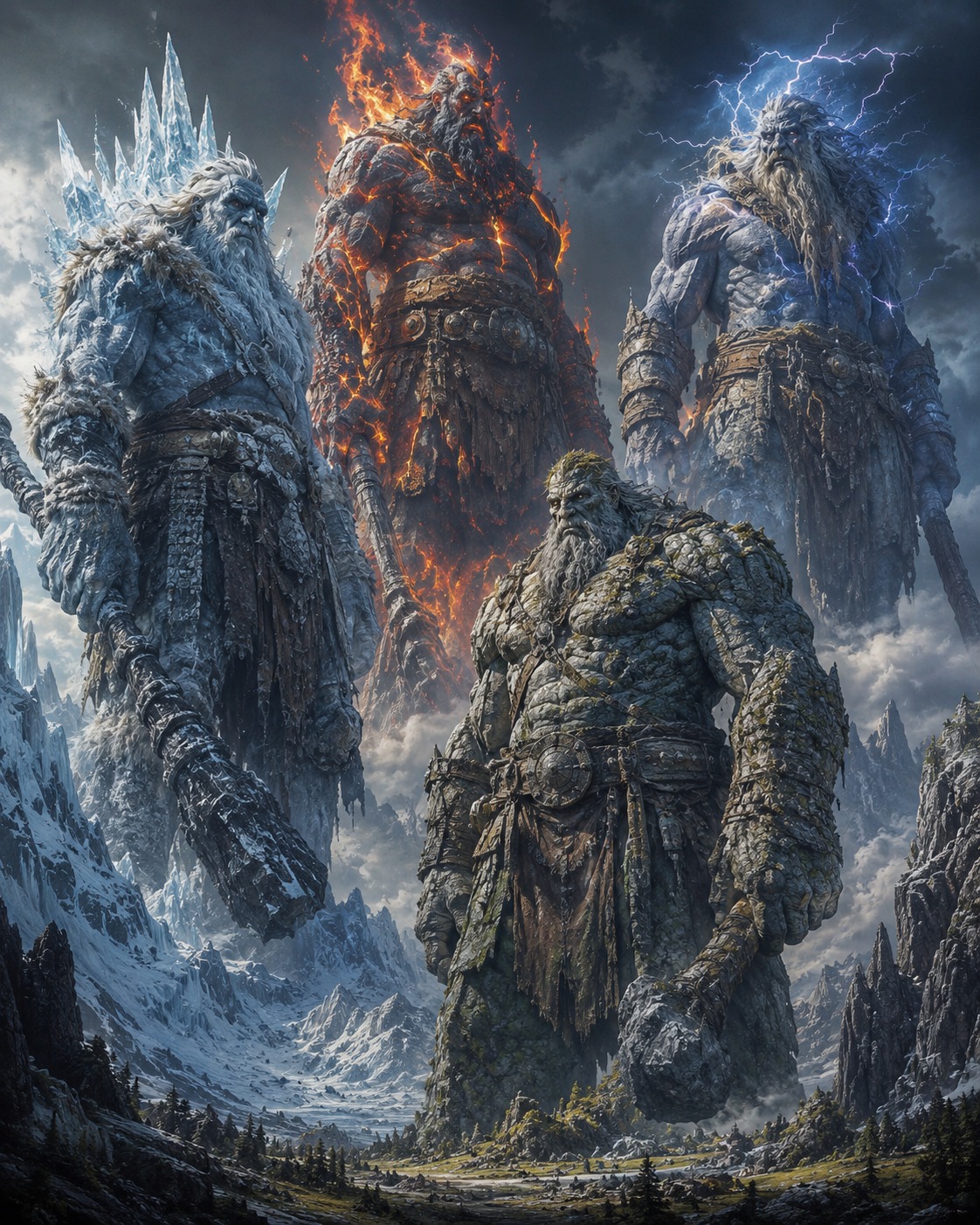
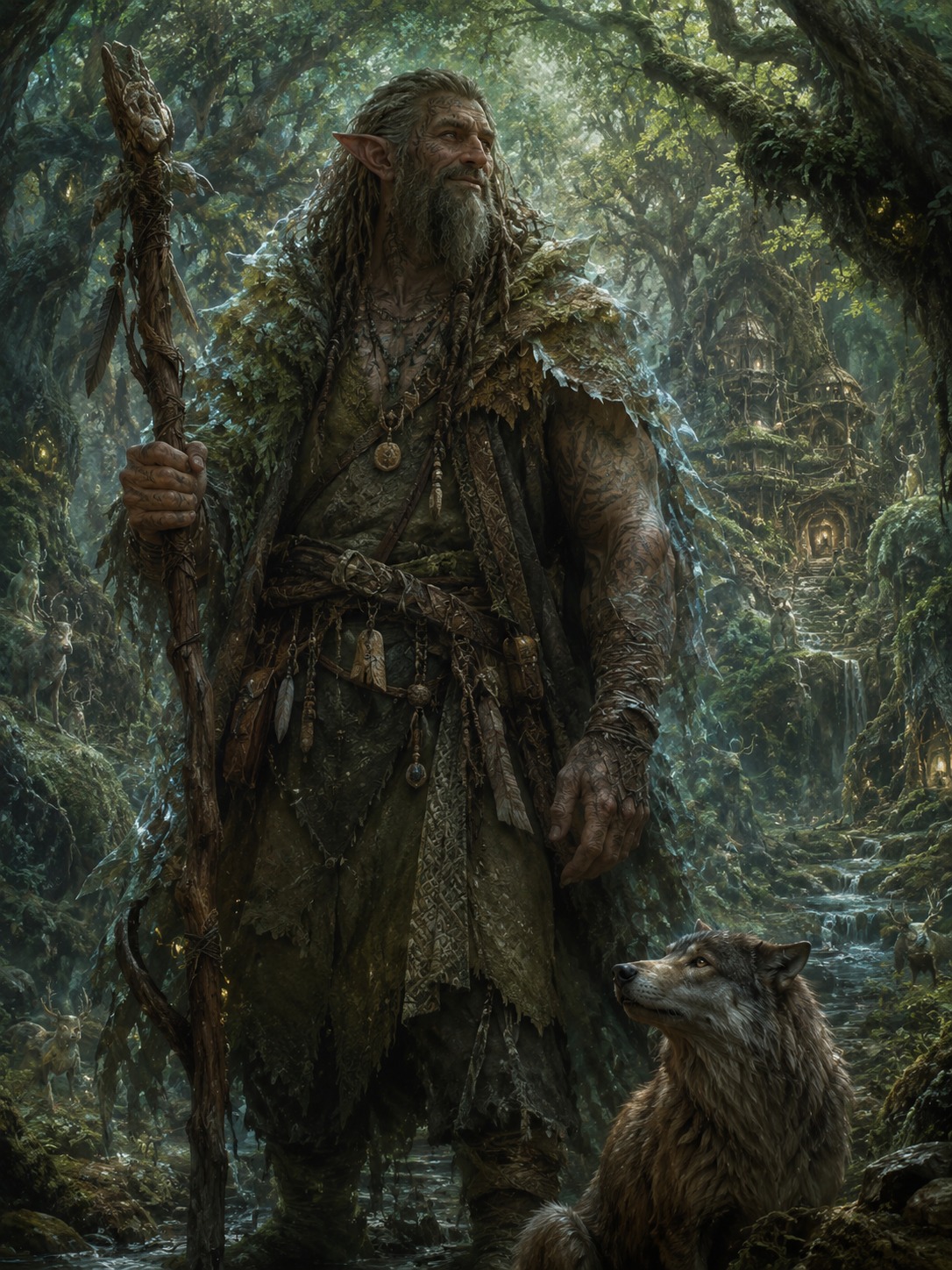
A giant-blooded but mild and retiring people who tend the deep forests, who tower over humans but never raise a hand in war, and who speak with beasts and spirits and hide themselves and their hamlets in illusions. The name comes from the Fir Bolg, the fifth invader tribe of Lebor Gabala Erenn (eleventh-century Ireland); but the modern fantasy firbolg is the work of Gary Gygax in Advanced Dungeons & Dragons Monster Manual II (TSR, 1983) and of Mike Mearls and Jeremy Crawford in Volo's Guide to Monsters (Wizards of the Coast, 2016), with Critical Role's Caduceus Clay in The Mighty Nein (2018-2021) fixing the modern popular image.
Origin
The Fir Bolg of Irish mythology — etymologically 'men of the sacks', after a tradition that they had been enslaved Greeks in Thrace who escaped to Ireland in boats of stitched hides — are the fifth invader tribe in Lebor Gabala Erenn (Book of the Taking of Ireland, compiled in the eleventh century; the oldest surviving manuscript is the Book of Leinster, c. 1150, Trinity College Dublin MS H 2.18). Geoffrey Keating retold them in Foras Feasa ar Eirinn (c. 1634). They were defeated by the Tuatha De Danann at the First Battle of Mag Tuired and pushed into Connacht in the west, where later rural tradition mythologised them as a race of giants. The Dungeons & Dragons firbolg, however, is a creative borrowing of the name rather than a faithful adaptation. Gary Gygax introduced the firbolg in Advanced Dungeons & Dragons Monster Manual II (TSR, 1983) as the most human-like of the giants — about ten feet tall, with throwing-stones — and tied them to Celtic myth in Deities and Demigods (TSR, 1984). Mike Mearls and Jeremy Crawford then inverted that template in Volo's Guide to Monsters (Wizards of the Coast, 2016), recasting the firbolg as a peaceful forest-dwelling giant kin tuned to nature, and Wizards of the Coast updated them in Mordenkainen Presents: Monsters of the Multiverse (2022). Matthew Mercer's Caduceus Clay in Critical Role's Campaign 2: The Mighty Nein (2018-2021) — a firbolg cleric who tends his family's mossy graveyard and brews tea — gave the new template its mainstream identity.
Features
- Stature of seven to eight feet (2.1-2.5 m), bovine or deer-like elongated faces, pale blue-grey or moss-green skin
- Long hair and beards, with a presence that is at once wild and gentle
- In fifth-edition D&D, the Powerful Build feature (counted as one size larger for carrying and lifting) and innate illusion magic, including Disguise Self and Detect Magic
- Speech of Beast and Leaf — a one-way racial communion with animals and plants
- Small forest villages hidden by illusion, tea, herbs, and modest cultivation; a pacifist way of life
Stories
Firbolgs appear as the quiet guardians of nature, the hermit sages, and the giants who would rather lose ground than fight. They are a staple race for stories of strength reconciled with gentleness, harmony with the wild, and the wisdom of withdrawal. Caduceus Clay in Critical Role's Mighty Nein anchored the modern reading: a cleric of nature who returns the dead to the earth and runs the family graveyard as a sacred duty. In fifth-edition D&D firbolgs gravitate toward the druid, cleric, and ranger classes, and they sometimes use their illusion magic to slip through human cities disguised as oversized humans. The Magic: The Gathering forest-folk archetype shares family with the figure.
Weakness
Choosing seclusion leaves firbolgs slow to respond to threats from outside, and their pacifism makes open conflict difficult; the fifth-edition Hidden Step is a flight ability rather than an attack one. A hidden grove that is discovered no longer offers shelter — a structural fragility built into the way they live, as Caduceus Clay's backstory of an unprotected family graveyard makes clear. Their size and stag-like faces make them awkward in human society and slow to gain easy trust. Their deep pacifism, finally, gives them a moral problem with even defensive violence.
Cultural Significance
The firbolg is the canonical example of an Irish-mythological name borrowed by American tabletop gaming and reshaped into something quite different. The original Fir Bolg were defeated settlers, not peaceful forest giants; Mark Williams, in Ireland's Immortals (Princeton University Press, 2016), chapter 4, argues that this is one of many late-twentieth-century American repurposings of Celtic mythology. The 2016 Wizards of the Coast revision into peaceful giants sits in the wider environmental-fantasy turn of the late twentieth century (Hayao Miyazaki, Nausicaa of the Valley of the Wind, 1984; Ursula K. Le Guin, much of her ecological work from the 1970s). Matthew Mercer said in a 2018 Patreon interview that Caduceus Clay's grove was inspired by photographs of the cemetery at Okunoin on Mount Koya in Japan, a resonance with East Asian temple-forest aesthetics.
In Popular Culture
- Lebor Gabala Erenn (compiled 11th c.; oldest surviving manuscript Book of Leinster c. 1150, Trinity College Dublin MS H 2.18) — Irish Fir Bolg
- Geoffrey Keating, Foras Feasa ar Eirinn (c. 1634) — 'sacks-of-hide' tradition of the Fir Bolg
- Gary Gygax, Advanced Dungeons & Dragons Monster Manual II (TSR, 1983) — first appearance of the D&D firbolg
- Gary Gygax, Advanced Dungeons & Dragons Deities and Demigods (TSR, 1984), Celtic chapter — firbolgs and the Tuatha De Danann
- Mike Mearls and Jeremy Crawford et al., Volo's Guide to Monsters (Wizards of the Coast, 2016) — peaceful forest-giant rebuild and player race
- Matthew Mercer, Taliesin Jaffe and others, Critical Role Campaign 2: The Mighty Nein (2018-2021) — Caduceus Clay and Pumat Sol
- Wizards of the Coast, Mordenkainen Presents: Monsters of the Multiverse (2022) — firbolg trait revision
- Keith Baker, Eberron: Rising from the Last War (Wizards of the Coast, 2019) — Eberron firbolg variant
- Mark Williams, Ireland's Immortals (Princeton University Press, 2016) — critical study of Fir Bolg reuse in popular culture
- Larian Studios, Baldur's Gate 3 (2023) — multiple firbolg NPCs
Trivia
- The etymology of Fir Bolg is debated: Keating's 1634 Foras Feasa ar Eirinn took it as 'men of the sacks' (after the leather sacks they were said to have hauled in Thrace), while nineteenth-century philologists associated it with the continental Celtic tribal name Belgae.
- Gygax's 1983 firbolg in Monster Manual II was a five-plus-one-hit-die giant who threw stones at intruders; Mike Mearls told ENWorld in November 2016 that for Volo's Guide to Monsters he wanted to offer a giant-blooded player race 'who looked like a stag and not like a brawler'.
- Matthew Mercer said in a 2018 Critical Role Patreon Q-and-A that Caduceus Clay's Blooming Grove cemetery was inspired by photographs of the Okunoin cemetery on Mount Koya in Wakayama, Japan.
- Jeremy Crawford clarified on Twitter in 2017 that the fifth-edition firbolg's Speech of Beast and Leaf is a one-way emotional communication, not a two-way dialogue with animals and plants — a clarification often missed at the table.