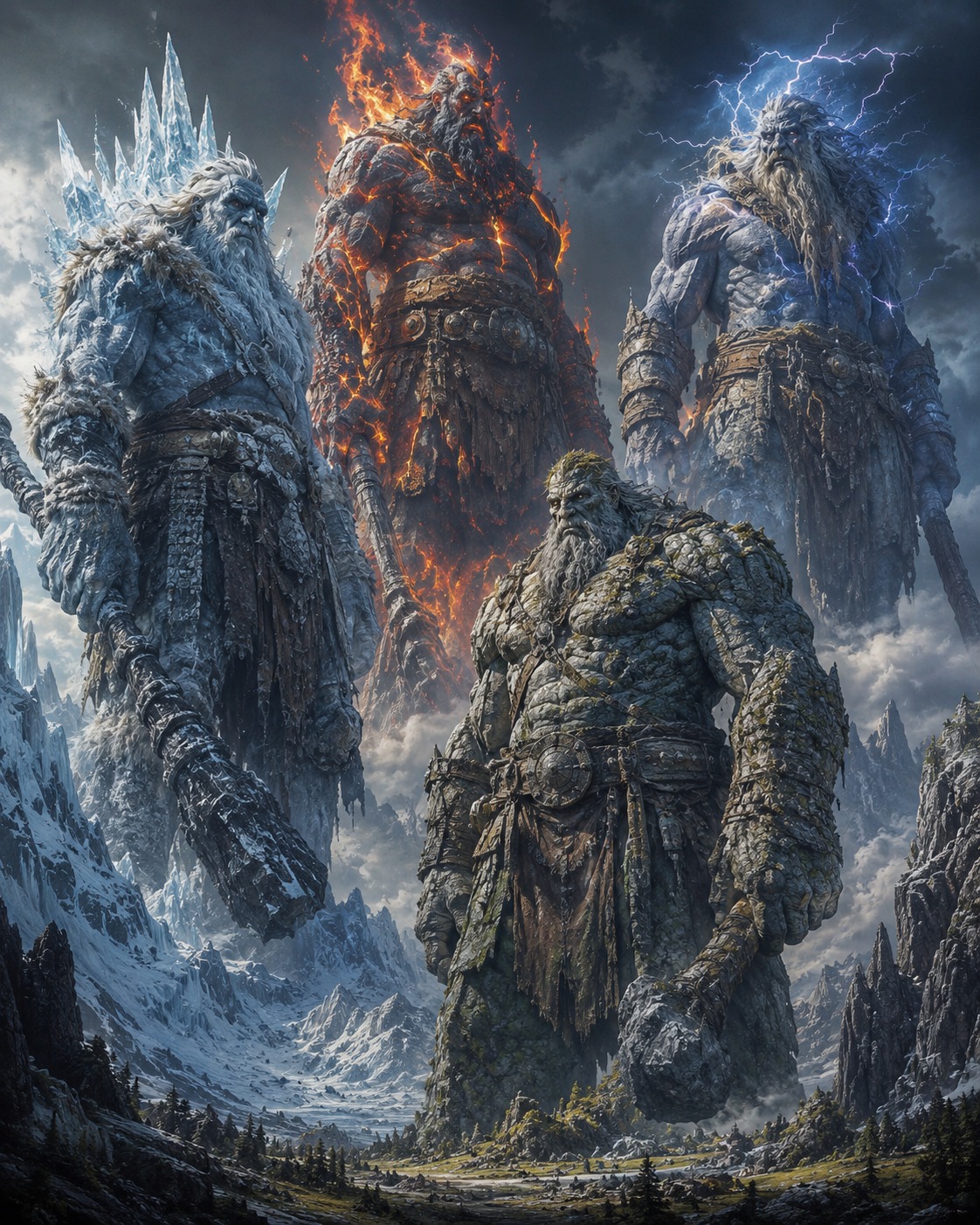
Giant-kin
Giant-kin · The Giant Race — Primal Titans Like Living Mountains
Names in Other Languages
 거인족한국어
Giant-kin · 거인 종족 — 산을 닮은 원시의 거대 종족
 巨人族日本語
Giant-kin · 巨人種族 — 山の如き原始の巨大種族
 巨人族繁體中文
Giant-kin · 巨人種族 — 宛如山岳的原始巨大種族
 RiesenvolkDeutsch
Giant-kin · Das Riesenvolk — Urzeitliche Titanen wie lebende Berge
 Peuple géantFrançais
Giant-kin · Le peuple géant — Titans primordiaux telles des montagnes vivantes
 Pueblo giganteEspañol
Giant-kin · El pueblo gigante — Titanes primigenios como montañas vivientes
 Povo gigantePortuguês
Giant-kin · O povo gigante — Titãs primordiais como montanhas vivas
 Lud olbrzymówPolski
Giant-kin · Lud olbrzymów — pradawni tytani niczym żywe góry
 Народ великановРусский
Giant-kin · Народ великанов — первозданные титаны, словно живые горы
A primal people of bodies that dwarf the human form, raising tribes in mountains, glaciers, and wastes and dividing along elemental lines — frost, fire, stone, storm, hill, and cloud. They wield overwhelming strength and live for centuries, the lingering remnants of a mythic age before human kingdoms. The oldest direct attestations are Hesiod's Gigantes and Titans in the Theogony (c. 700 BCE) and Snorri Sturluson's Jotnar in the Prose Edda (c. 1220 CE); Dungeons & Dragons' Monster Manual (TSR, 1977) fixed the six-elemental schema, and the fifth-edition adventure Storm King's Thunder (Wizards of the Coast, 2016) canonised the Ordning, the caste order among giants.
Origin
In Greek tradition the Gigantes are born when the blood of the castrated Uranus falls on Gaia, the Earth (Hesiod, Theogony lines 183-187), and they perish in the Gigantomachy against the Olympians; the Great Altar of Pergamon (c. 165 BCE, now at the Pergamon Museum in Berlin) preserves the largest surviving relief of that war. The Titans precede them, deposed by Zeus and his siblings in the Titanomachy of Theogony lines 617-735. In the Norse tradition, Snorri Sturluson's Prose Edda Gylfaginning chapters four to six tells how the primal Jotunn Ymir was born from the meeting of fire and frost, and how Odin and his brothers shaped the world from his slain body; the Codex Regius (c. 1270 CE), in Vafthruthnismal and Voluspa, distinguishes frost giants (hrimthursar), mountain giants (bergrisar), and the fire giants of Muspelheim, and tells that Surtr will lead them with a flaming sword at Ragnarok. Dungeons & Dragons crystallised the modern fantasy template in Gary Gygax's Advanced Dungeons & Dragons Monster Manual (TSR, 1977), which fixed six elemental subraces — hill, stone, frost, fire, cloud, and storm — and the fifth-edition adventure Storm King's Thunder (Christopher Perkins et al., Wizards of the Coast, 2016) arranged them into the Ordning caste hierarchy, descending from storm to hill.
Features
- Stature far beyond human scale — about five metres for hill giants and around eight for storm giants in fifth-edition D&D
- Six elemental branches: frost (cold immune), fire (fire immune), stone (camouflage and crushing blows), storm (lightning and weather), cloud (floating fortresses), and hill (raw strength and appetite)
- Long lives — average around six hundred years in fifth-edition D&D, storm giants more than fifteen hundred
- Tribal and clan societies, rune magic, and a giant tongue derived in D&D from Old Norse
- Mastery of elemental forces and of mythic treasures (Jotnar runes, the storm giants' weatherwork)
Stories
In Norse and Greek myth the giants are the primordial threat that the new gods must overcome to establish their order; Hesiod's Gigantomachy is the mythic charter of Olympian rule, and Snorri's Jotnar remain a chaos the Aesir must perpetually contain. Tolkien's stone-giants hurl rocks in chapter four of The Hobbit, and the cinema of The Lord of the Rings has used giant-figures to body forth the rage of mountain and storm. Modern fantasy reads them through the decay of the mythic age — Storm King Hekaton and his daughter Serissa in fifth-edition Storm King's Thunder, the Colossus of Akros in Magic: The Gathering's Theros set (2014), and the Jotnar of Santa Monica Studio's God of War (2018) all play on the collapse of an old order under a younger world.
Weakness
Mass and simplicity make the giants slow and easily outmanoeuvred; Hesiod's Gigantes fall to the heroes' traps one by one, and the Jotnar break repeatedly before Thor's hammer Mjolnir. Tribal feuds, dwindling numbers, and the receding mythic age are their structural doom — the Ordning of the fifth edition collapses into internal war when Storm King Hekaton vanishes. Their bulk turns against them in the human city, in confined warehouses, and against fliers with strong battle magic; and from Ragnarok onward the giant is the race fated to perish with the end of the world itself.
Cultural Significance
Giants carry two archetypal weights at once. They are the remnants of an older order, lingering after a younger civilisation has overtaken them — the figure of Beowulf's Grendel and the kin of Cain (c. 1000 CE manuscript, Cotton Vitellius A. xv, British Library) is the Germanic Christian crystallisation of that idea. They are also the personification of the magnitude and anger of nature itself: volcano, glacier, storm, avalanche. The Japanese Daidarabotchi, who is said to have heaped up Mount Fuji, shows that giant-as-landform-maker is an independent Eastern tradition. The most striking modern reinterpretation is Hajime Isayama's Attack on Titan (Kodansha, 2009-21), where the giants become an allegory for ethnic violence and state coercion.
In Popular Culture
- Hesiod, Theogony lines 183-187 and 617-735 (c. 700 BCE) — Gigantes, Titans, and the blood of Uranus
- Great Altar of Pergamon (c. 165 BCE, Pergamon Museum, Berlin) — relief of the Gigantomachy
- Snorri Sturluson, Prose Edda (c. 1220) — Gylfaginning chapters 4-6, Ymir and the kin of the Jotnar
- Codex Regius (GKS 2365 4to, c. 1270) — Vafthruthnismal, Voluspa, Surtr at Ragnarok
- Beowulf (composed eighth century, c. 1000 CE manuscript Cotton Vitellius A. xv, British Library) — Grendel's giant lineage
- J. R. R. Tolkien, The Hobbit (Allen & Unwin, 1937) chapter 4 — stone-giants hurling rocks in the storm
- Gary Gygax, Advanced Dungeons & Dragons Monster Manual (TSR, 1977) — the six elemental subraces
- Christopher Perkins et al., Storm King's Thunder (Wizards of the Coast, 2016) — the Ordning hierarchy
- Hajime Isayama, Attack on Titan (Kodansha, 2009-2021) — allegorical re-reading of the giant
- Santa Monica Studio, God of War (Sony, 2018) — the Jotnar of Jotunheim
Trivia
- Snorri's Ymir in Gylfaginning chapter 5 is etymologically cognate with the Indo-Iranian Yama / Yima — the first mortal in the Vedic Rigveda 10.13 — a parallel studied by Georges Dumezil in Mythes et dieux des Germains (1939).
- The Gigantos Alkyoneus, in the tradition preserved by Apollodorus, Library 1.6.1, could not die on his native soil; Herakles had to drag him off it before he could be killed.
- The Ordning of fifth-edition Storm King's Thunder, ranking storm above cloud, fire, frost, stone, and hill, was arranged that way because, as designer Christopher Perkins told ENWorld in 2016, 'mythic dignity and combat challenge happen to rise in the same order'.
- The line in Beowulf that traces Grendel's ancestry to Cain (lines 102-114) was, in J. R. R. Tolkien's 1936 Oxford lecture Beowulf: The Monsters and the Critics, taken as the moment where a Germanic pagan giant-tradition is absorbed into Christian cosmology by a self-conscious twelfth-century scribe.