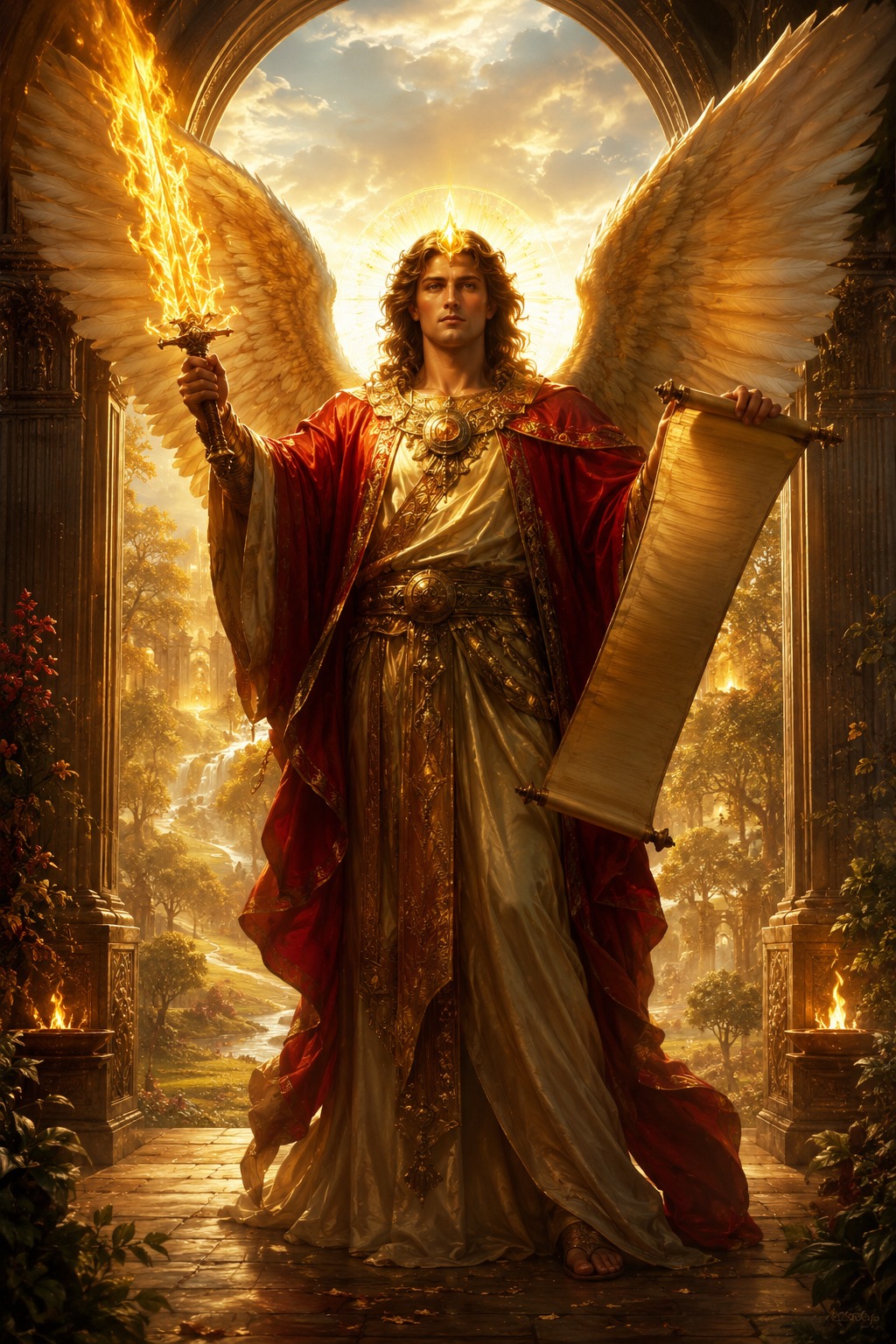
Uriel
Uriel · Archangel — Light of God, Angel of Wisdom and Repentance
Names in Other Languages
 우리엘한국어
Uriel · 대천사 — 신의 불빛, 지혜와 회개의 천사
 ウリエル日本語
Uriel · 大天使 — 神の光、知恵と悔悛の天使
 烏列爾繁體中文
Uriel · 大天使 — 神之光,智慧與悔改之天使
 UrielDeutsch
Uriel · Erzengel — Licht Gottes, Engel der Weisheit und Reue
 UrielFrançais
Uriel · Archange — Lumière de Dieu, ange de la sagesse et du repentir
 UrielEspañol
Uriel · Arcángel — Luz de Dios, ángel de la sabiduría y el arrepentimiento
 UrielPortuguês
Uriel · Arcanjo — Luz de Deus, anjo da sabedoria e do arrependimento
 UrielPolski
Uriel · Archanioł — Światło Boga, anioł mądrości i pokuty
 УриилРусский
Uriel · Архангел — Свет Божий, ангел мудрости и покаяния
Uriel (Hebrew Uri'el, Greek Ouriel, Latin Uriel, 'light of God') is the decisive canonical archangel of Jewish apocalyptic literature — apocrypha. The etymology is the decisive canonical vocabulary of the Hebrew compound of 'ur (light or flame)' and 'El (God)' — 'light of God' or 'fire of God'. The decisive textual canon is the apocryphal 1 Enoch (1 Enoch) 9:1, 10:1-8, 20:2, 21-22, and 33-36 of c. 3rd-1st century BCE — the decisive canon in which Uriel is one of the seven archangels or four archangels (Michael, Gabriel, Raphael, Uriel) — and the apocryphal 2 Esdras (2 Esdras, 4 Ezra) 4, 5, and 10 of c. 70-100 CE — the decisive canon in which Uriel taught Ezra (Ezra) the providence of God and the mysteries of the end of times. The decisive canonical iconography in which it was excluded from the Catholic canon at the Council of Rome (Council of Rome) of 745 but is considered the decisive canon in the Eastern Orthodox (Eastern Orthodox), Gnostic (Gnostic), and Christian-comparative traditions. The decisive canonical iconography of the angel holding a flaming sword or torch, the scroll of wisdom (scroll of wisdom), gold or crimson robes, and a shining flame on the forehead or hand.
Origin
The iconographic origin is the seven-archangel faith of the c. 3rd century BCE Hellenistic period Jewish apocalyptic literature — the decisive origin, and the decisive textual canon is the apocryphal 1 Enoch (1 Enoch) 9:1 of c. 3rd-1st century BCE — the decisive origin canon in which Uriel was established as one of the four archangels along with Michael, Raphael, and Gabriel — and 10:1-8 — the decisive canon in which Uriel warned Noah (Noah) of the Great Flood — and 20:2 — the decisive canon of 'one of the holy angels, Uriel, who is over the world and Tartarus (Tartaros)' — and 21-22 — the decisive canon in which Uriel showed Enoch the abodes of the souls of the dead — and 33-36 — the decisive canon in which Uriel taught Enoch the movements of the celestial bodies and the mysteries of the calendar. The apocryphal 2 Esdras (2 Esdras, 4 Ezra) 4:1 of c. 70-100 CE — 'the angel Uriel answered' — the decisive canon — and 5:20 — 'the angel Uriel was sent to me' — the decisive canon — and 10:28 — the decisive canon in which Uriel taught Ezra the providence of God and the mysteries of the end of times. The Uriel of the Gnostic Pistis Sophia (Pistis Sophia) of c. 3rd-4th century is the decisive canon.
Features
- Angel holding a flaming sword or torch
- Unrolling the scroll of wisdom
- Gold or crimson robes
- Shining flame on the forehead or hand
- Guardian of the eastern entrance of Eden
- Angel who warned Noah of the Great Flood
Stories
The seven-archangel faith of the c. 3rd century BCE Hellenistic period Jewish apocalyptic literature is the decisive origin, and the decisive textual canon is the apocryphal 1 Enoch 9:1, 10:1-8, 20:2, 21-22, and 33-36 of c. 3rd-1st century BCE, the apocryphal 2 Esdras 4, 5, and 10 of c. 70-100 CE, and the Gnostic Pistis Sophia of c. 3rd-4th century. After being excluded from the Catholic canon at the Council of Rome (Council of Rome) of 745, the decisive canon in the Eastern Orthodox (Eastern Orthodox) and Christian-comparative traditions, and 8 November as the angel feast day of the Eastern Orthodox church is the decisive canon. The Three Archangels and Tobias by Fra Filippo Lippi (Fra Filippo Lippi, 1406-1469) of 1455-1460 in Italy and the Uriel of the Virgin of the Rocks (Virgin of the Rocks) by Leonardo da Vinci (Leonardo da Vinci, 1452-1519) of 1495-1496 are the decisive Renaissance art canon, and the Uriel of Paradise Lost (Paradise Lost) Book III by the British poet John Milton (John Milton, 1608-1674) of 1667 — 'Regent of the Sun' — is the decisive 17th-century canon. The 'Prolog im Himmel' (Prolog im Himmel) of Faust Part 1 (Faust) by Johann Wolfgang von Goethe (Johann Wolfgang von Goethe, 1749-1832) of 1808 in Germany — Uriel — is the decisive 19th-century literary canon, and the Uriel of the 1980 D&D Deities & Demigods (Deities & Demigods) by TSR in the USA, and the Uriel (played by Robert Wisdom) of Season 4 of the CW channel drama Supernatural (Supernatural) in the USA of 2008-2009 are the 21st-century decisive global video canon.
Weakness
Uriel's weaknesses are: (1) apocryphal angel — the decisive canonical weakness — excluded from the Catholic canon at the Council of Rome of 745, weaker in theological authority than the other archangels (Michael, Gabriel, Raphael) — the decisive canon; (2) weight of light — the decisive canon in which his light is so strong that humans are gripped by fear when they look directly at it; (3) weight of eschatology — the decisive canon of the mysteries of the end of times in the c. 70-100 CE 2 Esdras canon; (4) warning of the Great Flood — the decisive canon of the c. 3rd-1st century BCE 1 Enoch 10:1-8 canon; (5) weight of the souls of the dead — the decisive canon of the 1 Enoch 21-22 canon; (6) binding of hierarchy — the decisive canon; (7) binding of the sacred domain — the decisive canon; (8) binding of the movements of celestial bodies — the decisive canon of the 1 Enoch 33-36 canon. The decisive canonical finale is the decisive canon in which despite being excluded from the Catholic canon at the Council of Rome of 745, Uriel survived as the decisive canon in the Eastern Orthodox, Gnostic, Mormonism (1843), spiritualism, and mysticism traditions.
Cultural Significance
Uriel is not merely an angel icon but the canonical iconographic figure of the decisive apocryphal canon, traversing the c. 3rd-1st century BCE apocryphal 1 Enoch 9, 10, 20, 21-22, and 33-36, the c. 70-100 CE apocryphal 2 Esdras 4, 5, and 10, the c. 3rd-4th century Gnostic Pistis Sophia, the 745 Council of Rome, the 1455-1460 Fra Filippo Lippi Three Archangels and Tobias, the 1495-1496 Leonardo da Vinci Virgin of the Rocks, the 1667 Milton Paradise Lost Book III, the 1808 Goethe Faust Part 1 'Prolog im Himmel', the 1980 D&D Deities & Demigods, and the 2008-2009 Supernatural Season 4. The seven-archangel faith of the c. 3rd century BCE Hellenistic period Jewish apocalyptic literature settled as the decisive canon in the apocryphal 1 Enoch 9:1 of c. 3rd-1st century BCE — the decisive canon in which Uriel was established as one of the four archangels along with Michael, Raphael, and Gabriel. The c. 70-100 CE apocryphal 2 Esdras 4, 5, and 10 — the decisive canon in which Uriel taught Ezra the providence of God and the mysteries of the end of times — is the decisive canon, and the Uriel of the Virgin of the Rocks (Virgin of the Rocks) of 1495-1496 by Leonardo da Vinci (Louvre, about 199x122cm) pointing to the young John the Baptist is the decisive Renaissance canon. The decisive 17th-century canon of the Uriel of Paradise Lost Book III by John Milton of 1667 — 'Regent of the Sun' — being deceived by Satan in disguise — and the decisive 19th-century canon of the celestial song of Uriel in the 'Prolog im Himmel' (Prolog im Himmel) of Faust Part 1 by Johann Wolfgang von Goethe of 1808. The decisive 21st-century canon is the Uriel (played by Robert Wisdom (Robert Wisdom, b. 1953)) of Season 4 of the CW channel drama Supernatural (Supernatural) (directed by Eric Kripke, c. 2005-2020 broadcast) of the USA started on 20 November 2008 — the 21st-century decisive global video canon.
In Popular Culture
- Apocryphal 1 Enoch 9, 10, 20, 21-22, 33-36 (c. 3rd-1st century BCE) — decisive origin canon
- Apocryphal 2 Esdras 4, 5, 10 (c. 70-100 CE) — decisive apocryphal canon
- Gnostic Pistis Sophia (c. 3rd-4th century) — decisive Gnostic canon
- Council of Rome excludes Uriel (745) — decisive Catholic canon
- Fra Filippo Lippi Three Archangels and Tobias (1455-1460) — decisive Renaissance canon
- Leonardo da Vinci Virgin of the Rocks (1495-1496) — decisive Renaissance canon
- John Milton Paradise Lost Book III, Uriel (1667) — decisive 17th-century literary canon
- Johann Wolfgang von Goethe Faust Part 1 'Prolog im Himmel', Uriel (1808) — decisive 19th-century literary canon
- TSR D&D Deities & Demigods, Uriel (1980) — decisive fantasy RPG canon
- Supernatural Season 4, Uriel Robert Wisdom (2008-2009) — 21st-century decisive video canon
Trivia
The etymology of Uriel (Uriel) is the decisive canonical vocabulary of the Hebrew Uri'el — the compound of 'ur' (light or flame) and 'El' (God) — 'light of God' or 'fire of God', and the Greek Ouriel, Latin Uriel, and Syriac Uriel are the decisive canonical vocabulary. The decisive textual canon is the apocryphal 1 Enoch (1 Enoch) 9:1 of c. 3rd-1st century BCE — the decisive canon in which Uriel was established as one of the four archangels along with Michael, Raphael, and Gabriel. 10:1-8 — the decisive canon in which Uriel warned Noah (Noah) of the Great Flood — and 20:2 — the decisive canon of 'one of the holy angels, Uriel, who is over the world and Tartarus (Tartaros)' — and 21-22 — the decisive canon in which Uriel showed Enoch (Enoch) the abodes of the souls of the dead — and 33-36 — the decisive canon in which Uriel taught Enoch the movements of the celestial bodies and the mysteries of the calendar. The c. 70-100 CE apocryphal 2 Esdras (2 Esdras, 4 Ezra) 4:1 — 'the angel Uriel answered' — the decisive canon — and 5:20 — 'the angel Uriel was sent to me' — the decisive canon — and 10:28 — the decisive canon in which Uriel taught Ezra the providence of God and the mysteries of the end of times. Although excluded from the Catholic canon at the Council of Rome (Council of Rome) of 745, the decisive canon in the Eastern Orthodox, Gnostic, and Christian-comparative traditions. The decisive canon of Paradise Lost Book III by the British poet John Milton of 1667 — Uriel — 'Regent of the Sun' — being deceived by Satan in disguise — and the decisive canon of the celestial song of Uriel in the 'Prolog im Himmel' (Prolog im Himmel) of Faust Part 1 by Johann Wolfgang von Goethe of 1808.