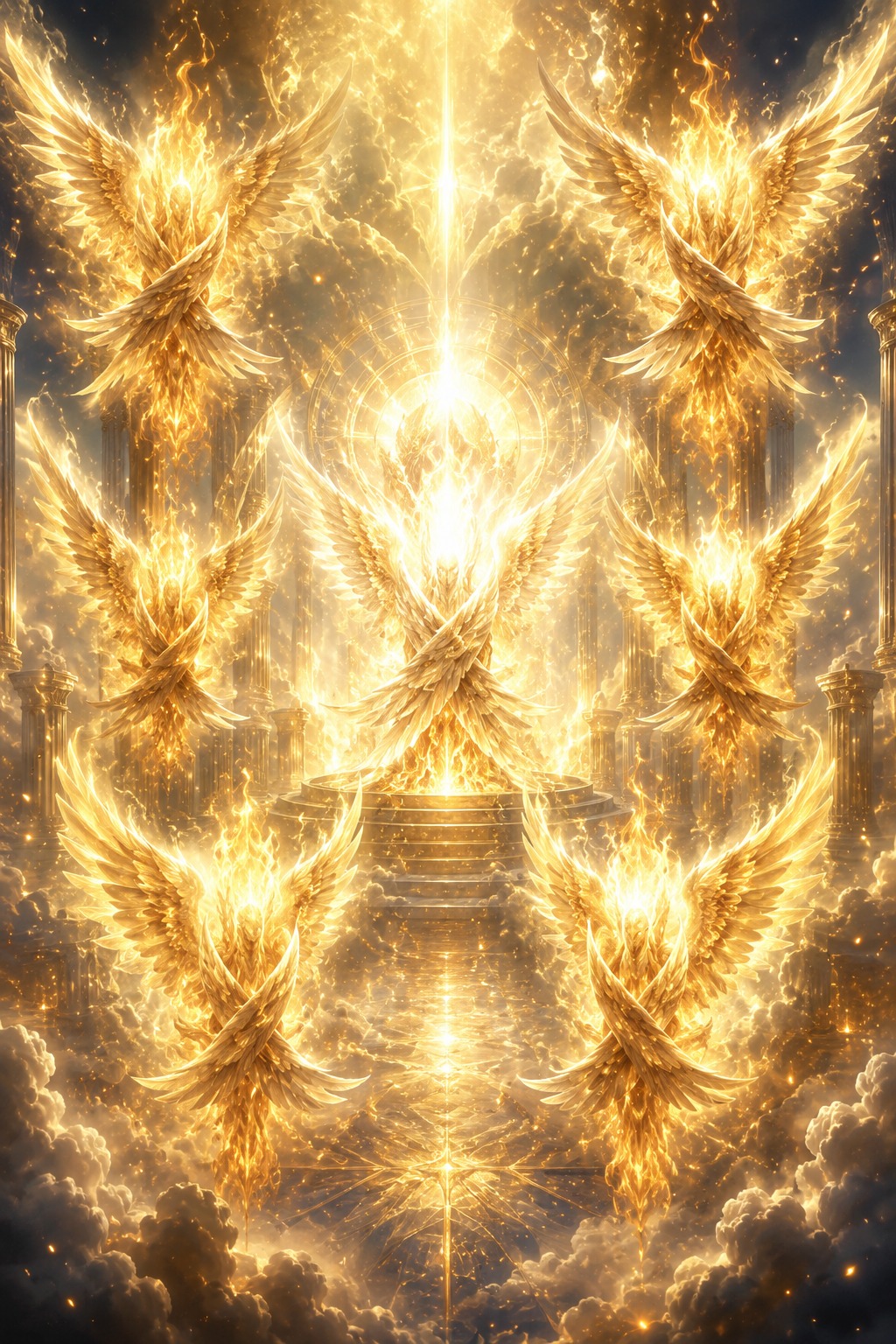
Seraphim
Seraphim · Highest Order of the Nine Angelic Choirs — The Burning Ones Around God
Names in Other Languages
 세라핌한국어
Seraphim· 천사 9계급의 최상위 신을 둘러싼 불타는 자들
 セラフィム日本語
Seraphim· 天使九階級の最高位 神を囲む燃える者たち
 熾天使繁體中文
Seraphim· 天使九階級最高位 圍繞神之熾燃者
 SeraphimDeutsch
Seraphim · Höchster der neun Engelchöre — Die Brennenden um Gott
 SéraphinsFrançais
Séraphins · Plus haut des neuf chœurs angéliques — Les Brûlants autour de Dieu
 SerafinesEspañol
Serafines · Más alto de los nueve coros angélicos — Los Ardientes en torno a Dios
 SerafinsPortuguês
Serafins · Mais alto dos nove coros angélicos — Os Ardentes ao redor de Deus
 SerafiniPolski
Serafini · Najwyższy z dziewięciu chórów anielskich — Płonący wokół Boga
 СерафимыРусский
Seraphim · Высший из девяти ангельских чинов — Пылающие вокруг Бога
Seraphim (Hebrew Səraphim, singular Saraph) is the highest rank of the 9 angelic hierarchies of Judeo-Christian angelology — the decisive canon — the decisive canonical iconographic figure of 'the burning ones' derived from the Hebrew saraph meaning 'to burn'. Aliases — burning ones, fiery angels, guardians of the throne, and together with the Cherubim the two closest ranks to God — are the decisive canonical vocabulary. The decisive textual canon is the decisive origin canon of the vision Isaiah saw in Isaiah (Isaiah) 6:1-7 of c. 8th century BCE in which 6-winged beings flew around God's throne crying 'Holy, holy, holy, Lord of Hosts; the whole earth is full of His glory', and the decisive canon of the first rank of the 9-rank angelic hierarchy in The Celestial Hierarchy (De Coelesti Hierarchia) chapter 7 of Pseudo-Dionysius (Pseudo-Dionysius) of c. 5th-6th century CE. The decisive canon of the Summa Theologica (Summa Theologica) Part I question 108 article 5 of Thomas Aquinas (Thomas Aquinas) of the 13th century, and the decisive canon of the 6-winged Seraph vision and the stigmata (stigmata) of St. Francis of Assisi (St. Francis of Assisi) on Mount La Verna on 14 September 1224.
Origin
The etymological origin is the decisive origin canon of 'the burning ones' derived from the Hebrew 'saraph' meaning 'to burn', and the iconographic origin is the decisive origin canon of Numbers (Numbers) 21:6-9 — 'And the Lord sent fiery serpents (seraphim) among the people' — originally meaning 'fiery serpents'. The decisive textual canon is the decisive origin canon of Isaiah (Isaiah) 6:1-7 of c. 8th century BCE — 'In the year that king Uzziah died I saw also the Lord sitting upon a throne, high and lifted up, and his train filled the temple. Above it stood the seraphims: each one had six wings; with twain he covered his face, and with twain he covered his feet, and with twain he did fly. And one cried unto another, and said, Holy, holy, holy, is the Lord of hosts: the whole earth is full of his glory'. The decisive canon of the purification in verse 7 in which one of the seraphim took a live coal from off the altar with the tongs and laid it upon Isaiah's mouth, saying 'Lo, this hath touched thy lips; and thine iniquity is taken away, and thy sin purged'. The decisive theological canon is the decisive canon of the first rank of the 9-rank angelic hierarchy (1. Seraphim, 2. Cherubim, 3. Thrones, 4. Dominions, 5. Virtues, 6. Powers, 7. Principalities, 8. Archangels, 9. Angels) in The Celestial Hierarchy (De Coelesti Hierarchia) chapter 7 of Syrian Pseudo-Dionysius the Areopagite (Pseudo-Dionysius the Areopagite) of c. 5th-6th century CE.
Features
- 6 wings — with two they covered their face, two their feet, and two they flew
- Beings of pure flame, not in human or animal form
- Cover their faces because they cannot directly see God's glory
- Continuously sing 'Holy, holy, holy, Lord of Hosts' (Sanctus, Trisagion)
- Main axis — first rank of the 9-rank angelic hierarchy
- Together with the Cherubim, the two closest ranks to God
Stories
The vision of Isaiah 6:1-7 of c. 8th century BCE is the decisive origin, and the decisive textual canon is Numbers 21:6-9, Isaiah 6:1-7 of c. 8th century BCE, Pseudo-Dionysius The Celestial Hierarchy chapter 7 of c. 5th-6th century CE, Thomas Aquinas Summa Theologica Part I question 108 article 5 of the 13th century, and the Seraph vision of St. Francis of Assisi at Mount La Verna on 14 September 1224. Called upon in meditation on God's love, purification, and sacred worship, and the decisive canon in which in the mystical tradition the love of the Seraphim is compared to a sacred flame that purifies the soul. A topic deeply treated theologically by Thomas Aquinas et al., and the decisive liturgical canon in which the Catholic Mass Sanctus — 'Holy, Holy, Holy Lord God of Hosts' — derives from the Seraphim's song. The decisive canon in which the Orthodox Church's Trisagion — 'Holy God, Holy Strong, Holy Immortal' — derives from the Seraphim's song. The decisive canon of the 9-rank angelic hierarchy in Dante Alighieri's (Dante Alighieri) Divine Comedy (Divina Commedia) Paradiso (Paradiso) Canto 28 lines 97-104 of c. 1320, and the decisive 17th-century English-literary canon of the Seraphim in John Milton's (John Milton) Paradise Lost (Paradise Lost) of 1667. The decisive 21st-century canon is the decisive fantasy RPG canon of Seraphim in the 1977 USA TSR Monster Manual, and the mention of Seraphim in the TV series Supernatural by USA CW from 2008 to 2020 is the 21st-century decisive global video canon.
Weakness
Seraphim's weaknesses are: (1) abstract and impersonal — the decisive canonical weakness — beings of pure flame, not in human or animal form, who rarely intervene in human daily life; (2) being overwhelmed by God's light — the decisive canonical weakness — because they receive God's light most closely, when humans see them directly, their sight and souls are overwhelmed; (3) covering their faces — Isaiah 6:2 — 'with twain he covered his face' — they cannot directly see God's glory and so cover their faces; (4) binding of the hierarchy — Pseudo-Dionysius The Celestial Hierarchy chapter 7 — trapped in the first rank of the 9-rank angelic hierarchy; (5) binding of the song — endlessly singing 'Holy, holy, holy'; (6) binding to God's throne — circling only around God's throne; (7) binding of the sacred domain — heaven; (8) binding of fire — pure flame. The decisive canonical finale is the decisive mythological canon in which, being abstract and impersonal, they do not intervene in human daily life, and so eternally sing 'Holy, holy, holy' around God's throne.
Cultural Significance
Seraphim is the canonical iconographic figure of the decisive Judeo-Christian canon, traversing Numbers 21:6-9, Isaiah 6:1-7 of c. 8th century BCE, Pseudo-Dionysius The Celestial Hierarchy chapter 7 of c. 5th-6th century CE, Thomas Aquinas Summa Theologica Part I question 108 article 5 of the 13th century, St. Francis of Assisi's La Verna vision of 14 September 1224, Dante Divine Comedy Paradiso Canto 28 of c. 1320, John Milton Paradise Lost of 1667, 1977 TSR D&D Monster Manual, and 2008-2020 CW Supernatural. The etymological origin is the decisive canon of 'the burning ones' derived from the Hebrew 'saraph' meaning 'to burn', and the iconographic origin is the decisive origin canon of 'fiery serpents (seraphim)' in Numbers 21:6-9, which settled in Isaiah 6:1-7 of c. 8th century BCE as 6-winged beings flying around God's throne crying 'Holy, holy, holy'. The decisive theological canon is the decisive canon of the first rank of the 9-rank angelic hierarchy (1. Seraphim, 2. Cherubim, 3. Thrones, 4. Dominions, 5. Virtues, 6. Powers, 7. Principalities, 8. Archangels, 9. Angels) in The Celestial Hierarchy (De Coelesti Hierarchia) chapter 7 of Syrian Pseudo-Dionysius the Areopagite of c. 5th-6th century CE, accepted as the core of orthodox angelology in Catholic, Orthodox, and most Protestant traditions. The decisive theological canon of the Seraphim as the 'flame of love (amor)' closest to God in the Summa Theologica (Summa Theologica) Part I question 108 article 5 of Thomas Aquinas (Thomas Aquinas, 1225-1274) of the 13th century, and the decisive canon of the 6-winged Seraph vision and the five wounds of the Cross (stigmata) of St. Francis of Assisi (St. Francis of Assisi, c. 1181 - 3 October 1226) on Mount La Verna in Tuscany, Italy on 14 September 1224. The decisive 14th-century canon is the decisive canon of the 9-rank angelic hierarchy in Dante Alighieri's (Dante Alighieri, 1265-1321) Divine Comedy (Divina Commedia) Paradiso (Paradiso) Canto 28 lines 97-104 of c. 1320, and the decisive 21st-century canon is the mention of Seraphim in the TV series Supernatural (Supernatural) by USA CW from 2005 to 2020 — the 21st-century decisive global video canon.
In Popular Culture
- Numbers 21:6-9 fiery serpents (seraphim) — decisive origin canon
- Isaiah 6:1-7 6-winged Seraphim (c. 8th century BCE) — decisive origin canon
- 1 Enoch 61:10 and 71:7 (c. 2nd century BCE) — decisive apocryphal canon
- Pseudo-Dionysius The Celestial Hierarchy chapter 7 first rank of the 9-rank angelic hierarchy (c. 5th-6th century CE) — decisive theological canon
- Thomas Aquinas Summa Theologica Part I question 108 article 5 (13th century) — decisive scholastic theological canon
- St. Francis of Assisi La Verna Seraph vision and stigmata (1224) — decisive Catholic canon
- Dante Divine Comedy Paradiso Canto 28 lines 97-104 (c. 1320) — decisive 14th-century literary canon
- John Milton Paradise Lost (1667) — decisive 17th-century English-literary canon
- TSR D&D Monster Manual Seraphim (1977) — decisive fantasy RPG canon
- CW TV series Supernatural Seraphim (2008-2020) — 21st-century decisive TV canon
Trivia
The etymology of Seraphim (Hebrew Səraphim, singular Saraph) is the decisive canonical vocabulary of 'the burning ones (burning ones)' derived from the Hebrew 'saraph' meaning 'to burn (to burn)', and aliases fiery angels, guardians of the throne, and together with the Cherubim the two closest ranks to God are the decisive canonical vocabulary. The iconographic origin is the decisive origin canon of Numbers 21:6-9 — 'And the Lord sent fiery serpents (seraphim) among the people' — originally meaning 'fiery serpents'. The decisive textual canon is the decisive origin canon of Isaiah (Isaiah) 6:1-7 of c. 8th century BCE in which 6-winged Seraphim flew around God's throne, two covering their faces, two covering their feet, and two flying, crying 'Holy, holy, holy, is the Lord of hosts: the whole earth is full of his glory', and the decisive canon of the purification in verse 7 in which one of the seraphim took a live coal from off the altar with the tongs and laid it upon Isaiah's mouth, saying 'Lo, this hath touched thy lips; and thine iniquity is taken away, and thy sin purged'. The decisive theological canon is the decisive canon of the first rank of the 9-rank angelic hierarchy in The Celestial Hierarchy (De Coelesti Hierarchia) chapter 7 of Syrian Pseudo-Dionysius the Areopagite (Pseudo-Dionysius the Areopagite) of c. 5th-6th century CE — 1st rank Seraphim, 2nd rank Cherubim, 3rd rank Thrones, 4th rank Dominions, 5th rank Virtues, 6th rank Powers, 7th rank Principalities, 8th rank Archangels, 9th rank Angels. The decisive canon of the Seraphim as the 'flame of love (amor)' closest to God in the Summa Theologica (Summa Theologica) Part I question 108 article 5 of Thomas Aquinas (Thomas Aquinas) of the 13th century, and the decisive canon of the 6-winged Seraph vision and the five wounds of the Cross (stigmata) of St. Francis of Assisi (St. Francis of Assisi, c. 1181 - 3 October 1226) on Mount La Verna in Tuscany, Italy on 14 September 1224. The decisive liturgical canon in which the Catholic Mass Sanctus and the Orthodox Trisagion derive from the Seraphim's song of 'Holy, holy, holy'. The decisive canon of the 9-rank angelic hierarchy in Dante Alighieri's (Dante Alighieri, 1265-1321) Divine Comedy (Divina Commedia) Paradiso (Paradiso) Canto 28 lines 97-104 of c. 1320, and the decisive 17th-century English-literary canon of the Seraphim in English John Milton's (John Milton, 1608-1674) Paradise Lost (Paradise Lost) of 1667.