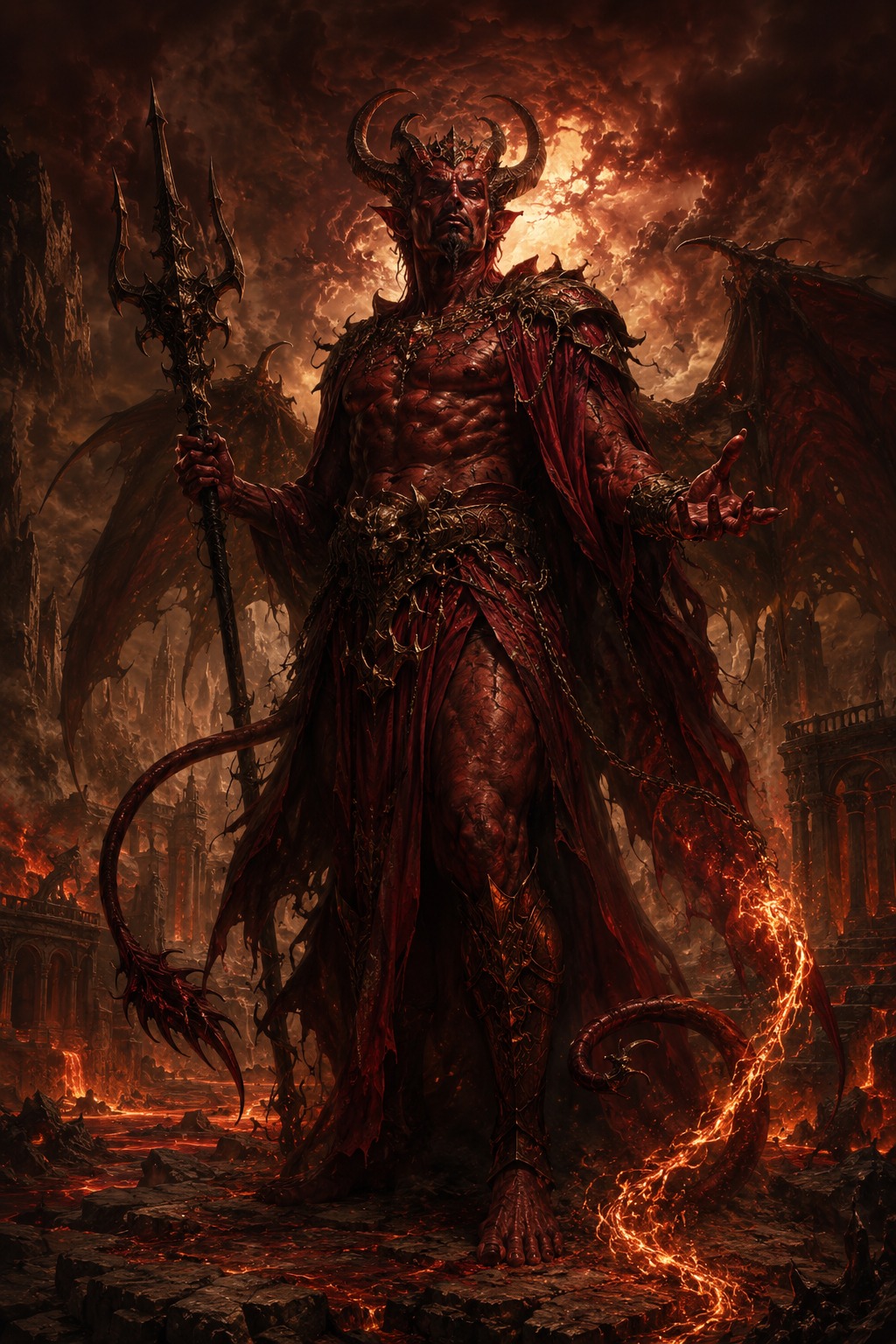
Satan
Satan · The Adversary — Prince of Wrath, Accuser of Humanity
Names in Other Languages
 사탄한국어
사탄한국어Satan· 대적자 분노의 왕, 인류의 고발자
 サタン日本語
Satan· 大いなる敵対者 怒りの王、人類の告発者
 撒旦繁體中文
Satan· 大敵 憤怒之王,人類之控告者
 SatanDeutsch
Satan · Der Widersacher — Fürst des Zorns, Ankläger der Menschheit
 SatanFrançais
Satan · L'Adversaire — Prince de la colère, accusateur de l'humanité
 SatanásEspañol
Satanás · El Adversario — Príncipe de la ira, acusador de la humanidad
 SatanásPortuguês
Satanás · O Adversário — Príncipe da ira, acusador da humanidade
 SzatanPolski
Szatan · Przeciwnik — Książę gniewu, oskarżyciel ludzkości
 СатанаРусский
Satan · Противник — Князь гнева, обвинитель человечества
Satan (Hebrew Satan, Greek Satanas, Latin Satanas, Aramaic Satana) is the supreme demon of the Judeo-Christian-Islamic tradition — the decisive canon, the decisive canonical vocabulary derived from the Hebrew 'satan' meaning 'adversary' or 'accuser'. The aliases Diabolos (Greek 'slanderer'), devil, Lucifer ('light-bearer'), Belial, Beelzebub, Iblis (Islamic Satan), old serpent, great dragon, and prince of darkness are the decisive canonical vocabulary. The decisive textual canon is the decisive origin canon of Job (Job) chapters 1:6-12 and 2:1-7 of c. 6th-4th century BCE — the adversary (the-satan, with the definite article) who tested Job (Job) in the heavenly court — and the decisive canon of Zechariah (Zechariah) 3:1-2 of c. 6th-5th century BCE — Satan accusing Joshua (Joshua). The decisive canon of the 40-day temptation of Jesus Christ in the wilderness in Matthew (Matthew) 4:1-11 and Luke (Luke) 4:1-13 of the 1st century CE, the decisive canon of the heavenly war in Revelation (Revelation) 12:7-9 in which the great dragon Satan was cast down by the archangel Michael, and the decisive canon of the thousand-year binding and the final eternal lake of fire in 20:1-3 and 20:10.
Origin
The iconographic origin is the decisive origin canon of the adversary concept of the heavenly court of the ancient Near East, and the decisive textual canon is the decisive origin canon of Job (Job) 1:6-12 and 2:1-7 of c. 6th-4th century BCE — 'Now there was a day when the sons of God came to present themselves before the Lord, and Satan came also among them' — the adversary (the-satan, with the definite article) of the heavenly court — and the decisive canon of Zechariah (Zechariah) 3:1-2 of c. 6th-5th century BCE — Satan accusing Joshua — and the decisive canon of the Wisdom of Solomon (Wisdom of Solomon) 2:24 of c. 1st century BCE — death entered the world through the envy of the devil. The decisive canon of the 40-day temptation of Jesus Christ in the wilderness in Matthew 4:1-11 of the 1st century CE in which Satan made the 3 temptations of 'stones to bread', 'cast yourself down from the temple', and 'I will give you all the kingdoms of the world and their glory' — and the decisive canon of Revelation 12:7-9 — 'And the great dragon was cast out, that old serpent, called the Devil, and Satan, which deceiveth the whole world' — who was defeated by the archangel Michael in the heavenly war and cast to the earth. The decisive canon of the Qur'an (Qur'an) 2:34 and 7:11-18 of the 7th-9th century in which Iblis (Iblis) refused to bow to Adam.
Features
- Red skin or dark red scales
- Horns and forked tail (medieval iconography)
- Trident or whip of fire
- Tempter in the wilderness — can transform into human form
- Old serpent (Revelation 12:9), great dragon
- Archduke of 'Wrath' among the Seven Deadly Sins
Stories
The ancient Near East heavenly court adversary concept is the decisive origin, and the decisive textual canon is Job 1:6-12 and 2:1-7 of c. 6th-4th century BCE, Zechariah 3:1-2 of c. 6th-5th century BCE, Wisdom of Solomon 2:24 of c. 1st century BCE, Matthew 4:1-11 and Luke 4:1-13 of the 1st century CE, Revelation 12:7-9, 20:1-3, and 20:10 of the 1st century CE, and Qur'an 2:34 and 7:11-18 of the 7th-9th century. The decisive canon called upon as a symbol of wrath, temptation, and seduction, and the decisive canon of the representative demon expelled in exorcism rituals. The decisive canon of theologically testing the free will of humans — like the test of Job, he acts only with God's permission, and the decisive canon of the 14th-century Augustine's (Augustinus) The City of God (De Civitate Dei) Book 11 chapter 13 of c. 5th century CE on Satan's fall and the decisive 14th-century canon of the giant 3-faced Satan (Lucifero) imprisoned in the ice of the deepest part of Hell of Dante Alighieri (Dante Alighieri, 1265-1321)'s Divine Comedy (Divina Commedia) Inferno (Inferno) Canto 34 of c. 1320, and the decisive 17th-century English-literary canon of John Milton's (John Milton, 1608-1674) Paradise Lost (Paradise Lost) of 1667 in which Satan is portrayed as the protagonist. The decisive 21st-century canon is the decisive global video canon of the 21st century — the Lucifer Morningstar (Satan) played by Tom Ellis (Tom Ellis) of the Fox (Fox) and later Netflix TV series Lucifer (Lucifer) (created by Tom Kapinos, Seasons 1-6) first aired in the USA on 25 January 2016.
Weakness
Satan's weaknesses are: (1) acts only under God's authority — the decisive canonical weakness — the decisive canon of Job 1:12 and 2:6 of c. 6th-4th century BCE — 'And the Lord said unto Satan, Behold, all that he hath is in thy power; only upon himself put not forth thine hand' — he acted only with God's permission; (2) Christ's name — the decisive canonical weakness — the decisive canon of Matthew 4:10 — 'Get thee hence, Satan'; (3) cross and holy water — the decisive canonical weakness — the decisive canon of the Catholic exorcism ritual; (4) archangel Michael — the decisive canonical weakness — the decisive canon of Revelation 12:7-9 — defeated in the heavenly war with the archangel Michael; (5) fate of the eternal lake of fire — Revelation 20:10 — 'And the devil that deceived them was cast into the lake of fire and brimstone, where the beast and the false prophet are, and shall be tormented day and night for ever and ever'; (6) limits of free will — testing the free will of humans; (7) binding of the sacred domain — the decisive canon; (8) thousand-year binding — Revelation 20:1-3 — an angel with the key of the bottomless pit and a great chain bound Satan for a thousand years. The decisive canonical finale is the decisive mythological canon of Revelation 20:7-10 of the 1st century CE — after being released after a thousand years, Satan gathered the armies of Gog and Magog (Gog and Magog) and surrounded the saints and the beloved city, but fire came down from heaven and cast Satan into the eternal lake of fire and brimstone, where with the beast and the false prophet he is tormented forever.
Cultural Significance
Satan is not merely a demon icon but the canonical iconographic figure of the decisive Judeo-Christian-Islamic canon, traversing the c. 6th-4th century BCE Job 1:6-12 and 2:1-7, the c. 6th-5th century BCE Zechariah 3:1-2, the c. 1st century BCE Wisdom of Solomon 2:24, the 1st century CE Matthew 4:1-11, Luke 4:1-13, Revelation 12:7-9, 20:1-3 and 20:10, the 7th-9th century Qur'an 2:34 and 7:11-18, the 5th century CE Augustine The City of God Book 11 chapter 13, the c. 1320 Dante Divine Comedy Inferno Canto 34, the 1667 Milton Paradise Lost, and the 2016-2021 Fox Lucifer. The adversary concept of the heavenly court of the ancient Near East settled as the decisive canon in Job (Job) chapters 1:6-12 and 2:1-7 of c. 6th-4th century BCE — the adversary (the-satan) who tested Job in the heavenly court. The decisive mythological canon is the decisive canon of the 40-day temptation in the wilderness in Matthew 4:1-11 of the 1st century CE, the decisive canon of the heavenly war in Revelation 12:7-9, and the decisive canon of the thousand-year binding and the eternal lake of fire and brimstone in 20:1-3 and 20:10. The decisive 14th-century canon is the giant 3-faced (red, yellow, black) Satan (Lucifero Lucifero) imprisoned in the ice of the deepest Cocytus (Cocytus) of Hell of Italy's Dante Alighieri (Dante Alighieri, 1265-1321)'s Divine Comedy (Divina Commedia) Inferno (Inferno) Canto 34 of c. 1320, and the decisive 17th-century English-literary canon of the Satan in England's John Milton (John Milton, born 9 December 1608 in London, died 8 November 1674 in London)'s Paradise Lost (Paradise Lost) of 1667 — about 10 books (later 12 books) — in which Satan is portrayed almost as the protagonist. The decisive 21st-century canon is the Lucifer Morningstar (Satan) played by Tom Ellis (Tom Ellis, born 17 November 1978 in Cardiff, England) of the Fox (Fox) to Netflix TV series Lucifer (Lucifer) (created by Tom Kapinos, Seasons 1-6, 93 episodes) from 25 January 2016 to 10 September 2021 — the 21st-century decisive global video canon.
In Popular Culture
- Job 1:6-12 and 2:1-7 adversary of the heavenly court (c. 6th-4th century BCE) — decisive origin canon
- Zechariah 3:1-2 Joshua's accuser (c. 6th-5th century BCE) — decisive canon
- Wisdom of Solomon 2:24 envy of the devil (c. 1st century BCE) — decisive apocryphal canon
- Matthew 4:1-11 and Luke 4:1-13 40-day temptation in the wilderness (1st century CE) — decisive origin canon
- Revelation 12:7-9 heavenly war old serpent great dragon (1st century CE) — decisive apocalyptic canon
- Revelation 20:1-3 and 20:10 thousand-year binding and eternal lake of fire (1st century CE) — decisive apocalyptic canon
- Qur'an 2:34 and 7:11-18 Iblis (7th-9th century) — decisive Islamic canon
- Augustine The City of God Book 11 chapter 13 (5th century CE) — decisive theological canon
- Dante Divine Comedy Inferno Canto 34 Lucifero (c. 1320) — decisive 14th-century literary canon
- John Milton Paradise Lost Satan (1667) — decisive 17th-century English-literary canon
- Fox/Netflix Lucifer Tom Ellis Seasons 1-6 (2016-2021) — 21st-century decisive TV canon
Trivia
The etymology of Satan (Hebrew Satan) is the decisive canonical vocabulary of the Hebrew 'satan' meaning 'adversary' or 'accuser', and the Greek Satanas, Latin Satanas, and aliases Diabolos (Greek 'slanderer'), devil, Lucifer ('light-bearer'), Belial, Beelzebub, Iblis (Islamic Satan), old serpent, great dragon, and prince of darkness are the decisive canonical vocabulary. The decisive textual canon is the decisive origin canon of Job (Job) 1:6-12 and 2:1-7 of c. 6th-4th century BCE — the adversary (the-satan, with the definite article) who tested Job (Job) in the heavenly court — and the decisive canon in which the satan of the original Book of Job was a position (accuser) in the heavenly court that acted only with God's permission, and which was gradually personified in later New Testament and apocryphal writings to become the head of evil opposing God. The decisive canon of Matthew 4:1-11 and Luke 4:1-13 of the 1st century CE — after the 40-day fast of Jesus Christ in the wilderness, Satan made the 3 temptations of 'stones to bread', 'cast yourself down from the temple pinnacle', and 'I will give you all the kingdoms of the world and their glory' — and the decisive canon of Revelation 12:7-9 — 'And there was war in heaven: Michael and his angels fought against the dragon; and the dragon fought and his angels, and prevailed not; neither was their place found any more in heaven. And the great dragon was cast out, that old serpent, called the Devil, and Satan' — and the decisive canon of 20:1-3 and 20:10 of the thousand-year binding and the eternal lake of fire and brimstone. The decisive canon of the Qur'an (Qur'an) 2:34 and 7:11-18 of the 7th-9th century in which Iblis (Iblis), after God created Adam from clay and commanded the angels to bow to Adam, refused on the grounds that he himself was a jinn (jinn) created from fire and could not bow to Adam who was made from clay, and was driven out by God. The decisive 14th-century canon is the giant 3-faced (red, yellow, black) Satan (Lucifero) imprisoned in the ice of the deepest Cocytus of Hell of Italy's Dante Alighieri (Dante Alighieri, 1265-1321)'s Divine Comedy (Divina Commedia) Inferno (Inferno) Canto 34 of c. 1320, the decisive 17th-century English-literary canon of the Satan in England's John Milton (John Milton, born 9 December 1608 in London, died 8 November 1674 in London)'s Paradise Lost (Paradise Lost) of 1667 in which Satan is portrayed almost as the protagonist, and the decisive German literary canon of Mephistopheles (Mephistopheles) in Johann Wolfgang von Goethe (Johann Wolfgang von Goethe, 1749-1832)'s Faust (Faust) Part 1 of 1808 and Part 2 of 1832. The decisive 21st-century canon is the Lucifer Morningstar (Satan) played by Tom Ellis (Tom Ellis, born 17 November 1978 in Cardiff, England) of the Fox (Fox) to Netflix TV series Lucifer (Lucifer) (created by Tom Kapinos, Seasons 1-6, 93 episodes) from 25 January 2016 to 10 September 2021 — the 21st-century decisive global video canon.