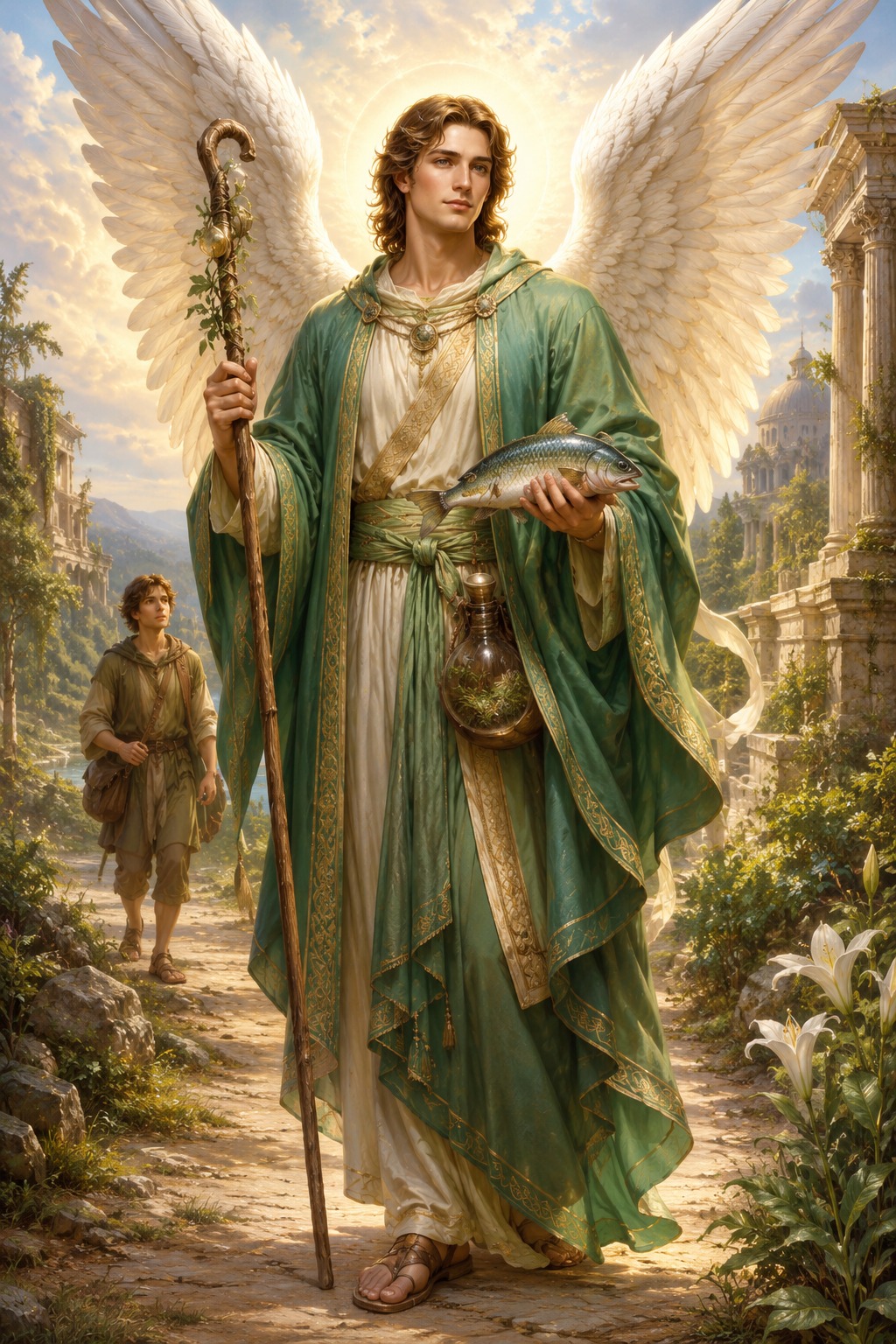
Raphael
Raphael · Archangel — Angel of Healing and Guide of Travelers
Names in Other Languages
 라파엘한국어
Raphael· 대천사 치유의 천사, 여행자의 길잡이
 ラファエル日本語
Raphael· 大天使 治癒の天使、旅人の道案内
 拉斐爾繁體中文
Raphael· 大天使 治癒之天使,旅人之嚮導
 RaphaelDeutsch
Raphael · Erzengel — Engel der Heilung, Führer der Reisenden
 RaphaëlFrançais
Raphaël · Archange — Ange de la guérison, guide des voyageurs
 RafaelEspañol
Rafael · Arcángel — Ángel de la sanación, guía de los viajeros
 RafaelPortuguês
Rafael · Arcanjo — Anjo da cura, guia dos viajantes
 RafałPolski
Rafał · Archanioł — Anioł uzdrowienia, przewodnik wędrowców
 РафаилРусский
Raphael · Архангел — Ангел исцеления, проводник путников
Raphael (Hebrew Rafa'el, Greek Rhaphael, Latin Raphael, 'healing of God') is the decisive canonical archangel of Judaism and Christianity — two decisive canonical religions. The etymology is the decisive canonical vocabulary of the Hebrew compound of 'rapha (healing)' and 'El (God)' — 'healing of God'. The decisive textual canon is the apocryphal Book of Tobit (Tobit) 3:17, 5:4-22, 6:1-18, 7:9-17, 8:1-9, 11:1-15, and 12:1-22 of c. 3rd-2nd century BCE — c. 225-175 BCE — the decisive canon in which Raphael, under the alias 'Azariah (Azariah)', accompanied the young Tobiah (Tobiah) on his journey, drove out the demon Asmodeus (Asmodeus), and healed Tobit's (Tobit) blindness with fish gall (gall) — and the apocryphal 1 Enoch (1 Enoch) 9:1, 10:4, 20:3, 40:9, and 71 of c. 3rd-1st century BCE — the decisive canon establishing Raphael as one of the seven archangels or four archangels (along with Michael, Gabriel, Raphael, and Uriel). The decisive canonical iconography of the angel in travel attire with a walking staff, a fish (Tobit episode) and a vial of medicinal herbs, the accompanying young Tobiah iconography, and green or teal robes.
Origin
The iconographic origin is the Persian-angel-faith influence of the c. 6th century BCE Babylonian Exile period, and the decisive textual canon is the apocryphal Book of Tobit (Tobit) 12:15 of c. 3rd-2nd century BCE — c. 225-175 BCE — the decisive origin canon of 'I am Raphael, one of the seven holy angels (eis ek ton hepta hagion angelon) who present the prayers of the holy ones and enter into the glory of the Holy One'. 5:4-22 — the decisive canon in which when Tobiah set out to collect his father Tobit's debt from Gabael (Gabael) in Media, Raphael accompanied him under the alias 'Azariah' — and 6:1-18 — the decisive canon of catching a large fish in the Tigris River and preserving its heart, liver, and gall. 7:9-17 — the decisive canon in which Sarah (Sarah), the daughter of Raguel (Raguel) of Media, had seven bridegrooms killed by the demon Asmodeus (Asmodeus), but Raphael married her to Tobiah — and 8:1-9 — the decisive canon of burning the heart and liver of the fish on the censer to drive out Asmodeus. Chapter 11 — the decisive canon of healing Tobit's eyes with fish gall — and 12:15 — the decisive canon of Raphael revealing 'I am Raphael, one of the seven holy angels'.
Features
- Angel in travel attire with a walking staff
- Fish (Tobit episode) and a vial of medicinal herbs
- Accompanying young Tobiah iconography
- Green or teal robes
- Patron saint of the sick, blind, travelers, pharmacists, and nurses
- Feast day on 29 September with the other archangels
Stories
The Persian-angel-faith influence of the c. 6th century BCE Babylonian Exile period is the decisive origin, and the decisive textual canon is the apocryphal Book of Tobit chapters 3, 5-8, and 11-12 of c. 3rd-2nd century BCE and the apocryphal 1 Enoch chapters 9, 10, 20, 40, and 71 of c. 3rd-1st century BCE. The 9-rank angel canon of the De Caelesti Hierarchia (De Caelesti Hierarchia) of Pseudo-Dionysius the Areopagite (Pseudo-Dionysius the Areopagite) of c. 5th century Syria is the decisive canon, and the Tobias and the Angel (Tobias and the Angel) of the workshop of Verrocchio (Andrea del Verrocchio, 1435-1488) of 1480-1485 in Italy — Uffizi Gallery — and the Tobias and Raphael of the Sistine Chapel by Perugino (Pietro Perugino) of 1481 are the decisive Renaissance art canon. The Tobit and the Archangel Raphael (Tobit and the Archangel Raphael) by Rembrandt (Rembrandt van Rijn, 1606-1669) of 1670 in the Netherlands is the decisive 17th-century art canon, and the Raphael of the oratorio Elijah (Elijah) by Felix Mendelssohn (Felix Mendelssohn, 1809-1847) of 1842 in Germany is the decisive 19th-century musical canon. The decisive Catholic canon in which Pope Pius IX (Pope Pius IX) of 1854 officially designated Raphael's feast day as 24 October (later integrated with 29 September Michael-Gabriel in 1969), and the Raphael of the 1980 D&D Deities & Demigods (Deities & Demigods) by TSR in the USA, and the Raphael of the film Hellboy II: The Golden Army (Hellboy II: The Golden Army) (directed by Guillermo del Toro, Universal) released in the USA on 11 July 2008 are the 21st-century decisive video canon.
Weakness
Raphael's weaknesses are: (1) limits of God's will — the decisive canonical weakness — the decisive canon that as the healing angel, he cannot prevent death contrary to God's will; (2) limits of free will — the decisive canon that he cannot directly intervene in self-harm caused by human free will or diseases caused by sin; (3) binding of the alias — the decisive canon in the c. 3rd-2nd century BCE Tobit 5 in which Raphael accompanied under the alias 'Azariah' (Azariah, help of YHWH) and had to hide his divine identity; (4) limited scope of Tobit — the decisive canon of the limited scope of the c. 3rd-2nd century BCE apocrypha; (5) confrontation with the demon Asmodeus — the decisive canon; (6) binding of hierarchy — the decisive canon as one of the seven or four archangels; (7) binding of the sacred domain — the decisive canon; (8) binding of medicine — the decisive canon. The decisive canonical finale is the decisive mythological canon of the c. 3rd-2nd century BCE Tobit 12:1-22 — Raphael revealing 'I am Raphael, one of the seven holy angels' before ascending to heaven.
Cultural Significance
Raphael is not merely an angel icon but the canonical iconographic figure of the decisive apocryphal canon, traversing the c. 3rd-2nd century BCE apocryphal Tobit chapters 3, 5-8, and 11-12, the c. 3rd-1st century BCE apocryphal 1 Enoch chapters 9, 10, 20, 40, and 71, the c. 5th century Pseudo-Dionysius De Caelesti Hierarchia, the 1480-1485 Verrocchio workshop Tobias and the Angel, the 1481 Perugino Sistine Chapel, the 1670 Rembrandt Tobit and the Archangel Raphael, the 1842 Mendelssohn Elijah, the 1854 Pope Pius IX feast day designation, the 1980 D&D Deities & Demigods, and the 2008 film Hellboy II. The Persian-angel-faith influence of the c. 6th century BCE Babylonian Exile (Babylonian Exile, 586-538 BCE) period settled as the decisive canon in the apocryphal Book of Tobit (Tobit) 12:15 of c. 3rd-2nd century BCE — c. 225-175 BCE — 'I am Raphael, one of the seven holy angels'. 5:4-22 — the decisive canon in which Raphael accompanied the young Tobiah on his journey under the alias 'Azariah (Azariah)' — and 6:1-18 — the decisive canon of preserving the heart, liver, and gall of the fish from the Tigris River — and chapter 8 — the decisive canon of burning the heart and liver of the fish on the censer to drive out the demon Asmodeus and enable the marriage of Tobiah and Sarah — and chapter 11 — the decisive canon of healing Tobit's eyes with fish gall. The decisive canon of 12:15 — 'I am Raphael, one of the seven holy angels' — and the decisive Catholic canon of 29 September the feast day of the three archangels Michael-Gabriel-Raphael. The Tobias and the Angel (Tobias and the Angel) of the workshop of Verrocchio (Andrea del Verrocchio) of 1480-1485 in Italy — Uffizi Gallery — about 84x66cm — and the Tobit and the Archangel Raphael by Rembrandt of 1670 in the Netherlands are the decisive art canon, and the feast-day designation by Pope Pius IX of 1854 is the decisive 19th-century Catholic canon.
In Popular Culture
- Apocryphal Book of Tobit chapters 3, 5-8, 11-12 (c. 3rd-2nd century BCE) — decisive origin canon
- Apocryphal 1 Enoch chapters 9, 10, 20, 40, 71 (c. 3rd-1st century BCE) — decisive apocryphal canon
- Pseudo-Dionysius De Caelesti Hierarchia (c. 5th century) — decisive angelology canon
- Verrocchio workshop Tobias and the Angel (1480-1485) — decisive Renaissance canon
- Perugino Sistine Chapel Tobias and Raphael (1481) — decisive Renaissance canon
- Rembrandt Tobit and the Archangel Raphael (1670) — decisive 17th-century art canon
- Mendelssohn oratorio Elijah, Raphael (1842) — decisive 19th-century musical canon
- Pope Pius IX Raphael feast day designation (1854) — decisive 19th-century Catholic canon
- TSR D&D Deities & Demigods, Raphael (1980) — decisive fantasy RPG canon
- Film Hellboy II: The Golden Army (2008) — 21st-century decisive video canon
Trivia
The etymology of Raphael (Raphael) is the decisive canonical vocabulary of the Hebrew Rafa'el — the compound of 'rapha' (healing) and 'El' (God) — 'healing of God', and the Greek Rhaphael and Latin Raphael are the decisive canonical vocabulary. The decisive textual canon is the apocryphal Book of Tobit (Tobit) 3:17 of c. 3rd-2nd century BCE — c. 225-175 BCE — the decisive canon of 'Raphael was sent and heard the prayers of both at the same time' — and 5:4-22 — the decisive canon in which when Tobiah set out to collect his father Tobit's debt from Gabael (Gabael) in Media, Raphael accompanied him under the alias 'Azariah (Azariah, help of YHWH)'. 6:1-18 — the decisive canon in which in the Tigris River Tobiah was attacked by a large fish, but Raphael taught him to catch the fish and preserve its heart, liver, and gall — and chapter 7 — the decisive canon in which Sarah (Sarah), the daughter of Raguel (Raguel) of Media, had seven bridegrooms killed by the demon Asmodeus (Asmodeus), but Raphael married her to Tobiah. 8:1-9 — the decisive canon of burning the heart and liver of the fish on the censer, whose smoke drove out Asmodeus to 'Upper Egypt (Upper Egypt)', where Raphael bound the demon — and chapter 11 — the decisive canon in which the returning Tobiah, by Raphael's teaching, applied fish gall to Tobit's eyes and healed his blindness. 12:15 — the decisive canon of 'I am Raphael, one of the seven holy angels (eis ek ton hepta hagion angelon) who present the prayers of the holy ones and enter into the glory of the Holy One' — and the decisive Catholic canon in which Pope Pius IX of 1854 officially designated Raphael's feast day as 24 October, then integrated with 29 September Michaelmas in 1969.