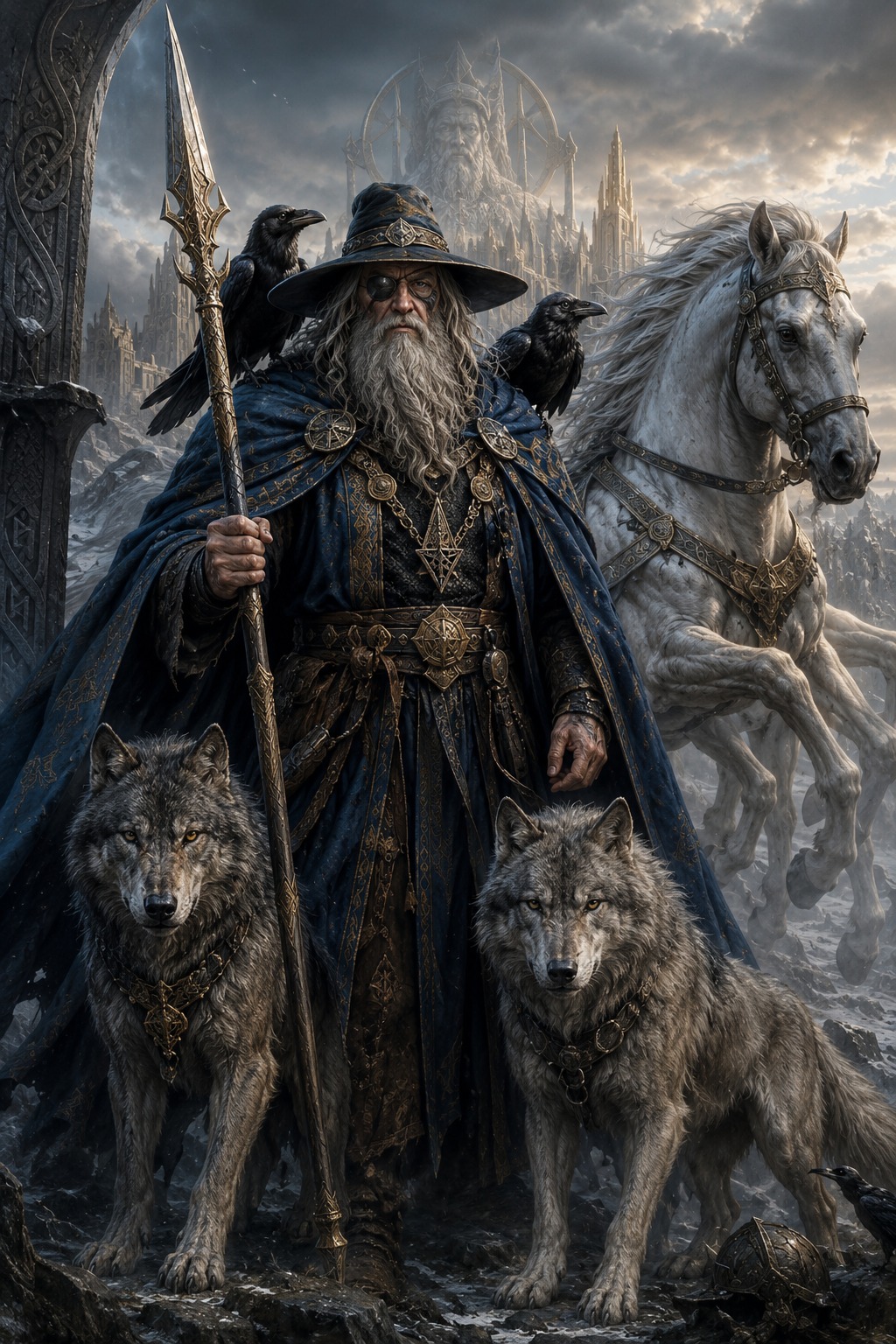
Odin
Odin · Allfather of Norse Myth — God of Wisdom, War, and Death
Names in Other Languages
 오딘한국어
오딘한국어Odin · 북유럽 주신 — 지혜와 전쟁, 죽음의 아버지
 オーディン日本語
Odin · 北欧主神 — 知恵と戦争、死の父
 奧丁繁體中文
Odin · 北歐主神 — 智慧、戰爭與死亡之父
 OdinDeutsch
Odin · Allvater der Nordischen Mythen — Gott der Weisheit, des Krieges und des Todes
 OdinFrançais
Odin · Père-de-tout dans la mythologie nordique — Dieu de la sagesse, de la guerre et de la mort
 OdínEspañol
Odín · Padre de todo en la mitología nórdica — Dios de la sabiduría, la guerra y la muerte
 OdinPortuguês
Odin · Pai de Todos da mitologia nórdica — Deus da sabedoria, da guerra e da morte
 OdynPolski
Odyn · Wszechojciec mitologii nordyckiej — Bóg mądrości, wojny i śmierci
 ОдинРусский
Odin · Всеотец скандинавской мифологии — Бог мудрости, войны и смерти
Odin (Old Norse Odin, Proto-Germanic Wodanaz, 'the one of frenzy, ecstasy, inspiration') is the decisive canonical chief god, the All-Father (Alfodr) of all gods and humans, and the god of wisdom, poetry, war, death, runes, and seidr magic of the Aesir (Aesir) in Norse mythology, and the decisive canonical iconographic figure as the grandson of the giant Buri (Buri), son of Borr (Borr) and Bestla (Bestla), who together with his brothers Vili (Vili) and Ve (Ve) killed the primordial giant Ymir (Ymir) and created the world from his body. The etymology is the decisive canonical vocabulary derived from the Old Norse Odin or Proto-Germanic Wodanaz ('frenzy, ecstasy, inspiration'), cognate with the English Wednesday (Old English Wodnesdaeg, 'Woden's day'), the German Mittwoch, and the Latin furor (frenzy). The decisive textual canon is the Prose Edda (Prose Edda) of c. 1220 of the early 13th-century Icelandic poet-historian Snorri Sturluson (Snorri Sturluson, 1179-1241) — chapters 6-9 (creation), 15 (Mimir's well), and 51 (Ragnarok) of Gylfaginning (Gylfaginning) — and the Voluspa (Voluspa), Havamal (Havamal) stanzas 138-141, Grimnismal (Grimnismal), and Vafthrudnismal (Vafthrudnismal) of the Poetic Edda (Poetic Edda) of the c. 1270 Codex Regius (Codex Regius) manuscript are the decisive poetic canon, and the decisive canonical iconography of sacrificing one eye to the well (Mimisbrunnr) of Mimir (Mimir) to gain cosmic wisdom, and hanging himself on Yggdrasil (Yggdrasill) for 9 days to learn the runes (runir).
Origin
The iconographic origin is chapter 9 of the c. 1st-century Roman historian Tacitus (Cornelius Tacitus, c. 56-120) Germania (Germania) — the decisive Roman-era canon of Wodan (Wodan, later Odin) identified by the Germanic tribes with Mercurius (Mercurius), and the decisive textual canon is the Prose Edda (Prose Edda) of c. 1220 of the early 13th-century Icelandic — Reykholt — Snorri Sturluson (Snorri Sturluson, 1179-1241) — chapters 6-9 of Gylfaginning (Gylfaginning) — the decisive mythological canon in which Odin and his brothers Vili (Vili) and Ve (Ve) killed the primordial giant Ymir (Ymir) and created the world from his body — and chapter 15 — the decisive canon of sacrificing one eye to the well (Mimisbrunnr) of Mimir (Mimir) to gain cosmic wisdom — and chapter 51 — the decisive canon of being swallowed by the giant wolf Fenrir (Fenrir) at Ragnarok. The Havamal (Havamal) stanzas 138-141 of the Poetic Edda (Poetic Edda) of the c. 1270 Codex Regius (Codex Regius) manuscript — the decisive canon in which Odin pierced himself with his spear Gungnir (Gungnir) on a branch of Yggdrasil (Yggdrasill) and hung himself for 9 days and 9 nights to learn the runes (runir) — and the Voluspa, Grimnismal, and Vafthrudnismal are the decisive poetic canon.
Features
- Old one-eyed man with blue cloak and wide-brimmed hat
- Spear Gungnir (Gungnir) — a weapon that never misses
- Ravens Huginn (Huginn, 'thought') and Muninn (Muninn, 'memory') on his shoulders
- Wolves Geri (Geri) and Freki (Freki) at his feet
- Eight-legged horse Sleipnir (Sleipnir)
- Gathers the slain warriors einherjar (einherjar) in Valhalla (Valholl)
Stories
Chapter 9 of the 1st-century Tacitus Germania — the Germanic-Mercurius identification canon — and the chief-god worship of the 9th-11th-century Norse Viking mythology is the decisive origin, and the decisive textual canon is chapters 6-9, 15, and 51 of Snorri Sturluson Prose Edda Gylfaginning of c. 1220 and the Voluspa, Havamal stanzas 138-141, Grimnismal, and Vafthrudnismal of the Poetic Edda of the c. 1270 Codex Regius manuscript. The 19th-century Germanic-nationalism revival — the 1835 Deutsche Mythologie (Deutsche Mythologie) of Jacob Grimm (Jacob Grimm, 1785-1863) and the 1856 German prose Edda translation of Karl Simrock — is the decisive 19th-century scholarly canon, and the Wotan (Wotan, Odin) of the opera tetralogy Der Ring des Nibelungen (Der Ring des Nibelungen) of Richard Wagner premiered at the Bayreuth Festspielhaus on 13-17 August 1876 is the decisive 19th-century musical canon. The Odin of the 1980 D&D Deities & Demigods (Deities & Demigods) by TSR in the USA is the decisive fantasy RPG canon, and the Odin played by Anthony Hopkins (Anthony Hopkins) of the Marvel Studios film Thor (Thor) (directed by Kenneth Branagh) released in the USA on 6 May 2011 is the decisive 21st-century film canon. The decisive 21st-century canon is the main antagonist Odin (played by Richard Schiff (Richard Schiff)) of God of War Ragnarok (God of War Ragnarok) (directed by Eric Williams, Santa Monica Studio) released by Sony Interactive Entertainment in the USA on 9 November 2022 — the decisive video-game canon.
Weakness
Odin's weaknesses are: (1) endless thirst for wisdom and breaking of promises — the decisive canonical weakness in the early 13th-century c. 1220 Snorri Gylfaginning chapter 15 canon — sacrificing one eye to Mimir's well to gain cosmic wisdom — the decisive canon — and the Havamal stanzas 138-141 — hanging himself on Yggdrasil for 9 days and 9 nights to learn the runes — the decisive canon; (2) fate of Ragnarok — the most decisive canonical weakness in chapter 51 of the 1220 Snorri Gylfaginning and the 1270 Voluspa canon — being swallowed by the giant wolf Fenrir (Fenrir) at Ragnarok — the decisive canon; (3) lack of one eye — losing one eye as the cost of Mimir's well — the decisive canon; (4) breaking of promises — the decisive canon that wisdom takes precedence over moral duty; (5) adoption of the trickster god Loki — the 1270 Lokasenna (Lokasenna) canon — the decisive canon; (6) dependence on ravens and wolves — the decisive canon of dependence on Huginn-Muninn and Geri-Freki; (7) dependence on Valhalla's einherjar — the decisive canon; (8) binding of the sacred domain — the decisive canon. The decisive canonical finale is chapter 51 of the 1220 Snorri Gylfaginning — the decisive mythological canon in which after Odin is swallowed by Fenrir at Ragnarok, his son Vidar (Vidarr) avenges him by tearing apart Fenrir's mouth.
Cultural Significance
Odin is not merely a chief-god icon but the canonical iconographic figure of the decisive Norse canon, traversing chapter 9 of the 1st-century Tacitus Germania, the early 13th-century c. 1220 Snorri Sturluson Prose Edda, the c. 1270 Codex Regius manuscript Poetic Edda, the 1835 Jacob Grimm Deutsche Mythologie, the 1876 Wagner Der Ring des Nibelungen Wotan, the 1980 D&D Deities & Demigods, the 2011 Marvel film Thor, and the 2022 Sony God of War Ragnarok. Chapter 9 of the c. 1st-century Roman historian Tacitus (Cornelius Tacitus, c. 56-120) Germania (Germania) — the decisive canon of the Germanic tribes identifying Wodan (Wodan) with Mercurius (Mercurius) — and the chief-god worship of the 9th-11th-century Norse Viking mythology settled as the decisive canon in chapters 6-9 (creation), 15 (Mimir's well), and 51 (Ragnarok) of Gylfaginning (Gylfaginning) of the Prose Edda (Prose Edda) of c. 1220 of the early 13th-century Icelandic — Reykholt — Snorri Sturluson (Snorri Sturluson, born c. 1179 in Hvammur, Iceland, assassinated 23 September 1241 at Reykholt, Iceland by order of King Haakon IV of Norway). The decisive mythological canon is the decisive canon in which Odin and his brothers Vili (Vili) and Ve (Ve) killed the primordial giant Ymir (Ymir) and created the world from his body, sacrificed one eye to Mimir's well to gain cosmic wisdom, and hung himself on Yggdrasil for 9 days and 9 nights to learn the runes. The decisive 21st-century canon is the Odin played by Anthony Hopkins (Anthony Hopkins, born 31 December 1937 in Wales, UK) of the Marvel Studios film Thor (Thor) (directed by Kenneth Branagh, worldwide box office about 449 million dollars) released in the USA on 6 May 2011, and the main antagonist Odin played by Richard Schiff (Richard Schiff, b. 1955) of God of War Ragnarok (God of War Ragnarok) (directed by Eric Williams, Santa Monica Studio, Metacritic 94, worldwide sales about 15 million) released by Sony Interactive Entertainment in the USA on 9 November 2022 is the 21st-century decisive global canon.
In Popular Culture
- Tacitus Germania chapter 9 (1st century CE) — decisive Roman-era canon
- Snorri Sturluson Prose Edda Gylfaginning chapters 6-9, 15, 51 (c. 1220) — decisive origin canon
- Codex Regius manuscript Poetic Edda Voluspa, Havamal stanzas 138-141, Grimnismal, Vafthrudnismal (c. 1270) — decisive poetic canon
- Jacob Grimm Deutsche Mythologie (1835) — decisive 19th-century scholarly canon
- Richard Wagner Der Ring des Nibelungen, Wotan (1876) — decisive 19th-century musical canon
- TSR D&D Deities & Demigods, Odin (1980) — decisive fantasy RPG canon
- Marvel film Thor, Anthony Hopkins Odin (2011) — 21st-century decisive film canon
- Sony God of War Ragnarok, main antagonist Odin Richard Schiff (2022) — 21st-century decisive video-game canon
Trivia
The etymology of Odin (Odin) is the decisive canonical vocabulary derived from the Old Norse Odin or Proto-Germanic Wodanaz ('the one of frenzy, ecstasy, inspiration'), cognate with the English Wednesday (Old English Wodnesdaeg, 'Woden's day'), the German Mittwoch, the Latin furor (frenzy), and the Proto-Indo-European root uat- ('inspired'). The aliases Alfodr (Alfodr, 'all-father'), Valfodr (Valfodr, 'father of the slain'), Gangleri (Gangleri, 'wanderer'), Sidgrani (Sidgrani, 'long-bearded'), and Har (Har, 'high one') are the decisive canonical vocabulary. The decisive textual canon is the Prose Edda (Prose Edda) of c. 1220 of the early 13th-century Icelandic — Reykholt — Snorri Sturluson (Snorri Sturluson, born c. 1179, died 23 September 1241) — chapters 6-9 of Gylfaginning (Gylfaginning) — the decisive mythological canon in which Odin and his brothers Vili (Vili) and Ve (Ve) killed the primordial giant Ymir (Ymir) and made the earth from his flesh, the mountains from his bones, the sea from his blood, the sky from his skull, and the clouds from his brain. Chapter 15 — the decisive canon of sacrificing one eye to the well (Mimisbrunnr) of Mimir (Mimir) to gain cosmic wisdom — and the c. 1270 Poetic Edda Havamal (Havamal) stanzas 138-141 — the decisive canon in which Odin pierced himself with his spear Gungnir (Gungnir) on a branch of Yggdrasil (Yggdrasill) and 'sacrificed himself to himself (sjalfr sjalfum mer)', hanging himself for 9 days and 9 nights to learn the 24 letters of the runes (runir, Elder Futhark). The decisive canon in which Odin's ravens Huginn (Huginn, 'thought') and Muninn (Muninn, 'memory') on his shoulders fly around the world daily and bring back information, and the wolves Geri (Geri, 'greed') and Freki (Freki, 'glutton') at his feet eat his food. The Odin played by Anthony Hopkins (Anthony Hopkins, born 31 December 1937 in Wales, UK) of the Marvel film Thor (Thor) (directed by Kenneth Branagh) released in the USA on 6 May 2011 is the 21st-century decisive global film canon, and the main antagonist Odin played by Richard Schiff (Richard Schiff, born 27 May 1955 in Maryland, USA) of God of War Ragnarok (God of War Ragnarok) released by Sony Interactive Entertainment in the USA on 9 November 2022 is the 21st-century decisive global video-game canon.