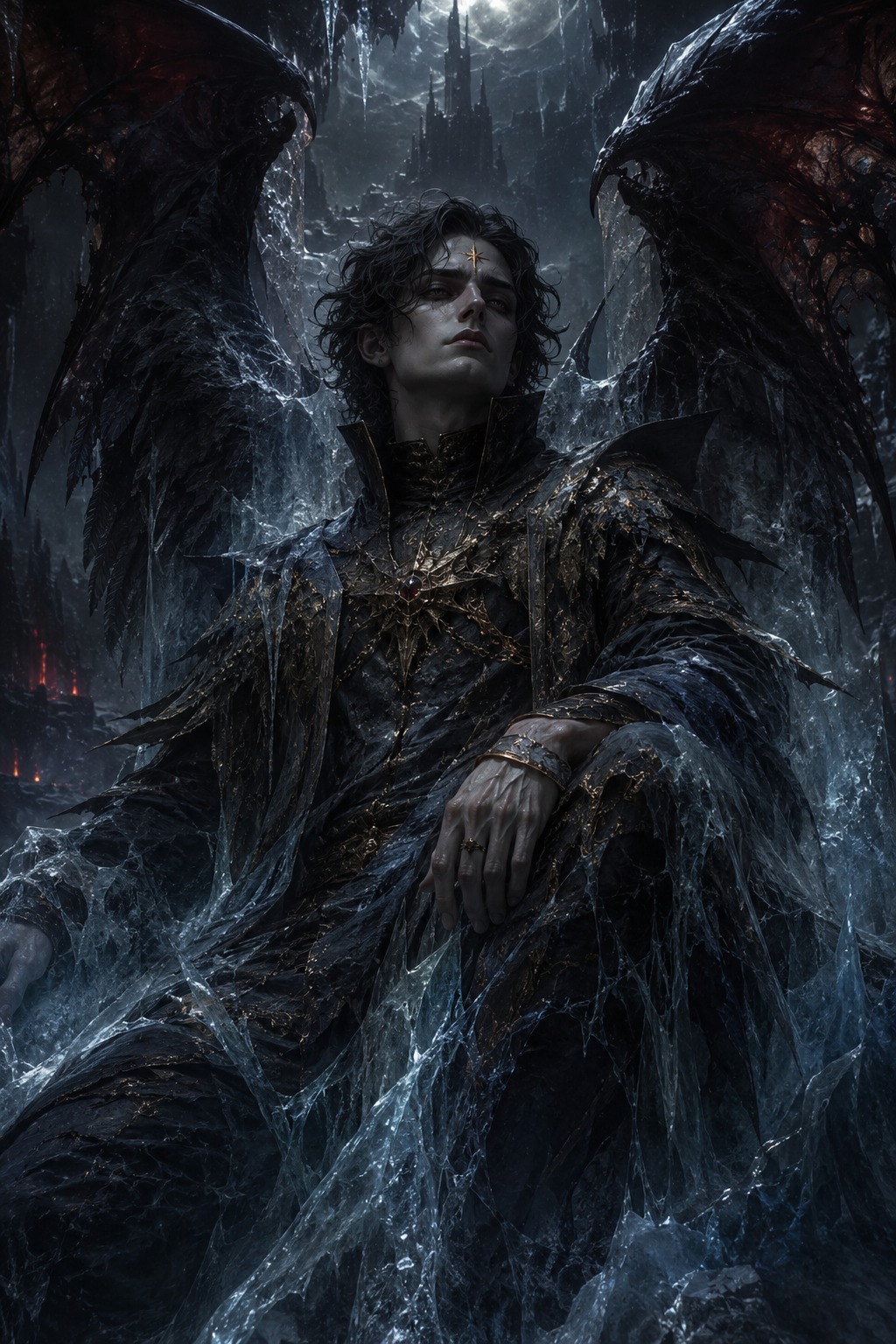
Lucifer
Lucifer · Bearer of Light — Fallen Archangel, Prince of Pride
Names in Other Languages
 루시퍼한국어
Lucifer· 빛을 운반한 자 타락한 대천사, 자만의 왕
 ルシファー日本語
Lucifer· 光を運ぶ者 堕天した大天使、傲慢の王
 路西法繁體中文
Lucifer· 光之使者 墮落大天使,傲慢之王
 LuziferDeutsch
Luzifer · Lichtträger — Gefallener Erzengel, Fürst der Hoffart
 LuciferFrançais
Lucifer · Porteur de lumière — Archange déchu, prince de l'orgueil
 LuciferEspañol
Lucifer · Portador de luz — Arcángel caído, príncipe de la soberbia
 LúciferPortuguês
Lúcifer · Portador da luz — Arcanjo caído, príncipe da soberba
 LucyferPolski
Lucyfer · Niosący światło — Upadły archanioł, książę pychy
 ЛюциферРусский
Lucifer · Несущий свет — Падший архангел, князь гордыни
Lucifer (Latin Lucifer — 'light-bringer', Hebrew Heylel — 'morning star') is the most famous fallen angel in Christian tradition — the decisive canon — and the Prince of Pride (Pride, Superbia) of the Seven Deadly Sins — originally God's most glorious archangel, who fell from heaven due to pride in seeking to make himself equal to God and became the King of Hell — the decisive canonical iconographic figure. Aliases — Satan (Satan), Morning Star (Morning Star, Lucifer), Heylel ben Shahar (Heylel ben Shahar), Helel (Helel), the fallen archangel, the King of Hell — are the decisive canonical vocabulary. The decisive Old Testament canon is the decisive origin canon of Isaiah (Isaiah) 14:12-15 of c. 6th century BCE — 'How art thou fallen from heaven, O Lucifer (Heylel ben Shahar), son of the morning! how art thou cut down to the ground, which didst weaken the nations'. The decisive literary canon is the decisive canon of Dante Alighieri's (Dante Alighieri) Divine Comedy (Divina Commedia) Inferno (Inferno) Canto 34 of c. 1308-1320 — the giant with three faces and six wings frozen up to his chest in the ice of Cocytus (Cocytus) — and John Milton's (John Milton) Paradise Lost (Paradise Lost) of 1667 — Lucifer as the tragic hero of free will.
Origin
The etymological origin is the decisive canon of the Latin 'Lucifer (Lucifer, lux + ferre, light-bringer)' — the decisive canon of the Latin common noun originally referring to the morning star of Venus. The decisive Old Testament canon is the decisive origin canon of Isaiah (Isaiah) 14:12-15 of c. 6th century BCE — a satire against the king of Babylon: 'How art thou fallen from heaven, O Lucifer, son of the morning (Heylel ben Shahar)!' — the decisive canon, with Jerome's (Jerome) Latin Bible Vulgate (Vulgate) of the 4th century translating Heylel as 'Lucifer', and the decisive canon of later Christian theology reinterpreting this satire as the myth of Satan's fall. The decisive New Testament canon is the decisive canon of Luke (Luke) 10:18 of the 1st century CE — 'I beheld Satan as lightning fall from heaven' — and Revelation (Revelation) 12:7-9 — Michael and his angels fighting against the great dragon, the old serpent Satan, casting him out of heaven. The decisive theological canon is the decisive canon of Augustine of Hippo's (Augustine of Hippo, 354-430) The City of God (De Civitate Dei) Book 11 Chapter 13 of the 5th century — Lucifer's fall through pride — and the decisive canon of Thomas Aquinas's (Thomas Aquinas, 1225-1274) Summa Theologica (Summa Theologica) Part I Question 63 of the 13th century.
Features
- Afterimage of the originally most beautiful archangel — Morning Star
- Bat or giant dark feathered wings
- Star on the forehead — vestige of 'Lucifer the Morning Star'
- Dante's depiction — giant with three faces and six wings frozen in Cocytus
- Main axis — Prince of 'Pride (Pride, Superbia)' of the Seven Deadly Sins
- Aliases — Satan (Satan), Heylel ben Shahar (Heylel ben Shahar), Morning Star
Stories
Heylel ben Shahar in Isaiah 14:12-15 of c. 6th century BCE is the decisive origin, and the decisive textual canon is the 'Lucifer' translation of Jerome's Vulgate of the 4th century, Dante's Divine Comedy Inferno Canto 34 of c. 1308-1320, and John Milton's Paradise Lost of 1667. The decisive canon called upon in literature and art as the symbol of pride, rebellion, free will, and Enlightenment, and theologically the decisive canon as the Prince of 'Pride' of the Seven Deadly Sins in Peter Binsfeld's 1589 classification. The decisive canon reinterpreted as a tragic and noble rebel rather than simple evil since the Renaissance and Romanticism, becoming the standard anti-hero prototype of modern fantasy. The decisive 21st-century video canon is the decisive 21st-century global video canon of the TV series Lucifer (Lucifer) (TV adaptation of the 2000-2006 DC Comics Vertigo spin-off Lucifer of Neil Gaiman's 1989 comic The Sandman, starring Tom Ellis (Tom Ellis)) by USA Fox (Seasons 1-3) and Netflix (Seasons 4-6) from 25 January 2016 to 10 September 2021 — 6 seasons, 93 episodes.
Weakness
Lucifer's weaknesses are: (1) Pride (Superbia) — the decisive canonical weakness — pride itself, which caused the fall, is the weakness, the decisive canon of being trapped in eternal wrath endlessly comparing God and himself; (2) the ice of Cocytus — the decisive canonical weakness — the decisive canon of being frozen up to his chest in the ice of the deepest Cocytus (Cocytus) of hell in Dante's Divine Comedy Inferno Canto 34, unable to move freely; (3) Michael's sword — the decisive canonical weakness — the decisive canon of being cast out of heaven by Michael's sword in Revelation 12:7-9; (4) Christ's authority — the decisive canonical weakness — powerless before Christ's authority; (5) God's name — the decisive canonical weakness — powerless before God's name; (6) binding of infinite freedom — the decisive canon; (7) binding of the sacred domain — the decisive canon; (8) binding of the apocalypse — the decisive canon of the thousand-year binding and the final binding in the lake of fire in Revelation 20:1-3 and 10. The decisive canonical finale is the decisive mythological canon of Revelation 20:10 — 'And the devil that deceived them was cast into the lake of fire and brimstone'.
Cultural Significance
Lucifer is not merely a demon icon but the canonical iconographic figure of the decisive Judeo-Christian canon, traversing Isaiah 14:12-15 of c. 6th century BCE, Luke 10:18 of the 1st century CE, Revelation 12:7-9, the 'Lucifer' translation of the 4th-century Vulgate, Augustine's 5th-century The City of God, Thomas Aquinas's 13th-century Summa Theologica, Dante's Divine Comedy Inferno Canto 34 of c. 1308-1320, Peter Binsfeld's 1589 Treatise on the Confessions of Witches and Wizards (Prince of Pride of the Seven Deadly Sins), John Milton's Paradise Lost of 1667, Collin de Plancy's Dictionnaire Infernal of 1818, and the USA TV series Lucifer of 2016-2021. The etymological origin settled as the decisive canon of the Latin 'Lucifer (Lucifer, lux + ferre, light-bringer)' — the Latin common noun originally referring to the morning star of Venus. The decisive Old Testament canon is the decisive canon of Isaiah (Isaiah) 14:12-15 of c. 6th century BCE — a satire against the king of Babylon: 'How art thou fallen from heaven, O Lucifer, son of the morning (Heylel ben Shahar)!' — the decisive canon in which Jerome's (Jerome) 4th-century Vulgate (Vulgate) translated Heylel as 'Lucifer', after which later Christian theology reinterpreted this satire as the myth of Satan's fall. The decisive theological canon is the decisive canon of Augustine of Hippo's (Augustine of Hippo, 354-430) The City of God (De Civitate Dei) Book 11 Chapter 13 of the 5th century — Lucifer's fall through pride — and the decisive canon of Thomas Aquinas's (Thomas Aquinas, 1225-1274) Summa Theologica (Summa Theologica) Part I Question 63 of the 13th century. The decisive 14th-century literary canon is the decisive canon of Dante Alighieri's (Dante Alighieri, 1265-1321) Divine Comedy (Divina Commedia) Inferno (Inferno) Canto 34 of c. 1308-1320 from Italy — the giant with three faces (red, yellow, black) and six wings (bat wings) frozen up to his chest in the ice of the deepest Cocytus (Cocytus, the Ninth Circle) of hell, eternally chewing the three traitors in his three mouths: Judas Iscariot (who betrayed Christ), and Brutus and Cassius (who betrayed Caesar). The decisive 17th-century English-literary canon is the decisive canon of Lucifer as the tragic hero of free will in Paradise Lost (Paradise Lost) of 1667 by the English John Milton (John Milton, 1608-1674) — 'Better to reign in Hell, than serve in Heaven' (1.263). The decisive 19th-century art canon is the decisive canon of the Lucifer iconography with bat wings and a star on the forehead in the Dictionnaire Infernal (Dictionnaire Infernal) of 1818 by the French Collin de Plancy (Collin de Plancy, 1793-1881), and the decisive 21st-century video canon is the decisive 21st-century global video canon of the TV series Lucifer (Lucifer) (TV adaptation of the 2000-2006 DC Comics Vertigo spin-off Lucifer (by Mike Carey) of Neil Gaiman's (Neil Gaiman) 1989 comic The Sandman (The Sandman), starring Tom Ellis (Tom Ellis, born 17 November 1978 in Cardiff, England), 6 seasons, 93 episodes) by USA Fox (Seasons 1-3) and Netflix (Seasons 4-6) from 25 January 2016 to 10 September 2021.
In Popular Culture
- Isaiah 14:12-15 fall of Heylel ben Shahar (Morning Star) (c. 6th century BCE) — decisive origin canon
- Luke 10:18 fall of Satan like lightning (1st century CE) — decisive New Testament canon
- Revelation 12:7-9 war in heaven between Michael and the great dragon (Satan) (1st century CE) — decisive New Testament canon
- Jerome Vulgate Latin Bible 'Lucifer' translation (4th century) decisive Latin canon
- Augustine The City of God Book 11 Chapter 13 (5th century) — decisive theological canon
- Thomas Aquinas Summa Theologica Part I Question 63 (13th century) — decisive scholastic theological canon
- Dante Divine Comedy Inferno Canto 34 giant with three faces and six wings frozen in Cocytus (c. 1308-1320) — decisive 14th-century literary canon
- Peter Binsfeld Treatise on the Confessions of Witches and Wizards Prince of Pride of the Seven Deadly Sins (1589) — decisive seven deadly sins canon
- John Milton Paradise Lost tragic hero of free will (1667) — decisive 17th-century English-literary canon
- TV series Lucifer (Lucifer) (starring Tom Ellis) (2016-2021) — 21st-century decisive global video canon
Trivia
The etymology of Lucifer (Latin Lucifer) is the decisive canonical vocabulary of the Latin 'Lucifer (Lucifer, lux + ferre, light-bringer)' — the decisive canon of the Latin common noun originally referring to the morning star of Venus, and aliases Satan (Satan), Morning Star (Morning Star), Heylel ben Shahar (Heylel ben Shahar), Helel (Helel), Eosphoros (Eosphoros, Greek 'morning star'), Phosphoros (Phosphoros), fallen archangel, King of Hell are the decisive canonical vocabulary. The decisive Old Testament canon is the decisive origin canon of Isaiah (Isaiah) 14:12-15 of c. 6th century BCE — a satire against the king of Babylon (probably Nebuchadnezzar II or Nabonidus): 'How art thou fallen from heaven, O Lucifer (Heylel ben Shahar), son of the morning! how art thou cut down to the ground, which didst weaken the nations! For thou hast said in thine heart, I will ascend into heaven, I will exalt my throne above the stars of God: I will sit also upon the mount of the congregation, in the sides of the north: I will ascend above the heights of the clouds; I will be like the most High'. The decisive Latin canon is the decisive canon of Jerome's (Jerome, 347-420) Latin Bible Vulgate (Vulgate) of the 4th century translating Heylel as 'Lucifer', and the decisive canon of later Christian theology reinterpreting this satire as the myth of Satan's fall. The decisive New Testament canon is the decisive canon of Luke (Luke) 10:18 of the 1st century CE — 'I beheld Satan as lightning fall from heaven' — and Revelation (Revelation) 12:7-9 — Michael and his angels fighting against the great dragon, the old serpent Satan, casting him out of heaven. The decisive theological canon is the decisive canon of Augustine of Hippo's (Augustine of Hippo, 354-430) The City of God (De Civitate Dei) Book 11 Chapter 13 of the 5th century — Lucifer's fall through pride — and the decisive canon of Thomas Aquinas's (Thomas Aquinas, 1225-1274) Summa Theologica (Summa Theologica) Part I Question 63 of the 13th century — Lucifer's fall through pride. The decisive 14th-century literary canon is the decisive canon of Dante Alighieri's (Dante Alighieri, 1265-1321) Divine Comedy (Divina Commedia) Inferno (Inferno) Canto 34 lines 28-67 of c. 1308-1320 — the giant with three faces (red, yellow, black) and six wings (bat wings) frozen up to his chest in the ice of the deepest Cocytus (Cocytus, the Ninth Circle, Giudecca) of hell, eternally chewing in his three mouths the three traitors: Judas Iscariot (who betrayed Christ), and Brutus and Cassius (who betrayed Caesar). The decisive 17th-century English-literary canon is the decisive canon of Lucifer as the tragic hero of free will in Paradise Lost (Paradise Lost) of 1667 by the English John Milton (John Milton, born 9 December 1608 in London, England, died 8 November 1674) — 'Better to reign in Hell, than serve in Heaven' (1.263). The decisive seven deadly sins canon is the decisive canon as the Prince of Pride (Pride, Superbia) of the Seven Deadly Sins classified in Treatise on the Confessions of Witches and Wizards (Tractatus de Confessionibus Maleficorum et Sagarum) of 1589 by the German Peter Binsfeld (Peter Binsfeld, 1545-1598). The decisive 19th-century art canon is the decisive canon of the Lucifer iconography with bat wings and a star on the forehead in the Dictionnaire Infernal (Dictionnaire Infernal) of 1818 by the French Collin de Plancy (Collin de Plancy, 1793-1881), and the decisive 21st-century video canon is the decisive 21st-century global video canon of the TV series Lucifer (Lucifer) (TV adaptation of the 2000-2006 DC Comics Vertigo spin-off Lucifer (written by Mike Carey) of Neil Gaiman's (Neil Gaiman) 1989 comic The Sandman (The Sandman), starring Tom Ellis (Tom Ellis, born 17 November 1978 in Cardiff, England), 6 seasons, 93 episodes) by USA Fox (Seasons 1-3) and Netflix (Seasons 4-6) from 25 January 2016 to 10 September 2021.