Loki
Loki · Norse God of Mischief and Shape — The Trigger of Ragnarök
Names in Other Languages
 로키한국어
로키한국어Loki · 북유럽 변신과 책략의 신 — 라그나로크의 방아쇠
 ロキ日本語
ロキ日本語Loki · 北欧変身と策略の神 — ラグナロクの引き金
 洛基繁體中文
Loki · 北歐變身與詭計之神 — 諸神黃昏的引信
 LokiDeutsch
Loki · Nordischer Gott des Wandels und der List — Auslöser des Ragnarök
 LokiFrançais
Loki · Dieu nordique de la métamorphose et de la ruse — Détonateur du Ragnarök
 LokiEspañol
Loki · Dios nórdico del cambio de forma y la astucia — Detonador del Ragnarök
 LokiPortuguês
Loki · Deus nórdico da forma e da astúcia — Detonador do Ragnarök
 LokiPolski
Loki · Nordycki bóg przemiany i podstępu — Zapalnik Ragnaröku
 ЛокиРусский
Loki · Скандинавский бог перемен и хитрости — Запал Рагнарёка
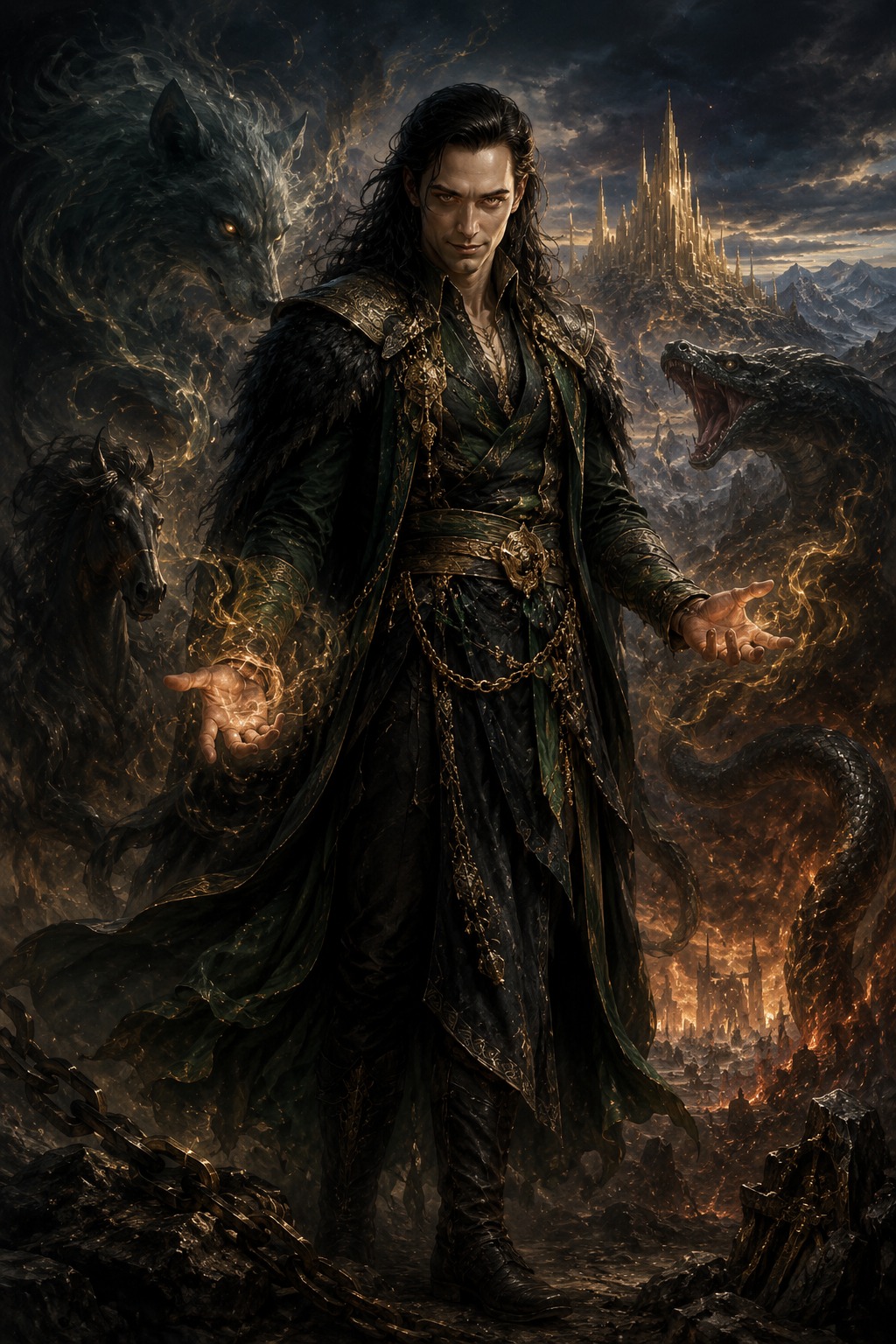
Loki (Old Norse Loki, 'knot or spider web') is the god of shape-shifting, cunning, fire, chaos, and the trickster of Norse mythology — the decisive canon, the decisive canonical iconographic figure as the son (Loki Laufeyjarson) of the giants Farbauti (Farbauti) and Laufey (Laufey), who became a member of Asgard (Asgard) by becoming a blood-brother of Odin (Odin) through a blood oath. The etymology is the decisive canonical vocabulary of the Old Norse Loki or 'knot (loop, knot)' or 'spider web (spider web)'. The decisive textual canon is the Prose Edda (Prose Edda) of c. 1220 of the early 13th-century Icelandic poet-historian Snorri Sturluson (Snorri Sturluson, 1179-1241) — chapters 33 (introduction), 34-35 (children), 42 (Asgard wall), 49 (death of Baldr), and 50 (binding) of Gylfaginning (Gylfaginning) — the decisive canon — and the Lokasenna (Lokasenna), Voluspa (Voluspa), and Thrymskvida (Thrymskvida) of the Poetic Edda (Poetic Edda) of the c. 1270 Codex Regius (Codex Regius) manuscript are the decisive poetic canon. The decisive canonical iconography in which with the giantess Angrboda (Angrboda) he produced three monster children — Fenrir (Fenrir, wolf), Jormungandr (Jormungandr, Midgard serpent), Hel (Hel, goddess of death) — and caused the death of Baldr (Baldr), igniting Ragnarok (Ragnarok).
Origin
The iconographic origin is the trickster-god worship of the 9th-11th century Norse Viking mythology, and the decisive textual canon is the Prose Edda (Prose Edda) of c. 1220 of the early 13th-century Icelandic — Reykholt — Snorri Sturluson (Snorri Sturluson, 1179-1241) — chapter 33 of Gylfaginning (Gylfaginning) — the decisive canon in which Loki is the son of the giants Farbauti (Farbauti) and Laufey (Laufey), and became a blood-brother of Odin through a blood oath — and chapters 34-35 — the decisive canon in which with the giantess Angrboda (Angrboda) he produced three monster children — Fenrir (Fenrir, wolf), Jormungandr (Jormungandr, Midgard serpent), Hel (Hel, goddess of death). Chapter 42 — the decisive canon in which to lure the horse Svadilfari (Svadilfari) of the giant builder of Asgard's walls, Loki transformed into a mare and then gave birth to Odin's 8-legged horse Sleipnir (Sleipnir) — and chapter 49 — the decisive canon in which Loki, disguised as an old woman, learned from Frigg that the mistletoe was Baldr's weakness, then had the blind Hodr (Hodr) hold the mistletoe arrow and killed Baldr — and chapter 50 — the decisive canon in which after Loki's insult (Lokasenna) at Aegir's (Aegir) feast, the gods bound him with the entrails of his son Narfi (Narfi) and placed a venomous snake above his head to torture him eternally.
Features
- Young, clever, handsome with a subtly twisted smile
- Freely shape-shifts between sexes, races, and animals
- Monster children — Fenrir wolf, Jormungandr serpent, Hel goddess of death
- Transformed into a mare to give birth to Sleipnir
- Bound while his wife Sigyn (Sigyn) catches the venom in a bowl
- Mutually destroyed with Heimdall (Heimdall) at Ragnarok
Stories
The trickster-god worship of the 9th-11th century Norse Viking mythology is the decisive origin, and the decisive textual canon is chapters 33, 34-35, 42, 49, and 50 of Snorri Sturluson Prose Edda Gylfaginning of c. 1220 and the Lokasenna, Voluspa, and Thrymskvida of the Poetic Edda of the c. 1270 Codex Regius manuscript. The Thrymskvida (Thrymskvida) of 1270 — the decisive canon in which the giant Thrymr (Thrymr) stole Thor's Mjollnir and demanded Freya, and as a result Loki disguised himself with Thor as a bride to recover the Mjollnir — and the Lokasenna (Lokasenna) — the decisive canon of insult to the gods at the feast of Aegir — are the decisive canon. The 1856 German prose Edda translation of Karl Simrock and the 1835 Deutsche Mythologie of Jacob Grimm are the decisive 19th-century scholarly canon, and the Loge (Loge, Loki) of the opera tetralogy Der Ring des Nibelungen of Richard Wagner premiered at the Bayreuth Festspielhaus on 13-17 August 1876 is the decisive 19th-century musical canon. The decisive 21st-century canon is the Loki played by Tom Hiddleston (Tom Hiddleston, born 9 February 1981 in Westminster, London, UK) of the Marvel Studios film Thor (Thor) (directed by Kenneth Branagh) released in the USA on 6 May 2011, and the Loki played by Tom Hiddleston of the Disney+ series Loki (Loki) (directed by Kate Herron) released in the USA on 9 June 2021 are the 21st-century decisive global video canon.
Weakness
Loki's weaknesses are: (1) lack of morality and loyalty — the decisive canonical weakness — the decisive canon that he eventually turns all the gods into enemies; (2) binding after killing Baldr — the most decisive canonical weakness in the 1220 Snorri Gylfaginning chapter 50 canon — the decisive canon in which the gods bound him with the entrails of his son Narfi (Narfi), placed a venomous snake (Skadi (Skadi) goddess) above his head to drip venom eternally, and his wife Sigyn (Sigyn) catches it in a bowl, but every time the bowl is emptied the venom drips onto Loki's face causing him to writhe; (3) fate of Ragnarok — the 1270 Voluspa canon — the decisive canon in which Loki is freed from his binding, leads the army of giants as commander, duels with Heimdall (Heimdall), and they mutually destroy each other; (4) giant lineage — the decisive canon; (5) double-edged trickster — the decisive canon of both helping the gods and bringing calamity; (6) weight of insult — the decisive canon of the 1270 Lokasenna; (7) binding of the sacred domain — the decisive canon; (8) binding of children — the decisive canon. The decisive canonical finale is chapter 51 of the 1220 Snorri Gylfaginning — the decisive mythological canon in which at Ragnarok Loki is freed from his binding, leads the army of giants as commander, duels with Heimdall, and they mutually destroy each other.
Cultural Significance
Loki is not merely a trickster-god icon but the canonical iconographic figure of the decisive Norse canon, traversing chapters 33, 34-35, 42, 49, and 50 of Snorri Sturluson Prose Edda Gylfaginning of the early 13th century c. 1220, the c. 1270 Codex Regius manuscript Poetic Edda Lokasenna, Voluspa, and Thrymskvida, the 1835 Jacob Grimm Deutsche Mythologie, the 1876 Wagner Der Ring des Nibelungen Loge, the 2011 Marvel film Thor, and the 2021 Disney+ Loki. The trickster-god worship of the 9th-11th century Norse Viking mythology settled as the decisive canon in Gylfaginning (Gylfaginning) of the Prose Edda (Prose Edda) of c. 1220 of the early 13th-century Icelandic — Reykholt — Snorri Sturluson (Snorri Sturluson, born c. 1179 in Hvammur, Iceland, assassinated 23 September 1241 at Reykholt, Iceland by order of King Haakon IV of Norway). The decisive mythological canon is the decisive canon in which Loki is the son of the giants Farbauti (Farbauti) and Laufey (Laufey), and became a blood-brother of Odin through a blood oath, the decisive canon of producing three monster children — Fenrir (Fenrir, wolf), Jormungandr (Jormungandr, Midgard serpent), Hel (Hel, goddess of death) — with the giantess Angrboda (Angrboda), the decisive canon of transforming into a mare to give birth to Odin's 8-legged horse Sleipnir (Sleipnir), the decisive canon of the murder of Baldr (Baldr), and the decisive canon of binding. The decisive 21st-century canon is the Loki played by Tom Hiddleston (Tom Hiddleston, born 9 February 1981 in Westminster, London, UK) of the Marvel Studios film Thor (Thor) (directed by Kenneth Branagh, worldwide box office about 449 million dollars) released in the USA on 6 May 2011, and the 2012 Avengers, 2013 Thor: The Dark World, 2017 Thor: Ragnarok, 2018 Infinity War, 2019 Endgame, and the 9 June 2021 Disney+ series Loki (Loki) (directed by Kate Herron, Seasons 1 and 2) are the 21st-century decisive global canon.
In Popular Culture
- Snorri Sturluson Prose Edda Gylfaginning chapters 33, 34-35, 42, 49, 50 (c. 1220) — decisive origin canon
- Codex Regius manuscript Poetic Edda Lokasenna, Voluspa, Thrymskvida (c. 1270) — decisive poetic canon
- Jacob Grimm Deutsche Mythologie (1835) — decisive 19th-century scholarly canon
- Richard Wagner Der Ring des Nibelungen, Loge (1876) — decisive 19th-century musical canon
- TSR D&D Deities & Demigods, Loki (1980) — decisive fantasy RPG canon
- Marvel film Thor, Tom Hiddleston Loki (2011) — 21st-century decisive film canon
- Marvel film Avengers, Tom Hiddleston Loki (2012) — 21st-century decisive film canon
- Marvel film Thor: Ragnarok, Tom Hiddleston Loki (2017) — 21st-century decisive film canon
- Marvel films Infinity War / Endgame, Tom Hiddleston Loki (2018-2019) — 21st-century decisive film canon
- Disney+ series Loki, Tom Hiddleston Loki (2021-2023) — 21st-century decisive video canon
Trivia
The etymology of Loki (Loki) is the decisive canonical vocabulary of the Old Norse Loki or 'knot (loop, knot)' or 'spider web (spider web)', and the aliases Loptr (Loptr, 'of the air'), Laufeyjarson (Laufeyjarson, 'son of Laufey'), and Lopthrótar (Lopthrótar) are the decisive canonical vocabulary. The decisive textual canon is the Prose Edda (Prose Edda) of c. 1220 of the early 13th-century Icelandic — Reykholt — Snorri Sturluson (Snorri Sturluson, born c. 1179, died 23 September 1241) — chapter 33 of Gylfaginning (Gylfaginning) — the decisive canon in which Loki is the son of the giants Farbauti (Farbauti) and Laufey (Laufey), and is 'the most beautiful but the most evil among the gods'. Chapters 34-35 — the decisive canon in which with the giantess Angrboda (Angrboda) he produced three monster children — Fenrir (Fenrir, wolf), Jormungandr (Jormungandr, Midgard serpent, an ouroboros that bites its own tail), Hel (Hel, goddess of death, half alive and half corpse), and chapter 42 — the decisive canon in which to lure the horse Svadilfari (Svadilfari) of the giant builder of Asgard's walls, Loki transformed into a mare and then gave birth to Odin's 8-legged horse Sleipnir (Sleipnir). Chapter 49 — the decisive canon in which Loki, disguised as an old woman, learned from Frigg that the mistletoe was Baldr's weakness, then had the blind Hodr (Hodr) hold the mistletoe arrow and killed Baldr — and chapter 50 — the decisive canon in which after Loki's insult (Lokasenna) at Aegir's (Aegir) feast, the gods bound him with the entrails of his son Narfi (Narfi) and placed a venomous snake above his head to torture him eternally. The decisive canon in which Loki's wife Sigyn (Sigyn) catches the venom in a bowl, but every time the bowl is emptied the venom drips onto Loki's face causing him to writhe, and every time he writhes an earthquake occurs. The Loki played by Tom Hiddleston (Tom Hiddleston, born 9 February 1981 in Westminster, London, UK, alumnus of Cambridge and the Royal Academy of Dramatic Art) of the Marvel Studios film Thor (Thor) (directed by Kenneth Branagh) released in the USA on 6 May 2011 is the 21st-century decisive global film canon, and the Loki played by Tom Hiddleston of the 9 June 2021 Disney+ series Loki (Loki) (directed by Kate Herron, Seasons 1 and 2 2021-2023) is the 21st-century decisive global series canon.