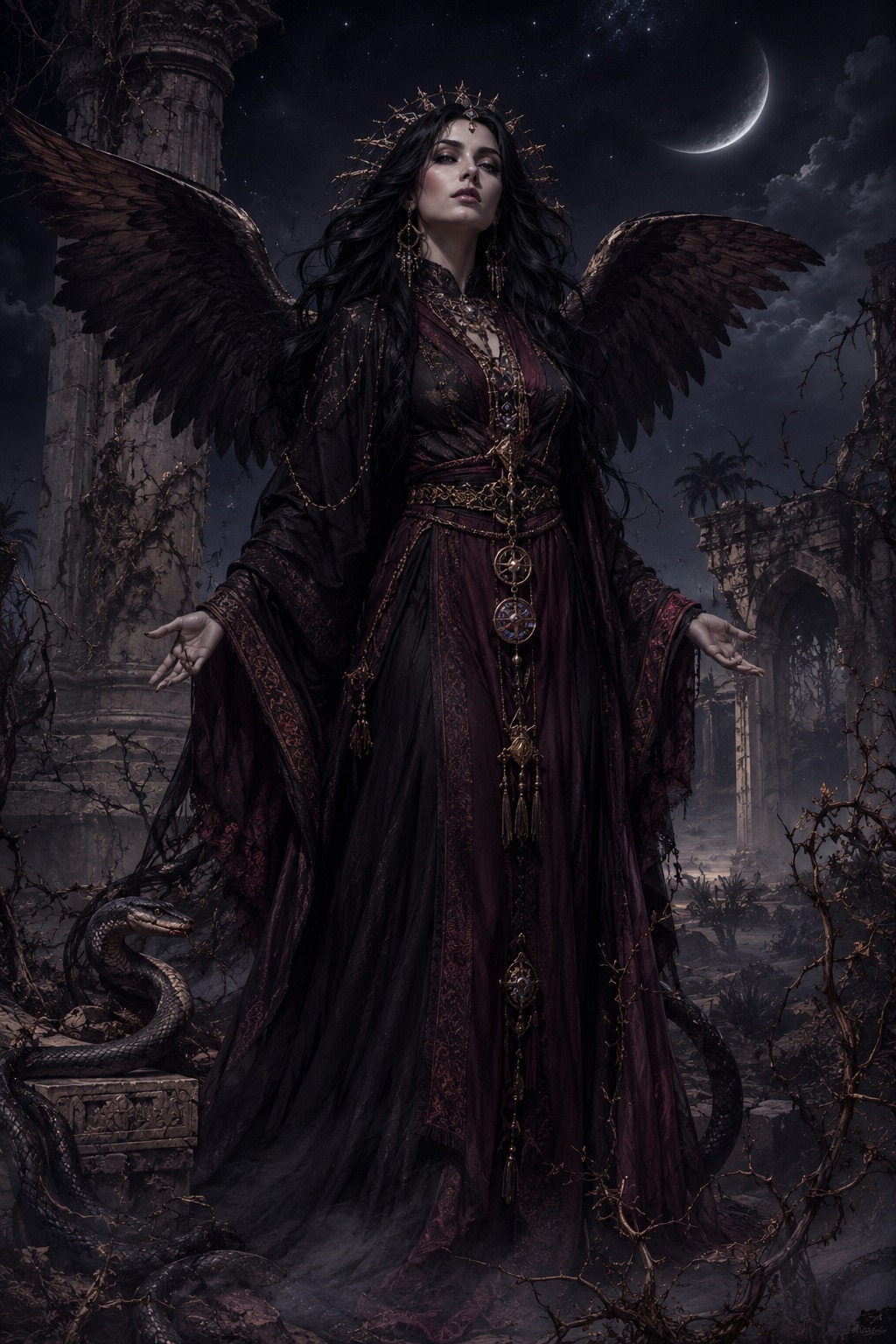
Lilith
Lilith · Witch of the Night — Adam's First Wife, Mother of Demons
Names in Other Languages
 릴리트한국어
Lilith· 밤의 마녀 아담의 첫 아내, 여악마의 어머니
 リリス日本語
Lilith· 夜の魔女 アダムの最初の妻、女悪魔の母
 莉莉絲繁體中文
Lilith· 夜之女巫 亞當之首妻,女惡魔之母
 LilithDeutsch
Lilith · Hexe der Nacht — Adams erste Frau, Mutter der Dämoninnen
 LilithFrançais
Lilith · Sorcière de la nuit — Première femme d'Adam, mère des démones
 LilithEspañol
Lilith · Bruja de la noche — Primera esposa de Adán, madre de demonios
 LilithPortuguês
Lilith · Bruxa da noite — Primeira esposa de Adão, mãe dos demônios
 LilitPolski
Lilit · Wiedźma nocy — Pierwsza żona Adama, matka demonic
 ЛилитРусский
Lilith · Ведьма ночи — Первая жена Адама, мать демониц
Lilith (Hebrew Lilith, Latin Lilith) is the female demon of Jewish mythology — the decisive canon — and in some traditions, the 'first woman' formed by God from earth at the same time as Adam, not from his rib, but who, considering herself equal to Adam and refusing to submit to him, left Eden and then united with Satan (Samael) and gave birth to countless demons (Lilim) — the decisive canonical iconographic figure. Aliases — Lilitu (Lilitu, Mesopotamian), Mother of Lilim, Consort of Samael, Night Demoness, Adam's First Wife — are the decisive canonical vocabulary. The decisive Old Testament canon is the decisive origin canon of Isaiah (Isaiah) 34:14 of c. 6th century BCE — 'Lilith (Hebrew Lilith), the night creature dwelling with wild beasts'. The decisive Jewish apocryphal canon is the decisive canon of the Alphabet of Ben Sira (Alphabet of Ben Sira) of c. 8th-10th century — the myth of Adam's first wife — and the decisive Kabbalah canon is the decisive canon of Lilith as the consort of Samael (Samael) in the Zohar (Zohar) by Moses de León (Moses de León) of c. 1280.
Origin
The etymological origin is the decisive origin canon of the Mesopotamian night demoness Lilitu (Lilitu, from Sumerian 'lil' meaning 'wind, spirit') of c. 2000 BCE, and the decisive origin art canon is the decisive canon of the Burney Relief (Burney Relief) (now in the British Museum) of Babylon of c. 19th century BCE — the iconography of a naked goddess with bird's feet and wings. The decisive Old Testament canon is the decisive origin canon of Isaiah (Isaiah) 34:14 of c. 6th century BCE — 'The wild beasts of the desert shall also meet with the wild beasts of the island, and the satyr shall cry to his fellow; the night creature Lilith (Hebrew Lilith) shall also rest there and find for herself a place of rest'. The decisive Talmud canon is the decisive canon of the Babylonian Talmud (Babylonian Talmud) Niddah 24b, Eruvin 100b, and Shabbat 151b of the 4th-6th century — Lilith as a demoness with long hair and wings, and the decisive canon that a man who sleeps alone falls into her hand. The decisive Jewish apocryphal canon is the decisive canon of the Alphabet of Ben Sira (Alphabet of Ben Sira) of c. 8th-10th century — 'When God created Adam, He created from earth at the same time as him a woman, Lilith. But Lilith, considering herself equal to Adam, refused to submit to him, spoke the holy name of God (Tetragrammaton YHWH) aloud, and left Eden' — the decisive canon in which God sent three angels Senoy (Senoy), Sansenoy (Sansenoy), and Semangelof (Semangelof) to bring Lilith back, but Lilith refused and instead accepted that 100 of her own children (the demons Lilim) would die every day, and the decisive canon that if an amulet bearing the names of the three angels is hung over a newborn's cradle, she cannot approach. The decisive Kabbalah canon is the decisive canon of Lilith as the consort of Samael (Samael, Satan) in the Zohar (Zohar) by the Spanish Moses de León (Moses de León, 1240-1305) of c. 1280.
Features
- Beautiful woman with long black hair
- Wings of a bat or owl
- Depicted joined with a serpent or lizard
- Night demoness who preys on newborns — Mother of Lilim (Lilim)
- Main axis Adam's first wife Consort of Samael (Samael)
- Aliases — Night Spirit, Lilitu (Lilitu), Night Demoness
Stories
The Mesopotamian night demoness Lilitu of c. 2000 BCE is the decisive origin, and the decisive textual canon is Isaiah 34:14 of c. 6th century BCE, Babylonian Talmud Niddah 24b, Eruvin 100b, and Shabbat 151b of the 4th-6th century, the Alphabet of Ben Sira of c. 8th-10th century, and the Zohar of Moses de León of c. 1280. The decisive canon as ancient Jewish amulets (kameah) made to banish her name for the protection of newborns, and the decisive canon broadly called upon as a symbol of autonomous women, anti-establishment, and femmes fatales in modern feminism, gothic, and dark fantasy. The decisive 19th-century art canon is the decisive canon of the oil painting Lilith (Lilith) (in the Atkinson Art Gallery) of 1892 by the English John Collier (John Collier, 1850-1934) — the iconography of a naked Lilith joined with a serpent. The decisive 21st-century video canon is the decisive 21st-century global video canon of the demon Lilith as the final seal of the finale of Season 3 of the TV series Supernatural (Supernatural) by USA CW from 1 May 2008, and the decisive 21st-century game canon is the decisive 21st-century global game canon of the main antagonist Lilith (Mother of Sanctuary) in Diablo IV (Diablo IV) by Blizzard Entertainment released on 4 June 2024.
Weakness
Lilith's weaknesses are: (1) the names of the three angels — the decisive canonical weakness — the decisive canon of fleeing before the names of the three angels of Jewish amulets, Senoy (Senoy), Sansenoy (Sansenoy), and Semangelof (Semangelof); (2) the protective amulet — the decisive canonical weakness — the decisive canon that if an amulet bearing the names of the three angels is hung over a newborn's cradle, she cannot approach; (3) death of her children — the decisive canonical weakness — the decisive canon of the Alphabet of Ben Sira that she must accept that 100 of her own children (Lilim) die every day; (4) God's holy name — the decisive canonical weakness — the decisive canon that although she left Eden by speaking God's holy name (YHWH, Tetragrammaton) aloud, she is powerless before the authority of that name; (5) Christ's authority — the decisive canonical weakness; (6) binding to Samael — the decisive canon of being bound as the consort of Samael (Satan); (7) binding of the sacred domain — the decisive canon; (8) binding of the night — the decisive canon of being bound as a night spirit. The decisive canonical finale is the decisive mythological canon of the eternal resting place of the night dwelling with wild beasts in Isaiah 34:14.
Cultural Significance
Lilith is not merely a demoness icon but the canonical iconographic figure of the decisive Judeo-Christian canon, traversing the Babylonian Burney Relief of c. 19th century BCE, the Mesopotamian Lilitu of c. 2000 BCE, Isaiah 34:14 of c. 6th century BCE, Babylonian Talmud Niddah 24b, Eruvin 100b, and Shabbat 151b of the 4th-6th century, the Alphabet of Ben Sira of c. 8th-10th century, the Zohar of Moses de León of c. 1280, Goethe's Faust Part I of 1808, John Collier's Lilith of 1892, the USA CW Supernatural of 2008, and Blizzard's Diablo IV of 2024. The etymological origin settled as the decisive canon of the Mesopotamian night demoness Lilitu (Lilitu, from Sumerian 'lil' meaning 'wind, spirit') of c. 2000 BCE. The decisive origin art canon is the decisive canon of the Burney Relief (Burney Relief) (now in the British Museum) of Babylon of c. 19th century BCE — the iconography of a naked goddess with bird's feet and wings. The decisive Old Testament canon is the decisive canon of Isaiah (Isaiah) 34:14 of c. 6th century BCE — 'The wild beasts of the desert shall also meet with the wild beasts of the island, and the satyr shall cry to his fellow; the night creature Lilith shall also rest there and find for herself a place of rest'. The decisive Talmud canon is the decisive canon of the Babylonian Talmud (Babylonian Talmud) Niddah 24b, Eruvin 100b, and Shabbat 151b of the 4th-6th century — Lilith as a demoness with long hair and wings. The decisive Jewish apocryphal canon is the decisive canon of the myth of Adam's first wife in the Alphabet of Ben Sira (Alphabet of Ben Sira) of c. 8th-10th century — the decisive canon in which Lilith, considering herself equal to Adam, refused to submit to him and left Eden, after which God sent three angels Senoy (Senoy), Sansenoy (Sansenoy), and Semangelof (Semangelof) to bring Lilith back, but Lilith refused. The decisive Kabbalah canon is the decisive canon of Lilith as the consort of Samael (Samael, Satan) in the Zohar (Zohar) by the Spanish Moses de León (Moses de León, 1240-1305) of c. 1280. The decisive 19th-century literary canon is the decisive canon of Lilith (Adam's first wife) in 'Walpurgisnacht' of Faust (Faust) Part I of 1808 by the German Johann Wolfgang von Goethe (Johann Wolfgang von Goethe, 1749-1832), and the decisive 19th-century art canon is the decisive canon of the oil painting Lilith (Lilith) (in the Atkinson Art Gallery) of 1892 by the English John Collier (John Collier, 1850-1934) — the iconography of a naked Lilith joined with a serpent. The decisive 21st-century video canon is the decisive canon of the demon Lilith as the final seal of the finale (aired 15 May 2008) of Season 3 of the TV series Supernatural (Supernatural) by USA CW from 1 May 2008, and the decisive 21st-century game canon is the decisive global game canon of the main antagonist Lilith (Mother of Sanctuary) in Diablo IV (Diablo IV) by USA Blizzard Entertainment (Blizzard Entertainment) released on 4 June 2024 (official release 6 June).
In Popular Culture
- Babylonian Burney Relief naked goddess with bird's feet and wings (c. 19th century BCE) — decisive origin art canon
- Mesopotamian night demoness Lilitu (Lilitu) (c. 2000 BCE) — decisive origin canon
- Isaiah 34:14 night creature Lilith (c. 6th century BCE) — decisive Old Testament canon
- Babylonian Talmud Niddah 24b, Eruvin 100b, Shabbat 151b (4th-6th century) — decisive Talmud canon
- Alphabet of Ben Sira Adam's first wife (c. 8th-10th century) — decisive Jewish apocryphal canon
- Moses de León Zohar consort of Samael (c. 1280) — decisive Kabbalah canon
- Goethe Faust Part I 'Walpurgisnacht' Lilith (1808) — decisive 19th-century literary canon
- John Collier oil painting Lilith (Lilith) (1892) — decisive 19th-century art canon
- CW TV series Supernatural Season 3 demon Lilith (2008) — 21st-century decisive TV canon
- Blizzard Diablo IV main antagonist Lilith (Mother of Sanctuary) (2024) — 21st-century decisive global game canon
Trivia
The etymology of Lilith (Hebrew Lilith) is the decisive canonical vocabulary of the Mesopotamian night demoness Lilitu (Lilitu, from Sumerian 'lil' meaning 'wind, spirit') of c. 2000 BCE — the decisive canon of the etymological connection with Hebrew 'layla (night)', and aliases Lilitu (Lilitu), Mother of Lilim, Consort of Samael, Night Demoness, Adam's First Wife, Mother of Hatred (Diablo IV) are the decisive canonical vocabulary. The decisive origin art canon is the decisive canon of the Burney Relief (Burney Relief, Queen of the Night) (now in the British Museum, ME 2003,0718.1, discovered 1924) of Babylon of c. 19th century BCE — the iconography of a naked goddess with bird's feet and wings. The decisive Old Testament canon is the decisive origin canon of Isaiah (Isaiah) 34:14 of c. 6th century BCE — 'The wild beasts of the desert shall also meet with the wild beasts of the island, and the satyr shall cry to his fellow; the night creature Lilith shall also rest there and find for herself a place of rest'. The decisive Talmud canon is the decisive canon of the Babylonian Talmud (Babylonian Talmud) Niddah 24b of the 4th-6th century — 'If a child resembles Lilith's face while in the mother's womb, he dies' — and Eruvin 100b — 'After Eve sinned, Adam was separated from her for 130 years, during which Lilith bore countless children from Adam's semen' — and Shabbat 151b — 'A man who sleeps alone falls into Lilith's hand'. The decisive Jewish apocryphal canon is the decisive canon of the Alphabet of Ben Sira (Alphabet of Ben Sira) 23a-23b of c. 8th-10th century — 'When God created Adam, He created from earth at the same time as him a woman, Lilith. But Lilith, considering herself equal to Adam, refused to submit (Adam lying on top) to him, spoke the holy name of God (Tetragrammaton YHWH) aloud, and left Eden' — the decisive canon in which God sent three angels Senoy (Senoy), Sansenoy (Sansenoy), and Semangelof (Semangelof) to bring Lilith back, but Lilith refused and instead accepted that 100 of her own children (the demons Lilim Lilim) would die every day, and that if an amulet (kameah) bearing the names of the three angels is hung over a newborn's cradle, she cannot approach. The decisive Kabbalah canon is the decisive canon of Lilith as the consort of Samael (Samael, Satan) in the Zohar (Zohar) by the Spanish Moses de León (Moses de León, 1240-1305) of c. 1280. The decisive 19th-century literary canon is the decisive canon of Lilith (Adam's first wife) in 'Walpurgisnacht' of Faust (Faust) Part I of 1808 by the German Johann Wolfgang von Goethe (Johann Wolfgang von Goethe, 1749-1832), and the decisive 19th-century art canon is the decisive canon of the oil painting Lilith (Lilith) (in the Atkinson Art Gallery, Southport) of 1892 by the English John Collier (John Collier, 1850-1934) — the iconography of a naked Lilith joined with a great snake (boa). The decisive 21st-century video canon is the decisive canon of the demon Lilith as the final seal of the finale (aired 15 May 2008) of Season 3 of the TV series Supernatural (Supernatural) by USA CW from 1 May 2008, and the decisive 21st-century game canon is the decisive global game canon of the main antagonist Lilith (Mother of Sanctuary, Mother of Hatred) in the action RPG Diablo IV (Diablo IV) by USA Blizzard Entertainment (Blizzard Entertainment) released on 4 June 2024 (official release 6 June).