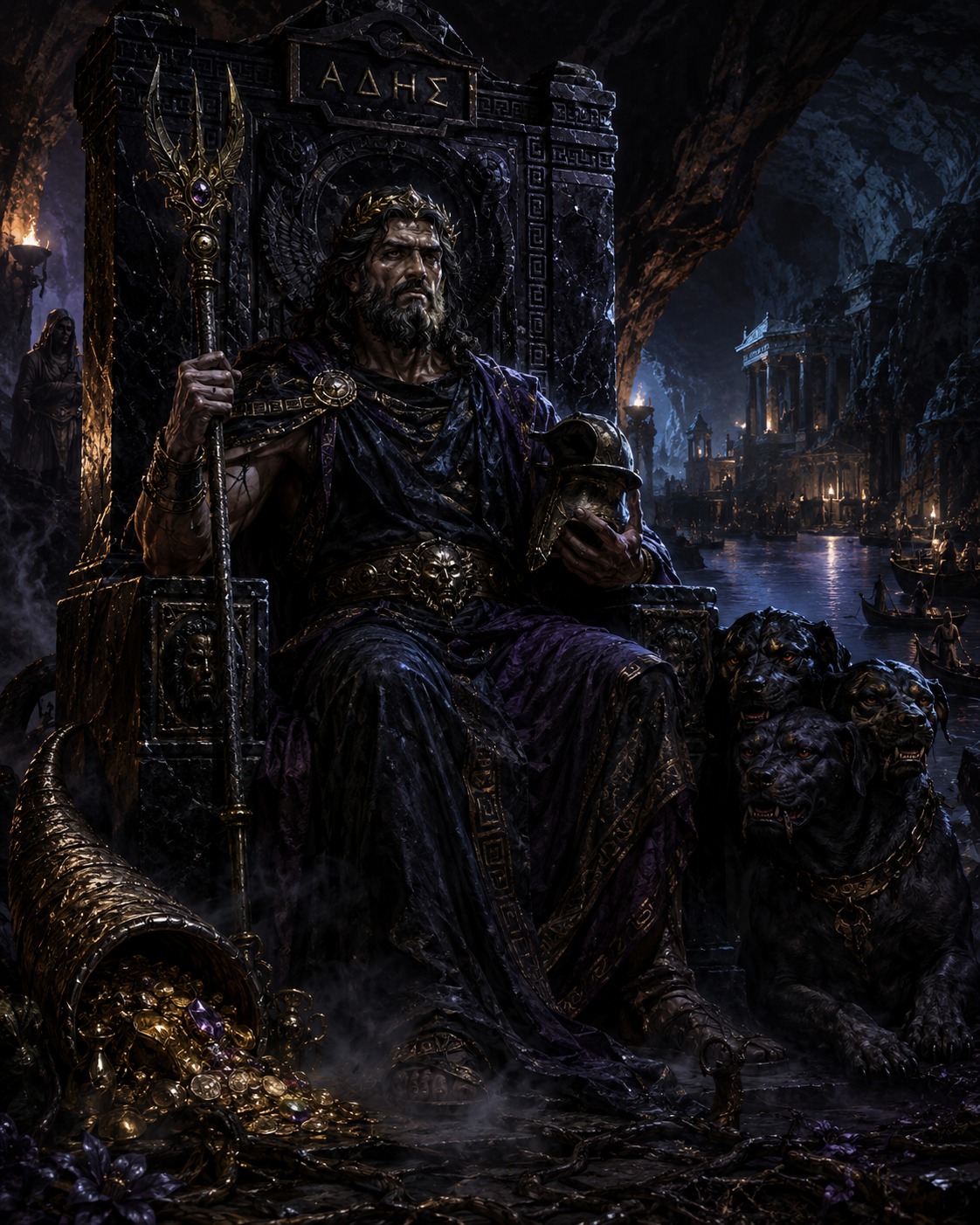
Hades
Hades · Greek God of the Underworld — King of the Dead
Names in Other Languages
 하데스한국어
Hades · 그리스 저승의 신 — 망자의 왕
 ハデス日本語
Hades · ギリシャ冥府の神 — 死者の王
 黑帝斯繁體中文
Hades · 希臘冥府之神 — 亡者之王
 HadesDeutsch
Hades · Griechischer Gott der Unterwelt — König der Toten
 HadèsFrançais
Hadès · Dieu grec des Enfers — Roi des morts
 HadesEspañol
Hades · Dios griego del inframundo — Rey de los muertos
 HadesPortuguês
Hades · Deus grego do submundo — Rei dos mortos
 HadesPolski
Hades · Grecki bóg podziemi — Król umarłych
 АидРусский
Hades · Греческий бог подземного мира — Царь мёртвых
Hades (Ancient Greek Haides, Latin Pluto) is the god of the underworld and king of the dead in Greek mythology — the decisive canon, the son of Kronos (Kronos) and Rhea (Rhea), the elder brother of Zeus (Zeus) and Poseidon (Poseidon), who does not belong to the 12 Olympian gods but holds equal power — the decisive canonical iconographic figure. The etymology of the Greek Haides is the decisive canonical vocabulary of 'unseen (a-idein, not-see)', and the alias Plouton (Plouton, 'god of wealth' — used to avoid speaking his true name) is the decisive canonical vocabulary. The decisive textual canon is the Theogony (Theogony) lines 453-491 of Hesiod (Hesiod) of c. 8th-7th century BCE — the decisive canon in which Kronos swallows his children — and lines 768-806 — the decisive canon of Hades's underworld realm — and the Iliad (Iliad) Book 15 lines 187-193 of Homer (Homer) of c. 8th century BCE — the decisive canon in which Zeus, Poseidon, and Hades, the three brothers, divided heaven, sea, and underworld by lot — and the Odyssey (Odyssey) Book 11 — the decisive canon of the Nekyia (Nekyia, evocation of the souls of the dead). The decisive canon of the Persephone (Persephone) abduction myth of the Homeric Hymns (Homeric Hymns) No. 2 Hymn to Demeter of c. 7th-6th century BCE, and the decisive canonical iconography of the mature male god clothed in darkness and dignity, hiding his appearance with the kynee (kynee) helmet, and commanding the guard dog Kerberos (Kerberos, 3-headed dog).
Origin
The iconographic origin is the underworld faith of the Bronze Age Mycenaean civilisation (c. 1600-1100 BCE), and the decisive textual canon is the Theogony (Theogony) lines 453-491 of Hesiod (Hesiod) of c. 8th-7th century BCE — the decisive canon in which Kronos (Kronos), fearing the prophecy of Gaia (Gaia) and Ouranos (Ouranos), swallows his children — and lines 768-806 — the decisive canon of Hades's underworld realm and Kerberos (Kerberos). The Iliad (Iliad) Book 15 lines 187-193 of Homer (Homer) of c. 8th century BCE — the decisive canon in which Poseidon said 'we three (Zeus, Poseidon, Hades), the children of Kronos, divided heaven, sea, and underworld by lot, and earth and Olympus are shared' — and the Odyssey (Odyssey) Book 11 — the decisive canon of the Nekyia (Nekyia) in which Odysseus evoked the souls of the dead at the entrance of the underworld. The Homeric Hymns (Homeric Hymns) No. 2 Hymn to Demeter (Hymn to Demeter) lines 1-90 of c. 7th-6th century BCE — the decisive canon in which Hades, riding a golden chariot, ascended to the earth and abducted Persephone (Persephone) and took her to the underworld — and lines 334-440 — the decisive canon in which Persephone ate 4 (or 6) pomegranate seeds and had to spend 1/3 (or 1/2) of each year in the underworld. The Bibliotheca (Bibliotheke) Book 1 chapter 1 verses 4-5 of Pseudo-Apollodorus of c. 1st century BCE — the decisive mythological canon — and the Metamorphoses (Metamorphoses) Book 5 lines 341-571 of Ovid (Publius Ovidius Naso) of c. 1st century CE — the decisive canon of the Persephone abduction.
Features
- Mature male god clothed in darkness and dignity
- Hides his appearance with the kynee (kynee) helmet
- Commands the guard dog Kerberos (Kerberos, 3-headed dog)
- Sceptre and cornucopia (cornucopia)
- River Styx (Styx) and ferryman Charon (Charon)
- Ruler of Tartaros (Tartaros) and Elysion (Elysion)
Stories
The Bronze Age Mycenaean underworld faith is the decisive origin, and the decisive textual canon is the Hesiod Theogony lines 453-491 and 768-806 of c. 8th-7th century BCE, the Homer Iliad Book 15 and Odyssey Book 11 Nekyia of c. 8th century BCE, and the Homeric Hymns No. 2 Hymn to Demeter lines 1-90 and 334-440 of c. 7th-6th century BCE. The decisive canon that the Greeks avoided calling his true name directly and used 'Plouton (Plouton, god of wealth)' as a euphemism, and he was invoked in funerary and burial rites and in agricultural fertility (underground roots). The decisive canon of the Persephone abduction in the Bibliotheca Book 1 chapter 1 verses 4-5 of Pseudo-Apollodorus of c. 1st century BCE and the Metamorphoses Book 5 lines 341-571 of Ovid of c. 1st century CE, and the Dis (Dis) of the c. 1320 Divina Commedia (Divina Commedia) Inferno (Inferno) Canto 9 of Dante Alighieri (Dante Alighieri, 1265-1321) is the decisive 14th-century canon. The Hades of the 1980 D&D Deities & Demigods (Deities & Demigods) by TSR in the USA is the decisive fantasy RPG canon, and the decisive 21st-century canon is the Hades (main antagonist) played by James Woods (James Woods, b. 1947) of the Disney film Hercules (Hercules) (directed by John Musker and Ron Clements) released in the USA on 27 June 1997, and the Hades (voiced by Logan Cunningham (Logan Cunningham)) of the video game Hades (Hades) by Supergiant Games (Supergiant Games) released in the USA on 17 September 2020 are the 21st-century decisive global video canon.
Weakness
Hades's weaknesses are: (1) obsession with Persephone — the decisive canonical weakness — the decisive canon of the Persephone abduction in the c. 7th-6th century BCE Homeric Hymns No. 2 Hymn to Demeter; (2) cannot directly intervene in the fate of death — the decisive canon; (3) firm wrath at the escape of souls — the decisive canon of the Orpheus (Orpheus) and Eurydice (Eurydice) myth and the decisive canon of the capture of Kerberos in the 12 Labours of Heracles (Heracles); (4) miserliness — the decisive canon; (5) binding of the true name — the decisive canon of the euphemism 'Plouton' to avoid calling his true name; (6) binding of the lot — the decisive canon in the c. 8th century BCE Homer Iliad Book 15 lines 187-193 in which he received the underworld by lot; (7) binding of the earth — the decisive canon that he rarely ascends to the earth; (8) binding of the sacred domain — the decisive canon. The decisive canonical finale is lines 334-440 of the c. 7th-6th century BCE Homeric Hymns No. 2 Hymn to Demeter — the decisive mythological canon in which Persephone ate 4 (or 6) pomegranate seeds and had to spend 1/3 (or 1/2) of each year in the underworld.
Cultural Significance
Hades is not merely an underworld-god icon but the canonical iconographic figure of the decisive Greek canon, traversing the Bronze Age Mycenaean underworld faith, the c. 8th-7th century BCE Hesiod Theogony lines 453-491 and 768-806, the c. 8th century BCE Homer Iliad Book 15 and Odyssey Book 11 Nekyia, the c. 7th-6th century BCE Homeric Hymns No. 2 Hymn to Demeter lines 1-90 and 334-440, the c. 1st century BCE Pseudo-Apollodorus Bibliotheca Book 1 chapter 1 verses 4-5, the c. 1st century CE Ovid Metamorphoses Book 5 lines 341-571, the c. 1320 Dante Divina Commedia Inferno, the 1980 D&D Deities & Demigods, the 1997 Disney Hercules, and the 2020 Supergiant Hades. The underworld faith of the Bronze Age Mycenaean civilisation (c. 1600-1100 BCE) settled as the decisive canon in lines 453-491 of the c. 8th-7th century BCE Hesiod Theogony — the decisive canon in which Kronos swallows his children — and lines 768-806 — the decisive canon of Hades's underworld realm. The decisive mythological canon is the decisive canon in Book 15 lines 187-193 of the c. 8th century BCE Homer Iliad in which Zeus, Poseidon, and Hades, the three brothers, divided heaven, sea, and underworld by lot, and the decisive canon in the c. 7th-6th century BCE Homeric Hymns (Homeric Hymns) No. 2 Hymn to Demeter in which Hades, riding a golden chariot, ascended to the earth and abducted Persephone (Persephone) and took her to the underworld. The decisive 21st-century canon is the main antagonist Hades played by James Woods (James Woods, born 18 April 1947 in Utah, USA) of the Disney film Hercules (Hercules) (directed by John Musker and Ron Clements, worldwide box office about 252 million dollars) released in the USA on 27 June 1997, and the Hades (voiced by Logan Cunningham (Logan Cunningham)) of the roguelike video game Hades (Hades) (winner of the BAFTA Games Award 2021 Best Game) by Supergiant Games (Supergiant Games) released in the USA on 17 September 2020 is the 21st-century decisive global video canon, and the Hades played by Steve Coogan (Steve Coogan) of the film Percy Jackson (Percy Jackson) released in the USA on 12 February 2010 is also the 21st-century decisive film canon.
In Popular Culture
- Mycenaean Bronze Age underworld faith (Bronze Age) — decisive origin canon
- Hesiod Theogony lines 453-491 and 768-806 (c. 8th-7th century BCE) — decisive birth and realm canon
- Homer Iliad Book 15 lines 187-193 (c. 8th century BCE) — decisive heroic-epic canon
- Homer Odyssey Book 11 Nekyia (c. 8th century BCE) — decisive death canon
- Homeric Hymns No. 2 Hymn to Demeter lines 1-90 and 334-440 (c. 7th-6th century BCE) — decisive Persephone abduction canon
- Pseudo-Apollodorus Bibliotheca Book 1 chapter 1 verses 4-5 (c. 1st century BCE) — decisive mythological canon
- Ovid Metamorphoses Book 5 lines 341-571 (c. 1st century CE) — decisive Latin canon
- Dante Divina Commedia Inferno Canto 9 Dis (c. 1320) — decisive 14th-century literary canon
- TSR D&D Deities & Demigods, Hades (1980) — decisive fantasy RPG canon
- Disney film Hercules, Hades James Woods (1997) — 21st-century decisive film canon
- Supergiant Games Hades, Logan Cunningham (2020) — 21st-century decisive video-game canon
Trivia
The etymology of Hades (Haides) is the decisive canonical vocabulary of the Greek Haides — 'unseen (a-idein, not-see)', and the Latin aliases Plouton (Plouton, 'god of wealth'), Aidoneus (Aidoneus), Stygios (Stygios, 'of Styx'), and Dis (Dis) are the decisive canonical vocabulary. The decisive textual canon is the Theogony (Theogony) lines 453-491 of Hesiod (Hesiod) of c. 8th-7th century BCE — the decisive canon in which Kronos (Kronos), fearing the prophecy of Gaia (Gaia) and Ouranos (Ouranos), swallows his children — and lines 768-806 — the decisive canon of Hades's underworld realm and Kerberos (Kerberos). The Iliad (Iliad) Book 15 lines 187-193 of Homer (Homer) of c. 8th century BCE — the decisive canon in which Zeus, Poseidon, and Hades, the three brothers, divided heaven, sea, and underworld by lot — and Book 5 line 845 — the decisive canon of Hades's kynee (kynee) helmet 'that hides one's appearance' — and the Odyssey (Odyssey) Book 11 — the decisive canon of the Nekyia (Nekyia, 'evocation of the dead') in which Odysseus evoked the souls of the dead at the entrance of the underworld. The Homeric Hymns (Homeric Hymns) No. 2 Hymn to Demeter (Hymn to Demeter) lines 1-90 of c. 7th-6th century BCE — the decisive canon in which Hades, riding a golden chariot, ascended to the earth and abducted Persephone (Persephone) from the Henna (Henna) plain of Sicily and took her to the underworld — and lines 334-440 — the decisive canon in which Persephone ate 4 (or 6) pomegranate seeds and had to spend 1/3 (or 1/2) of each year in the underworld — the decisive canon as the origin of the 4 seasons. The main antagonist Hades played by James Woods (James Woods, born 18 April 1947 in Utah, USA) of the Disney film Hercules (Hercules) (directed by John Musker and Ron Clements, worldwide box office about 252 million dollars) released in the USA on 27 June 1997 is the 21st-century decisive global film canon, and the Hades (voiced by Logan Cunningham (Logan Cunningham)) of the roguelike video game Hades (Hades) (winner of the BAFTA Games Award 2021 Best Game, Metacritic 93) by Supergiant Games (Supergiant Games) released in the USA on 17 September 2020 is the 21st-century decisive global video-game canon.