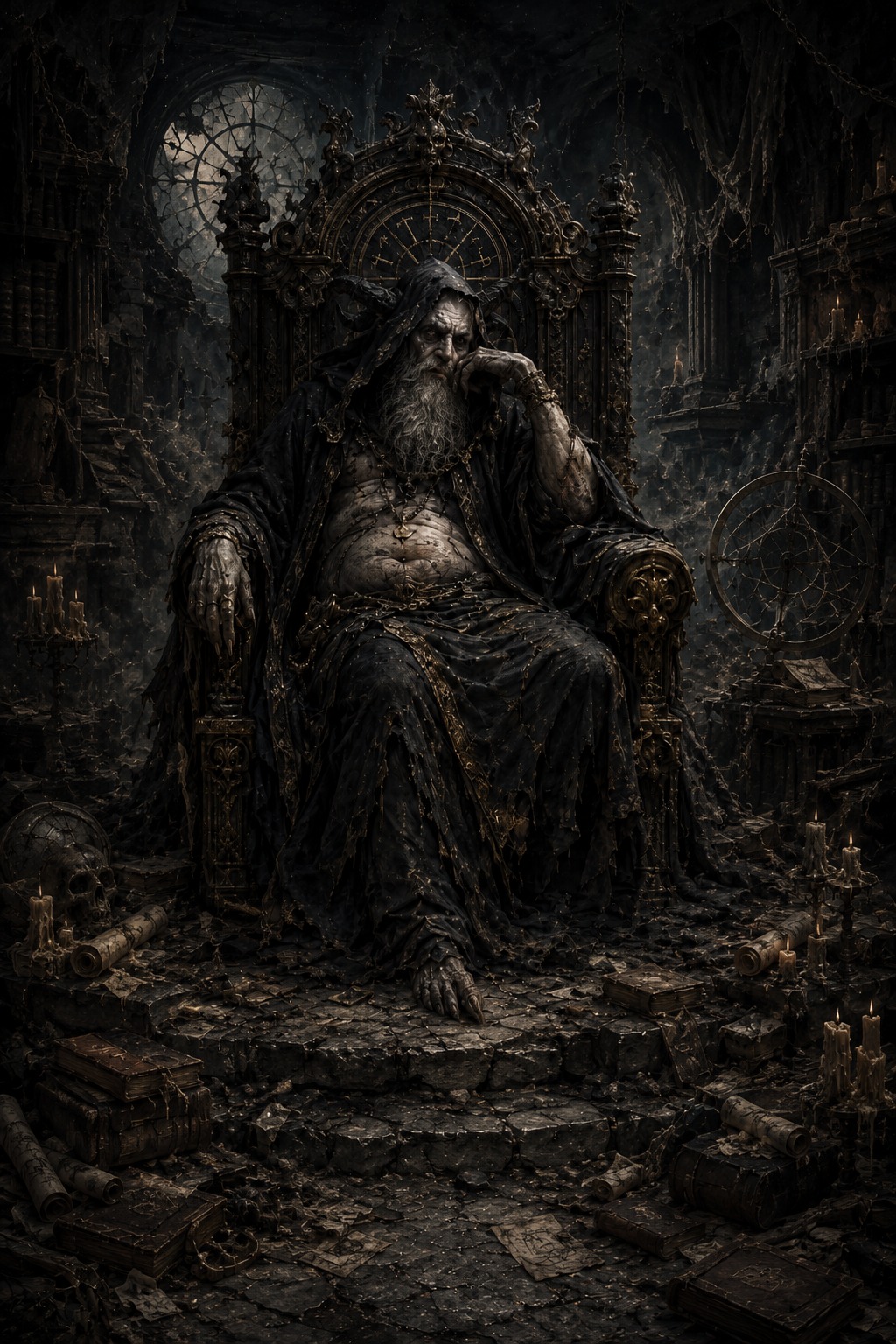
Belphegor
Belphegor · Prince of Sloth — He Who Ruins Humanity Through Laziness
Names in Other Languages
 벨페고르한국어
Belphegor· 나태의 대공 게으름으로 인간을 망치는 자
 ベルフェゴール日本語
Belphegor· 怠惰の大公 怠けさせて人を堕落させる者
 貝爾菲格繁體中文
Belphegor· 怠惰大公 以懶惰毀人之惡魔
 BelphegorDeutsch
Belphegor · Fürst der Trägheit — Der Mensch durch Faulheit zugrunde richtet
 BelphégorFrançais
Belphégor · Prince de la paresse — Celui qui ruine l'humanité par la fainéantise
 BelfegorEspañol
Belfegor · Príncipe de la pereza — El que arruina a la humanidad con la holgazanería
 BelfegorPortuguês
Belfegor · Príncipe da preguiça — Aquele que arruína a humanidade pela vagabundagem
 BelfegorPolski
Belfegor · Książę lenistwa — Ten, kto rujnuje ludzkość przez gnuśność
 БельфегорРусский
Belphegor · Князь лени — Тот, кто губит человечество ленью
Belphegor (Latin Belphegor, English Belphegor) is the demon of Judeo-Christian tradition — the decisive canon — and the Prince of Sloth (Sloth, Acedia) — one of the Seven Deadly Sins — derived from the Hebrew Baal-Peor (Baal-Peor, 'Lord of Peor') — the decisive canonical vocabulary — the decisive canonical iconographic figure of the Moabite god of the Old Testament era personified from the Judeo-Christian perspective. Aliases — Baal-Peor (Baal-Peor), Belfagor (Belfagor), Balphegor (Balphegor), Prince of Sloth — are the decisive canonical vocabulary. The decisive Old Testament canon is the decisive origin canon of Numbers (Numbers) 25:1-9 of c. 6th-4th century BCE — 'And Israel abode in Shittim, and the people began to commit whoredom with the daughters of Moab. And they called the people unto the sacrifices of their gods: and the people did eat, and bowed down to their gods. And Israel joined himself unto Baal-Peor (Baal-Peor): and the anger of the LORD was kindled against Israel'. The decisive satirical literary canon is the decisive canon of Novella di Belfagor Arcidiavolo (Novella di Belfagor Arcidiavolo) by the Italian Niccolò Machiavelli (Niccolò Machiavelli) of 1518.
Origin
The etymological origin is the decisive canon of the Hebrew 'Baal (Baal, lord)' + 'Peor (Peor)' meaning 'Lord of Peor' — the decisive canon that Peor is the name of a mountain in Moab east of the Jordan River, and the decisive Old Testament canon is the decisive origin canon of Numbers (Numbers) 25:1-9 of c. 6th-4th century BCE — the idolatry of Israel falling into Baal-Peor (Baal-Peor) through the seduction of the daughters of Moab — the decisive canon in which 24,000 died in God's wrath. The decisive canon of Psalm (Psalm) 106:28 — 'They joined themselves also unto Baal-Peor, and ate the sacrifices of the dead' — and Hosea (Hosea) 9:10 — 'I found Israel like grapes in the wilderness; I saw your fathers as the firstripe in the fig tree at her first time: but they went to Baal-Peor'. The decisive 16th-century satirical literary canon is the decisive canon of Novella di Belfagor Arcidiavolo (Novella di Belfagor Arcidiavolo) by the Italian Niccolò Machiavelli (Niccolò Machiavelli, 1469-1527) of 1518 — the decisive canon in which when humans boasted that 'marriage is happy', the council of hell sent Belphegor to earth to verify the truth, where he lived as a wealthy human, married, and after experiencing the misery of marriage, fled back to hell in disillusionment — the decisive satirical canon. The decisive seven deadly sins canon is the decisive canon as the Prince of the deadly sin of Sloth (Sloth, Acedia) classified in Treatise on the Confessions of Witches and Wizards (Tractatus de Confessionibus Maleficorum et Sagarum) of 1589 by the German Peter Binsfeld (Peter Binsfeld, 1545-1598).
Features
- Bearded gloomy old man or lewd figure sitting on a toilet
- Black hood and rags
- Magical powder that prevents discovery
- Long fingernails and lazy posture
- Main axis — Prince (Prince) of 'Sloth (Sloth, Acedia)' of the Seven Deadly Sins
- Alias — descendant of Baal-Peor (Baal-Peor, Lord of Peor)
Stories
Baal-Peor in Numbers 25:1-9, Psalm 106:28, and Hosea 9:10 of c. 6th-4th century BCE is the decisive origin, and the decisive satirical literary canon is Novella di Belfagor Arcidiavolo by Machiavelli of 1518 and the Prince of Sloth of the seven deadly sins in Peter Binsfeld's 1589 Treatise on the Confessions of Witches and Wizards. The decisive canon called upon as a symbol of sloth, procrastination, and stagnation of discovery, and theologically connected to the sin of humans burying the talents given by God out of laziness (Parable of the Talents, Matthew 25:14-30) — the decisive canon frequently appearing in Renaissance and Baroque satirical literature as a character feeling disillusionment with marriage and human society. The decisive 19th-century art canon is the decisive canon of the Belphegor iconography of a bearded old man sitting on a toilet or throne in the Dictionnaire Infernal (Dictionnaire Infernal) of 1818 by the French Collin de Plancy (Collin de Plancy, 1793-1881), and the decisive 21st-century game canon is the decisive 21st-century global indie game canon of the demon Belphie (Belphegor) in the video game Helltaker (Helltaker) released on 11 May 2020 by the Polish Mini Studio (Mini Studio).
Weakness
Belphegor's weaknesses are: (1) diligence, creativity, and challenge — the decisive canonical weakness — his temptation is neutralized when exposed to relentless effort and learning, cannot approach those who actively use the time given by God; (2) disillusionment with marriage — the decisive canonical weakness — the decisive canon of Machiavelli's Novella di Belfagor Arcidiavolo of 1518 in which after descending to earth to verify humans' claim that 'marriage is happy', he fled back to hell in disillusionment with the misery of marriage; (3) God's wrath — the decisive canonical weakness — the decisive canon of Numbers 25 in which 24,000 died in God's wrath at the idolatry of Baal-Peor; (4) Phinehas's spear — the decisive canonical weakness — the decisive canon of Numbers 25:7-8 in which Phinehas (Phinehas) thrust through with a spear the Israelite who was with the Moabite woman; (5) God's name — the decisive canonical weakness — powerless before God's name and Christ's authority like all other demons; (6) binding of the sacred domain — the decisive canon; (7) binding of sloth — the decisive canon of the binding of the deadly sin of Sloth; (8) binding of Mount Peor — the decisive canon of the binding to Mount Peor in Moab. The decisive canonical finale is the decisive satirical canon of Machiavelli's Novella di Belfagor Arcidiavolo of 1518 in which he fled back to hell in disillusionment with the misery of marriage.
Cultural Significance
Belphegor is not merely a demon icon but the canonical iconographic figure of the decisive Judeo-Christian canon, traversing Numbers 25:1-9, Psalm 106:28, Hosea 9:10 of c. 6th-4th century BCE, Machiavelli's Novella di Belfagor Arcidiavolo of 1518, Peter Binsfeld's 1589 Treatise on the Confessions of Witches and Wizards, Collin de Plancy's Dictionnaire Infernal of 1818, and the 2020 Helltaker. The etymological origin is the decisive canon of the Hebrew 'Baal' + 'Peor' meaning 'Lord of Peor' — Peor being the name of a mountain in Moab east of the Jordan River. The decisive Old Testament canon is the decisive origin canon of Numbers (Numbers) 25:1-9 of c. 6th-4th century BCE — the idolatry of Israel falling into Baal-Peor (Baal-Peor) through the seduction of the daughters of Moab — settled as the decisive canon in which 24,000 died in God's wrath. The decisive 16th-century satirical literary canon is the decisive canon of Novella di Belfagor Arcidiavolo (Novella di Belfagor Arcidiavolo, La favola di Belfagor) — published posthumously in 1549 — by the Italian political thinker Niccolò Machiavelli (Niccolò Machiavelli, born 3 May 1469 in Florence, Italy, died 21 June 1527) of 1518 — the decisive canon in which the council of hell sent Belphegor to earth to verify humans' claim that the marriage of the dead was the cause of their fate, where he lived as a wealthy human and married, and after experiencing the misery of marriage, fled back to hell — the decisive satirical canon. The decisive seven deadly sins canon is the decisive canon as the Prince of the deadly sin of Sloth (Sloth, Acedia) classified in Treatise on the Confessions of Witches and Wizards (Tractatus de Confessionibus Maleficorum et Sagarum) of 1589 by the German Peter Binsfeld (Peter Binsfeld, 1545-1598) — Lucifer (Pride), Mammon (Greed), Asmodeus (Lust), Leviathan (Envy), Beelzebub (Gluttony), Satan (Wrath), Belphegor (Sloth). The decisive 19th-century art canon is the decisive canon of the Belphegor iconography of a bearded old man sitting on a toilet or throne in the Dictionnaire Infernal (Dictionnaire Infernal) of 1818 by the French Collin de Plancy (Collin de Plancy, 1793-1881), and the decisive 20th-century canon is the decisive canon of the novel Belphégor (Belphégor) by the French Arthur Bernède of 1927 and the French TV series Belphégor or the Phantom of the Louvre (Belphégor ou le Fantôme du Louvre) of 1965. The decisive 21st-century game canon is the decisive 21st-century global indie game canon of the demon Belphie (Belphegor - 'Belphie') in the video game Helltaker (Helltaker) released on 11 May 2020 by the Polish Mini Studio (Mini Studio).
In Popular Culture
- Numbers 25:1-9 idolatry of Baal-Peor (c. 6th-4th century BCE) — decisive origin canon
- Psalm 106:28 and Hosea 9:10 Baal-Peor (c. 6th-4th century BCE) — decisive Old Testament canon
- Machiavelli Novella di Belfagor Arcidiavolo 1518 (published 1549) — decisive 16th-century satirical literary canon
- Peter Binsfeld Treatise on the Confessions of Witches and Wizards Prince of Sloth of the seven deadly sins (1589) — decisive seven deadly sins canon
- Collin de Plancy Dictionnaire Infernal old man on the toilet (1818) — decisive 19th-century art canon
- Arthur Bernède novel Belphégor (1927) — decisive 20th-century canon
- TV series Belphégor or the Phantom of the Louvre (1965) — decisive 20th-century TV canon
- Video game Helltaker Belphie (Belphegor 'Belphie') (2020) — 21st-century decisive global game canon
Trivia
The etymology of Belphegor (Latin Belphegor, English Belphegor) is the decisive canonical vocabulary of the Hebrew 'Baal (Baal, lord)' + 'Peor (Peor)' meaning 'Lord of Peor' — the decisive canon that Peor is the name of a mountain in Moab east of the Jordan River, and aliases Baal-Peor (Baal-Peor), Belfagor (Belfagor), Balphegor (Balphegor), Prince of Sloth, and Belphie (Helltaker) are the decisive canonical vocabulary. The decisive Old Testament canon is the decisive origin canon of Numbers (Numbers) 25:1-9 of c. 6th-4th century BCE — 'And Israel abode in Shittim, and the people began to commit whoredom with the daughters of Moab. And they called the people unto the sacrifices of their gods: and the people did eat, and bowed down to their gods. And Israel joined himself unto Baal-Peor (Baal-Peor): and the anger of the LORD was kindled against Israel' — the decisive canon in which by Moses' command the chiefs of Israel were killed, Phinehas (Phinehas) thrust through with a spear the Israelite who was with the Moabite woman, God's wrath ceased, and 24,000 died. The decisive canon of Psalm (Psalm) 106:28 — 'They joined themselves also unto Baal-Peor, and ate the sacrifices of the dead' — and Hosea (Hosea) 9:10 — 'they went to Baal-Peor'. The decisive 16th-century satirical literary canon is the decisive canon of Novella di Belfagor Arcidiavolo (Novella di Belfagor Arcidiavolo) — published posthumously in 1549 — by the Italian political thinker Niccolò Machiavelli (Niccolò Machiavelli, born 3 May 1469 in Florence, Italy, died 21 June 1527) of 1518 — the decisive canon in which the council of hell sent Belphegor to earth as a wealthy human to verify the claim that the marriage of the dead was the cause of their fate, where he married, and after experiencing the misery of marriage, fled back to hell — the decisive satirical canon. The decisive seven deadly sins canon is the decisive canon as the Prince of the deadly sin of Sloth (Sloth, Acedia) classified in Treatise on the Confessions of Witches and Wizards (Tractatus de Confessionibus Maleficorum et Sagarum) of 1589 by the German Catholic bishop Peter Binsfeld (Peter Binsfeld, 1545-1598) — Lucifer (Pride, Pride), Mammon (Greed, Greed), Asmodeus (Lust, Lust), Leviathan (Envy, Envy), Beelzebub (Gluttony, Gluttony), Satan (Wrath, Wrath), Belphegor (Sloth, Sloth). The decisive 19th-century art canon is the decisive canon of the Belphegor iconography of a bearded old man sitting on a toilet or throne in the Dictionnaire Infernal (Dictionnaire Infernal) of 1818 by the French Collin de Plancy (Collin de Plancy, 1793-1881) — the toilet iconography being the decisive canon of the satirical interpretation that the worship style of the idol of Mount Peor in Moab was offering one's own feces to the god. The decisive 21st-century game canon is the decisive 21st-century global indie game canon of the demon Belphie (Belphegor - 'Belphie') in the indie video game Helltaker (Helltaker) released on 11 May 2020 by the Polish Mini Studio (Mini Studio, Łukasz Piskorz).