Baphomet
Baphomet · Goat-Headed Idol — Symbol of the Occult and Conspiracy
Names in Other Languages
 바포메트한국어
Baphomet· 산양 머리 우상 비교(秘敎)와 음모의 상징
 バフォメット日本語
Baphomet· 山羊頭の偶像 秘教と陰謀の象徴
 巴弗滅繁體中文
Baphomet· 山羊首偶像 秘教與陰謀之象徵
 BaphometDeutsch
Baphomet · Ziegenköpfiges Idol — Sinnbild von Geheimlehre und Verschwörung
 BaphometFrançais
Baphomet · Idole à tête de bouc — Symbole de l'occulte et du complot
 BafometEspañol
Bafomet · Ídolo de cabeza de cabra — Símbolo del ocultismo y la conspiración
 BafoméPortuguês
Bafomé · Ídolo de cabeça de bode — Símbolo do ocultismo e da conspiração
 BafometPolski
Bafomet · Bałwan o głowie kozła — Symbol okultyzmu i spisku
 БафометРусский
Baphomet · Идол с козлиной головой — Символ оккультизма и заговора
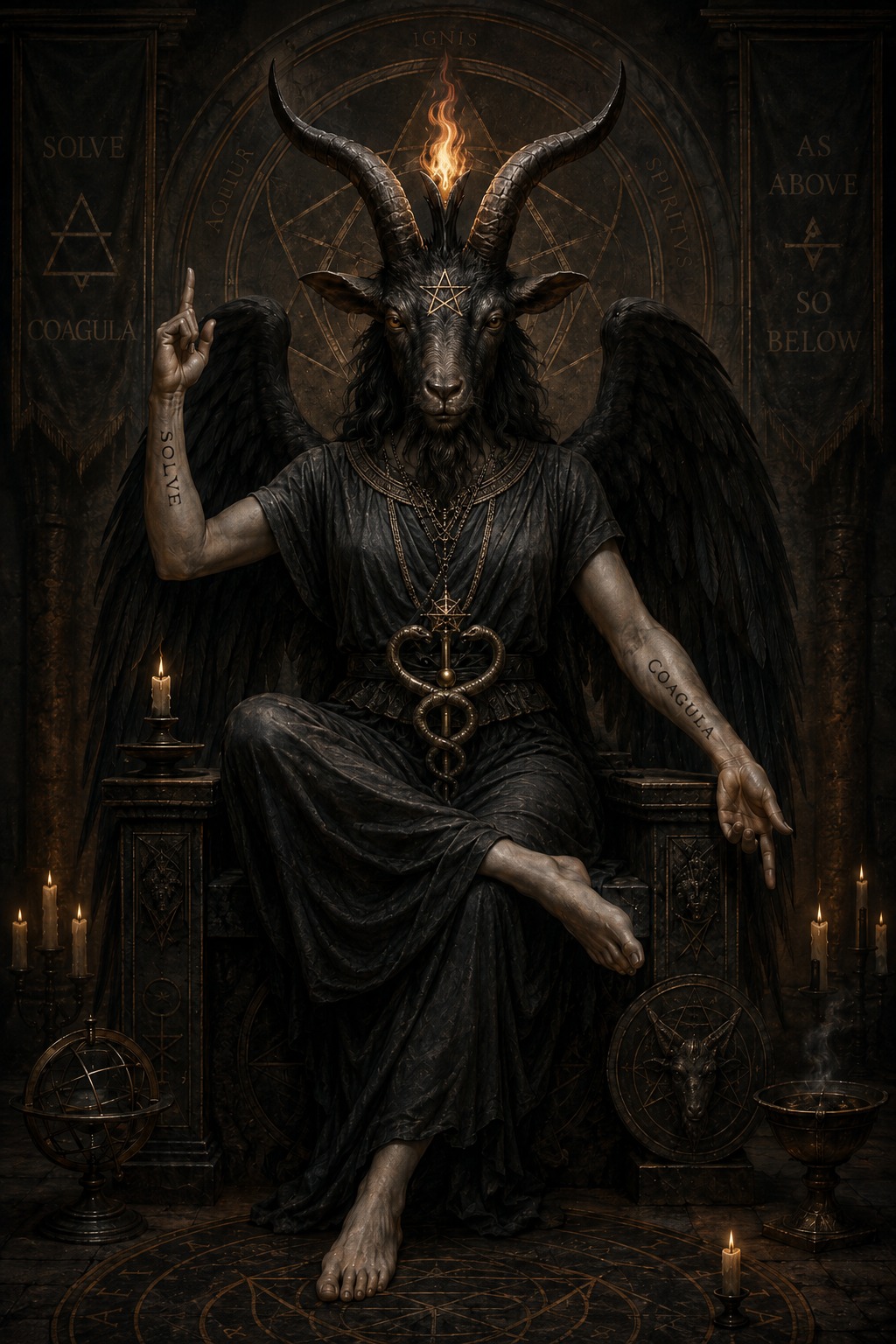
Baphomet (Latin Baphometh, English Baphomet) is the decisive canonical iconographic figure of the name of the idol that the Knights Templar (Knights Templar) were alleged to have worshipped at the trials of the late Middle Ages of the 14th century — the decisive canonical iconographic figure of an androgynous seated figure with a goat's head and a human body, with an inverted pentagram on the forehead, bat wings, and a torch. Aliases — Baphomet (Baphomet), Goat of Mendes, Sabbatic Goat, Goat-headed Idol, Symbol of Esotericism and Conspiracy — are the decisive canonical vocabulary. The decisive origin canon is the decisive origin canon of becoming famous after King Philip IV (Philip IV, 'the Fair') of France tortured the Templars on 13 October 1307 to extract confessions that they worshipped 'Baphomet' to destroy the Templars, and the decisive canon of the iconography of the 'Baphomet de Mendes' in Dogme et Rituel de la Haute Magie (Dogme et Rituel de la Haute Magie, published 1854-1856) of 1856 by the French occultist Eliphas Levi (Eliphas Levi, 1810-1875).
Origin
The etymology of Baphomet is the decisive canon presumed to be a corruption of the French variant of 'Mahomet (Mahomet, the Islamic prophet Muhammad)' — the decisive canon of the name created by the fear of Eastern idols of the Crusades era. The decisive origin canon is the decisive origin canon of King Philip IV (Philip IV, 'the Fair', 1268-1314) of France accusing the Knights Templar (Knights Templar, founded 1119) of heresy on Friday 13 October 1307 — accusing them of worshipping the idol 'Baphomet' and torturing them to extract confessions in order to avoid repaying his debts and destroy them — the decisive canon in which the last Grand Master Jacques de Molay (Jacques de Molay, 1243-1314) was burned at the stake on the Ile de la Cite in Paris on 18 March 1314. The decisive 19th-century occult canon is the decisive canon of the 'Baphomet de Mendes (Sabbatic Goat)' in Dogme et Rituel de la Haute Magie (Dogme et Rituel de la Haute Magie, published in 2 volumes in Paris 1854-1856) of 1856 by the French occultist Eliphas Levi (Eliphas Levi, real name Alphonse Louis Constant, 1810-1875) — the decisive canonical iconography of the androgynous seated figure with a goat's head and female breasts, bat wings, an inverted pentagram (pentagram) on the forehead, two fingers pointing upward and downward in the pose of 'As above, so below (As above, so below, the balance philosophy of Hermeticism)', and a torch above the head.
Features
- Androgynous seated figure with a goat's head and a human body
- Inverted pentagram on the forehead
- Two fingers pointing upward and downward — 'As above, so below'
- Bat wings and a torch above the head
- Female breasts symbol of androgyny
- Main axis symbol of esotericism and conspiracy goat-headed idol
- Aliases — Goat of Mendes (Goat of Mendes), Sabbatic Goat (Sabbatic Goat)
Stories
The trial of the Knights Templar by King Philip IV of France of 1307 is the decisive origin, and the decisive textual canon is the iconography of the 'Baphomet de Mendes' in Dogme et Rituel de la Haute Magie by Eliphas Levi of 1856. The decisive canon used as a symbol of occult esoteric organizations (especially the American Church of Satan), and the decisive canon called upon as a symbol of secret societies and hidden power in conspiracy theories and urban legends. The decisive canon of a philosophical iconography that visualizes the balance philosophy of Hermeticism/alchemy (male-female, above-below). The decisive 20th-century occult canon is the decisive canon of the 'Sigil of Baphomet' as the official symbol of the Church of Satan (Church of Satan) founded by Anton LaVey (Anton LaVey, 1930-1997) of the USA on 30 April 1966, and the decisive 21st-century canon is the decisive canon of the 8.5-foot Baphomet bronze statue unveiled in Detroit, USA by the Satanic Temple (The Satanic Temple) in 2014, and the decisive 21st-century global canon of conspiracy theories/games/comics of the 21st century.
Weakness
Baphomet's weaknesses are: (1) absence of substance — the decisive canonical weakness — the decisive canon of being a composite image created by political conspiracy (the Templar purge) and later occult imagination rather than an actually existing demon — the decisive canon of being closer to a symbol than substance itself; (2) religious authority — the decisive canonical weakness — the decisive canon of being powerless before religious authority like other idols; (3) binding of the cross — the decisive canon of being powerless before the Christian cross and holy water; (4) corruption of etymology — the decisive canon of the binding of the corruption of Mahomet; (5) binding of time — the decisive canon as a product of 14th-century politics; (6) binding of the sacred domain — the decisive canon; (7) binding of the goat — the decisive canon of the binding of the goat's head; (8) binding of esotericism — the decisive canon of the binding as a symbol of secret societies. The decisive canonical finale is the decisive mythological canon as a forgotten idol after the burning of Jacques de Molay on 18 March 1314.
Cultural Significance
Baphomet is not merely an idol icon but the canonical iconographic figure of the decisive occult canon, traversing the trial of the Knights Templar by King Philip IV of France of 1307-1314, Dogme et Rituel de la Haute Magie by Eliphas Levi of 1856, the 'Sigil of Baphomet' of the Church of Satan by Anton LaVey of 1966, and the Baphomet bronze statue of the American Satanic Temple of 2014. The etymology of Baphomet settled as the decisive canon presumed to be a corruption of the French variant of 'Mahomet (the Islamic prophet Muhammad)' — the decisive canon of the name created by the fear of Eastern idols of the Crusades era. The decisive origin canon is the decisive origin canon of King Philip IV (Philip IV, 'the Fair', 1268-1314) of France on Friday 13 October 1307 (the theory of the origin of the 'Friday the 13th' superstition) accusing the Knights Templar (Knights Templar, founded 1119, Catholic military religious order) of heresy — accusing them of worshipping the idol 'Baphomet' and torturing them to extract confessions in order to avoid repaying his debts and destroy them — the decisive canon in which Pope Clement V dissolved the Knights Templar by the papal bull 'Vox in Excelso' on 3 April 1312 and the last Grand Master Jacques de Molay (Jacques de Molay, 1243-1314) was burned at the stake on the Ile de la Cite in Paris on 18 March 1314. The decisive 19th-century occult canon is the decisive canon of the 'Baphomet de Mendes (Sabbatic Goat)' in Dogme et Rituel de la Haute Magie (Dogme et Rituel de la Haute Magie, published in 2 volumes in Paris 1854-1856) of 1856 by the French occultist Eliphas Levi (Eliphas Levi, real name Alphonse Louis Constant, 1810-1875) — the decisive canonical iconography of the androgynous seated figure with a goat's head and female breasts, bat wings, an inverted pentagram on the forehead, two fingers pointing upward at the white moon and downward at the black moon in the pose of 'As above, so below (As above, so below, the balance philosophy of Hermeticism)', and a torch above the head. The decisive 20th-century occult canon is the decisive canon of the 'Sigil of Baphomet' as the official symbol of the Church of Satan (Church of Satan) founded by Anton Szandor LaVey (Anton Szandor LaVey, 1930-1997) of San Francisco, USA on 30 April 1966 (Walpurgis Night), and the decisive 21st-century canon is the decisive global canon of the 8.5-foot (about 2.6 meters)/1-ton Baphomet bronze statue (Baphomet statue) unveiled by the Satanic Temple (The Satanic Temple, founded 2013) in Detroit, Michigan, USA on 25 July 2014.
In Popular Culture
- 13 October 1307 arrest of the Knights Templar by King Philip IV of France — decisive origin canon
- 1307-1314 confessions of 'Baphomet worship' at the trial of the Knights Templar — decisive origin canon
- 1312 Pope Clement V's papal bull 'Vox in Excelso' dissolving the Knights Templar — decisive Catholic canon
- 18 March 1314 burning of Jacques de Molay on the Ile de la Cite in Paris — decisive closing canon
- Eliphas Levi Dogme et Rituel de la Haute Magie 'Baphomet de Mendes' 1856 — decisive 19th-century occult canon
- Eliphas Levi's iconography of the androgynous seated figure 1856 — decisive iconographic canon
- Anton LaVey's 'Sigil of Baphomet' of the Church of Satan 1966 — decisive 20th-century occult canon
- American Satanic Temple's Baphomet bronze statue Detroit 2014 — decisive 21st-century global canon
- Symbol of 'As above, so below' of Hermeticism/alchemy — decisive philosophical canon
- Baphomet in 21st-century conspiracy theories/games/comics/subculture — decisive 21st-century global canon
Trivia
The etymology of Baphomet (Latin Baphometh, English Baphomet) is the decisive canonical vocabulary presumed to be a corruption of the French variant of 'Mahomet (the Islamic prophet Muhammad)', and aliases Baphomet (Baphomet), Goat of Mendes, Sabbatic Goat, Goat-headed Idol, Symbol of Esotericism and Conspiracy, Variant of the Seal of Solomon are the decisive canonical vocabulary. The decisive origin canon is the decisive origin canon of King Philip IV (Philip IV, 'the Fair', born 1268, died 29 November 1314) of France on Friday 13 October 1307 (the theory of the origin of the later 'Friday the 13th' superstition) accusing the Knights Templar (Knights Templar, founded in 1119 in Jerusalem by Hugues de Payens and 9 knights, Catholic military religious order, active in the protection of the Crusades, finance, and banking) of heresy — accusing them of worshipping the 'Baphomet' idol and torturing them (water torture, burning of the feet, etc.) to extract confessions in order to avoid repaying his enormous debts and destroy them — the decisive canon in which Pope Clement V (Clement V) dissolved the Knights Templar by the papal bull 'Vox in Excelso' on 3 April 1312 and the last Grand Master Jacques de Molay (Jacques de Molay, born 1243, died 1314) was burned at the stake on the Ile de la Cite (Ile de la Cite) in Paris on 18 March 1314. The decisive 19th-century occult canon is the decisive canon of the 'Baphomet de Mendes (Sabbatic Goat)' in Dogme et Rituel de la Haute Magie (Dogme et Rituel de la Haute Magie, published in 2 volumes in Paris 1854-1856, the most influential occult book of the 19th century) of 1856 by the French occultist Eliphas Levi (Eliphas Levi, real name Alphonse Louis Constant, born 8 February 1810 in Paris, died 31 May 1875 in Paris, originally a Catholic priest candidate) — the decisive canonical iconography of the androgynous seated figure with a goat's head (influence of the goat god Ba of Mendes in Egypt) and female breasts, bat wings, an inverted pentagram on the forehead, two fingers pointing upward at the white moon and downward at the black moon in the pose of 'As above, so below (As above, so below, the balance philosophy of Hermeticism)', a torch above the head, a caduceus (the staff of Hermes) on the lap, and the letters 'SOLVE (dissolve)' and 'COAGULA (coagulate)' on the two arms. The decisive 20th-century occult canon is the decisive canon of the 'Sigil of Baphomet (the goat's head inside an inverted pentagram with the 5 Hebrew letters 'Leviathan' outside)' as the official symbol of the Church of Satan (Church of Satan) founded by Anton Szandor LaVey (Anton Szandor LaVey, born 11 April 1930, died 29 October 1997) of San Francisco, California, USA on 30 April 1966 (Walpurgis Night, 'Year One of Satan Anno Satanas I'), and the decisive 21st-century canon is the decisive global canon of the 8.5-foot (about 2.6 meters)/1-ton bronze Baphomet statue (Baphomet statue, work of Mark Porter and Mojo) unveiled by the Satanic Temple (The Satanic Temple, founded in 2013 by Lucien Greaves) in Detroit, Michigan, USA on 25 July 2014, and the decisive 21st-century global canon of the boss Baphomet in the game Ragnarok Online (2002) and various 21st-century conspiracy theories/games/comics of Baphomet.