Bael
Bael · First of Solomon's 72 Spirits — King of the East
Names in Other Languages
 바알한국어
바알한국어Bael· 솔로몬의 72귀신 제1위 동방의 왕
 バアル日本語
Bael· ソロモンの72魔神第1位 東方の王
 巴力繁體中文
Bael· 所羅門72魔神第一位 東方之王
 BaelDeutsch
Bael · Erster der 72 Geister Salomos — König des Ostens
 BaelFrançais
Bael · Premier des 72 esprits de Salomon — Roi de l'Orient
 BaelEspañol
Bael · Primero de los 72 espíritus de Salomón — Rey de Oriente
 BaelPortuguês
Bael · Primeiro dos 72 espíritos de Salomão — Rei do Oriente
 BaelPolski
Bael · Pierwszy z 72 duchów Salomona — Król Wschodu
 БаальРусский
Bael· Первый из 72 духов Соломона Царь Востока
Bael (Latin Bael, English Bael, Hebrew Baal — 'lord') is the 1st of the 72 demons in Book 1 Ars Goetia (Ars Goetia) of the 17th-century grimoire — the decisive canon — The Lesser Key of Solomon (Lemegeton Clavicula Salomonis) — and the King of the East (King of the East), commanding 66 legions (legions) of demons — the decisive canonical iconographic figure. The etymological origin is the decisive origin canon of Baal (Baal, son of El), the Canaanite and Phoenician god of fertility, thunder, and war, in the Ugaritic Baal Cycle (Ugaritic Baal Cycle, KTU 1.1-1.6) of c. 13th century BCE — the decisive canonical vocabulary degraded by the later Judeo-Christian tradition to a foreign idol. Aliases — Baal (Baal), Baal Hadad (Baal Hadad), Baal-Zebub (Baal-Zebub), Baal-Peor (Baal-Peor), King of the East — are the decisive canonical vocabulary. The decisive Old Testament canon is the decisive canon of the confrontation between Elijah and the 450 prophets of Baal on Mount Carmel in 1 Kings (1 Kings) 18:17-40 of c. 6th-4th century BCE.
Origin
The etymological origin is the decisive canon of the common noun 'Baal (Baal, lord, king)' in Hebrew and Ugaritic — the decisive canon of the fertility god of various regions of Canaan, and the decisive origin canon is the decisive canon of Baal (Baal Hadad), the Canaanite and Phoenician god of fertility, thunder, and war, in the Ugaritic Baal Cycle (Ugaritic Baal Cycle, KTU 1.1-1.6) of c. 13th century BCE from Ugarit (now Ras Shamra, Syria) — the decisive canon of victory in the combat with Yamm (Yamm), the god of the sea, and Mot (Mot), the god of death. The decisive Old Testament canon is the decisive origin canon of the confrontation between Elijah (Elijah) and the 450 prophets of Baal on Mount Carmel (Mount Carmel) in 1 Kings (1 Kings) 18:17-40 of c. 6th-4th century BCE — 'If the LORD be God, follow him: but if Baal, then follow him' — the decisive canon in which God's fire came down from heaven and burned Elijah's burnt offering, after which the 450 prophets of Baal were slain. The decisive canon of Gideon (Gideon) tearing down his father's altar of Baal in Judges (Judges) 6:25-32, and the decisive canon of Hosea (Hosea) 2:8-13. The decisive grimoire canon is the decisive origin canon of Bael in Pseudomonarchia Daemonum (Pseudomonarchia Daemonum) of the Dutch Johann Weyer (Johann Weyer) of 1563, and the decisive canon of the 1st rank King of the East (King of the East) of the 72 demons in Book 1 Ars Goetia (Ars Goetia) of The Lesser Key of Solomon (Lemegeton Clavicula Salomonis) of the 17th century — 'Bael is a great king, and when he appears, he comes in various forms, sometimes in the form of a cat, sometimes in the form of a toad, sometimes in the form of a man, and sometimes with all three heads at once (cat, toad, and man), and his voice is hoarse, and he grants the conjuror the power of invisibility'.
Features
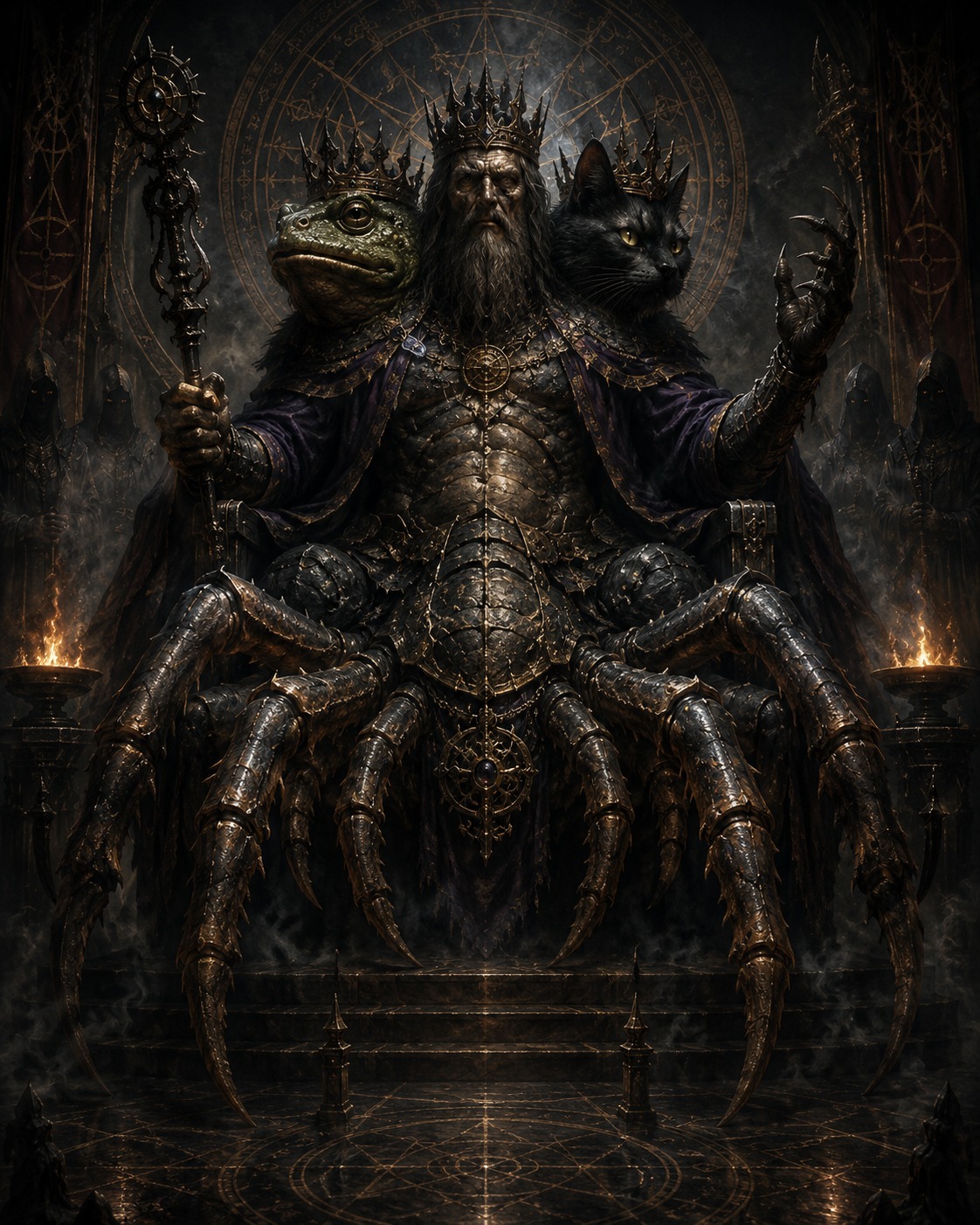
- Three heads toad, man, cat
- Giant form with spider legs (8 legs)
- Main axis 1st of Solomon's 72 demons King of the East (King of the East) commanding 66 legions
- Speaks with a hoarse voice and grants the conjuror invisibility
- Aliases — Baal (Baal), Baal Hadad (Baal Hadad), Baal-Zebub (Baal-Zebub), Baal-Peor (Baal-Peor)
Stories
Baal in the Ugaritic Baal Cycle of c. 13th century BCE — the Canaanite and Phoenician god of fertility, thunder, and war — is the decisive origin, and the decisive Old Testament canon is the confrontation between Elijah and the 450 prophets of Baal on Mount Carmel in 1 Kings 18:17-40, and the decisive grimoire canon is Bael in Johann Weyer's Pseudomonarchia Daemonum of 1563 and the 1st rank King of the East of the 72 demons in Book 1 Ars Goetia of The Lesser Key of Solomon of the 17th century. The decisive canon of granting the power of invisibility (invisibility) to the conjuror in the Solomonic magic tradition, and the decisive canon frequently cited as the prototype of the powerful demon king in modern occult and fantasy. The decisive 19th-century art canon is the decisive canon of the Bael iconography of three heads (cat, man, toad) and spider legs in the Dictionnaire Infernal (Dictionnaire Infernal) of 1818 by the French Collin de Plancy (Collin de Plancy, 1793-1881), and the decisive 21st-century game canon is the decisive global game canon of Bael (Baal) in the Megami Tensei (Megami Tensei) series by Japanese Atlus (Atlus) from 11 September 1987 and the Shin Megami Tensei (Shin Megami Tensei) series from 30 October 1992.
Weakness
Bael's weaknesses are: (1) Solomon's signet ring — the decisive canonical weakness — there is a history of being sealed before Solomon's signet ring, controllable through accurate magical procedures; (2) God's name — the decisive canonical weakness — powerless before God's name and Christ's authority like all other demons; (3) strong will and accurate ritual — the decisive canonical weakness — without strong will and accurate ritual, becomes a threat to the conjuror instead; (4) Elijah's fire — the decisive canonical weakness — the decisive canon of being powerless before God's fire called by Elijah in 1 Kings 18:36-38; (5) destruction of Gideon's altar — the decisive canonical weakness — the decisive canon of Gideon's destruction of the altar of Baal in Judges 6:25-32; (6) binding of the sacred domain — the decisive canon; (7) binding of 66 legions — the decisive canon of the responsibility of commanding 66 legions; (8) binding of the East — the decisive canon of being bound as King of the East. The decisive canonical finale is the decisive mythological canon of being one of the 72 demons bound by Solomon's seal, eternally responding to the conjuror's call.
Cultural Significance
Bael is not merely a demon icon but the canonical iconographic figure of the decisive Semitic-Judeo-Christian canon, traversing the Ugaritic Baal Cycle (KTU 1.1-1.6) of c. 13th century BCE, 1 Kings 18:17-40 of c. 6th-4th century BCE — the confrontation on Mount Carmel — Judges 6:25-32 — Gideon's destruction of the altar — Hosea 2:8-13, Johann Weyer's Pseudomonarchia Daemonum of 1563, the 1st rank of the 72 demons in Book 1 Ars Goetia of The Lesser Key of Solomon of the 17th century, Collin de Plancy's Dictionnaire Infernal of 1818, and the Megami Tensei series from 1987. The etymological origin is the decisive canon of the common noun 'Baal (Baal, lord, king)' in Hebrew and Ugaritic — settled as the decisive canon of the fertility god of various regions of Canaan. The decisive origin canon is the decisive canon of Baal (Baal Hadad, son of El), the Canaanite and Phoenician god of fertility, thunder, and war, in the Ugaritic Baal Cycle (Ugaritic Baal Cycle, KTU 1.1-1.6) of c. 13th century BCE from Ugarit (now Ras Shamra, Syria) — victory in the combat with Yamm (Yamm), the god of the sea, and Mot (Mot), the god of death. The decisive Old Testament canon is the decisive canon of the confrontation between Elijah (Elijah) and the 450 prophets of Baal on Mount Carmel (Mount Carmel) in 1 Kings (1 Kings) 18:17-40 of c. 6th-4th century BCE — 'If the LORD be God, follow him: but if Baal, then follow him' — the decisive canon in which God's fire came down from heaven and burned Elijah's burnt offering, after which the 450 prophets of Baal were slain. The decisive grimoire canon is the decisive canon of the 1st rank King of the East (King of the East) of the 72 demons in Book 1 Ars Goetia (Ars Goetia) of The Lesser Key of Solomon (Lemegeton Clavicula Salomonis) of the 17th century — 'Bael is a great king, and appears in various forms, sometimes with all three heads at once (cat, toad, and man), and grants the conjuror the power of invisibility'. The decisive 19th-century art canon is the decisive canon of the Bael iconography of three heads (cat, man, toad) and spider legs (8) in the Dictionnaire Infernal (Dictionnaire Infernal) of 1818 by the French Collin de Plancy (Collin de Plancy, 1793-1881), and the decisive 21st-century game canon is the decisive global game canon of Bael (Baal) in the Megami Tensei (Megami Tensei) series by Japanese Atlus (Atlus) from 11 September 1987 and the Shin Megami Tensei (Shin Megami Tensei) series from 30 October 1992.
In Popular Culture
- Ugaritic Baal Cycle (KTU 1.1-1.6) Canaanite and Phoenician god of fertility, thunder, and war Baal (Baal Hadad) (c. 13th century BCE) — decisive origin canon
- 1 Kings 18:17-40 confrontation between Elijah and the 450 prophets of Baal on Mount Carmel (c. 6th-4th century BCE) — decisive Old Testament canon
- Judges 6:25-32 Gideon's destruction of the altar of Baal (c. 6th-4th century BCE) — decisive Old Testament canon
- Hosea 2:8-13 (c. 6th-4th century BCE) — decisive Old Testament canon
- Johann Weyer Pseudomonarchia Daemonum Bael (1563) — decisive origin grimoire canon
- The Lesser Key of Solomon Book 1 Ars Goetia 1st rank King of the East of the 72 demons (17th century) — decisive grimoire canon
- Collin de Plancy Dictionnaire Infernal Bael with three heads and spider legs (1818) — decisive 19th-century art canon
- Video games Megami Tensei and Shin Megami Tensei series Bael (from 1987) — 21st-century decisive global game canon
Trivia
The etymology of Bael (Latin Bael, English Bael, Hebrew Baal) is the decisive canonical vocabulary of the common noun 'Baal (Baal, lord, king)' in Hebrew and Ugaritic — the decisive canon of the fertility god of various regions of Canaan, and aliases Baal (Baal), Baal Hadad (Baal Hadad, storm god), Baal-Zebub (Baal-Zebub, god of Ekron), Baal-Peor (Baal-Peor, Lord of Peor), King of the East are the decisive canonical vocabulary. The decisive origin canon is the decisive canon of Baal (Baal Hadad, son of El or son of Dagon), the Canaanite and Phoenician god of fertility, thunder, and war, in the Ugaritic Baal Cycle (Ugaritic Baal Cycle, KTU 1.1-1.6) of c. 13th century BCE from Ugarit (now Ras Shamra, Syria, discovered in 1928) — victory in the combat with Yamm (Yamm), the god of the sea, and Mot (Mot), the god of death. The decisive Old Testament canon is the decisive canon of the confrontation between Elijah (Elijah) and the 450 prophets of Baal on Mount Carmel (Mount Carmel) in 1 Kings (1 Kings) 18:17-40 of c. 6th-4th century BCE — 'If the LORD be God, follow him: but if Baal, then follow him' — the decisive canon in which God's fire came down from heaven and burned even the stones and earth of Elijah's altar and the water in the trench, after which the people cried out 'YHWH is God'. The decisive grimoire canon is the decisive origin canon of Bael, who first systematically appeared as a King commanding 66 legions (legions) of spirits, in Pseudomonarchia Daemonum (Pseudomonarchia Daemonum) of the Dutch physician and occultist Johann Weyer (Johann Weyer, 1515-1588) of 1563, and the decisive canon of the 1st rank King of the East (King of the East) of the 72 demons in Book 1 Ars Goetia (Ars Goetia) of The Lesser Key of Solomon (Lemegeton Clavicula Salomonis) of the 17th century — 'Bael is a great king, and when he appears, he comes in various forms, sometimes in the form of a cat, sometimes in the form of a toad, sometimes in the form of a man, and sometimes with all three heads at once (cat, toad, and man), and his voice is hoarse, and he grants the conjuror the power of invisibility'. The decisive 19th-century art canon is the decisive canon of the Bael iconography of three heads (cat, man, toad) and spider legs (8) in the Dictionnaire Infernal (Dictionnaire Infernal) of 1818 by the French Collin de Plancy (Collin de Plancy, 1793-1881), and the decisive 21st-century game canon is the decisive global game canon of Bael (Baal) in the Megami Tensei (Megami Tensei) series by Japanese Atlus (Atlus) from 11 September 1987 and the Shin Megami Tensei (Shin Megami Tensei) series from 30 October 1992.