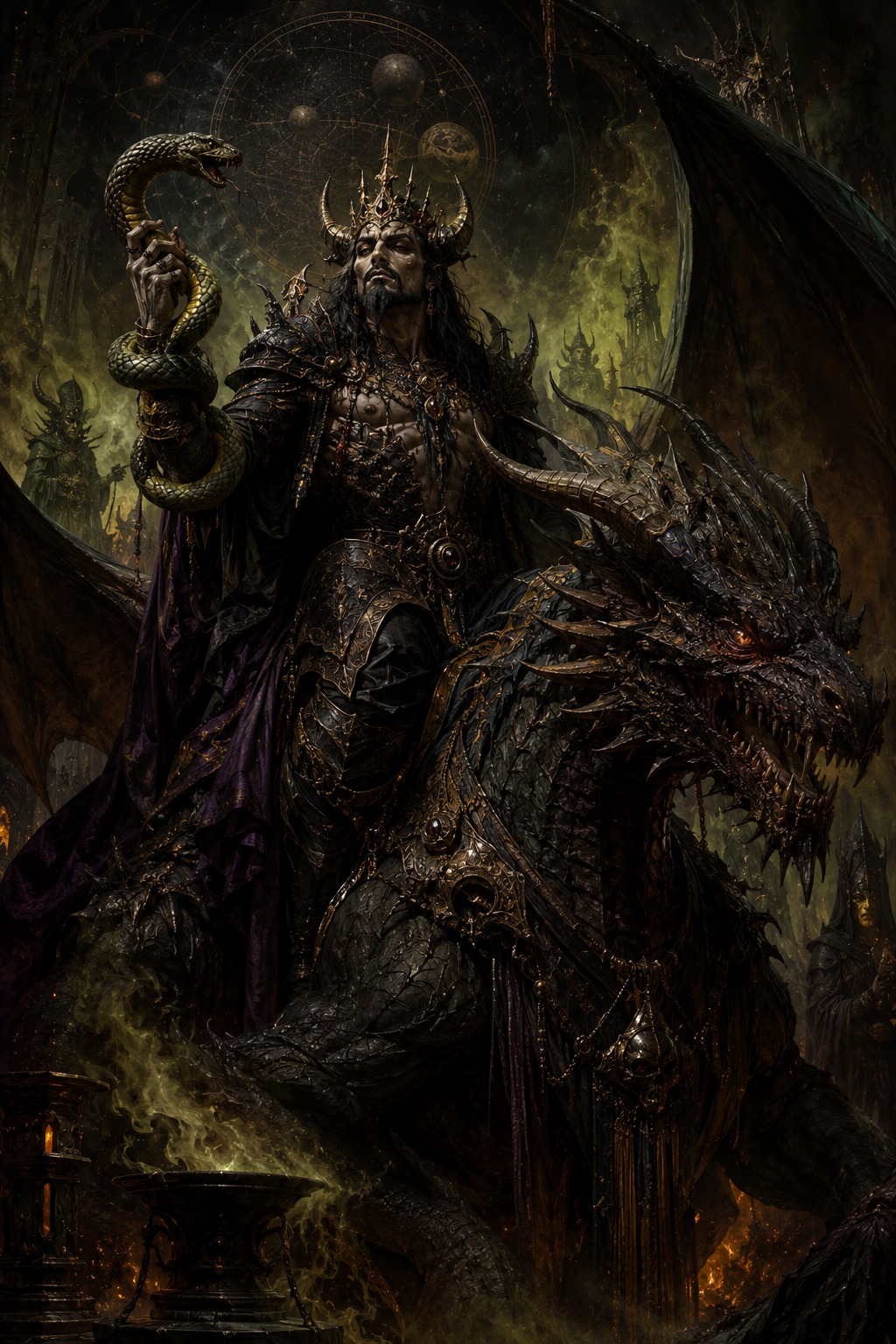
Astaroth
Astaroth · 29th of Solomon's 72 Spirits — Great Duke
Names in Other Languages
 아스타로트한국어
Astaroth · 솔로몬의 72귀신 제29위 — 위대한 공작
 アスタロト日本語
Astaroth · ソロモンの72魔神第29位 — 大公爵
 亞斯她錄繁體中文
Astaroth · 所羅門72魔神第29位 — 大公爵
 AstarothDeutsch
Astaroth · 29. der 72 Geister Salomos — Großherzog
 AstarothFrançais
Astaroth · 29e des 72 esprits de Salomon — Grand duc
 AstarothEspañol
Astaroth · 29º de los 72 espíritus de Salomón — Gran Duque
 AstarotePortuguês
Astarote · 29º dos 72 espíritos de Salomão — Grande Duque
 AstarotPolski
Astarot · 29. z 72 duchów Salomona — Wielki książę
 АстаротРусский
Astaroth · 29-й из 72 духов Соломона — Великий герцог
Astaroth (Latin Astaroth, English Astaroth) is the demon of the Great Duke rank, 29th of the 72 demons in Book 1 Ars Goetia (Ars Goetia) of the 17th-century grimoire — the decisive canon — The Lesser Key of Solomon (Lemegeton Clavicula Salomonis) — commanding 40 legions (legions) of demons — the decisive canonical iconographic figure. The etymological origin is the decisive canonical vocabulary of Ishtar (Ishtar, Akkadian), the Mesopotamian goddess of fertility, love, and war of c. 2000 BCE → Phoenician and Canaanite Astarte (Astarte) → the foreign goddess Ashtoreth (Ashtoreth) of the Old Testament → the male duke-demon of the 16th-17th century grimoires. Aliases — Ashtoreth (Ashtoreth), Astarte (Astarte), Ishtar (Ishtar), the Duke of liberal sciences — are the decisive canonical vocabulary. The decisive textual canon is the decisive origin canon of Astaroth in Pseudomonarchia Daemonum (Pseudomonarchia Daemonum) of Johann Weyer (Johann Weyer) of 1563, and the decisive canon of the 29th rank Great Duke of the 72 demons in Book 1 Ars Goetia of The Lesser Key of Solomon (Lemegeton Clavicula Salomonis) of the 17th century. The decisive 19th-century art canon of the Astaroth iconography on the wicked dragon in the Dictionnaire Infernal (Dictionnaire Infernal) of Collin de Plancy of 1818, and the decisive 21st-century global game canon of Astaroth (in the form of a golem wielding a giant axe) in the Soulcalibur (Soul Edge/Soulcalibur) series by Japanese Namco (Namco) from 1995.
Origin
The etymological origin is the decisive origin canon of Ishtar (Ishtar, Akkadian), the Mesopotamian goddess of fertility, love, and war of c. 2000 BCE — the decisive canon as the descendant of the Sumerian Inanna (Inanna) — and the decisive canon transmitted as the Phoenician and Canaanite Astarte (Astarte). The decisive Old Testament canon is the decisive origin canon of 1 Kings (1 Kings) 11:5 of c. 6th-4th century BCE — 'For Solomon went after Ashtoreth (Ashtoreth) the goddess of the Zidonians' — and 11:33, and the decisive canon of Judges (Judges) 2:13 — 'And they forsook the LORD, and served Baal and Ashtaroth' — and 10:6 — the decisive canon of the original fertility and love goddess being highlighted as a foreign goddess from the perspective of Jewish monotheism. The decisive grimoire canon is the decisive canon of Astaroth first appearing systematically as a Great Duke commanding 40 legions of spirits in Pseudomonarchia Daemonum (Pseudomonarchia Daemonum) of the Dutch Johann Weyer (Johann Weyer, 1515-1588) of 1563, and the decisive canon of the 29th rank Great Duke (Great Duke) of the 72 demons in Book 1 Ars Goetia (Ars Goetia) of The Lesser Key of Solomon (Lemegeton Clavicula Salomonis) of the 17th century — 'Astaroth is a Great and Powerful Duke, and appeareth in the Form of an hurtful Angel riding on an Infernal Beast like a Dragon, and carrying in his right hand a Viper, and his breath causes a horrible stench, so the conjuror must hold a magic silver ring before his face to defend himself'.
Features
- Form of a giant man or angel riding a wicked dragon
- Holds a viper in one hand (right hand)
- Crown and armor, the dignity of a duke
- Foul breath, so the conjuror must hold a magic silver ring before his face
- Main axis — 29th rank of Solomon's 72 demons — Great Duke (Great Duke)
- Alias — source of Ashtoreth (Ashtoreth), Astarte (Astarte), Ishtar (Ishtar)
Stories
The Mesopotamian goddess Ishtar of c. 2000 BCE is the decisive origin, and the decisive textual canon is Astaroth in Johann Weyer's Pseudomonarchia Daemonum of 1563 and the 29th rank Great Duke of the 72 demons in Book 1 Ars Goetia of The Lesser Key of Solomon of the 17th century. The decisive canon as a demon called upon in Solomonic magic to teach the liberal arts, natural sciences, and astronomy — the decisive canon of the traces of the original fertility and love goddess promising secret knowledge and the revelation of hidden truths. The decisive canon of telling truthfully how he fell from heaven and what his sins were, and the decisive canon as the Duke of the deadly sin of Sloth (Sloth, Acedia) classified in Peter Binsfeld's 1589 Treatise on the Confessions of Witches and Wizards. The decisive 19th-century art canon of the Astaroth iconography on the wicked dragon in the Dictionnaire Infernal (Dictionnaire Infernal) of 1818 by the French Collin de Plancy (Collin de Plancy, 1793-1881), and the decisive 21st-century canon is the decisive global game canon of Astaroth (in the form of a golem wielding a giant axe) in the Soulcalibur (Soulcalibur) series by Japanese Namco (Namco, now Bandai Namco) from December 1995, beginning with Soul Edge (Soul Edge).
Weakness
Astaroth's weaknesses are: (1) foul stench — the decisive canonical weakness — his breath causes a horrible stench, so the conjuror must hold a magic silver ring before his face; (2) gazing from the left — the decisive canonical weakness — if gazed at from the left, he tells lies to the conjuror; (3) goddess's pride — the decisive canonical weakness — the original goddess's pride remains, forcing acknowledgment of his true form as is; (4) confession of truth — the decisive canonical weakness — must tell truthfully how he fell from heaven and what his sins were; (5) binding of Solomon's seal — controlled by Solomon's seal; (6) God's name — the decisive canonical weakness — powerless before God's name and Christ's authority like all other demons; (7) binding of the sacred domain — the decisive canon; (8) binding of 40 legions — the decisive canon of the responsibility of commanding 40 legions. The decisive canonical finale is the decisive mythological canon of being one of the 72 demons bound by Solomon's seal, eternally responding to the conjuror's call.
Cultural Significance
Astaroth is not merely a demon icon but the canonical iconographic figure of the decisive Semitic-Judeo-Christian canon, traversing the Mesopotamian goddess Ishtar of c. 2000 BCE, Phoenician and Canaanite Astarte, 1 Kings 11:5 and 33, Judges 2:13 and 10:6 of c. 6th-4th century BCE, Johann Weyer's Pseudomonarchia Daemonum of 1563, the 29th rank of the 72 demons in Book 1 Ars Goetia of The Lesser Key of Solomon of the 17th century, Peter Binsfeld's 1589 Treatise on the Confessions of Witches and Wizards, Collin de Plancy's Dictionnaire Infernal of 1818, and the Soulcalibur series from 1995. The etymological origin settled as the decisive canon of Ishtar (Ishtar, Akkadian), the Mesopotamian goddess of fertility, love, and war of c. 2000 BCE — the descendant of the Sumerian Inanna. The decisive Old Testament canon is the decisive origin canon of 1 Kings 11:5 of c. 6th-4th century BCE — 'For Solomon went after Ashtoreth (Ashtoreth) the goddess of the Zidonians' — and 11:33, and the decisive canon of Judges 2:13 — 'And they forsook the LORD, and served Baal and Ashtaroth (Ashtaroth)' — the decisive canon of the original fertility and love goddess being highlighted as a foreign goddess from the perspective of Jewish monotheism. The decisive grimoire canon is the decisive canon of Astaroth first appearing systematically as a Great Duke commanding 40 legions of spirits in Pseudomonarchia Daemonum (Pseudomonarchia Daemonum) of the Dutch Johann Weyer (Johann Weyer) of 1563, and the decisive canon of the 29th rank Great Duke (Great Duke) of the 72 demons in Book 1 Ars Goetia (Ars Goetia) of The Lesser Key of Solomon (Lemegeton Clavicula Salomonis) of the 17th century — 'Astaroth is a Great and Powerful Duke, and appeareth in the Form of an hurtful Angel riding on an Infernal Beast like a Dragon, and carrying in his right hand a Viper, and he teaches the conjuror Liberal Sciences, Natural Sciences, and Astronomy'. The decisive 19th-century art canon of the Astaroth iconography on the wicked dragon in the Dictionnaire Infernal (Dictionnaire Infernal) of 1818 by the French Collin de Plancy (Collin de Plancy, 1793-1881) is the decisive canon, and the decisive 21st-century canon is the decisive global game canon of Astaroth (in the form of a golem wielding a giant axe) in the Soulcalibur (Soulcalibur) series by Japanese Namco (Namco, now Bandai Namco) from December 1995, beginning with Soul Edge (Soul Edge).
In Popular Culture
- Mesopotamian goddess Ishtar (Ishtar) (c. 2000 BCE) — decisive origin canon
- Phoenician and Canaanite Astarte (Astarte) (c. 1500-500 BCE) — decisive Semitic canon
- 1 Kings 11:5 and 33, Judges 2:13 and 10:6 Ashtoreth/Ashtaroth (c. 6th-4th century BCE) — decisive Old Testament canon
- Johann Weyer Pseudomonarchia Daemonum Astaroth (1563) — decisive origin grimoire canon
- The Lesser Key of Solomon Book 1 Ars Goetia 29th rank Great Duke of the 72 demons (17th century) — decisive grimoire canon
- Collin de Plancy Dictionnaire Infernal Astaroth on the wicked dragon (1818) — decisive 19th-century art canon
- Video game Soulcalibur (Soulcalibur) series Astaroth (from 1995) — 21st-century decisive global game canon
Trivia
The etymological origin of Astaroth (Latin Astaroth, English Astaroth) is the decisive origin canon of Ishtar (Ishtar, Akkadian), the Mesopotamian goddess of fertility, love, and war of c. 2000 BCE — the decisive canon as the descendant of the Sumerian Inanna (Inanna) — and the decisive canon transmitted as the Phoenician and Canaanite Astarte (Astarte). Aliases — Ashtoreth (Ashtoreth), Astarte (Astarte), Ishtar (Ishtar), Duke of liberal sciences, and Great Duke (Great Duke) — are the decisive canonical vocabulary. The decisive Old Testament canon is the decisive origin canon of 1 Kings (1 Kings) 11:5 of c. 6th-4th century BCE — 'For Solomon went after Ashtoreth (Ashtoreth) the goddess of the Zidonians' — and 11:33, and the decisive canon of Judges (Judges) 2:13 — 'And they forsook the LORD, and served Baal and Ashtaroth (Ashtaroth)' — and 10:6 — the decisive canon of the original fertility and love goddess being highlighted as a foreign goddess from the perspective of Jewish monotheism. The decisive grimoire canon is the decisive origin canon of Astaroth first appearing systematically as a Great Duke commanding 40 legions (legions) of spirits in Pseudomonarchia Daemonum (Pseudomonarchia Daemonum) of the Dutch physician and occultist Johann Weyer (Johann Weyer, 1515-1588) of 1563, and the decisive canon of the 29th rank Great Duke (Great Duke) of the 72 demons in Book 1 Ars Goetia (Ars Goetia) of The Lesser Key of Solomon (Lemegeton Clavicula Salomonis) of the 17th century — 'Astaroth is a Great and Powerful Duke, and appeareth in the Form of an hurtful Angel riding on an Infernal Beast like a Dragon, and carrying in his right hand a Viper, and his breath causes a horrible stench, so the conjuror must hold a magic silver ring before his face to defend himself; he teaches the conjuror the past, present, and future of all matters, and Liberal Sciences, Natural Sciences, and Astronomy, and tells truthfully how he fell from heaven and what his sins were'. The decisive seven deadly sins canon is the decisive canon as the Duke of the deadly sin of Sloth (Sloth, Acedia) classified in Treatise on the Confessions of Witches and Wizards (Tractatus de Confessionibus Maleficorum et Sagarum) of 1589 by the German Peter Binsfeld (Peter Binsfeld, 1545-1598). The decisive 19th-century art canon of the Astaroth iconography on the wicked dragon in the Dictionnaire Infernal (Dictionnaire Infernal) of 1818 by the French Collin de Plancy (Collin de Plancy, 1793-1881) is the decisive canon, and the decisive 21st-century canon is the decisive global game canon of Astaroth (in the form of a golem wielding a giant axe) in Soul Edge (Soul Edge) by Japanese Namco (Namco, now Bandai Namco) from December 1995 and the Soulcalibur (Soulcalibur) series from July 1998, and the decisive 21st-century video canon of Astaroth in the USA film Constantine (Constantine) (starring Keanu Reeves) of 2005.