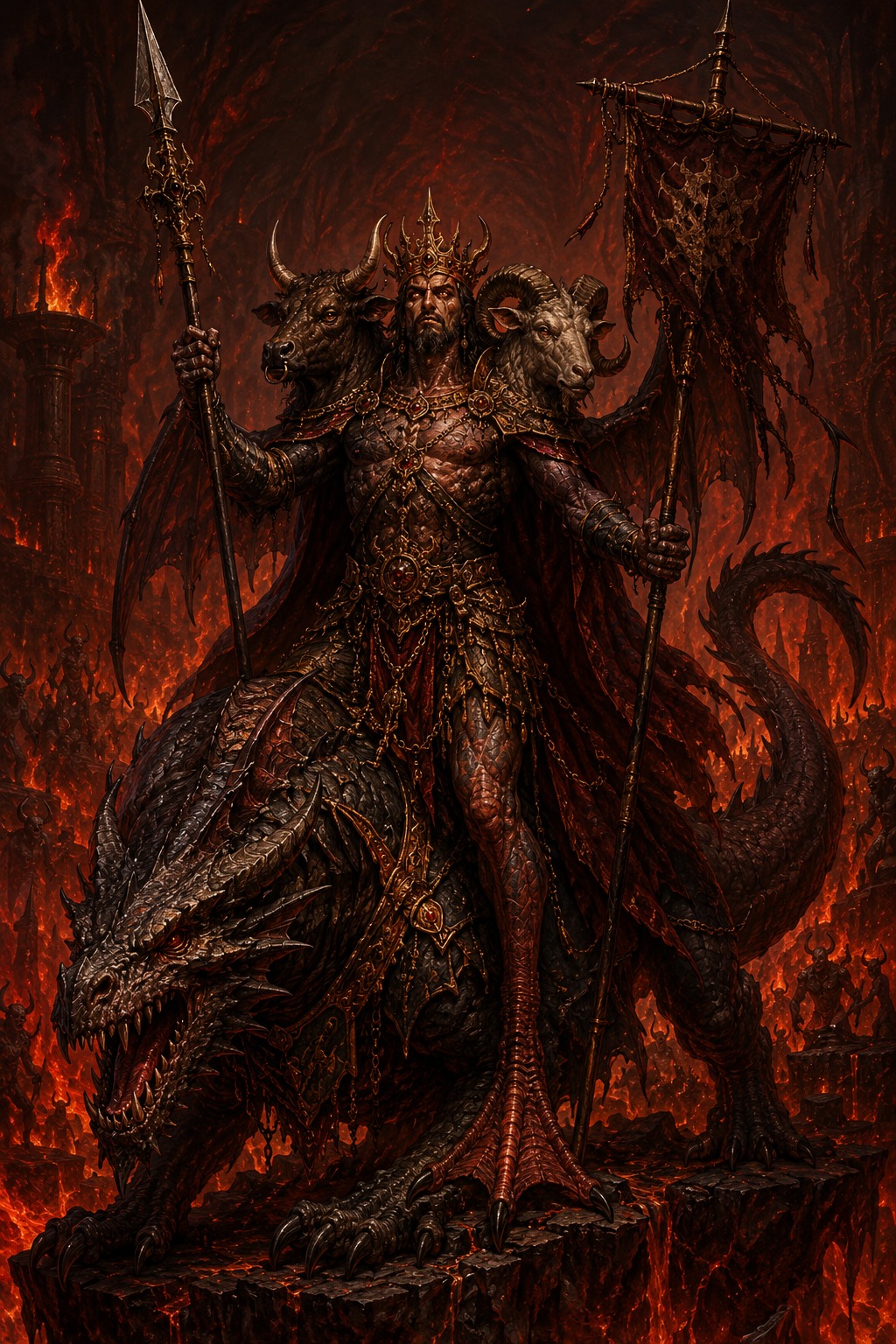
Asmodeus
Asmodeus · Prince of Lust — Demon Who Destroys Marriages
Names in Other Languages
 아스모데우스한국어
Asmodeus · 정욕의 대공 — 결혼을 파괴하는 마왕
 アスモデウス日本語
Asmodeus · 色欲の大公 — 結婚を破壊する魔王
 阿斯莫德繁體中文
Asmodeus · 色慾大公 — 破壞婚姻之魔王
 AsmodäusDeutsch
Asmodäus · Fürst der Wollust — Ehe-zerstörender Dämonenkönig
 AsmodéeFrançais
Asmodée · Prince de la luxure — Démon destructeur de mariages
 AsmodeoEspañol
Asmodeo · Príncipe de la lujuria — Demonio destructor de matrimonios
 AsmodeuPortuguês
Asmodeu · Príncipe da luxúria — Demônio destruidor de casamentos
 AsmodeuszPolski
Asmodeusz · Książę pożądliwości — Demon niszczący małżeństwa
 АсмодейРусский
Asmodeus · Князь похоти — Демон, разрушающий браки
Asmodeus (Hebrew Ashmedai, Greek Asmodaios, Latin Asmodaeus) is the great demon of lust, marriage destruction, and wrath of Jewish apocrypha and Christian tradition — the decisive canon, the decisive canonical iconographic figure derived from the Persian Zoroastrian Aeshma-daeva (Aeshma-daeva, 'wrath demon'). The etymology is the decisive canonical vocabulary of the Zoroastrian Avesta (Avesta) Aeshma (Aeshma, 'wrath') + daeva (daeva, 'evil god'), and the Hebrew Ashmedai (Ashmedai) and Greek Asmodaios are the decisive canonical vocabulary. The decisive textual canon is the Book of Tobit (Book of Tobit) chapter 3 verse 8 of c. 200 BCE Jewish apocrypha — the decisive canon of the lust demon who killed Sarah's (Sarah) seven husbands on their wedding night — and chapter 3 verse 17, chapter 6 verses 14-18, and chapter 8 verses 1-3 — the decisive canon in which the archangel Raphael (Raphael) made Tobias (Tobias) burn fish liver and heart on incense, and the smoke drove Asmodeus away and Raphael bound him in upper Egypt. The Testament of Solomon (Testament of Solomon) chapter 5 of c. 1st-3rd century CE — the decisive canon of the lust towards Solomon's wife — and the Lesser Key of Solomon (Lesser Key of Solomon, Ars Goetia) of c. 17th century — the decisive canon as the 32nd king of the 72 demons.
Origin
The iconographic origin is the Aeshma-daeva (Aeshma-daeva, 'wrath demon') of the Avesta (Avesta) of the Persian Zoroastrianism of c. 5th-3rd century BCE — the decisive origin canon, and the decisive textual canon is the Book of Tobit (Book of Tobit) chapter 3 verse 8 of c. 200 BCE Jewish apocrypha — the decisive canon in which Sarah (Sarah), the daughter of Raguel (Raguel) of Ecbatana (Ecbatana) in Media (Media), married seven husbands, but all were killed by Asmodeus before entering the bedchamber on the wedding night — and chapter 3 verse 17 — the decisive canon in which God sent the archangel Raphael (Raphael) to save her — and chapter 6 verses 14-18 — the decisive canon in which Raphael taught Tobias (Tobias) to burn fish liver and heart on incense, and the smoke would drive Asmodeus away — and chapter 8 verses 1-3 — the decisive canon in which on the wedding night when Tobias married Sarah, he burned fish liver and heart on incense, and the smoke drove Asmodeus away and Raphael bound him in upper Egypt. The Testament of Solomon (Testament of Solomon) chapter 5 of c. 1st-3rd century CE — the decisive canon in which King Solomon summoned Asmodeus with a magic ring, and he tried to seize the throne with lust towards Solomon's wife — and the Babylonian Talmud Gittin (Gittin) 68a-b of c. 4th-6th century — the decisive canon of Asmodeus as the king of demons who took Solomon's throne.
Features
- Three heads — bull, man, and ram
- Dragon tail and goose feet
- King who rides a dragon
- Spear and banner in his right hand
- Archduke of 'Lust' among the Seven Deadly Sins
- 32nd king of the 72 demons (Lesser Key of Solomon)
Stories
The Aeshma-daeva (Aeshma-daeva) of the Avesta of the Persian Zoroastrianism of c. 5th-3rd century BCE is the decisive origin, and the decisive textual canon is the Book of Tobit chapter 3 verse 8, chapter 3 verse 17, chapter 6 verses 14-18, and chapter 8 verses 1-3 of c. 200 BCE Jewish apocrypha, the Testament of Solomon chapter 5 of c. 1st-3rd century CE, and the Babylonian Talmud Gittin 68a-b of c. 4th-6th century. The decisive canon called upon as a symbol of marriage destruction, infidelity, and lust, and the decisive canon of the prayer of banishing him in the protection rite of newlyweds due to the Book of Tobit myth. The decisive canon used as a warning against gambling and wrong unions, and the decisive canon of the Pseudomonarchia daemonum (Pseudomonarchia daemonum) of 1577 by Johann Weyer (Johann Weyer) and the Paradise Lost (Paradise Lost) Book 6 of 1667 by John Milton (John Milton). The decisive literary canon is the novel The Devil upon Two Sticks (Le Diable boiteux) of 1707 by Alain-Rene Lesage (Alain-Rene Lesage), and the Asmodeus iconography of the Dictionnaire Infernal (Dictionnaire Infernal) of 1818 by Collin de Plancy (Collin de Plancy) is the decisive art canon. The decisive 21st-century canon is the decisive fantasy RPG canon of the Asmodeus as 'Archduke of Nine Hells (Archduke of Nine Hells)' of the 1977 D&D Monster Manual (Monster Manual) by TSR in the USA, the decisive canon of the Asmodeus of the D&D 5th Edition Player's Handbook (Player's Handbook) by Wizards of the Coast in 2014, and the Asmodeus of the TV series Lucifer (Lucifer) by Fox in the USA from 2016 to 2021 are the 21st-century decisive global video canon.
Weakness
Asmodeus's weaknesses are: (1) smoke of burning fish liver and heart — the decisive canonical weakness — the decisive canon of the c. 200 BCE Book of Tobit chapter 6 verses 14-18 and chapter 8 verses 1-3 — the archangel Raphael (Raphael) made Tobias (Tobias) burn fish liver and heart on incense, and the smoke drove him away; (2) power of the archangel Raphael — the decisive canonical weakness — the decisive canon of the Book of Tobit — bound in upper Egypt; (3) love and faith of a true married couple — the decisive canonical weakness — the decisive canon that he could not approach the wedding armed with the faith of Tobias and Sarah; (4) Solomon's ring — the decisive canon of the c. 1st-3rd century CE Testament of Solomon chapter 5 — bound by Solomon's magic ring; (5) binding of incense — the decisive canon; (6) binding of the binding — the decisive canon of being bound in the desert of Egypt; (7) binding of the sacred domain — the decisive canon; (8) binding of the lust of the Seven Deadly Sins — the decisive canon. The decisive canonical finale is the decisive mythological canon of the c. 200 BCE Book of Tobit chapter 8 verses 1-3 — on the wedding night of Tobias and Sarah, when fish liver and heart were burned on incense, the smoke drove Asmodeus away, and Raphael bound him in upper Egypt.
Cultural Significance
Asmodeus is not merely a great-demon-of-lust icon but the canonical iconographic figure of the decisive canon, traversing the c. 5th-3rd century BCE Zoroastrian Avesta Aeshma-daeva, the c. 200 BCE Jewish apocrypha Book of Tobit chapter 3 verse 8, chapter 3 verse 17, chapter 6 verses 14-18, and chapter 8 verses 1-3, the c. 1st-3rd century CE Testament of Solomon chapter 5, the c. 4th-6th century Babylonian Talmud Gittin 68a-b, the 1577 Johann Weyer Pseudomonarchia daemonum, the 1667 John Milton Paradise Lost Book 6, the 1707 Lesage The Devil upon Two Sticks, the 17th century Lesser Key of Solomon (Lesser Key of Solomon), the 1818 Collin de Plancy Dictionnaire Infernal, the 1977 TSR D&D Monster Manual, the 2014 D&D 5th Edition, and the 2016-2021 Fox Lucifer. The Aeshma-daeva (Aeshma-daeva, 'wrath demon') of the Avesta (Avesta) of the Persian Zoroastrianism of c. 5th-3rd century BCE is the most decisive origin canon, and it settled as the decisive canon in the c. 200 BCE Jewish apocrypha Book of Tobit (Book of Tobit) chapter 3 verse 8 — the decisive canon of the lust demon who killed Sarah's seven husbands on their wedding night — and chapter 8 verses 1-3 — the decisive canon in which Raphael drove him away with the smoke of fish liver and heart and bound him in upper Egypt. The decisive art canon is the Asmodeus iconography — three heads (bull, man, ram), dragon tail, goose feet, riding a dragon, holding a spear and a banner — of the 32nd king of the 72 demons of the Lesser Key of Solomon (Lesser Key of Solomon, Ars Goetia) of the 17th century — and the Asmodeus iconography of the Dictionnaire Infernal (Dictionnaire Infernal) of 1818 by the French Collin de Plancy (Collin de Plancy) is the decisive art canon, and the decisive fantasy RPG canon of the Asmodeus as 'Archduke of Nine Hells (Archduke of Nine Hells)' of the 1977 USA TSR D&D Monster Manual is the decisive canon. The decisive 21st-century canon is the Asmodeus of the TV series Lucifer (Lucifer) (later Netflix, Seasons 1-6, created by Tom Kapinos) by Fox in the USA first aired on 25 January 2016 — and the Asmodeus of the D&D 5th Edition Player's Handbook (Player's Handbook) published by Wizards of the Coast in the USA on 19 August 2014 — the 21st-century decisive global video canon.
In Popular Culture
- Zoroastrian Avesta Aeshma-daeva (c. 5th-3rd century BCE) — decisive origin canon
- Jewish apocrypha Book of Tobit chapter 3 verses 8, 17, chapter 6 verses 14-18, chapter 8 verses 1-3 (c. 200 BCE) — decisive origin canon
- Testament of Solomon chapter 5 (c. 1st-3rd century CE) — decisive Judeo-Christian canon
- Babylonian Talmud Gittin 68a-b (c. 4th-6th century) — decisive Jewish canon
- Johann Weyer Pseudomonarchia daemonum (1577) — decisive grimoire canon
- Milton Paradise Lost Book 6 (1667) — decisive English-literature canon
- Lesage The Devil upon Two Sticks (1707) — decisive literary canon
- Lesser Key of Solomon 32nd king of 72 demons (17th century) — decisive grimoire canon
- Collin de Plancy Dictionnaire Infernal Asmodeus iconography (1818) — decisive art canon
- TSR D&D Monster Manual Asmodeus (1977) — decisive fantasy RPG canon
- Fox/Netflix Lucifer Seasons 1-6 (2016-2021) — 21st-century decisive TV canon
Trivia
The etymology of Asmodeus (Hebrew Ashmedai) is the decisive canonical vocabulary of the Zoroastrian Avesta (Avesta) Aeshma (Aeshma, 'wrath') + daeva (daeva, 'evil god'), and the Greek Asmodaios, Latin Asmodaeus, and aliases Ashmedai (Ashmedai), Ashmodai (Ashmodai), and Ashmodeus (Ashmodeus) are the decisive canonical vocabulary. The decisive textual canon is the Book of Tobit (Book of Tobit) chapter 3 verse 8 of c. 200 BCE Jewish apocrypha — the decisive canon in which Sarah (Sarah), the daughter of Raguel (Raguel) of Ecbatana (Ecbatana) in Media (Media), married seven husbands, but all were killed by Asmodeus before entering the bedchamber on the wedding night. Chapter 3 verse 17 — the decisive canon in which God sent the archangel Raphael (Raphael) to save her — and chapter 6 verses 14-18 — the decisive canon in which Raphael taught Tobias (Tobias) to burn the liver and heart of a Tigris river fish on incense, and the smoke would drive Asmodeus away — and chapter 8 verses 1-3 — the decisive canon in which on the wedding night when Tobias married Sarah, he burned fish liver and heart on incense, and the smoke drove Asmodeus away and Raphael bound him in upper Egypt. The Testament of Solomon (Testament of Solomon) chapter 5 of c. 1st-3rd century CE — the decisive canon in which King Solomon summoned Asmodeus with a magic ring, and he tried to seize the throne with lust towards Solomon's wife, and the Babylonian Talmud Gittin (Gittin) 68a-b of c. 4th-6th century — the decisive canon of Asmodeus who took Solomon's throne. The decisive iconography of the 32nd king of the 72 demons of the Lesser Key of Solomon (Lesser Key of Solomon, Ars Goetia) of the 17th century — three heads (bull, man, ram), dragon tail, goose feet, riding a dragon, holding a spear and a banner — and the Asmodeus iconography of the Dictionnaire Infernal (Dictionnaire Infernal) of 1818 by the French Collin de Plancy (Collin de Plancy) is the decisive art canon. The decisive 21st-century canon is the Asmodeus of the TV series Lucifer (Lucifer) (later Netflix, Seasons 1-6, created by Tom Kapinos) by Fox in the USA first aired on 25 January 2016 and the Asmodeus as 'Archduke of Nine Hells (Archduke of Nine Hells)' of the 1977 USA TSR D&D Monster Manual (Monster Manual) is the 21st-century decisive global video canon.