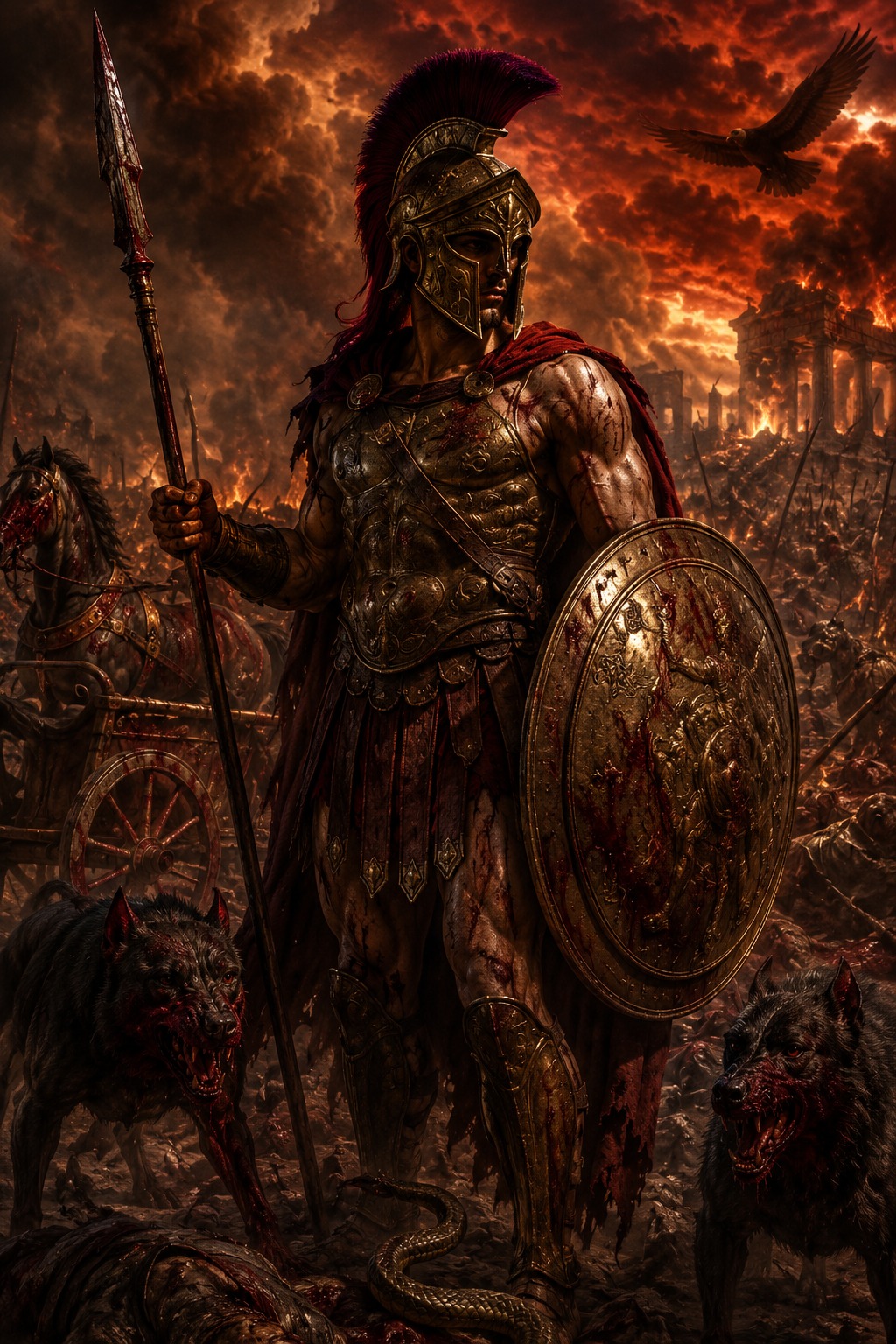
Ares
Ares · Greek God of War and Slaughter
Names in Other Languages
 아레스한국어
Ares · 전쟁과 학살의 신
 アレス日本語
Ares · ギリシャ戦争・殺戮の神
 阿瑞斯繁體中文
Ares · 希臘戰爭與屠殺之神
 AresDeutsch
Ares · Griechischer Gott des Krieges und des Gemetzels
 ArèsFrançais
Arès · Dieu grec de la guerre et du carnage
 AresEspañol
Ares · Dios griego de la guerra y la masacre
 AresPortuguês
Ares · Deus grego da guerra e do massacre
 AresPolski
Ares · Grecki bóg wojny i rzezi
 АресРусский
Ares · Греческий бог войны и резни
Ares (Ancient Greek Ares, Latin Mars) is the decisive canonical god of war, slaughter, and frenzy among the 12 Olympian gods of Greek mythology, and the decisive canonical iconographic figure as the son of Zeus (Zeus) and Hera (Hera), though even his parents disliked him. The etymology Greek Ares is the decisive canonical vocabulary meaning 'destruction', 'curse', or 'vengeance', and the aliases Enyalios (Enyalios, 'god of war'), Brotoloigos (Brotoloigos, 'plague of men'), Andreiphontes (Andreiphontes, 'man-slayer'), and Theoutios (Theoutios, 'of the god') are the decisive canonical vocabulary. The decisive textual canon is the Theogony (Theogony) lines 921-923 of Hesiod (Hesiod) of c. 8th-7th century BCE — the decisive canon of the birth of Ares as son of Zeus and Hera — and the Iliad (Iliad) Book 5 lines 385-391 of Homer (Homer) of c. 8th century BCE — the decisive canon in which the giant brothers Otos (Otos) and Ephialtes (Ephialtes) of the Aloadae (Aloadae) imprisoned Ares in a bronze jar for 13 months — and Book 5 lines 846-863 — the decisive canon in which Diomedes (Diomedes), with the help of Athena (Athena), wounded Ares with his spear, and Ares screamed like the cry of 9000-10000 men.
Origin
The iconographic origin is the Bronze Age Mycenaean civilisation (c. 1600-1100 BCE) Mycenaean Linear B clay tablet inscription 'a-re' (Ares) — the decisive origin canon, and the decisive textual canon is the Theogony (Theogony) lines 921-923 of Hesiod (Hesiod) of c. 8th-7th century BCE — the decisive canon of the birth of Ares as son of Zeus (Zeus) and Hera (Hera). The Iliad (Iliad) Book 5 lines 385-391 of Homer (Homer) of c. 8th century BCE — the decisive canon in which the giant brothers Otos (Otos) and Ephialtes (Ephialtes) of the Aloadae (Aloadae) imprisoned Ares in a bronze jar for 13 months — and Book 5 lines 846-863 — the decisive canon in which Diomedes (Diomedes), with the help of Athena (Athena), wounded Ares with his spear, and Ares screamed like the cry of 9000-10000 men — and Book 5 lines 890-891 — the decisive canon in which Zeus called Ares 'most hateful of gods (echthistos theon)'. The Odyssey (Odyssey) Book 8 lines 266-366 — the decisive canon in which the affair of Ares and Aphrodite (Aphrodite) was caught in the bronze net of Hephaistos (Hephaistos) and they were shamed before all the Olympian gods.
Features
- Young-to-middle-aged male god armed with helmet, armour, spear, and shield
- Accompanied by eagles, snakes, dogs, and fierce hounds
- Bronze chariot dyed with blood
- Two sons Phobos (Phobos, fear) and Deimos (Deimos, terror)
- More worshipped in Thrace (Thracia)
- Large in stature but weak in courage
Stories
The Bronze Age Mycenaean 'a-re' (Ares) inscription is the decisive origin, and the decisive textual canon is Hesiod Theogony lines 921-923 of c. 8th-7th century BCE and Homer Iliad Book 5 lines 385-391, 846-863, 890-891 and Odyssey Book 8 lines 266-366 of c. 8th century BCE — the decisive canon. The Homeric Hymns (Homeric Hymns) No. 8 Hymn to Ares of c. 7th-6th century BCE is the decisive religious canon, and the Areopagos (Areopagos, 'Hill of Ares') on the Athenian Acropolis of c. 5th century BCE is the decisive religious canon. The Temple of Ares (Temple of Ares) at the Athenian Agora of c. 4th century BCE — Doric style, about 30m long — is the decisive art canon, and the Metamorphoses (Metamorphoses) Book 4 lines 171-189 of Ovid (Publius Ovidius Naso) of c. 1st century CE — the decisive canon of the affair of Ares and Aphrodite — is the decisive Latin canon. The decisive 21st-century canon is the main antagonist Ares of God of War (God of War) (directed by David Jaffe, Santa Monica Studio) released by Sony Interactive Entertainment in the USA on 22 March 2005 — the decisive video-game canon, and the Ares played by David Thewlis (David Thewlis) of the Warner Bros. film Wonder Woman (Wonder Woman) (directed by Patty Jenkins) released in the USA on 2 June 2017 is the decisive global film canon.
Weakness
Ares's weaknesses are: (1) large in stature but weak in courage — the decisive canonical weakness in the c. 8th-century-BCE Homer Iliad Book 5 lines 846-863 — the decisive canon in which when Diomedes (Diomedes), with the help of Athena (Athena), wounded Ares with his spear, Ares screamed like the cry of 9000-10000 men; (2) twice defeated by Heracles — the decisive canon in the c. 1st-century-BCE Pseudo-Apollodorus Bibliotheca Book 2 chapter 5 section 11 — the decisive canon in which Heracles twice defeated Ares — and the decisive canon in which Heracles defeated Ares's son Kyknos (Kyknos); (3) imprisonment by Aloadae giant brothers — the c. 8th-century-BCE Homer Iliad Book 5 lines 385-391 — the decisive canon in which Otos (Otos) and Ephialtes (Ephialtes) imprisoned Ares in a bronze jar for 13 months; (4) shame from the affair with Aphrodite — the c. 8th-century-BCE Homer Odyssey Book 8 lines 266-366 — the decisive canon in which Ares and Aphrodite were caught in Hephaistos's bronze net and shamed; (5) hatred from parents — Homer Iliad Book 5 lines 890-891 — the decisive canon in which Zeus called Ares 'most hateful of gods'; (6) Greek avoidance — the decisive canon as the god of barbarism, avoided by the Greeks; (7) defeat by Athena — Homer Iliad Book 21 lines 391-414 — the decisive canon in which Athena struck down Ares with a stone; (8) binding of the sacred domain — the decisive canon. The decisive canonical finale is the decisive mythological canon of the c. 8th-century-BCE Homer Iliad Book 5 lines 846-863 — Ares's scream.
Cultural Significance
Ares is not merely a war-god icon but the canonical iconographic figure of the decisive Greek-Roman canon, traversing the Bronze Age Mycenaean 'a-re' inscription, the c. 8th-7th-century-BCE Hesiod Theogony, the c. 8th-century-BCE Homer Iliad Book 5 and Odyssey Book 8, the c. 7th-6th-century-BCE Homeric Hymns No. 8, the c. 5th-century-BCE Areopagos, the c. 4th-century-BCE Athenian Agora Temple of Ares, the c. 1st-century-CE Ovid Metamorphoses Book 4, the 2005 Sony God of War, and the 2017 Warner Bros. Wonder Woman. The Bronze Age Mycenaean civilisation (c. 1600-1100 BCE) Mycenaean Linear B clay tablet inscription 'a-re' (Ares) is the decisive origin, and the decisive mythological canon is the c. 8th-7th-century-BCE Hesiod Theogony lines 921-923 — the decisive canon of the birth of Ares as son of Zeus and Hera — and the c. 8th-century-BCE Homer Iliad Book 5 lines 385-391 — the decisive canon of the bronze jar 13-month imprisonment by Aloadae giant brothers — and Book 5 lines 846-863 — the decisive canon in which Diomedes, with the help of Athena, wounded Ares with his spear, and Ares screamed like the cry of 9000-10000 men. Book 5 lines 890-891 — the decisive canon in which Zeus called Ares 'most hateful of gods' — and the Odyssey Book 8 lines 266-366 — the decisive canon in which the affair of Ares and Aphrodite was caught in Hephaistos's bronze net and they were shamed before all the Olympian gods. The Areopagos (Areopagos, 'Hill of Ares') on the Athenian Acropolis of c. 5th century BCE is the decisive religious canon, and the Temple of Ares (Temple of Ares) at the Athenian Agora of c. 4th century BCE — Doric style, about 30m long — is the decisive art canon. The decisive 21st-century canon is the main antagonist Ares of God of War (God of War) (directed by David Jaffe, Santa Monica Studio, Metacritic 94, worldwide sales about 4.7 million) released by Sony Interactive Entertainment in the USA on 22 March 2005, and the Ares played by David Thewlis (David Thewlis) of the Warner Bros. film Wonder Woman (Wonder Woman) (directed by Patty Jenkins, worldwide box office about 822 million dollars) released in the USA on 2 June 2017 — the 21st-century decisive global canon.
In Popular Culture
- Mycenaean Linear B 'a-re' (Bronze Age) — decisive origin canon
- Hesiod Theogony lines 921-923 (c. 8th-7th century BCE) — decisive birth canon
- Homer Iliad Book 5 lines 385-391, 846-863, 890-891 (c. 8th century BCE) — decisive heroic-epic canon
- Homer Odyssey Book 8 lines 266-366 (c. 8th century BCE) — decisive Aphrodite-affair canon
- Homeric Hymns No. 8 Hymn to Ares (c. 7th-6th century BCE) — decisive religious canon
- Athenian Areopagos (c. 5th century BCE) — decisive religious canon
- Athenian Agora Temple of Ares (c. 4th century BCE) — decisive art canon
- Ovid Metamorphoses Book 4 lines 171-189 (c. 1st century CE) — decisive Latin canon
- Sony God of War, main antagonist Ares (2005) — 21st-century decisive video-game canon
- Warner Bros. film Wonder Woman, David Thewlis Ares (2017) — 21st-century decisive film canon
Trivia
The etymology Greek Ares is the decisive canonical vocabulary meaning 'destruction', 'curse', or 'vengeance', and the aliases Enyalios (Enyalios, 'god of war'), Brotoloigos (Brotoloigos, 'plague of men'), Andreiphontes (Andreiphontes, 'man-slayer'), Miaiphonos (Miaiphonos, 'blood-stained'), and Touros (Touros, 'wild') are the decisive canonical vocabulary. The decisive textual canon is the Theogony (Theogony) lines 921-923 of Hesiod (Hesiod) of c. 8th-7th century BCE — the decisive canon of the birth of Ares as son of Zeus (Zeus) and Hera (Hera). The c. 8th-century-BCE Homer Iliad Book 5 lines 385-391 — the decisive canon in which the giant brothers Otos (Otos) and Ephialtes (Ephialtes) of the Aloadae (Aloadae) imprisoned Ares in a bronze jar (chalkeos keramos) for 13 months — and Book 5 lines 846-863 — the decisive canon in which Diomedes (Diomedes), with the help of Athena (Athena), wounded Ares's belly with his spear, and Ares screamed like the cry of 9000-10000 men and fled to Olympus — and Book 5 lines 890-891 — the decisive canon in which Zeus called Ares 'most hateful of gods (echthistos theon)'. The Odyssey Book 8 lines 266-366 — the song of Demodokos (Demodokos) — the decisive canon in which the affair of Ares and Aphrodite (Aphrodite) was caught in the bronze net of Hephaistos (Hephaistos) and they were shamed before all the Olympian gods, and the main antagonist Ares of God of War (God of War) (directed by David Jaffe, Santa Monica Studio, Metacritic 94) released by Sony Interactive Entertainment in the USA on 22 March 2005 — the former master of the protagonist Kratos (Kratos) — and the Ares played by David Thewlis (David Thewlis, b. 1963) of the Warner Bros. film Wonder Woman (Wonder Woman) (directed by Patty Jenkins, worldwide box office about 822 million dollars) released in the USA on 2 June 2017 is the 21st-century decisive global canon.