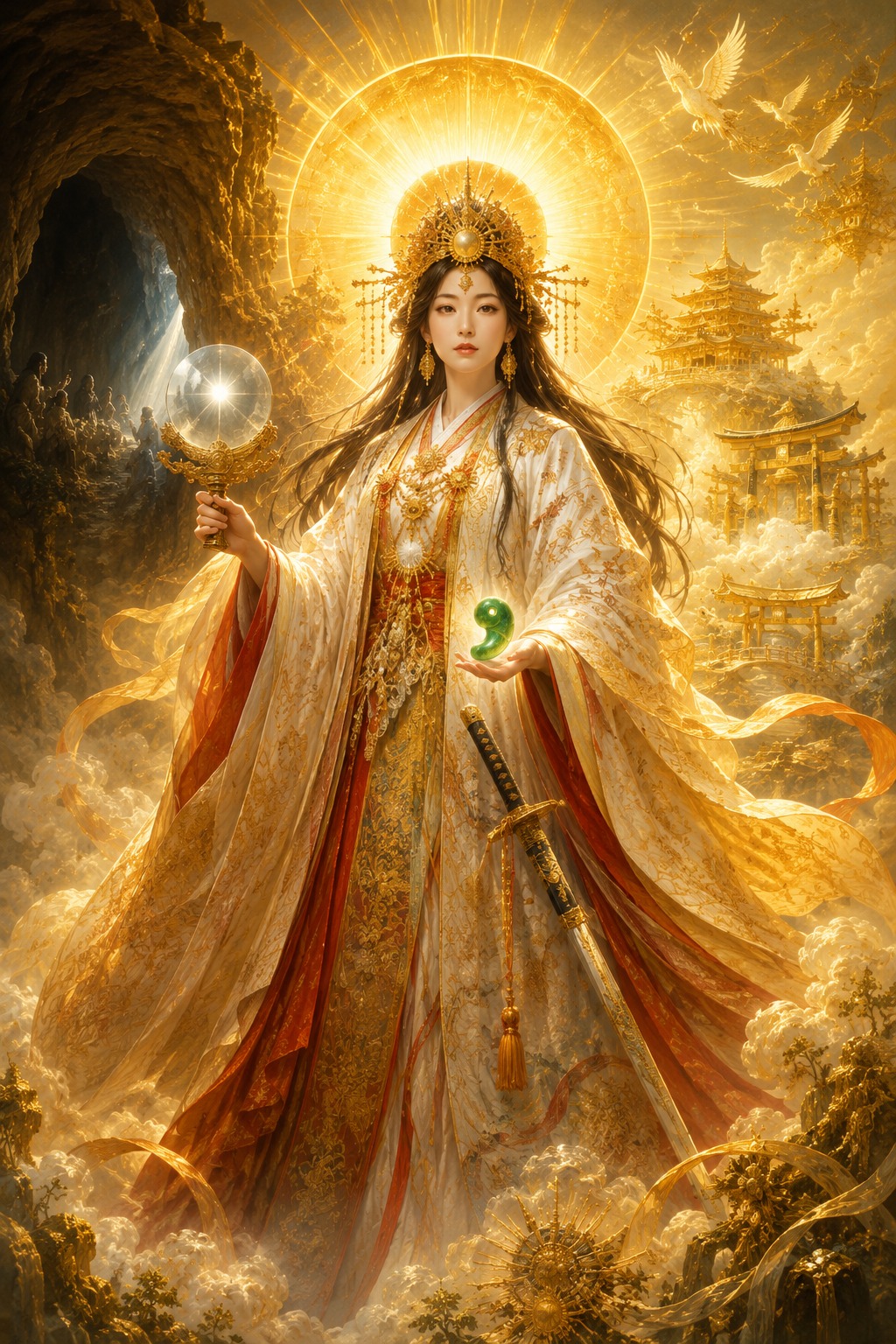
Amaterasu
Amaterasu · Japanese Sun Goddess — Ancestress of the Imperial House
Names in Other Languages
 아마테라스한국어
Amaterasu· 일본 태양 여신 황실의 시조
 天照大神日本語
Amaterasu· 日本太陽女神 皇室の祖
 天照大神繁體中文
Amaterasu· 日本太陽女神 皇室之祖
 AmaterasuDeutsch
Amaterasu · Japanische Sonnengöttin — Stammmutter des Kaiserhauses
 AmaterasuFrançais
Amaterasu · Déesse japonaise du soleil — Ancêtre de la maison impériale
 AmaterasuEspañol
Amaterasu · Diosa japonesa del sol — Antepasada de la Casa Imperial
 AmaterasuPortuguês
Amaterasu · Deusa japonesa do sol — Ancestral da Casa Imperial
 AmaterasuPolski
Amaterasu · Japońska bogini słońca — Przodek rodu cesarskiego
 АматэрасуРусский
Amaterasu · Японская богиня солнца — Прародительница императорского дома
Amaterasu (Amaterasu-Ōmikami) is the supreme deity and sun goddess of Japanese Shinto mythology — the decisive canon — the ruler of Takamagahara and the ancestor of the Japanese Imperial Family — the decisive canonical iconographic figure. The etymology is Amaterasu (, 'the one who illuminates heaven') + Ōmikami (, 'great deity') — the decisive canonical vocabulary — and aliases Ōhirume-no-Muchi (, 'great goddess of the sun'), Amaterasu-Ōmikami, and the Great Deity of Ise are the decisive canonical vocabulary. The decisive textual canon is the decisive origin canon of Kojiki Vol. 1 of 712 CE by Ō no Yasumaro — Amaterasu was born from Izanagi's left eye when he returned from Yomi and purified himself — and the decisive canon of Amaterasu hiding in Ame-no-Iwato (, Heavenly Rock Cave) in fury at her brother Susanoo's outrages, plunging the world into darkness. The decisive canon of Nihon Shoki Vol. 1 Age of the Gods of 720 CE by Prince Toneri, and the decisive canon of the principal deity of the Inner Shrine (Naiku) of Ise Grand Shrine and the Shikinen Sengū ritual every 20 years.
Origin
The iconographic origin is the decisive origin canon of ancient Japanese sun worship, and the decisive textual canon is the decisive origin canon of Kojiki Vol. 1 of 712 CE in which Izanagi went to Yomi to find his dead wife Izanami and returned to wash away the pollution in the river of Tsukushi, and Amaterasu was born from his left eye, Tsukuyomi from his right eye, and Susanoo from his nose — the decisive origin canon of the Three Noble Children . Amaterasu received the heavens of Takamagahara from her father and ruled them — the decisive canon — and the decisive canon in which her brother Susanoo ascended to heaven and broke the rice paddy ridges and threw impure things into the shrine, and Amaterasu in fury hid in Ame-no-Iwato (, Heavenly Rock Cave), plunging heaven and earth into darkness. The decisive canonical finale is the decisive mythological canon in which the other gods held a grand feast in front of Ame-no-Iwato, and Ame-no-Uzume's dance and the Yata-no-Kagami mirror drew Amaterasu out with curiosity, and Tachikarao opened the rock door, returning light to the world. The decisive canon of the Tenson Kōrin (, descent of the heavenly grandson) in which she sent her grandson Ninigi to the earth to become the ancestor of the Japanese Imperial Family, with the Three Sacred Treasures — Yata-no-Kagami, Yasakani-no-Magatama, and Kusanagi-no-Tsurugi — sent together.
Features
- Beautiful goddess surrounded by brilliant light
- Three Sacred Treasures — Yata-no-Kagami (, mirror), Yasakani-no-Magatama (, jewel), Kusanagi-no-Tsurugi (, sword)
- Ruler of the heavens of Takamagahara
- Principal deity of the Inner Shrine (Naiku) of Ise Grand Shrine
- Main axis — supreme deity of Japanese Shinto and ancestor of the Imperial Family
- Main figure of the Heavenly Rock Cave myth
Stories
Ancient Japanese sun worship is the decisive origin, and the decisive textual canon is Kojiki Vol. 1 of 712 CE, Nihon Shoki Vol. 1 Age of the Gods of 720 CE, and Engishiki of 927 CE. The decisive canon as the mythological basis of the legitimacy of the Japanese Imperial Family — the Emperor is her direct descendant. The decisive canon of the Shikinen Sengū (, ritual of rebuilding the shrine every 20 years) of Ise Grand Shrine as the most important ritual for her, started in 690 CE and continuing through the 62nd in 2013. The decisive canon called upon for agriculture, navigation, fertility, and national welfare, and the decisive 21st-century canon is the decisive global game canon of Amaterasu in the form of a white wolf in the video game Ōkami released in Japan on 20 April 2006 by Capcom (Capcom Clover Studio production). The decisive canon of Amaterasu in Marvel Comics Thor (Thor) from 2010 to 2017, and the decisive canon of the black flames of 'Amaterasu' of Uchiha Itachi's Mangekyō Sharingan in Japanese Naruto (Naruto) from 1999 to 2014.
Weakness
Amaterasu's weaknesses are: (1) vulnerability to passion — the decisive canonical weakness — hid in Ame-no-Iwato in fury at her brother Susanoo's outrages, plunging the world into darkness; (2) binding of Ame-no-Iwato — trapped in the Heavenly Rock Cave, the other gods had to draw her out with a grand feast and the Yata-no-Kagami mirror's curiosity; (3) binding of Susanoo — affected by her brother Susanoo's actions; (4) binding of the Three Sacred Treasures — bound to the Three Sacred Treasures ; (5) binding of the Imperial Family — bound to the fate of the Imperial Family as its ancestor; (6) binding of Ise Grand Shrine — bound to the 20-year Shikinen Sengū cycle of Ise Grand Shrine; (7) binding of the sacred domain — Takamagahara; (8) binding of the sun — the courses of the sun. The decisive canonical finale is the decisive mythological canon of being drawn out of Ame-no-Iwato in Kojiki Vol. 1 of 712 CE by Ame-no-Uzume's dance and the Yata-no-Kagami mirror, returning light to the world.
Cultural Significance
Amaterasu is the canonical iconographic figure of the decisive Japanese canon, traversing Kojiki Vol. 1 of 712 CE, Nihon Shoki Vol. 1 Age of the Gods of 720 CE, Engishiki of 927 CE, the Shikinen Sengū of Ise Grand Shrine from 690 CE, the Daijōsai of the Emperor's enthronement, the 2006 Capcom video game Ōkami, and 'Amaterasu' in Naruto from 1999 to 2014. The iconographic origin is the decisive origin canon of ancient Japanese sun worship, and settled as the decisive origin canon of the Three Noble Children in Kojiki Vol. 1 of 712 CE by Ō no Yasumaro in which Izanagi returned from Yomi and washed away the pollution in the river of Tsukushi, with Amaterasu born from his left eye, Tsukuyomi from his right eye, and Susanoo from his nose. The decisive mythological canon is the decisive canon of Amaterasu hiding in Ame-no-Iwato (, Heavenly Rock Cave) in fury at Susanoo's outrages of breaking the rice paddy ridges and throwing impure things into the shrine in Kojiki Vol. 1 of 712 CE, plunging heaven and earth into darkness, and the decisive canon in which the other gods held a grand feast in front of Ame-no-Iwato, and Ame-no-Uzume's dance and the Yata-no-Kagami mirror drew Amaterasu out with curiosity, and Tachikarao opened the rock door, returning light to the world. The decisive Tenson Kōrin canon is the decisive canon of the Tenson Kōrin (, descent of the heavenly grandson) in Kojiki of 712 CE in which she sent her grandson Ninigi down to the Takachiho peak of Himuka of Tsukushi on earth to become the ancestor of the Japanese Imperial Family, with the Three Sacred Treasures — Yata-no-Kagami, Yasakani-no-Magatama, and Kusanagi-no-Tsurugi — sent together. The decisive shrine canon is the decisive canon of being the principal deity of the Inner Shrine (Naiku Kōtai Jingū) of Ise Grand Shrine, with the Shikinen Sengū every 20 years started by Empress Jitō 's decree of 690 CE continuing through the 62nd in 2013. The decisive 21st-century canon is the decisive canon of Amaterasu in the form of a white wolf in the video game Ōkami (Clover Studio production) released in Japan on 20 April 2006 by Capcom (Capcom), and the decisive canon of the black flames of 'Amaterasu' of Uchiha Itachi's Mangekyō Sharingan in the manga Naruto (Naruto) by Japanese Masashi Kishimoto from 1999 to 2014.
In Popular Culture
- Kojiki Vol. 1 Three Noble Children of Izanagi (712 CE) — decisive origin canon
- Kojiki Vol. 1 Ame-no-Iwato myth (712 CE) — decisive origin canon
- Nihon Shoki Vol. 1 Age of the Gods (720 CE) — decisive origin canon
- Engishiki (927 CE) decisive shrine canon
- Ise Grand Shrine Shikinen Sengū (690 CE) — decisive shrine ritual canon
- Capcom video game Ōkami (2006) — 21st-century decisive global game canon
- Masashi Kishimoto manga Naruto 'Amaterasu' of Uchiha Itachi (1999-2014) — decisive manga canon
Trivia
The etymology of Amaterasu (Amaterasu-Ōmikami) is the decisive canonical vocabulary of Amaterasu (, 'the one who illuminates heaven') + Ōmikami (, 'great deity'), and aliases Ōhirume-no-Muchi (, 'great goddess of the sun'), Amaterasu-Ōmikami, the Great Deity of Ise, and Amaterasu-Sumeōkami are the decisive canonical vocabulary. The decisive textual canon is the decisive origin canon of Kojiki Vol. 1 of 712 CE by Ō no Yasumaro (, c. 723 CE) in which Izanagi went to Yomi to find his dead wife Izanami and returned to wash away the pollution in the river of Tsukushi, and Amaterasu (sun) was born from his left eye, Tsukuyomi (, moon) from his right eye, and Susanoo (, storm and sea) from his nose — the decisive canon of the Three Noble Children . Amaterasu received the heavens of Takamagahara from her father Izanagi and ruled them — the decisive canon — and the decisive canon of Amaterasu hiding in Ame-no-Iwato (, Heavenly Rock Cave) in fury at her brother Susanoo's outrages of breaking the rice paddy ridges and throwing the impure hide of a flayed horse into the shrine, plunging heaven and earth into darkness, and the decisive canon in which the other gods held a grand feast in front of Ame-no-Iwato, and Ame-no-Uzume's erotic dance and the Yata-no-Kagami mirror drew Amaterasu out with curiosity, and Tachikarao opened the rock door, returning light to the world. The decisive Tenson Kōrin canon is the decisive canon of the Tenson Kōrin (, descent of the heavenly grandson) in Kojiki of 712 CE in which she sent her grandson Ninigi down to the Takachiho peak of Himuka of Tsukushi on earth to become the ancestor of the Japanese Imperial Family, with the Three Sacred Treasures — Yata-no-Kagami (, mirror), Yasakani-no-Magatama (, jewel), and Kusanagi-no-Tsurugi (, sword, originally Ame-no-Murakumo-no-Tsurugi) — sent together. The decisive canon of the same myth in Nihon Shoki Vol. 1 Age of the Gods of 720 CE by Prince Toneri, and the decisive canon of Ise Grand Shrine in Engishiki of 927 CE. The decisive shrine canon is the decisive canon of being the principal deity of the Inner Shrine (Naiku Kōtai Jingū, Ise City, Mie Prefecture) of Ise Grand Shrine, with the Shikinen Sengū every 20 years started by Empress Jitō 's decree of 690 CE — the decisive canon of rebuilding the shrine anew and renewing all rituals — and the decisive canon of the 62nd Shikinen Sengū on 2 October 2013. The decisive 21st-century canon is the decisive global game canon of the sun goddess Amaterasu in the form of a white wolf in the video game Ōkami (Clover Studio production, directed by Hideki Kamiya) released in Japan on 20 April 2006 by Capcom (Capcom), and the decisive canon of the black flames of 'Amaterasu ' of Uchiha Itachi's Mangekyō Sharingan in the manga Naruto (Naruto) by Japanese Masashi Kishimoto from November 1999 to November 2014.