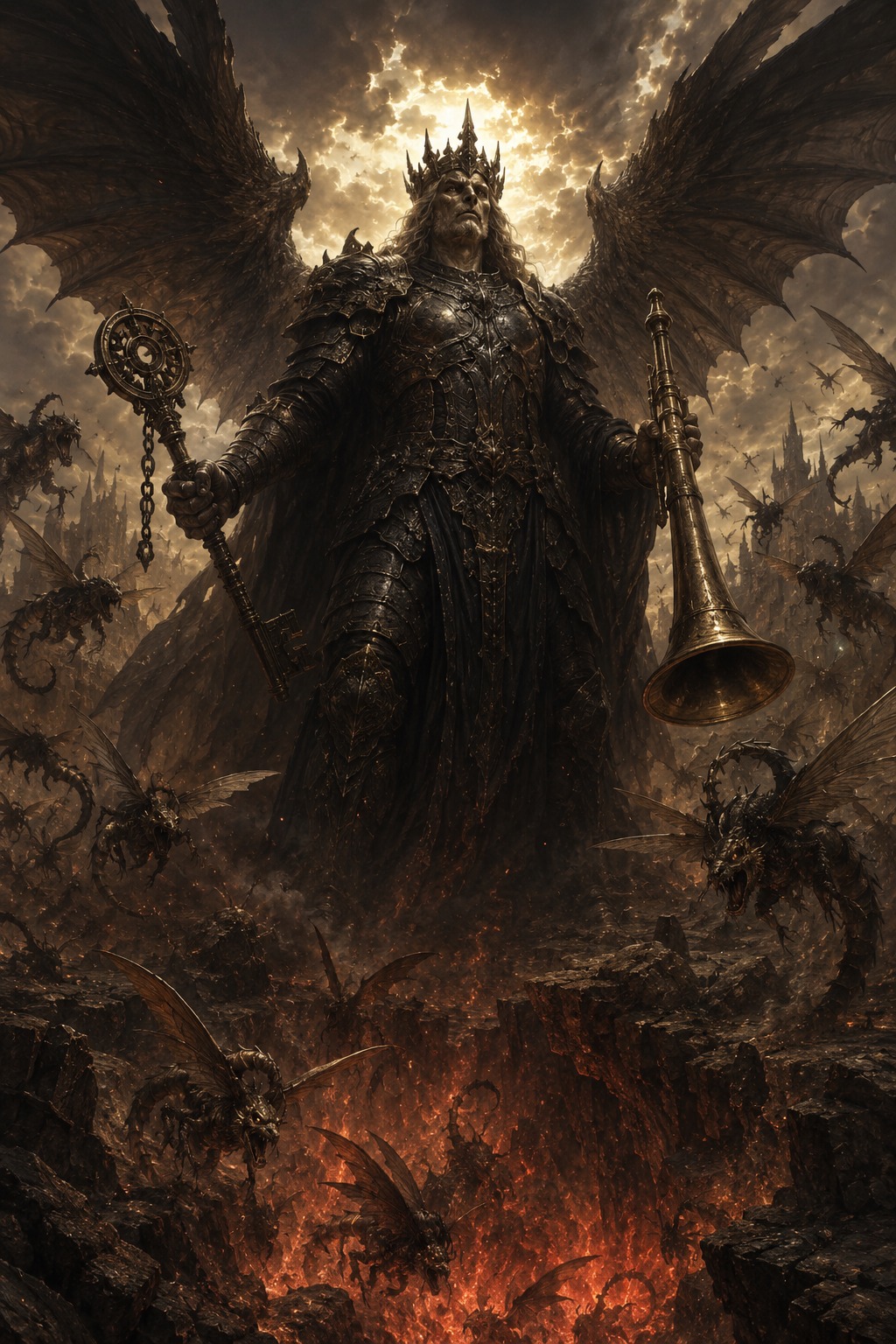
Abaddon
Abaddon· Angel of Destruction King of the Abyss
Names in Other Languages
 아바돈한국어
Abaddon· 멸망의 천사 무저갱의 왕
 アバドン日本語
Abaddon· 滅びの天使 底なき淵の王
 亞巴頓繁體中文
Abaddon· 毀滅天使 無底坑之王
 AbaddonDeutsch
Abaddon · Engel der Vernichtung — König des Abgrunds
 AbaddonFrançais
Abaddon· Ange de la destruction Roi de l'Abîme
 AbadónEspañol
Abadón· Ángel de la destrucción Rey del Abismo
 AbadomPortuguês
Abadom· Anjo da destruição Rei do Abismo
 AbaddonPolski
Abaddon· Anioł zniszczenia Król Otchłani
 АваддонРусский
Abaddon· Ангел погибели Царь Бездны
Abaddon (Hebrew Avaddon, Greek Apollyōn, Latin Abaddon) is the angel of destruction in the Judeo-Christian tradition — the decisive canon — derived from the Hebrew verb avad meaning 'to perish, destroy' — the decisive canonical iconographic figure of 'destruction (destruction)' and the Greek Apollyon (Apollyōn) meaning 'destroyer (destroyer)'. Aliases — Apollyon, Abaddon, King of the Abyss (Abyss), King of the Locust Swarm — are the decisive canonical vocabulary. The decisive textual canon is the decisive origin canon of Job (Job) 26:6, 28:22, and 31:12 of c. 6th-4th century BCE in which 'Abaddon' is personified as the grave or place of destruction, and the decisive canon of Proverbs (Proverbs) 15:11 and 27:20 and Psalm (Psalm) 88:11. The decisive New Testament canon is the decisive canon of Revelation (Revelation) 9:11 of the 1st century CE — 'And they had a king over them, which is the angel of the bottomless pit (angel of the bottomless pit), whose name in the Hebrew tongue is Abaddon, but in the Greek tongue hath his name Apollyon'. The decisive 17th-century English-literary canon of Apollyon's combat with Christian in The Pilgrim's Progress (The Pilgrim's Progress) by John Bunyan (John Bunyan) of 1678.
Origin
The etymological origin is the decisive origin canon of 'destruction (destruction)' derived from the Hebrew verb avad meaning 'to perish, destroy (to perish, destroy)', and the decisive Old Testament canon is the decisive origin canon of Job (Job) 26:6 of c. 6th-4th century BCE — 'Hell is naked before him, and destruction (Abaddon) hath no covering' — and 28:22 — 'Destruction (Abaddon) and Death say, We have heard the fame thereof with our ears' — and 31:12 — originally meaning a personified grave or place of destruction. The decisive canon of Proverbs (Proverbs) 15:11 — 'Hell and destruction (Abaddon) are before the Lord: how much more then the hearts of the children of men' — and 27:20 and Psalm (Psalm) 88:11 — 'Shall thy lovingkindness be declared in the grave? or thy faithfulness in destruction (Abaddon)?'. The decisive New Testament canon is the decisive origin canon of Revelation (Revelation) 9:1-11 of the 1st century CE in which when the fifth angel sounded his trumpet, a star fallen from heaven to earth received the key to the bottomless pit (Abyss), and the pit was opened, and a locust-like army came out with the teeth of lions (verse 7), faces of men, hair of women, teeth of lions, and tails like scorpions (verse 10), and tormented for five months (verse 5) the humans who did not have the seal of God, with verse 11 — 'And they had a king over them, which is the angel of the bottomless pit (angel of the bottomless pit), whose name in the Hebrew tongue is Abaddon, but in the Greek tongue hath his name Apollyon'.
Features
- Commands a vast army resembling a locust swarm
- He himself is the giant king in dark armor — the angel of the bottomless pit
- Trumpet of judgment and key to the Abyss
- Locust army — lion's teeth and scorpion's tail (Revelation 9:7-10)
- Main axis King of the Abyss (Abyss)
- Alias 'Apollyon (Apollyon, destroyer)'
Stories
Job 26:6, 28:22, and 31:12 of c. 6th-4th century BCE 'Abaddon' is the decisive origin, and the decisive textual canon is Proverbs 15:11 and 27:20, Psalm 88:11, and Revelation 9:11 of the 1st century CE. The decisive canon frequently called upon as a symbol of apocalypse, judgment, and destruction in apocalyptic literature and horror genres, and the decisive canon as a double-sided figure rather than mere evil, with orthodox theology also viewing him as an angel executing God's apocalyptic judgment. The decisive 17th-century English-literary canon is the decisive canon of the combat between the protagonist Christian and Apollyon in the Valley of Humiliation in Part 1 of The Pilgrim's Progress (The Pilgrim's Progress) of 1678 by the English John Bunyan (John Bunyan, 1628-1688) — Apollyon described as 'a hideous monster with scales like a dragon, feet of a bear, mouth of a lion, and wings of darkness'. The decisive 19th-century art canon of Abaddon in the Dictionnaire Infernal (Dictionnaire Infernal) of 1818 by Collin de Plancy (Collin de Plancy), and the decisive fantasy RPG canon of Abaddon in the 1977 USA TSR Monster Manual (Monster Manual), and the decisive 21st-century canon is the decisive global video canon of Abaddon (the last of the Knights of Hell after Lucifer was banished) played by Alaina Huffman in Season 8 episode 23 through Season 10 of the TV series Supernatural (Supernatural) by USA CW from 2013 to 2015.
Weakness
Abaddon's weaknesses are: (1) God's command — the decisive canonical weakness — the decisive canon of Revelation 9:1 — 'And I saw a star fall from heaven unto the earth: and to him was given the key of the bottomless pit' — opens the bottomless pit only by God's appointed time and authority, cannot open the bottomless pit without God's command; (2) the five-month limit — the decisive canonical weakness — the decisive canon of Revelation 9:5 and 10 — 'And to them it was given that they should not kill them, but that they should be tormented five months' — authority to torment humans for only five months; (3) the limit of God's seal — the decisive canonical weakness — the decisive canon of Revelation 9:4 — 'but only those men which have not the seal of God in their foreheads' — cannot harm the righteous who have God's seal; (4) limits of time and scope of power — the decisive canonical weakness — his power is limited in time and scope by God; (5) Christ's authority — the decisive canonical weakness; (6) binding of the Abyss — bound to the Abyss; (7) binding of the sacred domain — the decisive canon; (8) binding of the fifth trumpet — released only at the time of the fifth trumpet. The decisive canonical finale is the decisive mythological canon of Christian repelling Apollyon with the 'sword of the Spirit' in Part 1 of John Bunyan's The Pilgrim's Progress of 1678.
Cultural Significance
Abaddon is not merely a destruction icon but the canonical iconographic figure of the decisive Judeo-Christian canon, traversing Job 26:6, 28:22, and 31:12 of c. 6th-4th century BCE, Proverbs 15:11 and 27:20, Psalm 88:11, Revelation 9:1-11 of the 1st century CE, Part 1 of John Bunyan's The Pilgrim's Progress of 1678, Collin de Plancy's Dictionnaire Infernal of 1818, the 1977 TSR D&D Monster Manual, and 2013-2015 CW Supernatural. The etymological origin is the decisive canon of 'destruction (destruction)' derived from the Hebrew verb avad meaning 'to perish, destroy', settled as the decisive canon originally meaning a personified grave or place of destruction. The decisive Old Testament canon is the decisive origin canon of Job 26:6 of c. 6th-4th century BCE — 'Hell is naked before him, and destruction (Abaddon) hath no covering' — personified as the grave or place of destruction. The decisive New Testament canon is the decisive canon of Revelation (Revelation) 9:1-11 of the 1st century CE in which when the fifth angel sounded his trumpet, a star received the key to the bottomless pit (Abyss), and the pit was opened, and a locust-like army came out with the teeth of lions (verse 7), faces of men, hair of women, teeth of lions, and tails like scorpions (verse 10), and tormented for five months (verse 5) the humans who did not have the seal of God, with verse 11 — 'And they had a king over them, which is the angel of the bottomless pit (angel of the bottomless pit), whose name in the Hebrew tongue is Abaddon, but in the Greek tongue hath his name Apollyon'. The decisive 17th-century English-literary canon is the decisive canon of the combat between the protagonist Christian and Apollyon in the Valley of Humiliation in Part 1 of The Pilgrim's Progress (The Pilgrim's Progress from This World, to That Which Is to Come) of 1678 by the English John Bunyan (John Bunyan, born 30 November 1628 in Bedford, England, died 31 August 1688 in London, England). The decisive 21st-century canon is the decisive global video canon of Abaddon (the last of the Knights of Hell after Lucifer was banished) played by Alaina Huffman in Season 8 episode 23 through Season 10 episode 22 of the TV series Supernatural (Supernatural) by USA CW from 8 October 2013 to 6 May 2015.
In Popular Culture
- Job 26:6, 28:22, 31:12 'Abaddon' place of destruction (c. 6th-4th century BCE) — decisive origin canon
- Proverbs 15:11, 27:20 and Psalm 88:11 (c. 6th-4th century BCE) — decisive canon
- Revelation 9:1-11 angel of the bottomless pit Abaddon-Apollyon (1st century CE) — decisive New Testament canon
- John Bunyan The Pilgrim's Progress Part 1 Valley of Humiliation (1678) — decisive 17th-century English-literary canon
- Collin de Plancy Dictionnaire Infernal (1818) — decisive art canon
- TSR D&D Monster Manual (1977) — decisive fantasy RPG canon
- CW TV series Supernatural Abaddon Alaina Huffman Seasons 8-10 (2013-2015) — 21st-century decisive TV canon
Trivia
The etymology of Abaddon (Hebrew Avaddon) is the decisive canonical vocabulary of 'destruction (destruction)' derived from the Hebrew verb avad meaning 'to perish, destroy (to perish, destroy)', and the Greek Apollyōn (Apollyōn) meaning 'destroyer (destroyer)' is the decisive canonical vocabulary, and aliases Apollyon, Abaddon, King of the Abyss (Abyss), King of the Locust Swarm, and angel of the fifth trumpet are the decisive canonical vocabulary. The decisive Old Testament canon is the decisive origin canon of Job (Job) 26:6 of c. 6th-4th century BCE — 'Hell is naked before him, and destruction (Abaddon) hath no covering' — and 28:22 — 'Destruction (Abaddon) and Death say, We have heard the fame thereof with our ears' — and 31:12 — originally meaning a personified grave or place of destruction. The decisive New Testament canon is the decisive canon of Revelation (Revelation) 9:1-11 of the 1st century CE in which when the fifth angel sounded his trumpet, a star fallen from heaven to earth received the key to the bottomless pit (Abyss), and the pit was opened, and a locust-like army came out — 'And the shapes of the locusts were like unto horses prepared unto battle; and on their heads were as it were crowns like gold, and their faces were as the faces of men. And they had hair as the hair of women, and their teeth were as the teeth of lions. And they had breastplates, as it were breastplates of iron; and the sound of their wings was as the sound of chariots of many horses running to battle. And they had tails like unto scorpions, and there were stings in their tails' — the decisive canon, with verse 11 — 'And they had a king over them, which is the angel of the bottomless pit (angel of the bottomless pit), whose name in the Hebrew tongue is Abaddon, but in the Greek tongue hath his name Apollyon'. The decisive 17th-century English-literary canon is the decisive canon of the combat between the protagonist Christian and Apollyon in the Valley of Humiliation in Part 1 of The Pilgrim's Progress (The Pilgrim's Progress from This World, to That Which Is to Come) of 1678 by the English Baptist Puritan writer John Bunyan (John Bunyan, born 30 November 1628 in Bedford, England, died 31 August 1688 in London, England) — Apollyon described as 'a hideous monster with scales like a dragon, feet of a bear, mouth of a lion, and wings of darkness' — Christian repelling Apollyon with the 'sword of the Spirit'. The decisive 19th-century art canon of the Abaddon iconography in the Dictionnaire Infernal (Dictionnaire Infernal) of 1818 by the French Collin de Plancy (Collin de Plancy, 1793-1881), and the decisive fantasy RPG canon of Abaddon in the 1977 USA TSR Monster Manual (Monster Manual). The decisive 21st-century canon is the decisive canon of Abaddon (the last of the Knights of Hell (Knights of Hell) after Lucifer was banished) played by Alaina Huffman (Alaina Huffman, born 17 April 1980 in Vancouver, Canada) in Season 8 episode 23 through Season 9 episode 22 of the TV series Supernatural (Supernatural) (created by Eric Kripke (Eric Kripke)) by USA CW from her first appearance on 8 October 2013 to 20 May 2014.