Manticore
Persian Legendary Lion-Man-Scorpion Hybrid
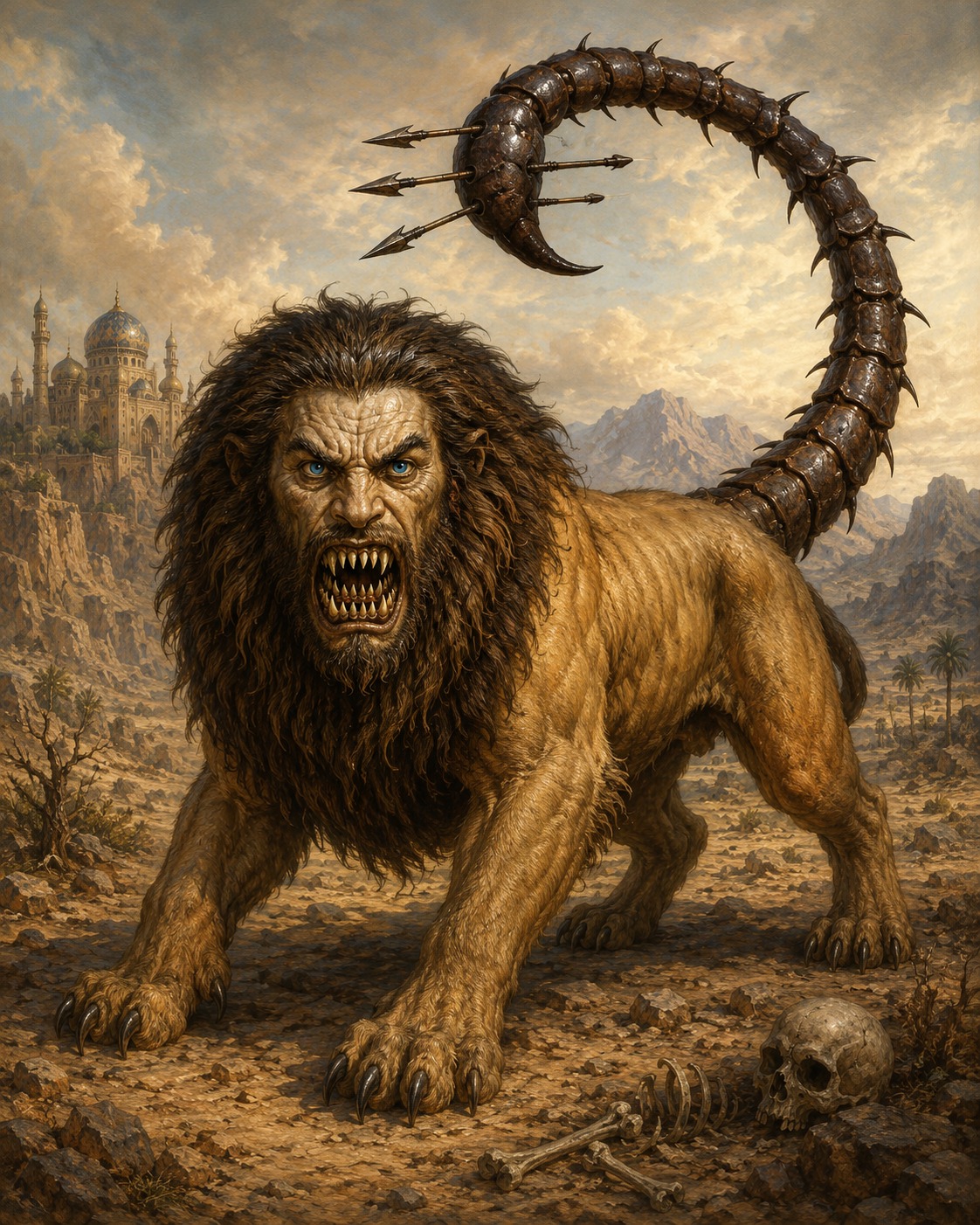
The Manticore (Persian martyaxwar, 'man-eater') is a composite beast of ancient Persian tradition, with the body of a lion, the face of a human, and the tail of a scorpion. The earliest Greek reference is in the Indika of Ctesias of Knidos (fourth century BCE), a Greek physician at the Persian court, who describes it as an Indian man-eater with blue eyes, three rows of shark-like teeth, and a tail that shoots venomous spines like arrows. Ctesias' account is hearsay he gathered at the Persian court; later scholars have read it as a Greek interpretation of the Indian tiger overlaid with Persian-Indian mythic elements. Pliny's Natural History and Aelian's De natura animalium expanded the description, and Isidore of Seville's Etymologies fixed the Latin manticora. From the twelfth-century Aberdeen Bestiary and MS Bodley 764 onward, the manticore became a standard image in medieval bestiaries, then a heraldic emblem of cruelty and cannibalism. Gary Gygax's 1977 Dungeons and Dragons Monster Manual added bat-wings and standardised the modern fantasy manticore.