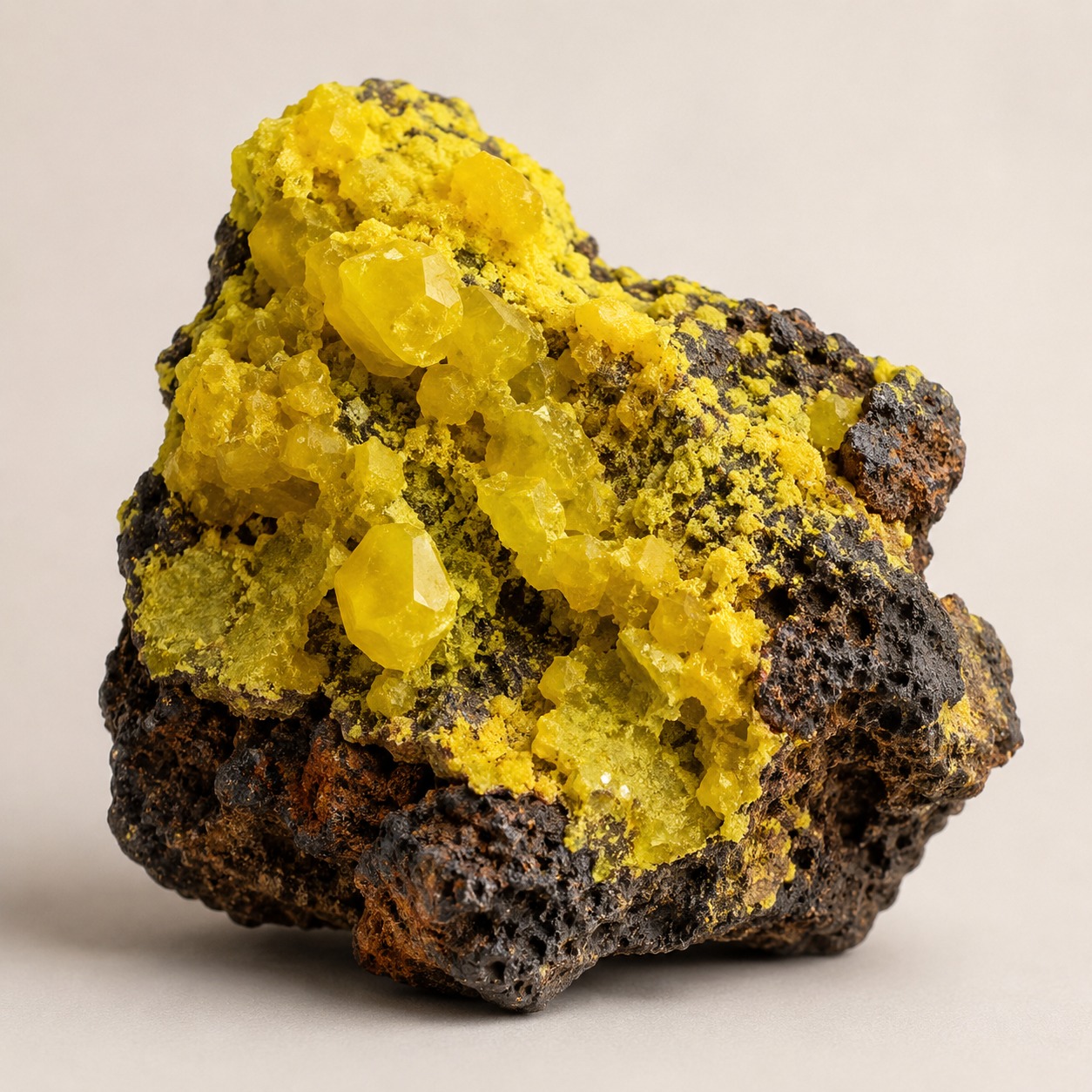
Sulfur
Sulfur· 硫黃 Fire of hell
Names in Other Languages
 유황한국어
유황한국어Sulfur· 硫黃 지옥의 불
 硫黄日本語
硫黄日本語Sulfur· 硫黄 地獄の火
 硫黃繁體中文
Sulfur· 硫黃 地獄之火
 SchwefelDeutsch
Sulfur· 硫黃 Hoellenfeuer
 SoufreFrançais
Sulfur· 硫黃 Feu de l enfer
 AzufreEspañol
Sulfur· 硫黃 Fuego del infierno
 EnxofrePortuguês
Sulfur· 硫黃 Fogo do inferno
 SiarkaPolski
Sulfur· 硫黃 Ogien piekielny
 СераРусский
Sulfur· 硫黃 Адский огонь
Sulfur (English Sulfur, Latin sulphur/sulfur, Greek θεῖον theion) is the element of hell's fire of the decisive canon — derived from Greek 'theion (θεῖον, divine)' — the decisive canonical vocabulary — the decisive mineralogical canon of the chemical element S — and the decisive biblical canon of the sulfur of Sodom and Gomorrah in Genesis 19, and the decisive canon as the active element among the three principles of alchemy (sulfur, mercury, salt). Aliases — Sulfur (Sulfur), theion (θεῖον, 'divine'), brimstone (brimstone, 'burning stone'), hell's fire — are the decisive canonical vocabulary. The decisive biblical canon is the decisive canon of the sulfur and fire of Sodom (Sodom) and Gomorrah (Gomorrah) in Genesis 19:24, and the decisive apocalyptic canon is the decisive canon of the lake of fire and brimstone (lake of fire and brimstone) of the beast and false prophet in Revelation 19:20. The decisive natural history canon is the decisive canon of sulfur in Pliny the Elder's (Pliny the Elder, 23-79) Natural History (Naturalis Historia) Book 35 verses 174-178 of the 1st century.
Origin
The etymological origin is the decisive canonical vocabulary of Greek 'theion (θεῖον, divine, of god)' — the decisive canon of the divinity of sulfur, and the decisive canon of Latin 'sulphur/sulfur' becoming the etymology of the chemical symbol S. The decisive biblical origin canon is the decisive canon of Genesis 19:24 of c. 1800 BCE — 'The Lord rained sulfur (Hebrew gophrit) and fire from heaven upon Sodom (Sodom) and Gomorrah (Gomorrah)' — the decisive canon of the destruction of Sodom and Gomorrah south of the Dead Sea. The decisive Homer canon is the decisive canon of Greek Homer's (Homer, 8th century BCE) Odyssey (Odyssey) Book 22 verses 481-482 of Odysseus burning sulfur (theion) to purify the palace after slaying the suitors. The decisive apocalyptic canon is the decisive canon of the 'lake of fire and brimstone' (Greek λίμνη τοῦ πυρὸς τοῦ καιομένου ἐν θείῳ) in John's Revelation (Revelation) 19:20, 20:10, and 21:8 of the 1st century. The decisive natural history canon is the decisive canon of the four classifications of sulfur (natural, artificial, solid, liquid) in the Roman Pliny the Elder's (Pliny the Elder, 23-79) Natural History (Naturalis Historia) Book 35 verses 174-178 of the 1st century.
Features
- Chemical element S atomic number 16 Mohs hardness 1.5-2.5
- Main axis — sulfur and fire of Sodom and Gomorrah in Genesis 19
- Three principles of alchemy — sulfur (active, soul), mercury (spirit), salt (body)
- Greek theion (θεῖον, 'divine') — etymology of divinity
- Component of black powder (75% saltpeter + 15% charcoal + 10% sulfur)
- Origin — volcanoes of Sicily, Vulcano island of Italy, China, Louisiana USA
Stories
The sulfur of Sodom and Gomorrah in Genesis 19 is the decisive biblical origin, and the decisive natural history canon is the four classifications of sulfur in Pliny the Elder's Natural History Book 35 verses 174-178 of the 1st century. The decisive canon used as the symbol of hell's fire (brimstone), and the decisive canon classified as the active element (soul) among the three principles of alchemy. The decisive medical canon is the decisive canon of the treatment of skin diseases with sulfur in ancient Egypt and Greece, and the decisive gunpowder canon is the decisive canon of the invention of black powder (75% saltpeter + 15% charcoal + 10% sulfur) in 9th-century Tang China — the decisive canon of its transmission to Europe in the 13th century. The decisive Paracelsus canon is the decisive canon of the three principles of alchemy by the Swiss Paracelsus (Paracelsus, 1493-1541) of the 16th century.
Weakness
Sulfur's weaknesses are: (1) odor — the decisive canonical weakness — the decisive canon of the strong pungent smell of sulfur dioxide when burned; (2) combustibility — the decisive canonical weakness — the decisive canon of igniting at 250 degrees and burning with a blue flame; (3) Mohs hardness 1.5-2.5 limit — the decisive canonical weakness — very soft; (4) binding of toxicity — the decisive canon of environmental pollution from sulfur dioxide and acid rain; (5) binding of volcanoes — the decisive canon of only being found near volcanoes; (6) binding of the sacred domain — the decisive canon; (7) binding of hell — the decisive canon of the binding of the lake of fire of Revelation; (8) binding of time — the decisive canon of the binding of 4000 years of biblical canon. The decisive canonical finale is the decisive mythological canon of the mass production of sulfuric acid in the 19th-century Industrial Revolution.
Cultural Significance
Sulfur is not merely a mineral icon but the canonical iconographic figure of the decisive biblical-Greek-Chinese-European canon, traversing the sulfur of Sodom and Gomorrah in Genesis 19 of c. 1800 BCE, Odysseus's purification in Homer's Odyssey Book 22 verses 481-482 of the 8th century BCE, Pliny the Elder's Natural History Book 35 verses 174-178 of the 1st century, the lake of fire in Revelation 19:20 of the 1st century, the black powder of 9th-century China, the three principles of alchemy of Paracelsus of the 16th century, and Lavoisier's elemental definition of 1789. The etymological origin settled as the decisive canon of Greek 'theion (θεῖον, divine)' — the decisive canon of the divinity of sulfur, with Latin 'sulphur/sulfur' as the etymology of the chemical symbol S. The decisive biblical origin canon is the decisive canon of Genesis 19:24 of c. 1800 BCE — 'The Lord rained sulfur (gophrit) and fire from heaven upon Sodom (Sodom) and Gomorrah (Gomorrah)', and the decisive Homer canon is the decisive canon of Greek Homer's (Homer, 8th century BCE) Odyssey (Odyssey) Book 22 verses 481-482 of Odysseus burning sulfur to purify the palace after slaying the suitors. The decisive apocalyptic canon is the decisive canon of the 'lake of fire and brimstone' (Greek λίμνη τοῦ πυρὸς τοῦ καιομένου ἐν θείῳ) in John's Revelation (Revelation) 19:20 (the beast and false prophet), 20:10 (the devil), and 21:8 (cowards and unbelievers) of the 1st century. The decisive natural history canon is the decisive canon of the four classifications of sulfur (natural, artificial, solid, liquid) and the sulfur of the Vulcano (Vulcano) island of Sicily in the Roman Pliny the Elder's (Pliny the Elder, 23-79) Natural History (Naturalis Historia) Book 35 verses 174-178 of the 1st century. The decisive gunpowder canon is the decisive canon of the invention of black powder (75% saltpeter KNO3 + 15% charcoal C + 10% sulfur S) by Taoist alchemists of Tang China (618-907) of the 9th century — the decisive canon of its transmission to Europe in the 13th century. The decisive Paracelsus canon is the decisive canon of the three principles of alchemy (tria prima, sulfur-soul, mercury-spirit, salt-body) by the Swiss physician and alchemist Paracelsus (Paracelsus, 1493-1541) of the 16th century. The decisive chemistry canon is the decisive canon of the French Lavoisier's (Antoine Lavoisier, 1743-1794) Treatise on Chemistry (Traité élémentaire de chimie) of 1789 listing sulfur as a chemical element.
In Popular Culture
- Sulfur and fire of Sodom (Sodom) and Gomorrah (Gomorrah) in Genesis 19:24 (c. 1800 BCE) — decisive biblical origin canon
- Odysseus's purification in Homer Odyssey (Odyssey) Book 22 verses 481-482 (8th century BCE) — decisive Homer canon
- Pliny the Elder Natural History (Naturalis Historia) Book 35 verses 174-178 (1st century) — decisive natural history canon
- Lake of fire and brimstone in John's Revelation (Revelation) 19:20, 20:10, 21:8 (1st century) — decisive apocalyptic canon
- Invention of black powder (75% saltpeter + 15% charcoal + 10% sulfur) in Tang China (9th century) — decisive gunpowder canon
- Sulfur of Vulcano (Vulcano) island of Italy — decisive Mediterranean canon
- Three principles of alchemy by Paracelsus (Paracelsus) (16th century) — decisive alchemical canon
- Antoine Lavoisier (Antoine Lavoisier) Treatise on Chemistry sulfur as element (1789) — decisive chemistry canon
- Sulfur of hell in Dante's Divine Comedy (1320) — decisive medieval canon
- Mass production of sulfuric acid in the Industrial Revolution (19th century) — decisive industrial canon
Trivia
The etymology of Sulfur (English Sulfur, Latin sulphur/sulfur, Greek θεῖον theion) is the decisive canonical vocabulary of Greek 'theion (θεῖον, 'divine, of god')' — the decisive canon of the divinity of sulfur, the decisive canon of Latin 'sulphur/sulfur' becoming the etymology of the chemical symbol S, and the English 'brimstone (burning stone)' from Germanic 'brennen (to burn)' and 'stein (stone)'. Aliases — Sulfur (Sulfur), theion (θεῖον, 'divine'), brimstone (brimstone, 'burning stone'), hell's fire, active element of alchemy, yellow stone — are the decisive canonical vocabulary. The decisive biblical canon is the decisive canon of Genesis (Genesis) 19:24 — 'The Lord rained sulfur (Hebrew gophrit) and fire from heaven upon Sodom (Sodom) and Gomorrah (Gomorrah)' — the decisive canon of the destruction of Sodom and Gomorrah south of the Dead Sea of c. 1800 BCE, and the decisive canon of the discovery of sulfur crystals south of the Dead Sea by archaeologists in the 19th century. The decisive Homer canon is the decisive canon of Greek Homer's (Homer, 8th century BCE) Odyssey (Odyssey) Book 22 verses 481-482 — 'After slaying the suitors, Odysseus (Odysseus) commands the nurse Eurycleia to bring sulfur (theion) and fire to purify the palace'. The decisive apocalyptic canon is the decisive canon of the 1st-century John's Revelation (Revelation) — 19:20 (the beast and false prophet are thrown alive into the lake of fire and brimstone), 20:10 (the devil is thrown into the lake of fire and brimstone), 21:8 (cowards, unbelievers, and murderers are thrown into the lake of fire and brimstone) — the 'lake of fire and brimstone (λίμνη τοῦ πυρὸς τοῦ καιομένου ἐν θείῳ)' — the decisive canon of the 'second death'. The decisive natural history canon is the decisive canon of the Roman Pliny the Elder's (Pliny the Elder, born 23 CE, died at Pompeii 79 CE) Natural History (Naturalis Historia) Book 35 verses 174-178 of the 1st century — the four classifications of sulfur (natural vivum, artificial, solid, liquid) — the decisive canon of the sulfur of Vulcano (Vulcano, named after Vulcan, god of volcanoes) island of Sicily in Italy. The decisive gunpowder canon is the decisive canon of the invention of black powder (75% saltpeter potassium nitrate KNO3 + 15% charcoal carbon C + 10% sulfur S) by Taoist alchemists of Tang China (618-907) of the 9th century — the decisive canon of the gunpowder formula in the 'Zhenyuan Miaodao Yaolüe' of c. 850 CE, and the decisive canon of its transmission to Europe in the 13th century. The decisive Paracelsus canon is the decisive canon of the three principles of alchemy (tria prima, sulfur sulphur — soul, active, combustibility; mercury mercurius — spirit, volatility; salt sal — body, solidity) by the Swiss physician and alchemist Paracelsus (Paracelsus, born 11 November 1493, died 24 September 1541, real name Theophrastus von Hohenheim) of the 16th century. The decisive chemistry canon is the decisive canon of the French Lavoisier (Antoine Lavoisier, born 26 August 1743, died 8 May 1794) listing sulfur as a chemical element in the table of 33 elements in his Treatise on Chemistry (Traité élémentaire de chimie) of 1789.
Related

Lead
Lead· Pb Metal of Saturn
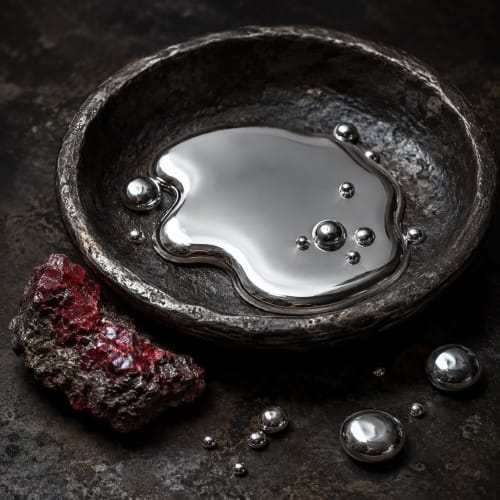
Mercury
Mercury· Hg Liquid metal, the element of Hermes

Philosopher's Stone
Philosopher's Stone· 賢者의 石 Ultimate of alchemy

Quartz
Quartz· 水晶 Crystal of light
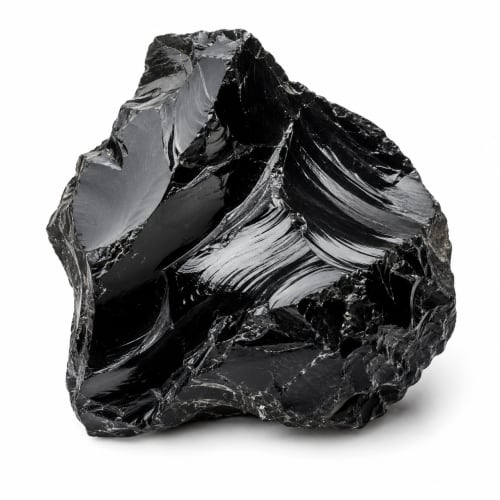
Obsidian
Obsidian· 黑曜石 Black glass of the volcano

Amethyst
Amethyst· 紫水晶 Gem of Dionysus
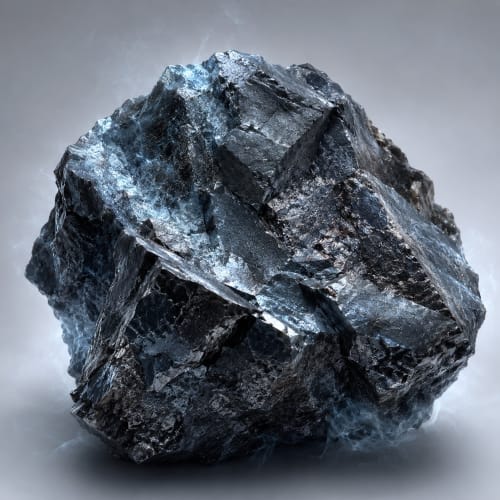
Cold Iron
Cold Iron· 寒鐵 Bane of the fae

Mithril
Mithril · True Silver — A Legendary Metal Light as a Feather, Harder Than Steel
Electrum
Electrum· 琥珀金 Natural gold-silver alloy
Pearl
Pearl· 眞珠 Tears of the sea

Meteoric Iron
Meteoric Iron· 隕鐵 Steel that fell from the sky

Iron
Iron· Fe Core metal of human civilization