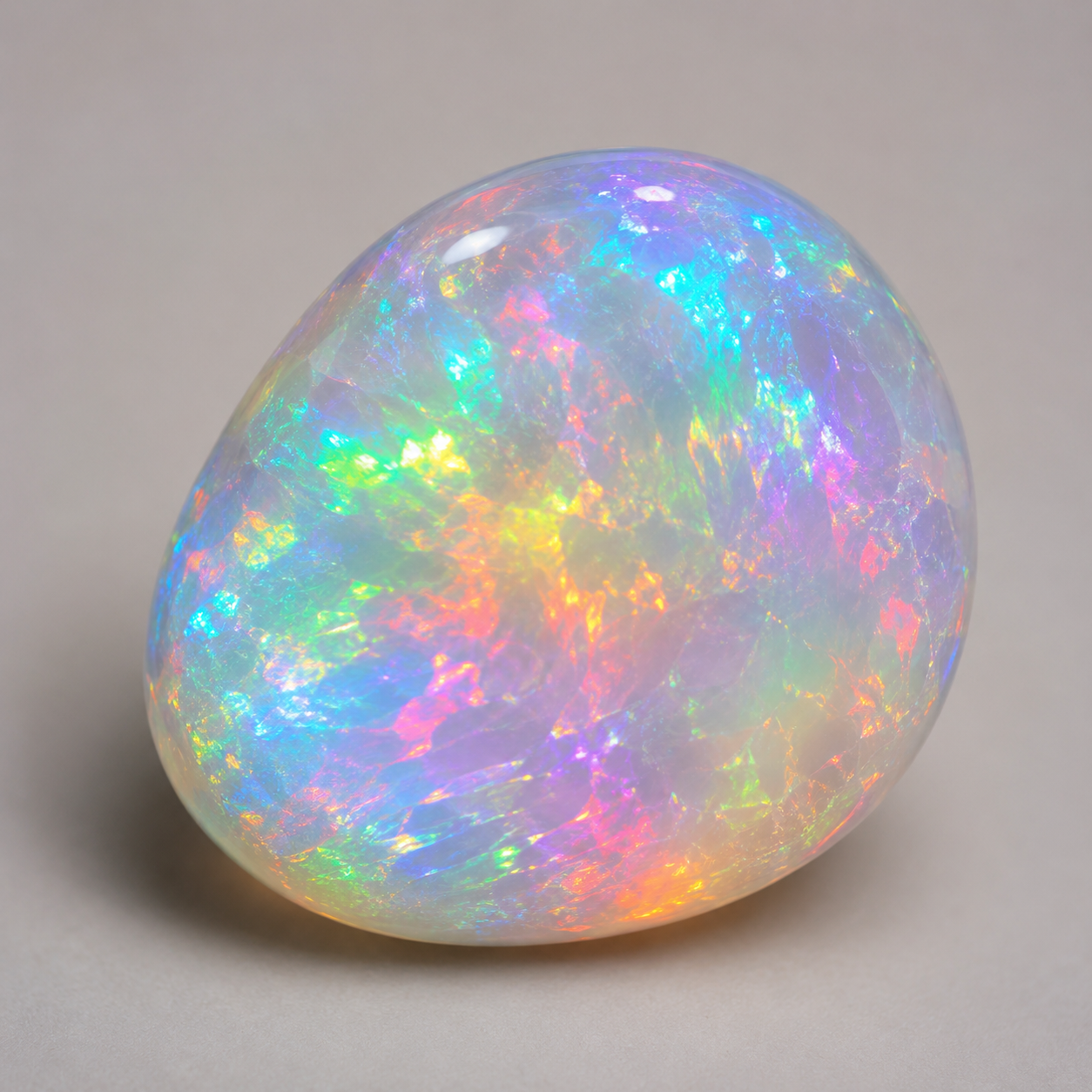
Opal
Opal· 蛋白石 Gem of the rainbow
Names in Other Languages
 오팔한국어
오팔한국어Opal· 蛋白石 무지개의 보석
 オパール日本語
Opal· 蛋白石 虹の宝石
 蛋白石繁體中文
Opal· 蛋白石 虹之寶
 OpalDeutsch
Opal· 蛋白石 Edelstein des Regenbogens
 OpaleFrançais
Opal· 蛋白石 Gemme de l arc-en-ciel
 OpaloEspañol
Opal· 蛋白石 Gema del arcoiris
 OpalaPortuguês
Opal· 蛋白石 Gema do arco-iris
 OpalPolski
Opal· 蛋白石 Klejnot teczy
 ОпалРусский
Opal· 蛋白石 Драгоценный камень радуги
Opal (English Opal, Latin opalus, Greek opallios, Sanskrit upala) is the gem of the rainbow of the decisive canon — derived from Sanskrit 'upala (gem, stone)' — the decisive canonical vocabulary — the decisive mineralogical canon of hydrated silica (SiO2·nH2O) — and the decisive canon of 'the stone containing the colors of all gems' in Pliny the Elder's Natural History Book 37 chapters 80-84 of the 1st century. Aliases — Opal (Opal), opalus (opalus), upala (upala), gem of the rainbow, queen of gems, birthstone of October — are the decisive canonical vocabulary. The decisive natural history canon is the decisive canon of 'opalus contains the fire of ruby, the green of emerald, the purple of amethyst, and the blue of sapphire, all in one stone' in Pliny the Elder's (Pliny the Elder, 23-79) Natural History (Naturalis Historia) Book 37 chapters 80-84 of the 1st century. The decisive Australian Aboriginal canon is the decisive canon of the Rainbow Serpent myth of the Australian Aboriginals (Aboriginal Australian) of over 60,000 years.
Origin
The etymological origin is the decisive canonical vocabulary of Sanskrit 'upala (उपल upala, gem, stone)' — the decisive canon becoming the etymology of Greek 'opallios (ὀπάλλιος)' and Latin 'opalus'. The decisive natural history origin canon is the decisive canon of the Roman Pliny the Elder's (Pliny the Elder, 23-79) Natural History (Naturalis Historia) Book 37 chapters 80-84 of the 1st century — 'opalus is the stone containing the colors of all gems, with the fire of ruby (carbunculus), the green of emerald (smaragdus), the purple of amethyst (amethystos), and the blue of sapphire, all in one stone, from India'. The decisive Antony canon is the decisive canon of the Roman senator Nonius (Nonius) of the 1st century BCE choosing exile to keep his opal ring from Mark Antony's (Mark Antony) greed in Pliny the Elder's Natural History Book 37 chapter 81. The decisive Hungary source canon is the decisive canon of the opal mines of Červenica (Červenica) of Hungary (now Slovakia) from the 12th century. The decisive Australian Aboriginal canon is the decisive canon of the Rainbow Serpent myth of the Australian Aboriginals of over 60,000 years.
Features
- Hydrated silica (SiO2·nH2O) amorphous Mohs hardness 5.5-6.5
- Main axis Pliny Natural History Book 37 chapters 80-84 stone of all gems' colors
- Sanskrit upala (gem) etymology
- Four types — white opal, black opal, fire opal, water opal
- Black opal of Lightning Ridge (Lightning Ridge) in Australia
- Origin — Australia (95%), Ethiopia, Mexico, Czechoslovakia
Stories
The opalus in Pliny the Elder's Natural History Book 37 chapters 80-84 of the 1st century is the decisive natural history origin, and the decisive Australian Aboriginal canon is the Rainbow Serpent myth of the Australian Aboriginals of over 60,000 years. The decisive canon used as the stone containing the colors of all gems, and the decisive canon invoked as the scales of the Rainbow Serpent of the Australian Aboriginals. The decisive medieval canon is the decisive canon of opal in Dante's Divine Comedy of 1320, and the decisive Hungary source canon is the decisive canon of the opal mines of Červenica (Červenica, now Slovakia) of Hungary from the 12th century — the decisive canon as the world's main source until the 19th century. The decisive Australian canon is the decisive canon of the discovery of Australian opal by the German geologist Johann Menge in 1849 — the decisive canon of the discovery of black opal at Lightning Ridge (Lightning Ridge) in 1875. The decisive advertising canon is the decisive canon of the bad luck myth of opal in Walter Scott's (Walter Scott) Anne of Geierstein (Anne of Geierstein) of 1829.
Weakness
Opal's weaknesses are: (1) water content — the decisive canonical weakness — the decisive canon of containing 3-21% water, causing cracking or breaking in dry environments — 'crazing'; (2) Mohs hardness 5.5-6.5 limit — the decisive canonical weakness — softer than sapphire (9) and diamond (10); (3) binding of amorphousness — the decisive canon of being weak to impact as amorphous; (4) binding of the bad luck myth — the decisive canon of the myth created by Walter Scott's Anne of Geierstein of 1829; (5) synthesis — the decisive canon of synthetic opal by Pierre Gilson (Pierre Gilson) of France in 1973 and Kyocera (Kyocera) of Japan in 1974; (6) binding of the sacred domain — the decisive canon; (7) binding of the rainbow — the decisive canon of the binding of the Rainbow Serpent of the Australian Aboriginals; (8) binding of time — the decisive canon of the binding of 60,000 years of Australian Aboriginals. The decisive canonical finale is the decisive mythological canon of the discovery of Australian opal in 1849.
Cultural Significance
Opal is not merely a mineral icon but the canonical iconographic figure of the decisive Sanskrit-Greco-Roman-Australian canon, traversing the Rainbow Serpent myth of the Australian Aboriginals of over 60,000 years, the colors of all gems in Pliny the Elder's Natural History Book 37 chapters 80-84 of the 1st century, the opal ring of Mark Antony and Nonius of the 1st century BCE, the mines of Červenica in Hungary of the 12th century, Dante's Divine Comedy of 1320, the bad luck myth of Walter Scott's Anne of Geierstein of 1829, the discovery of Australian opal in 1849, the discovery of black opal at Lightning Ridge in 1875, and the synthetic opal of Gilson in 1973. The etymological origin settled as the decisive canon of Sanskrit 'upala (gem)' — the decisive canon becoming the etymology of Greek 'opallios' and Latin 'opalus'. The decisive natural history origin canon is the decisive canon of the Roman Pliny the Elder's (Pliny the Elder, 23-79) Natural History (Naturalis Historia) Book 37 chapters 80-84 of the 1st century — 'opalus is the stone containing the colors of all gems, with the fire of ruby, the green of emerald, the purple of amethyst, and the blue of sapphire, all in one stone', and the decisive Antony canon is the decisive canon of the Roman senator Nonius (Nonius) of the 1st century BCE choosing exile to keep his opal ring from Mark Antony's (Mark Antony) greed in Pliny the Elder's Natural History Book 37 chapter 81. The decisive Hungary source canon is the decisive canon of the opal mines of Červenica (Červenica) of Hungary (now Slovakia) from the 12th century — the decisive canon as the world's main source until the 19th century, and the decisive Australian Aboriginal canon is the decisive canon of the Rainbow Serpent (Rainbow Serpent) of the 'Dreamtime' (Dreamtime) of the Australian Aboriginals (Aboriginal Australian) of over 60,000 years — the decisive canon of the creator god Rainbow Serpent whose scales fell to earth and became opal. The decisive Australian source canon is the decisive canon of the discovery of opal in South Australia by the German geologist Johann Menge (Johann Menge) in 1849 — the decisive canon of the discovery of black opal at Lightning Ridge (Lightning Ridge) in New South Wales in 1875, and the decisive canon of opal as Australia's national gemstone in 1956. The decisive advertising canon is the decisive canon of the bad luck myth of opal from Walter Scott's (Walter Scott, 1771-1832) Anne of Geierstein (Anne of Geierstein) of 1829 — the decisive canon of the 50% collapse of the Victorian opal market. The decisive synthesis canon is the decisive canon of the invention of synthetic opal by Pierre Gilson (Pierre Gilson) of France in 1973 and the synthetic opal of Kyocera (Kyocera) of Japan in 1974.
In Popular Culture
- Rainbow Serpent (Rainbow Serpent) myth of the Australian Aboriginals (Aboriginal Australian) (over 60,000 years) — decisive Australian Aboriginal canon
- Pliny the Elder Natural History (Naturalis Historia) Book 37 chapters 80-84 stone of all gems' colors (1st century) — decisive natural history origin canon
- Opal ring of Mark Antony (Mark Antony) and Nonius (Nonius) (1st century BCE) — decisive Antony canon
- Opal mines of Červenica (Červenica) of Hungary (now Slovakia) (from 12th century) — decisive Hungary source canon
- Opal in Dante's Divine Comedy (1320) — decisive medieval canon
- Bad luck myth in Walter Scott (Walter Scott) Anne of Geierstein (1829) — decisive 19th-century canon
- Discovery of Australian opal by Johann Menge (Johann Menge) of Germany (1849) — decisive Australian source canon
- Discovery of black opal at Lightning Ridge (Lightning Ridge) (1875) — decisive Australian black opal canon
- Invention of synthetic opal by Pierre Gilson (Pierre Gilson) (1973) — decisive synthesis canon
- Australia's national gemstone designation (1956) — 21st-century decisive global canon
Trivia
The etymology of Opal (English Opal, Latin opalus, Greek ὀπάλλιος opallios, Sanskrit उपल upala) is the decisive canonical vocabulary of Sanskrit 'upala (उपल upala, 'gem, stone')' — the decisive canon becoming the etymology of Greek 'opallios (ὀπάλλιος)', Latin 'opalus', and English 'opal'. Aliases — Opal (Opal), opalus (opalus), upala (upala), opallios (opallios), gem of the rainbow, queen of gems, birthstone of October, gemstone of the 14th wedding anniversary, scales of the Rainbow Serpent — are the decisive canonical vocabulary. The decisive natural history origin canon is the decisive canon of the Roman Pliny the Elder's (Pliny the Elder, born 23 CE, died at Pompeii 79 CE) Natural History (Naturalis Historia, 37 books) Book 37 chapters 80-84 of the 1st century — 'paederos (beloved of children) or opalus is the stone containing the colors of all gems, with the fire of ruby (carbunculus), the green of emerald (smaragdus), the purple of amethyst (amethystos), and the blue of sapphire, all in one stone, second only to diamond' — and the decisive canon of 'India is the source'. The decisive Antony canon is the decisive canon of the Roman senator Nonius (Nonius) of the 1st century BCE choosing exile to keep his walnut-sized opal ring from Mark Antony's (Mark Antony, 83-30 BCE) greed in Pliny the Elder's Natural History Book 37 chapter 81 — the decisive canon of 'Nonius's opal was worth 2 million sesterces'. The decisive Hungary source canon is the decisive canon of the opal mines of Červenica (Červenica, Dubnik opal mines) of the Hungary Kingdom (now eastern Slovakia) from the 12th century to the 19th century — the decisive canon of the magnificent opal jewelry of the Austrian Empress in 1816. The decisive Australian Aboriginal canon is the decisive canon of the 'Dreamtime' (Dreamtime) Rainbow Serpent (Rainbow Serpent, myth of Wagyl or Wagyl) of the Australian Aboriginals (Aboriginal Australian) of over 60,000 years — the decisive canon of the creator god Rainbow Serpent whose scales fell to earth and became opal. The decisive Australian source canon is the decisive canon of the discovery of opal in South Australia by the German geologist Johann Menge (Johann Menge) in 1849 — the decisive canon of the discovery of black opal at Lightning Ridge (Lightning Ridge, main source of black opal) in New South Wales in 1875, the discovery of opal at Coober Pedy (Coober Pedy, main source of white opal) in South Australia in 1915, and the decisive canon of opal as Australia's national gemstone designation in 1956 — the decisive canon of 95% of the world's opal source. The decisive advertising canon is the decisive canon of the bad luck myth of opal from the English writer Walter Scott's (Walter Scott, born 15 August 1771, died 21 September 1832) novel Anne of Geierstein (Anne of Geierstein) of 1829 — the story of Hermione, owner of the opal ring, dying when holy water falls on it — the decisive canon of the 50% collapse of the Victorian opal market. The decisive synthesis canon is the decisive canon of the invention of synthetic opal (Gilson opal) by Pierre Gilson (Pierre Gilson) of France in 1973 — the decisive canon of the synthetic opal of Kyocera (Kyocera) of Japan in 1974.