Musket
The muzzle-loading firearm of the early modern era
Names in Other Languages
 머스킷한국어
Musket · 근대 보병의 화승총
 マスケット日本語
近代歩兵の火縄銃
 火槍繁體中文
近代步兵的前裝式火器
 MusketeDeutsch
Die Vorderlader-Feuerwaffe der Neuzeit
 MousquetFrançais
L'arme à feu à chargement par la bouche
 MosqueteEspañol
El arma de fuego de avancarga
 MosquetePortuguês
A arma de fogo de antecarga
 MuszkietPolski
Broń palna ładowana od przodu
 МушкетРусский
Дульнозарядное огнестрельное оружие Нового времени
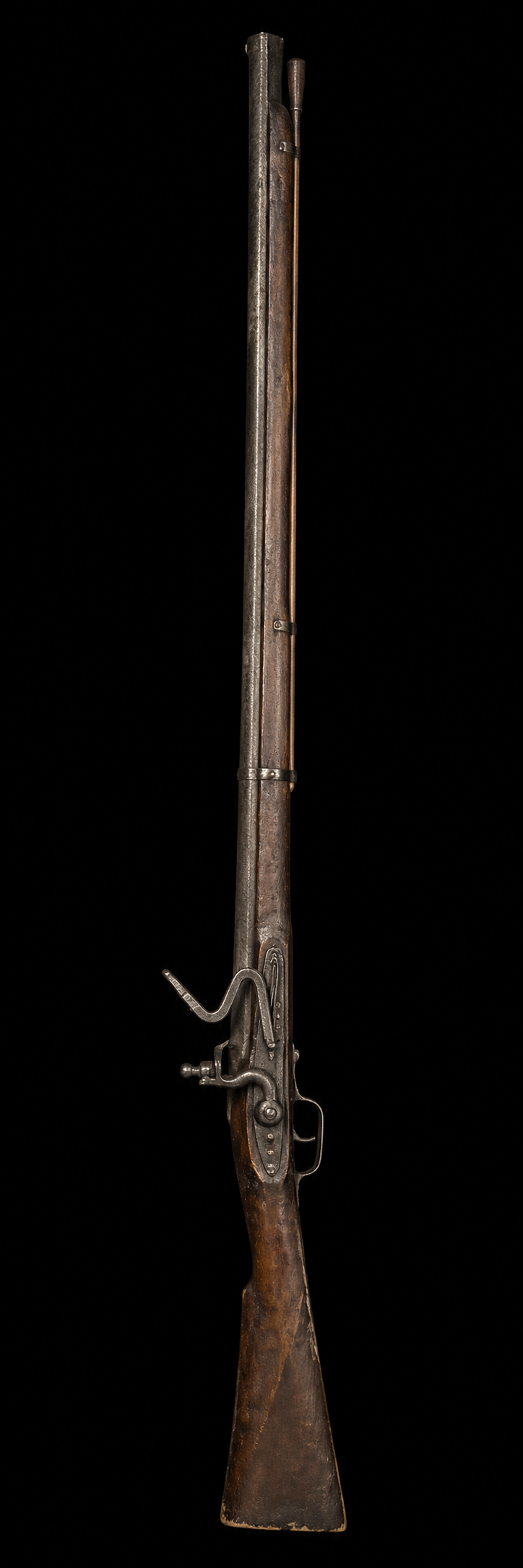
The musket is a muzzle-loading smoothbore long gun used from the 15th to the 19th century, the revolutionary firearm that ended the age of armor. Grown from the hand cannon, it was refined by ignition system from the matchlock to the flintlock to the percussion cap. Its effective range was about 100 m and it fired two or three rounds a minute; individual accuracy was poor, but in the linear tactics of hundreds of men ranked side by side and firing in volley it was immensely powerful. No plate armor could stop a musket ball, so the military supremacy of the armored knightly class finally vanished. From the 16th century to the Napoleonic Wars it was the standard infantry firearm, and with a bayonet fixed it doubled as a spear for close combat.
Origin
The musket appeared in 15th-century Europe as the hand cannon grew longer and more refined. In the 16th century the matchlock musket, fired by a lit cord (the match), became the infantry's mainstay — early ones so heavy and long they were rested on a fork to shoot. In the 17th and 18th centuries the flintlock made it lighter and more reliable — issue muskets like the British 'Brown Bess' and the French 'Charleville' appeared — and it became the center of infantry tactics. Through the percussion musket of the 19th century, the rifled musket of the mid-19th century, with its spiral grooves, vastly raised range and accuracy and replaced the smoothbore musket.
Features
- Muzzle-loading smoothbore long gun
- Developed from matchlock to flintlock to percussion cap
- Effective range about 100 m, two or three rounds a minute
- Poor individual accuracy but optimal for volley fire
- Defeated plate armor — the end of the age of armor
- Doubled for close combat with a fixed bayonet
Stories
Because an individual musket was inaccurate and hard to aim at one man, the heart of its use was linear tactics: hundreds of men in two or three ranks firing together in a 'volley' to throw up a wall of shot. One rank fired while another reloaded, keeping the fire unbroken, and the rule was to hold fire until the enemy came close, then loose it all at once. When the muzzle-fixed bayonet appeared, the musketeer became a spearman the instant he had fired, fending off a cavalry charge without separate pikemen. Loading — handling powder, ball, and ramrod in turn — demanded hard drill.
Weakness
With a smoothbore barrel its individual accuracy was very low, and beyond 100 m it was hard to hit a chosen target. Being muzzle-loaded, it was slow, only two or three rounds a minute, and during loading the soldier was wholly defenseless. Wet priming or powder from rain or damp made it impossible to fire, and the thick smoke of black powder shrouded the field after a few volleys, making aim harder still. These weaknesses were resolved one by one with the rifling, breech-loading, metallic cartridge, and repeating mechanisms of the 19th century.
Cultural Significance
The musket is remembered as the weapon that completed the gunpowder revolution begun by the hand cannon and ended the age of armor and the knight. The sight of briefly drilled commoners ranked side by side and firing in volley became the emblem of the modern army and of mass conscription, and well-drilled lines of musket infantry were the protagonists of 17th–19th-century war. The 'musketeer,' meanwhile, was also the name of the French king's guard corps, kept forever in the public memory by Alexandre Dumas's The Three Musketeers. The name 'musket' itself comes from the Italian moschetto ('sparrowhawk') — a trace of the custom of naming early firearms after birds of prey.
In Popular Culture
The musket is the standard firearm of historical drama and games set in the 17th–19th centuries. Alexandre Dumas's The Three Musketeers popularized the name, and it is a fixture of Napoleonic and colonial war pieces — films such as The Last of the Mohicans and Master and Commander, and the British series Sharpe. In games it is familiar as the line infantry of Empire and Napoleon: Total War, or the muskets of Assassin's Creed III (the American Revolution). It is usually portrayed as a weapon of massed firepower — inaccurate shot by shot, but fearsome in ranked volley — illustrating the history of linear tactics well.
Trivia
- The order 'don't fire until you see the whites of their eyes' is traced to the Battle of Bunker Hill in 1775; it arose because the musket was so inaccurate that fire had to be held until the enemy was close enough for a single volley to tell.
- The name 'musket' comes from the Italian moschetto ('sparrowhawk') — an echo of the custom of naming early firearms after birds of prey (as with the falconet).
- When the muzzle-fixed bayonet (named after the French town of Bayonne) appeared, the musketeer became a spearman at once, so the separate pikemen who had guarded the musketeers were finally no longer needed.