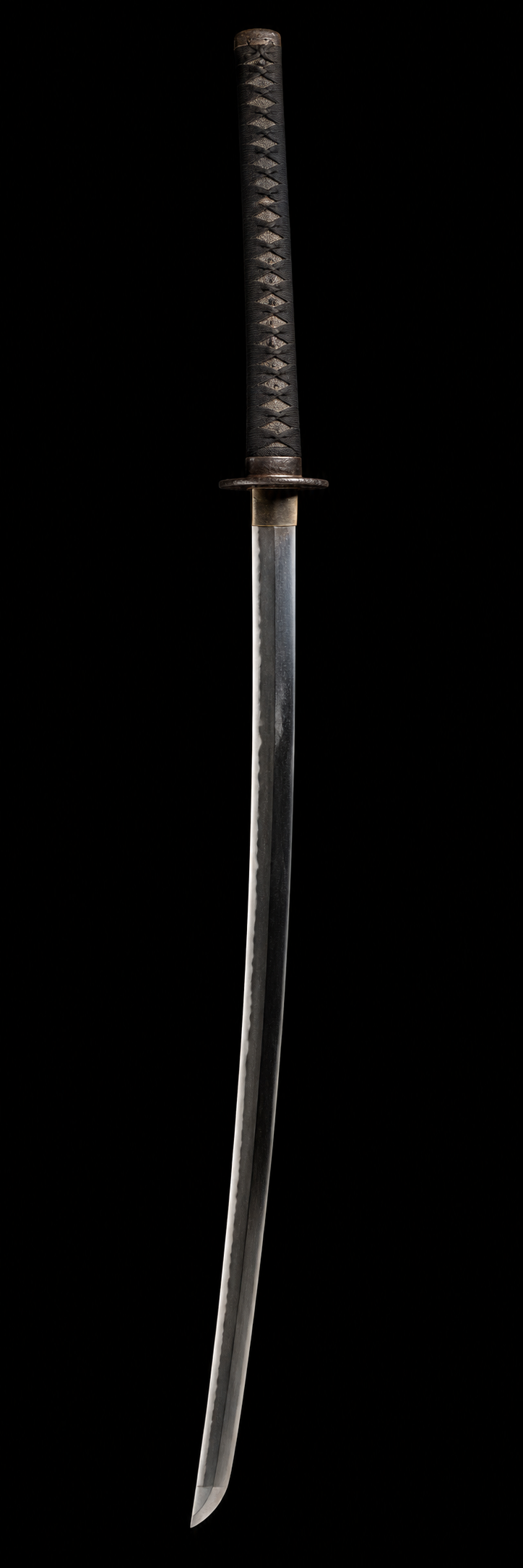
Katana
The iconic curved sword of the Japanese samurai
Names in Other Languages
 카타나한국어
Katana · 일본 사무라이의 곡검
 刀日本語
刀日本語日本の侍の魂が宿る曲刀
 武士刀繁體中文
日本武士之魂的彎刀
 KatanaDeutsch
Das gebogene Schwert des japanischen Samurai
 KatanaFrançais
Le sabre courbe emblématique du samouraï japonais
 KatanaEspañol
La espada curva del samurái japonés
 KatanaPortuguês
A espada curva do samurai japonês
 KatanaPolski
Zakrzywiony miecz japońskiego samuraja
 КатанаРусский
Изогнутый меч японского самурая
The katana is the representative single-edged curved sword of Japan, regarded as the symbol of the samurai class and a weapon in which the soul dwells. With a gently curved blade of about 60 to 80 cm, it is made by a distinctive forging in which tamahagane, jade steel, is folded and hammered again and again. The spine of the blade, the mune, is soft steel and the edge, the ha, hard steel, so it has flexibility and cutting power together. The hamon, the temper line, produced by yaki-ire, hardening different parts differently with clay applied, is unique to each blade. Its present form took hold in the Muromachi period (1336 to 1573), and worn edge-up in the belt, the obi, it makes possible the fast draw, iai, that cuts in the very act of drawing the sword.
Origin
The katana developed from the tachi of the late Heian period (794 to 1185). The tachi was a long, curved sword for mounted combat, slung at the waist edge-down, but as the style of warfare changed from mounted to infantry combat, the uchigatana, the katana form worn thrust through the belt edge-up to be drawn and cut swiftly, became the standard, and that form was established in the Muromachi period. Thereafter, in the Edo period (1603 to 1868), the daisho, the wearing together of the katana and the shorter wakizashi, became the mark of samurai status, and the katana became the spiritual symbol of the samurai.
Features
- A single-edged curved blade (about 60 to 80 cm)
- A method of folding and forging tamahagane, jade steel
- The hamon, the temper pattern, unique to each blade
- A hilt wrap of samegawa, rayskin, and ito, silk cord
- Varied artistic designs of the tsuba, the guard
- A dual-structure blade of a hard edge and a soft spine
Stories
The katana was the main weapon and spiritual symbol of the samurai, used not only in battle but in ceremony. Its greatest feature is the way it is worn edge-up in the belt, by which iaido, the art of the draw, became possible, joining the very act of drawing from the scabbard into a cut, strong in the first stroke that cuts before the foe at the moment of encounter. Its structure with a hard edge and a soft spine and its gentle curve gave it superb cutting power against an unarmored or lightly armed foe. Its true element, though, was cutting held in two hands rather than one, so a swordsmanship developed of drawing deep and accurate cuts with the whole body's strength set into the blade.
Weakness
The weakness of the katana arises from its being a curved sword leaning toward the cut. It is at a disadvantage to a straight sword in the straight thrust, and because of the curved blade its penetration in piercing hard plate armor head-on is also lower. The hard-quenched edge cuts well but chips easily if struck recklessly. Above all, the method of folding and forging tamahagane takes much labor and many months, so it cannot be mass-produced: this raised the value of a single sword but was a limit on arming an army quickly.
Cultural Significance
The katana is called the soul of the samurai and forms the heart of Japanese warrior culture. In the Edo period the daisho, the wearing together of the katana and the wakizashi, was a privilege of the warrior class alone and a mark of status, and the sword stood for the honor and spirit of its owner. The blades of the legendary smith Masamune, the master of the Kamakura period, and of Muramasa, to whose blades a sinister reputation as bloodthirsty cursed swords later attached, became symbolic names of Japanese sword culture. Today the katana is, beyond Japan, one of the most famous swords in the whole world, deeply imprinted as the image of the famed sword of the East through samurai films and countless comics and games.
In Popular Culture
The katana is the most widely appearing sword not only in works about the samurai but in popular culture across the world. It is drawn as the emblematic weapon of the protagonist from the samurai films of Akira Kurosawa to Western works like Kill Bill and in countless comics, animation, and games. In fiction, though, the katana is often exaggerated as the strongest sword that can cut anything, with unrealistic depictions of cutting a gun barrel in two or slicing another sword at a stroke. This mythologized image is far from the real katana's sophisticated method of making and its original purpose.
Trivia
- The curve of the katana, the sori, is formed largely in the hardening as well as in the forging: the spine coated thick with clay and the edge coated thin cool at different rates, the hardened edge contracting to bend the blade, and the same process creates the hamon, the temper pattern unique to each sword.
- The katana was regarded as the soul of the samurai and bound to the warrior class; in the Edo period the daisho, the wearing together of the katana and the wakizashi, was the mark of samurai status, and Masamune, revered as the greatest master, and Muramasa, to whose blades the legend of sinister cursed swords attached, became symbols of Japanese sword culture.
- The folding and forging of tamahagane was a method to remove the impurities and even out the carbon of traditional bloomery steel, and the katana was superb at cutting an unarmored foe, but the popular image of the strongest sword that cuts anything is a romantic exaggeration, and against plate armor or in the thrust the straight sword had its advantages.