Camel Armor
Protective equipment for war camels
Names in Other Languages
 낙타 갑옷한국어
Camel Armor · 전투 낙타의 보호 장비
 ラクダの鎧日本語
砂漠の騎兵を支えた駱駝用防具
 駱駝甲繁體中文
支援沙漠騎兵的駱駝用護甲
 KamelpanzerDeutsch
Schutzausrüstung für Kriegskamele der Wüstenkavallerie
 Armure de chameauFrançais
Équipement de protection pour chameaux de guerre du désert
 Armadura de camelloEspañol
Equipo protector para camellos de guerra del desierto
 Armadura de cameloPortuguês
Equipamento protetor para camelos de guerra do deserto
 Zbroja wielbłądaPolski
Wyposażenie ochronne dla wielbłądów bojowych pustyni
 Верблюжий доспехРусский
Защитное снаряжение для боевых верблюдов пустыни
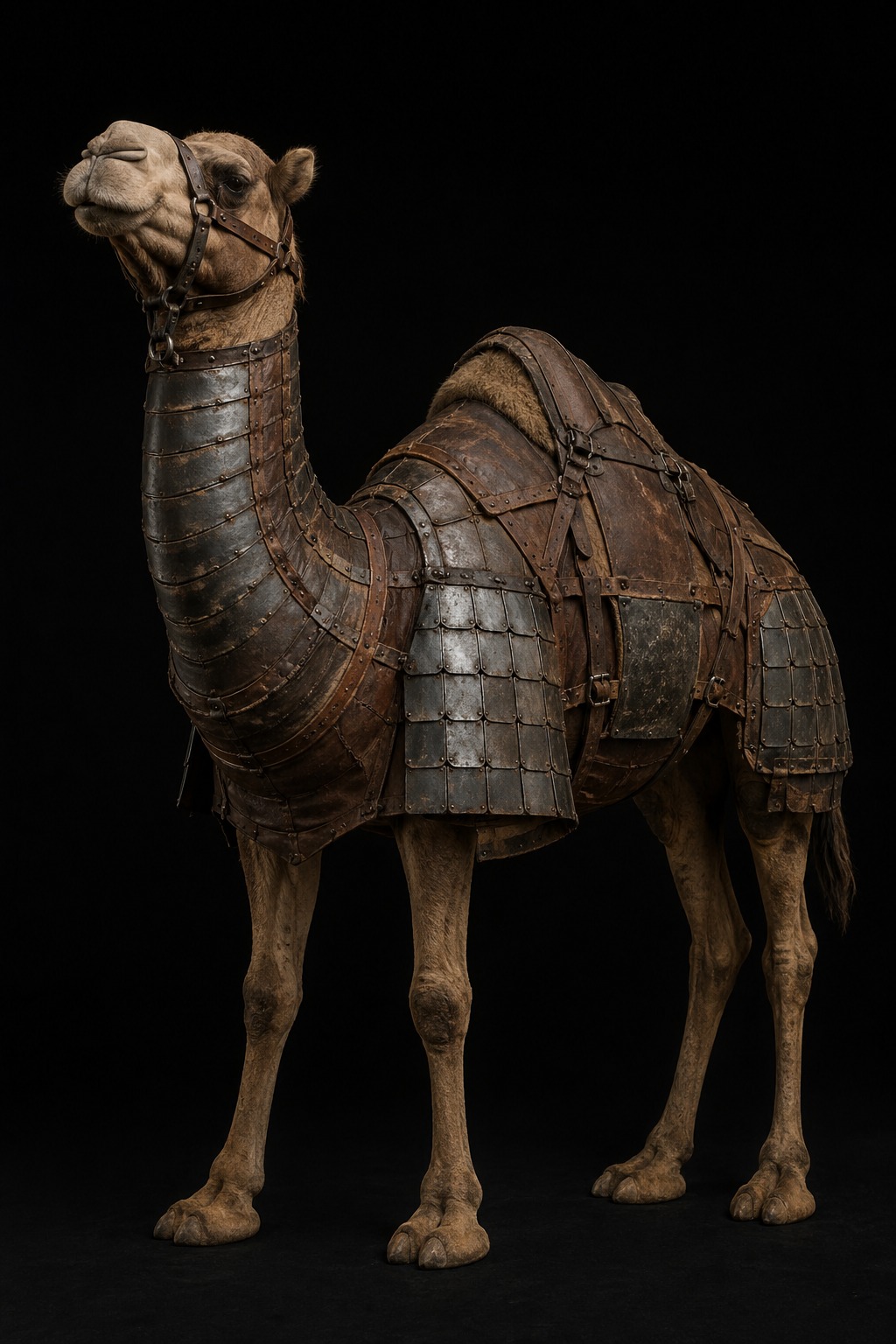
Camel armor is the armor made to cover the beast of the camel cavalry that rode the deserts of the Middle East, North Africa, and India. Its mark is that it is smaller, lighter, and more open in grain than the horse armor of the same age. It was woven of leather, felt, small mail, and small plates joined in panels that covered the chest, the long neck, and the flanks, and the back, with its two great humps rising upward, was naturally left bare, so that on it a saddle or a small howdah could be set. Where the horse armor sought to wrap one face firmly, camel armor placed greater weight on keeping the beast's breath alive under the hot desert sun and the sand, and so an open grain through which the wind could pass between mail and small plate was common. Above all, the body of the camel itself served as a weapon, for the smell of the beast troubled the enemy's horses and broke their ranks, and so camel armor stood as a tool to keep this beast-weapon alive as long as possible.
Origin
Leading the camel into battle goes back at least to the reliefs of King Shalmaneser III of Assyria in the 9th century BC. Herodotus, in his Histories, set down that in the Battle of Thymbra of around 547 BC, when Cyrus the Great of Persia met Croesus of Lydia, the Persians lined up the camels that carried the baggage and sent them out in front of the enemy cavalry, and the horses there could not bear the smell of the camels and broke their ranks. The place where a camel in a full set of armor began to be drawn often, however, is the age of the Islamic desert armies from the 7th century, when the camel cavalry took its place in the Umayyad and Abbasid armies that took up the residue of Sassanid Persia. In India the place of the camel cavalry was set firm in the Mughal Empire and the Rajput houses, and from the 16th to the 18th century the mail-and-plate camel armor was polished at Bikaner and Jaisalmer in Rajasthan. From the 17th to the 19th century the form of setting a small cannon, the zamburak, on the back of the same camel took root, so that a single camel was at once a moving piece of artillery.
Features
- A short suit of a few panels covering the chest, the neck, and the flanks
- A use in which the back, where the humps rise, was left bare for saddle and load
- An open grain through which the wind could pass between mail and small plate
- Indian mail-and-plate armor polished at Bikaner and Jaisalmer in Rajasthan
- The smell of the camel used together as a beast-weapon that troubled the enemy's horses
- In the later zamburak age the same camel was set as a place for a small cannon on its back
Stories
Camel armor was used in the desert as a tool to keep a beast-weapon alive in one place as long as possible. The cover over chest, neck, and flanks took the first blow of arrows and spears coming from the front, and when the same beast met enemy cavalry, the horses, unable to bear the smell of the camel, often broke their ranks, and so the beast itself stood as a weapon at the same place. In the Battle of Thymbra under Cyrus the Great, this was first clearly set down in source, and on the fields of Mu'tah and Yarmuk in the early Islamic conquests of the 7th century the camel troop also stood in the place from which to wrap the enemy quickly in the wide open desert. In the Indian Mughal Empire the same camel carried one or two arquebusiers on its back across the Rajasthan desert, where it took its most marked face in the place of swift scout and raid, and from the 17th to the 19th century, as the form of setting a zamburak, a small cannon, on the back came in, camel armor grew once more into a place that guarded the beast and the firearm together.
Weakness
The limit of camel armor grew above all from the body of the beast itself. Two great humps rise upward, so that the middle of the back is naturally left bare, and that place could only be set as the seat for saddle and load, and so against a blow falling from above it was always weak. The armor woven with open grain to keep the beast's breath alive under the hot desert sun was also weaker against arrows and short spears coming in through the same open grain than the single thick face of horse armor. Above all, the camel was slower of foot than the horse, and a beast that, once startled, swayed in a greater swing, and so it broke easily before a sudden blow or a great noise from the enemy. After the 16th century, with the spread of firearms, the camel often swayed back against its own lines at the noise of guns, and a single suit of camel armor had to be polished by separate hand to the body of one beast, so its price was very high, and the same armor stayed within the seat of the desert royal house and the wealthy city ruler and did not easily reach the hand of the common foot.
Cultural Significance
Camel armor stands at the place where a people who lived in the desert raised one of their beasts into a weapon of their own, and its face stands in the desert that the horse armor of the same age could not reach. Herodotus' Histories sets down most clearly that in 547 BC Cyrus the Great in the Battle of Thymbra sent the camels in front of the enemy cavalry and broke the line of Lydia, and the same episode was written again in Greek and Roman sources of later ages. In Rajasthan in India the royal houses of Bikaner and Jaisalmer held this seat for more than a century, and the Bikaner Camel Corps, which grew up in the same desert, was set as a unit of the British Indian Army in the 19th century and runs on today as a seat of the Indian Border Security Force. At the Royal Armouries in Leeds, England, at the Junagarh Fort in Bikaner, the Desert Museum at Jaisalmer, and the National Museum in New Delhi, many mail-and-plate camel armors of the 16th to 19th centuries are kept, and some of them are still set with a zamburak on the back, showing the same three at one place.
In Popular Culture
Camel armor appears in films, period dramas, and games of the desert as a mark of the soldier of the desert. The camel train that leads the Arab Revolt across the desert in Lawrence of Arabia (1962), the Antioch market scene of Ben-Hur (1959), and the camel host borne by Saladin in Kingdom of Heaven (2005) are its close kin, and in the BBC period dramas and the Indian films Jodhaa Akbar (2008) and Bajirao Mastani (2015) the Rajasthani mail-and-plate camel armor is rendered faithfully. The strategy games Total War: Rome II, with its Arabian and Parthian camel cavalry, Civilization VI, with its Arabian Mamluks and Saracens, and Age of Empires II, with its Saracen and Indian camel troops, set the same camel armor as the mark of these factions. Films, however, often draw the suit on the camel too splendidly, and so blur the truth that the desert armor was light and open in grain.
Trivia
- Herodotus' Histories sets down that in the Battle of Thymbra of around 547 BC, when Cyrus the Great of Persia met Croesus of Lydia, the Persians lined up the camels that carried the baggage and sent them out in front of the enemy cavalry, and the horses there could not bear the smell of the camels and broke their ranks, and Persia won the day, and so it stands as the oldest source for the camel as a beast-weapon.
- The Bikaner Camel Corps, raised for more than a century by the royal house of the desert city of Bikaner in Rajasthan, was set as a unit of the British Indian Army in the 19th century and runs on today as a seat of the Indian Border Security Force, and every year at the parade of India's Republic Day the camel troop marches with the traces of the old armor on them.
- From the 17th to the 19th century the form of setting a small cannon, the zamburak, on the back of the camel took root in Persia, India, and Central Asia, so that a single camel was at once a moving piece of artillery, and the camel armor of the same age grew once more into a place that guarded the beast and the firearm together.