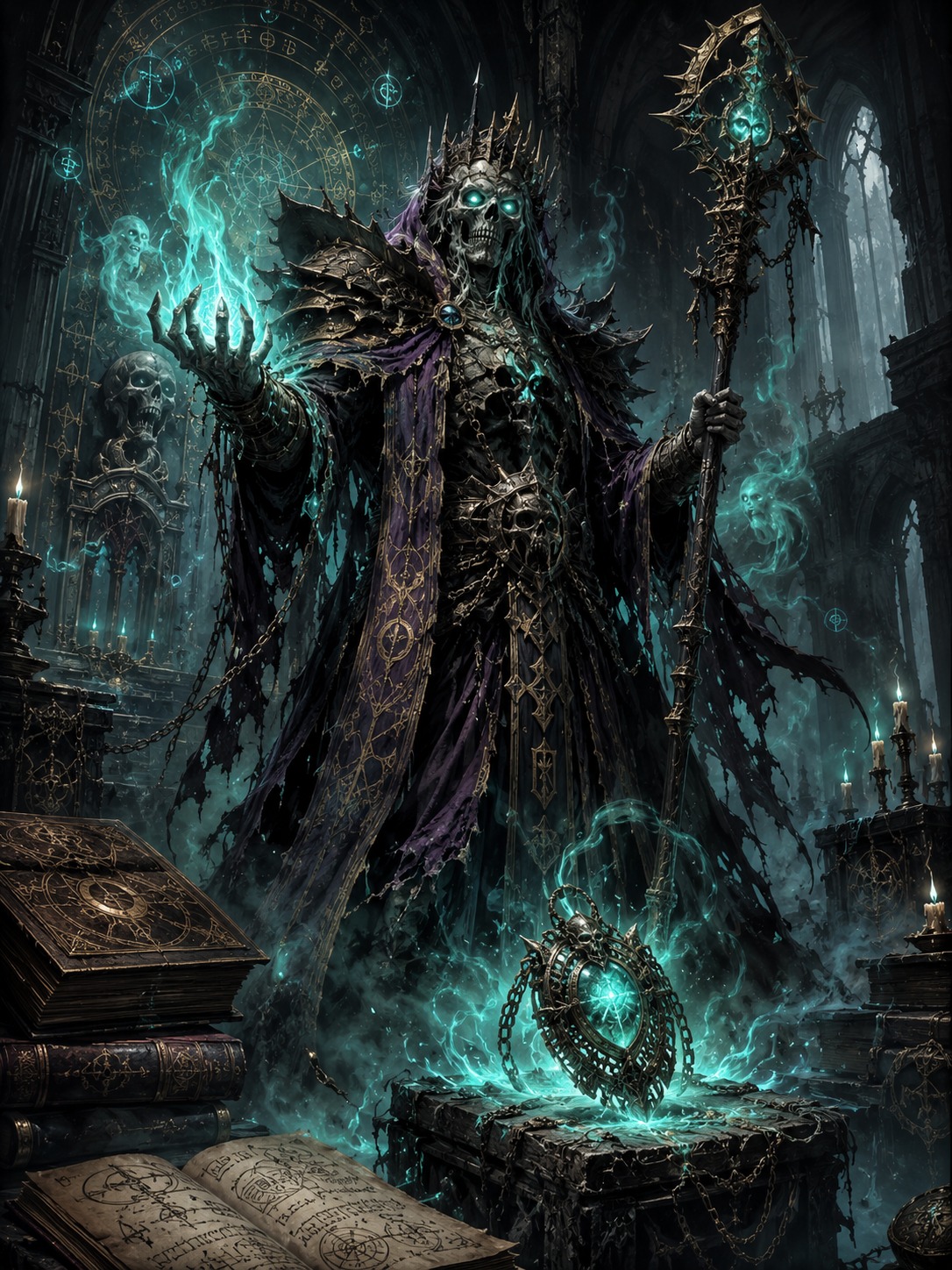
Lich
Lich · The Undying Mage — An Archmage Who Refused Death by Sealing the Soul
Names in Other Languages
 리치한국어
리치한국어Lich · 불사 마법사 — 영혼을 봉인해 죽음을 거부한 대마법사
 リッチ日本語
Lich · 不死の魔法使い — 魂を封じ死を拒んだ大魔法使い
 巫妖繁體中文
Lich · 不死法師 — 封印靈魂以拒死亡的大法師
 LichDeutsch
Lich · Der untote Magier — Ein Erzmagier, der den Tod durch Seelenbannung verweigerte
 LicheFrançais
Lich · Le mage immortel — Un archimage ayant refusé la mort en scellant son âme
 LicheEspañol
Lich · El mago imperecedero — Un archimago que rechazó la muerte sellando su alma
 LichPortuguês
Lich · O mago imorredouro — Um arquimago que recusou a morte selando a alma
 LiczPolski
Lich · Nieumarły mag — arcymag, który odmówił śmierci, pieczętując duszę
 ЛичРусский
Lich · Бессмертный маг — архимаг, отвергший смерть, запечатав душу
The Lich (English Lich) is the powerful mage who has become an undead by obsession with knowledge and power, sealing the soul in a vessel called a phylactery so that it revives as long as the vessel survives, and is the canonical iconographic figure of the apex of mage-undead. The etymology lies in the Old English lic ('corpse, body'), and the general 'corpse' sense that appears in the eighth-century Old English epic Beowulf was specified in later English literature as the mage-undead meaning. The iconographic origin includes Clark Ashton Smith's pulp fantasy short story The Empire of the Necromancers (1932) and the undead mage Thulsa Doom in Robert E. Howard's Kull series (1934), but the decisive canonisation was Gary Gygax's short article The Lich in The Strategic Review Vol. 2 No. 4 published by TSR in May 1976, and the addition of the lich to page 61 of the first edition AD&D Monster Manual of January 1977. In Gygax's 1978 adventure module Tomb of Horrors (S1), the appearance of the demilich Acererak — the canon that even if the body is destroyed, as long as the phylactery sealing the soul survives, the lich revives — established the decisive canon. The Lich King Arthas Menethil in Blizzard's World of Warcraft: Wrath of the Lich King, released on 13 November 2008, settled the twenty-first-century global canon of the lich.
Origin
The iconographic origin consists of three stages: (1) the etymological origin in the Old English lic ('corpse, body'), (2) the immortal mage tradition of 1930s American pulp fantasy, and (3) the D&D canonisation by Gary Gygax in 1976-1977. The etymological origin is the Old English lic ('corpse'), a general vocabulary item appearing in the eighth-century Beowulf — a synonym of modern English 'corpse' — revived by pulp fantasy writers as the name of the mage-undead. The pulp fantasy canon is The Empire of the Necromancers (Weird Tales, September 1932) by Clark Ashton Smith (1893-1961) — in which two necromancers of the desert city Yond revived the dead to found an empire, only to perish when the magic was undone — and Thulsa Doom, the resurrected mage who appears in By This Axe I Rule! (composed 1929, published 1934) in Robert E. Howard's (1906-1936) Kull series. The decisive canonisation was the short article The Lich by Gary Gygax (1938-2008) published in The Strategic Review Vol. 2 No. 4 by TSR in May 1976, and the addition of the lich as a canonical monster entry to page 61 of the first edition AD&D Monster Manual of January 1977. In the April 1978 published module Tomb of Horrors (S1), Gygax introduced the demilich Acererak — an evolved form of the lich consisting only of a skull with the soul sealed in jewels — and established the phylactery canon.
Features
- Withered skull form and cold intellect
- Phylactery (soul vessel) sealing the soul
- Master of vast black magic and necromancy
- Conspirator within the time of the deathless
- Revival as long as the phylactery survives, even when the body is destroyed
- Apex of mage-undead — contrasted with the death knight as apex of warrior-undead
Stories
Following Gary Gygax's canonisation of the lich in D&D 1976-1977, the demilich Acererak of the 1978 Tomb of Horrors became the most decisive canonical figure, and subsequent D&D canonical figures included Vecna (introduced to the Greyhawk setting in 1976, created by Brian Blume as a lich-god) and the subsequent variants Fistandantilus and Raistlin Majere of the 1985 Dragonlance setting. The lich was game-fied as a magical-unit character of the Horde in Blizzard Entertainment's video game Warcraft II: Tides of Darkness, released on 21 January 1994, and in Warcraft III: Reign of Chaos of 3 July 2002, the Lich King Ner'zhul — an orc necromancer sealed in an icy throne by the Burning Legion who became the Lich King — established the modern gaming lich canon. The Lich King Arthas Menethil in Blizzard's World of Warcraft: Wrath of the Lich King, released on 13 November 2008 — reigning as an undying Lich King with his soul sealed in the sword Frostmourne (a phylactery variant) wearing the Helm of the Icy Throne — completed the decisive twenty-first-century global canon of lich iconography. The Lich character in Episode 26 'Mortal Folly' of Season 2 of the American Cartoon Network series Adventure Time, broadcast on 27 September 2010, is the canonical American animation lich.
Weakness
The lich's weaknesses are: (1) destruction of the phylactery — in Gary Gygax's D&D canon since 1976, to annihilate the lich completely the phylactery sealing the soul must be found and destroyed, not the body itself, since when only the body is destroyed it revives from the phylactery after a few days; (2) hidden phylactery — the demilich Acererak's phylactery in the 1978 Tomb of Horrors is hidden deep in the labyrinth so that the adventurers must explore the entire labyrinth, the canonical adventure narrative; (3) holy magic and the power of light — in D&D canon the cleric's Turn Undead holy magic weakens the lich, and in the final battle of the 2008 Wrath of the Lich King the bearer of light Tirion Fordring's Dawnlight sword purifies the Lich King Arthas; (4) phylactery purification — when the phylactery sealing the soul is purified by sacred ritual, the lich's soul is freed and the lich is completely annihilated; (5) obsession with immortality — the essential weakness is that the lich is itself bound to its own phylactery, so when the chains of the soul are loosened it collapses. The 2002 Warcraft III climax in which Arthas merges with the spirit of Ner'zhul sealed in the icy throne by Frostmourne, and the 2010 Adventure Time narrative in which Finn and Jake seal The Lich by mantra and ritual, are canonical variations.
Cultural Significance
The lich is not merely an undead but the canonical iconographic figure of the apex of mage-undead in which pulp fantasy, D&D gaming canon, and contemporary video games converge, condensing the central allegory of modern fantasy: 'the cost of immortality and the arrogance of knowledge'. Clark Ashton Smith and Robert E. Howard of 1930s American pulp fantasy — both writers belonging to the Lovecraft Circle of weird fiction — established the pulp prototype of the mage-undead, and Gary Gygax's D&D canonisation of 1976-1978 — sealing the soul in a phylactery — established the decisive motif of modern fantasy. The term phylactery derives from the Greek phylakterion ('that which guards') and originally referred to the Jewish tefillin (the scripture-box phylactery), but Gary Gygax borrowed it in the 1978 Tomb of Horrors as the soul-sealing vessel of the lich — a canonical case of religious-historical vocabulary appropriated by a fantasy game. The Lich King Arthas Menethil of the 2002 Warcraft III and the 2008 Wrath of the Lich King became canonical figures of game narrative as the tragedy of a heroic prince corrupted by obsession with power, and The Lich in the 2010 Adventure Time is the canonical case of lich iconography settling in American children's animation. In the 2017-2020 video-game-quotation top hundred lists by critics' associations, Arthas's line 'I am no longer your son' was ranked thirty-third.
In Popular Culture
- Old English Beowulf (c. eighth century) — etymological origin of lic
- Clark Ashton Smith, The Empire of the Necromancers (1932) — pulp fantasy lich prototype
- Robert E. Howard, By This Axe I Rule! (Thulsa Doom) (1934) — pulp fantasy resurrected mage
- Gary Gygax, The Lich, The Strategic Review (May 1976) — decisive event of lich canonisation
- Gary Gygax, AD&D Monster Manual (1977) — D&D lich canon
- Gary Gygax, Tomb of Horrors, Acererak (1978) — demilich and phylactery canon
- Blizzard, Warcraft II (1994) — canonisation of the gaming lich
- Blizzard, Warcraft III, Lich King Ner'zhul (2002) — gaming lich canon
- Blizzard, World of Warcraft: Wrath of the Lich King (2008) — decisive twenty-first-century global lich canon
Trivia
The etymology of lich, the Old English lic (modern English 'corpse'), is a general vocabulary item appearing in eighth-century Old English epics such as Beowulf — the first attestation in the Oxford English Dictionary is from the eighth century — and its trace remains in modern English 'lich-gate' or 'lych-gate' (the corpse-laying gate). Gary Gygax's article The Lich in The Strategic Review Vol. 2 No. 4 of TSR in May 1976 is the decisive event of lich canonisation, and the same May 1976 issue simultaneously introduced Gygax's own Greyhawk-setting character Vecna — establishing the two great canonical figures of D&D lich theology at the same point. The term phylactery, deriving from the Greek phylakterion, originally referred to the Jewish tefillin (the scripture-box amulet), but Gary Gygax borrowed it in the 1978 Tomb of Horrors as the soul-sealing vessel of the lich, the most famous vocabulary appropriation in D&D game history, and in D&D 5e of 2014 the name was changed to 'Soul Cage' as a result of religious protests from Jewish organisations. World of Warcraft: Wrath of the Lich King, released on 13 November 2008, sold 2.8 million copies in its first 24 hours and 4 million in its first month, setting the video-game release record, and in the same year the gaming magazine Game Informer ranked Lich King Arthas at number nine in its top fifty game characters of all time.