Wood Elf
Wood Elf · Forest Elves — Wild Archers and Nature Tribes
Names in Other Languages
 우드엘프한국어
Wood Elf · 숲엘프 — 야생의 궁수와 자연 부족
 ウッドエルフ日本語
Wood Elf · 森エルフ — 野生の弓手と自然部族
 木精靈繁體中文
Wood Elf · 森林精靈 — 荒野弓手與自然部族
 WaldelfDeutsch
Wood Elf · Waldelfen — Wilde Bogenschützen und Naturstämme
 Elfe sylvainFrançais
Wood Elf · Elfes des forêts — Archers sauvages et tribus de la nature
 Elfo silvanoEspañol
Wood Elf · Elfos del bosque — Arqueros salvajes y tribus de la naturaleza
 Elfo silvestrePortuguês
Wood Elf · Elfos da floresta — Arqueiros selvagens e tribos da natureza
 Leśny ElfPolski
Wood Elf · Elfy lasu — dzicy łucznicy i plemiona natury
 Лесной эльфРусский
Wood Elf · Эльфы леса — дикие лучники и племена природы
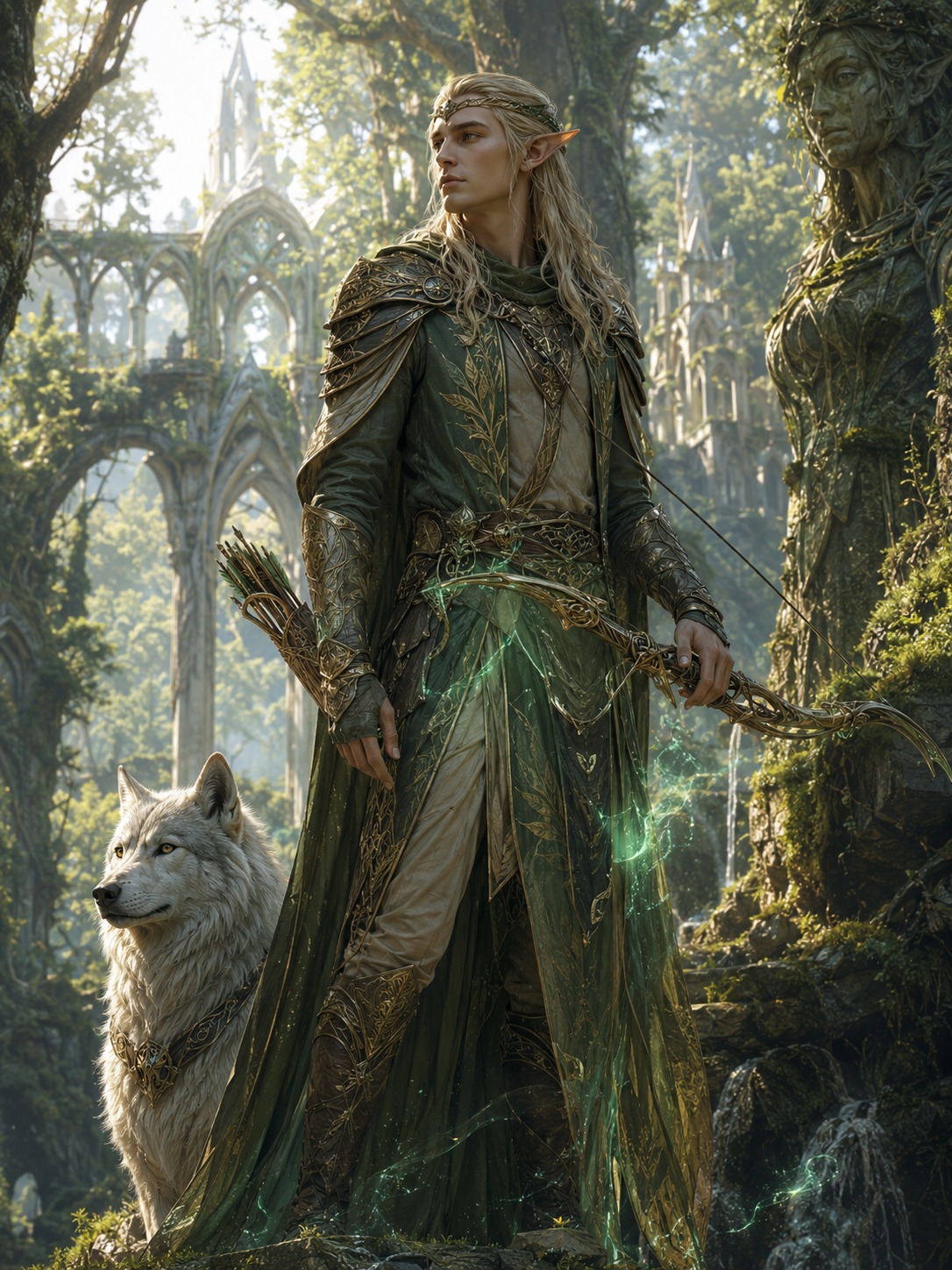
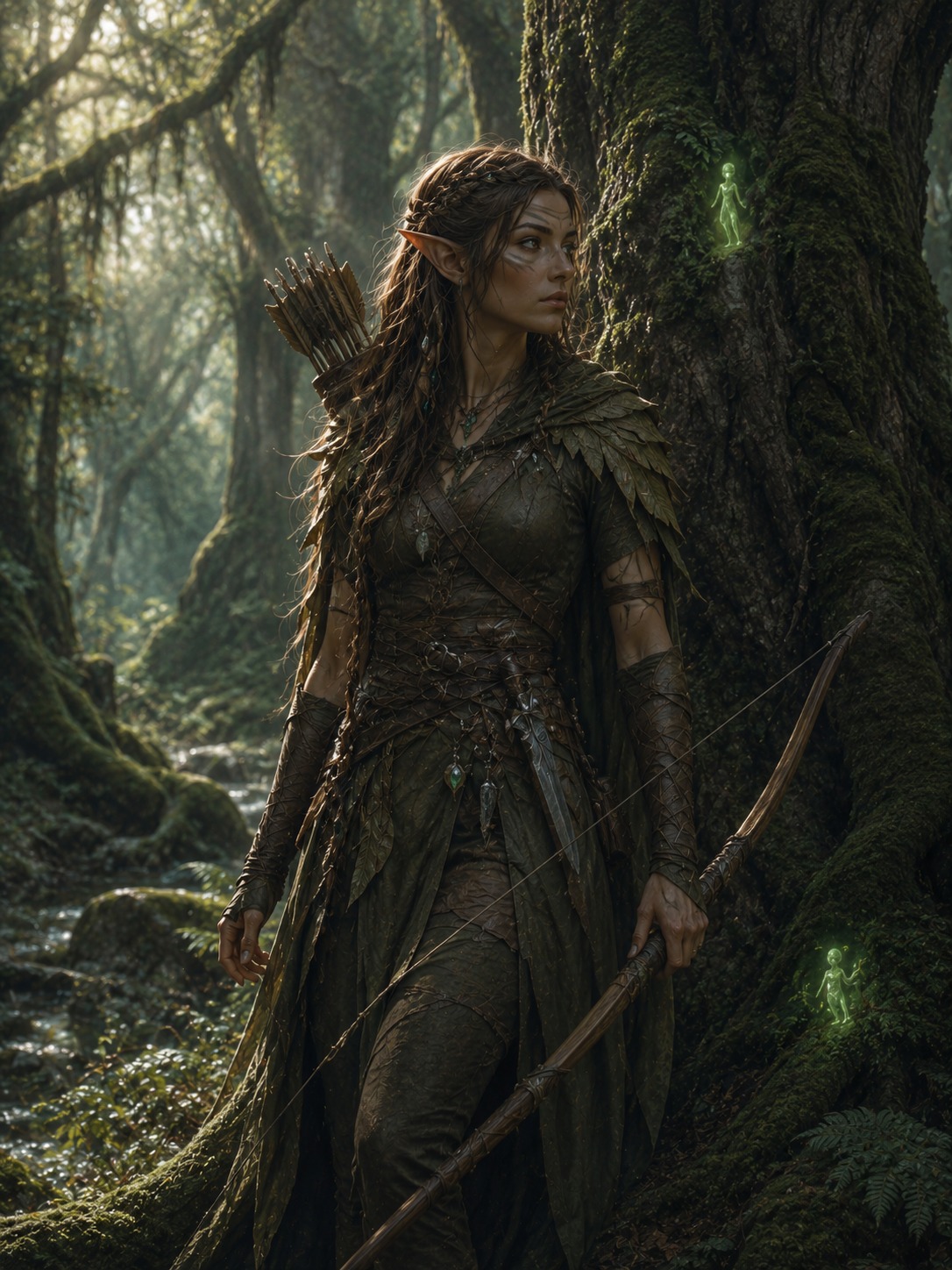
The Wood Elf — Tolkien's Silvan Elves — is a wild forest-dwelling branch of the elven race, derived from the elf taxonomy of Appendix F of J.R.R. Tolkien's 'The Lord of the Rings' (1954-55) and codified for tabletop play in the AD&D Monster Manual (1977) and 'Greyhawk Adventures' (1989). Wood Elves stand 165 to 180 centimetres tall with lithe builds, copper, olive or tawny skin, green-brown camouflaging clothing, long straight black or brown hair, and the long pointed ears common to all elves. Their tribal society maintains a simple hunter-gatherer life in contrast to the magical aristocracy of the High Elves, and they specialise in the longbow, tracking, stealth and communion with nature-spirits. In the fifth-edition 'Player's Handbook' (2014) the wood-elf subrace carries +2 Dexterity, +1 Wisdom, the Elf Weapon Training (longsword, shortsword, shortbow, longbow), Fleet of Foot (+5 movement) and Mask of the Wild traits. The iconography runs from the Mirkwood Elves (Thranduil, Legolas) and the Galadhrim of Lothlórien in Tolkien's 'The Hobbit' (1937) and 'The Lord of the Rings' (1954-55) through the Wood Elf army of Games Workshop's Warhammer Fantasy (from 1987), the Bosmer of Bethesda's 'The Elder Scrolls' series (from 1994), the Dalish of BioWare's 'Dragon Age' series, and the Night Elves of Blizzard's 'World of Warcraft' (from 2004).
Origin
The direct textual source is Appendix F 'On the Elves' of J.R.R. Tolkien's 'The Lord of the Rings' (1955), where Tolkien distinguishes the High Elves (Vanyar, Noldor, Sindar — divine and nymph-like) from the Silvan or Tawarwaith ('forest folk'), the indigenous wood-elves of Middle-earth. Tolkien's classification was borrowed directly into Gary Gygax's AD&D Monster Manual (1977) and into 'Greyhawk Adventures' (1989, Jim Ward and others) as the D&D Sylvan / Wood Elf subrace, locked to Chaotic Good alignment. The mythological substrate is the Germanic-Norse forest spirit — the Light Elves (Ljósálfar) of Álfheimr in the Old Norse 'Eddas' — together with the Celtic Sídhe and the Irish Tuatha Dé Danann and the forest sprites of medieval European bestiaries. Tolkien developed the elf taxonomy during work on the 'Quenta Silmarillion' (1937-1948) and the most detailed canon survives in the posthumously published 'The Silmarillion' (1977, edited by Christopher Tolkien). 'Mordenkainen Presents: Monsters of the Multiverse' (2022) standardises the Wood Elf alongside Eladrin, Drow and High Elf as the four canonical D&D elf subraces.
Features
- 165-180 centimetres tall, lithe build, copper, olive or tawny skin
- Green-brown camouflage clothing, long straight black or brown hair
- Long pointed ears common to all elves
- Master of the longbow, tracking, stealth and communion with nature-spirits
- Tribal hunter-gatherer society in contrast with the High Elven magical aristocracy
- Fifth-edition +2 Dexterity, +1 Wisdom, Elf Weapon Training, Fleet of Foot, Mask of the Wild
Stories
Standard wild guerrilla archer race in tabletop role-playing campaigns, with the nature-aligned, civilisation-avoiding philosophy used to provide an outsider's perspective on urban political intrigue. The same iconography has been borrowed for the Wood Elf army of Warhammer Fantasy, the Bosmer of 'The Elder Scrolls', the Night Elves of 'World of Warcraft' and the Dalish of 'Dragon Age', making it the visual standard for the 'wild-elf' subrace across English-language fantasy RPGs.
Weakness
Distrust of the outside world and of technology makes the Wood Elves prone to isolation, and their woodland-skirmisher discipline serves them poorly in set-piece battles or sieges — Helm's Deep-type engagements. Their nature-dependent way of life loses efficiency in urban, desert or mountain environments, and their high-magic tradition is thin compared with that of the High Elves.
Cultural Significance
Tolkien synthesised Germanic-Norse forest spirits, the Celtic Sídhe and the Irish Tuatha Dé Danann into the modern Wood Elf in the 1930s-50s, and through D&D this synthesis became the visual and narrative standard for the wild-elf race across English-language fantasy RPGs; twenty-first-century adaptations in Warhammer, the Elder Scrolls, Dragon Age and World of Warcraft have extended the image into the universal iconography of global game culture.
In Popular Culture
The Mirkwood Elves of J.R.R. Tolkien's 'The Hobbit' (1937), Legolas, Thranduil and the Galadhrim of 'The Lord of the Rings' (1954-55), 'The Silmarillion' (1977, edited by Christopher Tolkien), the AD&D Monster Manual (1977), 'Greyhawk Adventures' (1989), the fifth-edition Player's Handbook (2014), the Wood Elf army of Warhammer Fantasy (Games Workshop, from 1987), the Bosmer of Bethesda's 'The Elder Scrolls' series (from 1994), the Night Elves of Blizzard's 'World of Warcraft' (from 2004) and the Dalish of BioWare's 'Dragon Age' series.
Trivia
In Tolkien's invented languages Quenya and Sindarin, Wood Elves are called 'Tawarwaith' ('forest folk') or 'Silvan', the latter borrowed from Latin 'silva' (forest). In a 1958 letter to the poet W.H. Auden (Letters #163), Tolkien said the High-Elf / Silvan distinction was inspired by the Olympian-versus-nymph hierarchy of Greek mythology.