Orc
Orc · Warrior Tribes — A Fierce Race That Reveres Strength and Honor
Names in Other Languages
 오크한국어
오크한국어Orc · 전사 부족 — 힘과 명예를 숭상하는 거친 종족
 オーク日本語
Orc · 戦士部族 — 力と名誉を崇める荒々しい種族
 獸人(歐克)繁體中文
Orc · 戰士部族 — 崇尚力量與名譽的粗獷種族
 OrkDeutsch
Orc · Kriegerstämme — Eine wilde Rasse, die Stärke und Ehre verehrt
 OrcFrançais
Orc · Tribus guerrières — Une race féroce qui révère la force et l'honneur
 OrcoEspañol
Orc · Tribus guerreras — Una raza feroz que venera la fuerza y el honor
 OrcPortuguês
Orc · Tribos guerreiras — Uma raça feroz que venera a força e a honra
 OrkPolski
Orc · Plemiona wojowników — dzika rasa czcząca siłę i honor
 ОркРусский
Orc · Племена воинов — свирепая раса, чтящая силу и честь
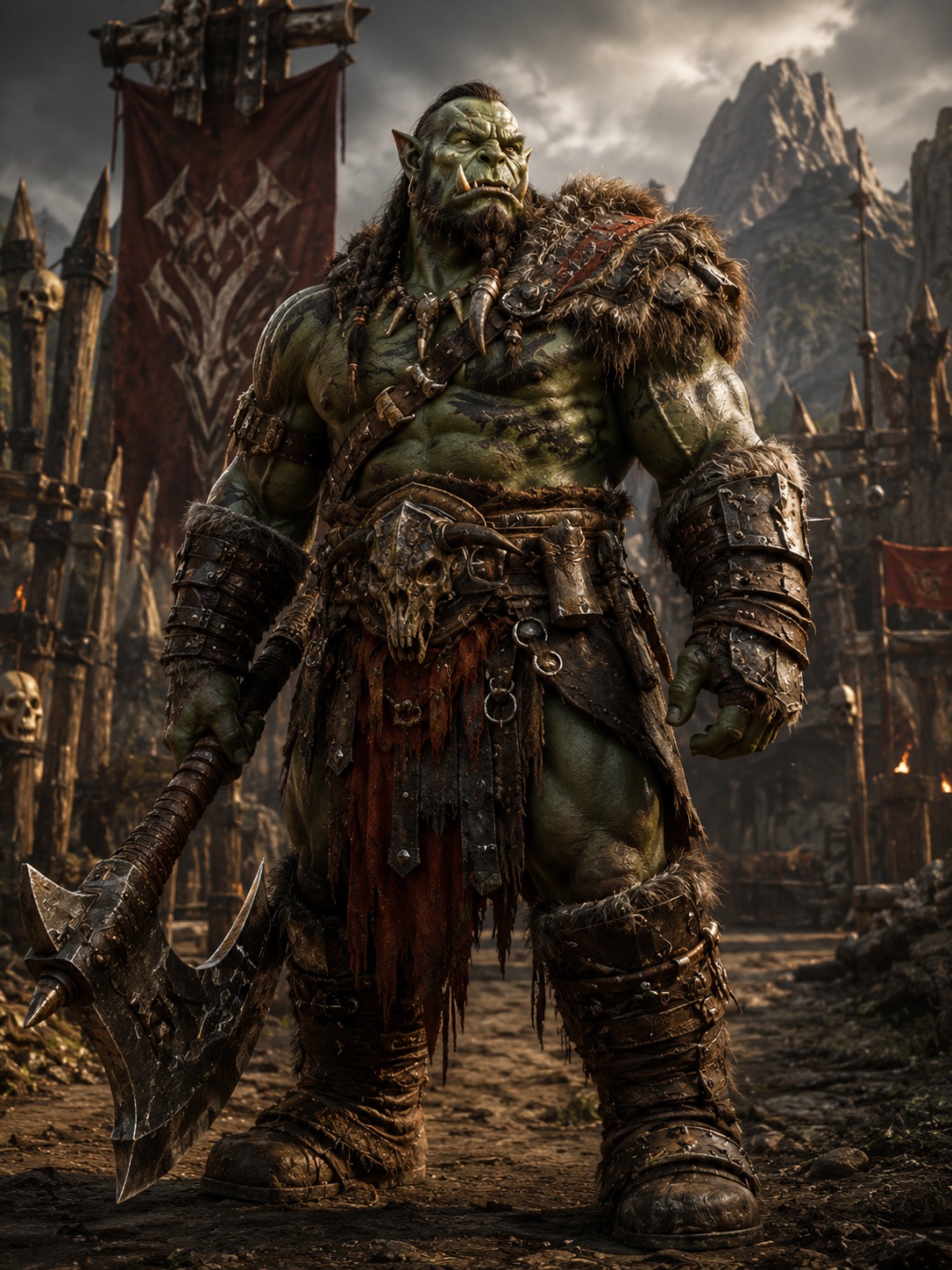
A warrior race marked by green, grey, or brown skin, protruding tusks, and a heavily muscled, often oversized frame. Orcs live in tribes and clans across wastelands, mountains, and fortresses, prizing strength, valour, and the honour of single combat. After J. R. R. Tolkien revived the word in The Hobbit (George Allen & Unwin, 1937) and The Lord of the Rings (1954–55), the orc became the most recognisable adversarial race of modern fantasy. Tolkien's letters 144 and 153 frame them as corruptions of Elves bred by Melkor, and through Dungeons & Dragons, Warhammer, and Warcraft the orc has shifted from generic foe to a society with its own pride, kinship, and warrior code.
Origin
The word descends from Old English 'orc' meaning demon or corpse-monster, attested in the compound 'orcneas' at Beowulf line 112. Tolkien addressed the term in his 1936 Oxford lecture 'Beowulf: The Monsters and the Critics' and revived it for his own mythology. The Hobbit (Allen & Unwin, 1937) used the form goblin; The Lord of the Rings (Allen & Unwin, 1954–55) consolidated 'Orc'. In Letters 144 and 153, Tolkien explains that Eru Iluvatar did not create orcs directly: Melkor bred them from captured Elves. Gary Gygax adopted Tolkien's race names wholesale in the 1974 first edition of Dungeons & Dragons; pressure from the Tolkien estate forced Hobbit to be renamed Halfling, but Orc remained as a common noun. Games Workshop's Warhammer Fantasy Battle (1983) and Blizzard's Warcraft: Orcs & Humans (1994) standardised the green skin, tusks, and bulked physique.
Features
- Green, grey, or brown skin, prominent lower tusks, heavy musculature
- Tribal and clan structure with chieftains, war-leaders, and shamans
- Honour culture built on personal combat and the right of challenge
- Settlements in highlands, badlands, and fortified strongholds
- Mounts of wolves, boars, or wargs; a distinct guttural tongue beside the common speech
Stories
Orcs first appeared as the rank-and-file of Sauron and Saruman in Tolkien, then settled into Dungeons & Dragons as the default humanoid antagonist. Warhammer cast them as cockney-spouting brawlers, Warcraft turned them into a displaced people with reclaimed pride, and The Elder Scrolls developed the Orsimer as a recognised civilisation. Stories that use orcs often turn on themes of civilisation versus the wild, prejudice versus understanding, and the cost of a warrior code; from the 2000s onward they appear increasingly as protagonists rather than only as enemies.
Weakness
Reliance on raw strength and martial display leaves orc societies vulnerable to diplomacy and stratagem, and inter-tribal feuding fractures coalitions easily. Tolkien's lesser orcs are weakened by sunlight, the species predating Saruman's Uruk-hai; Warcraft's orcs were once enslaved by demonic bloodlust, which still surfaces as a temptation. The cultural insistence on answering every challenge can itself become a trap for outsiders to exploit.
Cultural Significance
From the late twentieth century onward, the orc has been read as a residue of colonial-era anxieties about the savage other, and that critique reshaped the figure. Warcraft's Thrall and the Elder Scrolls Orsimer responded with stories of diaspora, resettlement, and reclaimed dignity. Japanese fantasy works such as Kentaro Miura's Berserk (Hakusensha, 1989–) and the Goblin Slayer light novels often blur the line between orc and ogre, treating them as a single brutal-humanoid grouping.
In Popular Culture
- Tolkien, The Hobbit (1937) and The Lord of the Rings (1954–55) — armies of Sauron and Saruman, Uruk-hai
- Dungeons & Dragons original set (TSR, 1974) and Monster Manual (1977) — baseline humanoid foe
- Games Workshop, Warhammer Fantasy Battle (1983) and Warhammer 40,000 (1987) — Orcs and Orks
- Blizzard, Warcraft series (1994–) — Thrall, Grommash Hellscream, Horde lore
- Bethesda, The Elder Scrolls series (1994–) — Orsimer of Morrowind and Skyrim
- Peter Jackson, The Lord of the Rings trilogy (2001–03) and The Hobbit trilogy (2012–14)
- Duncan Jones, Warcraft (Universal/Legendary, 2016)
- Monolith Productions, Middle-earth: Shadow of Mordor (2014) and Shadow of War (2017) — Nemesis System
Trivia
- In Letter 144 Tolkien described the Black Speech of Mordor as sounding like 'the noise of stones falling into a cauldron'.
- TSR retained Orc, Elf, and Dwarf when the Tolkien estate forced the renaming of Hobbit to Halfling in 1977.
- Blizzard designers cited the 1989 fourth edition of Warhammer Fantasy Battle as the immediate visual source for Warcraft's green orcs.
- Monolith Productions holds United States patent 10,807,003 covering the Nemesis System used in Shadow of Mordor.