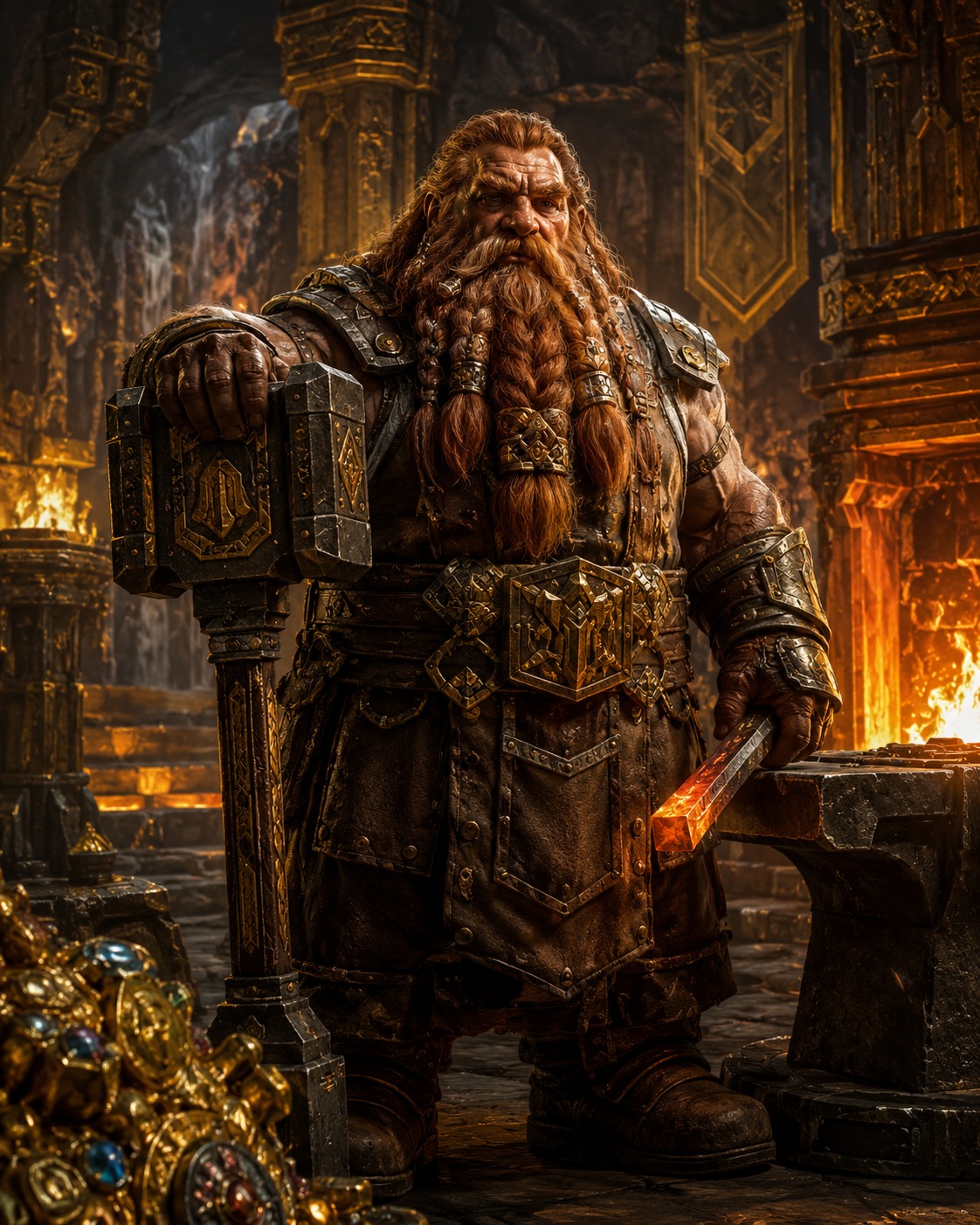
Dwarf
Dwarf · People of the Mountain — Smiths, Miners, Rune Artisans
Names in Other Languages
 드워프한국어
Dwarf · 산의 종족 — 대장장이와 광부, 룬의 장인
 ドワーフ日本語
Dwarf · 山の種族 — 鍛冶師と鉱夫、ルーンの匠
 矮人繁體中文
Dwarf · 山之種族 — 鐵匠與礦工,符文工匠
 ZwergDeutsch
Dwarf · Volk des Berges — Schmiede, Bergleute, Runenmeister
 NainFrançais
Dwarf · Peuple de la montagne — Forgerons, mineurs, artisans des runes
 EnanoEspañol
Dwarf · Pueblo de la montaña — Herreros, mineros, artesanos de runas
 AnãoPortuguês
Dwarf · Povo da montanha — Ferreiros, mineiros, artesãos de runas
 KrasnoludPolski
Dwarf · Lud góry — kowale, górnicy, runiczni rzemieślnicy
 ГномРусский
Dwarf · Народ горы — кузнецы, рудокопы, мастера рун
A short and broadly built race that raises great kingdoms inside mountains and beneath the earth. Long beards, dense musculature, mastery of forge and mine, and a near-religious regard for gold, oaths, and family honour define them. The figure descends from the Old Norse 'dvergr', whose oldest written sources are Snorri Sturluson's Prose Edda (c. 1220) and the Codex Regius (c. 1270), which preserves the Voluspa list of dwarf-names. J. R. R. Tolkien's The Hobbit (Allen & Unwin, 1937) and The Lord of the Rings (1954-55) recast the dvergar as a kingdom-building people in exile, and Dungeons & Dragons (TSR, 1974) made that template the standard for modern fantasy.
Origin
Old Norse 'dvergr' (plural dvergar) descends from Proto-Germanic *dwergaz. In Snorri Sturluson's Prose Edda (Gylfaginning chapter 14), the dwarves come into being like maggots in the corpse of the giant Ymir and are given shape and wit by the gods. The Codex Regius (GKS 2365 4to, c. 1270, today held at the Arni Magnusson Institute in Reykjavik) preserves the Dvergatal in Voluspa stanzas 9-16, a roster of more than seventy named dwarves. The treasures of the gods — Thor's hammer Mjolnir, Odin's spear Gungnir and ring Draupnir, Freyr's golden boar Gullinbursti, and Sif's golden hair — are forged by the sons of Ivaldi and by the brothers Brokkr and Eitri (or Sindri) in Skaldskaparmal. The Brothers Grimm's Kinder- und Hausmaerchen number 53, Schneewittchen (Snow White, first edition 1812), turned the dwarves into seven mountain-miners; Disney's animated Snow White and the Seven Dwarfs (1937) fixed that iconography in the popular imagination. The same year Tolkien published The Hobbit (Allen & Unwin, 1937), launching Thorin Oakenshield and his company and the trope of the exiled mountain kingdom; Gary Gygax adopted the template wholesale in the first edition of Dungeons & Dragons (1974).
Features
- Height of about four to five feet (1.2-1.5 m), broadly built and densely muscled
- Unmatched skill at smithing, jewelcraft, mining, and rune-carving
- Stone halls within mountains: Erebor, Khazad-dum, Karak Ankor, Ironforge
- Devotion to gold, oaths, and clan or family loyalty above almost all else
- Old Norse-derived or Tolkienian Khuzdul tongues, kept secret from outsiders
Stories
In Norse myth the dwarves are the underground masters whose forges the gods themselves must petition; they are the source of most named divine treasures. In Grimm's Schneewittchen and the Disney film they are miners and protectors. Tolkien shaped them into the Thorin Oakenshield template — a king in exile leading a quest to reclaim a lost mountain home — and made Gimli son of Gloin a hero of the Fellowship of the Ring. Wagner's Der Ring des Nibelungen (1869-1876) gave them their tragic register through Alberich and Mime, dwarves consumed by gold. From Dungeons & Dragons forward they are the canonical sturdy warrior-craftsman ally, divided typically into mountain and hill subraces.
Weakness
Stubbornness, an obsessive attachment to gold, and an inability to let grudges fade are the defining weaknesses. Tolkien's king Thror was seduced by the gold of Moria and woke the Balrog beneath it; Thorin himself falls into the same dragon-sickness in The Hobbit. The dwarf Andvari in Volsunga saga curses the gold taken from him and brings doom on the line of Sigurd. Warhammer's Book of Grudges, codified in 1986 Warhammer Armies, formalises this trait: any wrong, once entered, must be answered even centuries later. Their short stature and short legs make them poor on horseback or in naval engagement.
Cultural Significance
The dwarf compresses pre-industrial mining and smithing trades into a single race; Germanic and Celtic mine-spirits such as the English coblynau and the German Kobold share the same archetype. The Brothers Grimm's polite seven miners (1812) and Disney's industrial-age workers (1937) gave the figure its modern shape, and Tolkien's letters 156 and 176 state explicitly that he modelled the Khuzdul tongue on Hebrew and that the dwarves were meant to be a diaspora people whose language is kept from outsiders. Warcraft's Bronzebeard, Wildhammer, and Dark Iron clans, and Terry Pratchett's Sam Vimes-era Discworld dwarves, are twenty-first-century variations on the same diaspora and trade-guild motif.
In Popular Culture
- Snorri Sturluson, Prose Edda (c. 1220) — Gylfaginning ch. 14, Skaldskaparmal
- Codex Regius (GKS 2365 4to, c. 1270) — the Dvergatal in Voluspa; Andvari in Volsunga saga
- Brothers Grimm, Kinder- und Hausmaerchen no. 53 Schneewittchen (1st ed., 1812)
- Richard Wagner, Der Ring des Nibelungen (premiered 1869-1876) — Alberich, Mime
- Walt Disney, Snow White and the Seven Dwarfs (1937)
- J. R. R. Tolkien, The Hobbit (Allen & Unwin, 1937), The Lord of the Rings (1954-55) — Thorin, Gimli, Durin, Khazad-dum
- Gary Gygax and Dave Arneson, Dungeons & Dragons original set (TSR, 1974) — Mountain and Hill Dwarves
- Games Workshop, Warhammer Dwarfs in Warhammer Armies (1986) — Slayers, Book of Grudges
- Blizzard, Warcraft series (1994–) — Bronzebeard, Wildhammer, and Dark Iron clans
Trivia
- The names Tolkien gave the thirteen dwarves of The Hobbit — Thorin, Balin, Dwalin, Fili, Kili, Dori, Nori, Ori, Oin, Gloin, Bifur, Bofur, Bombur — are taken almost verbatim from the Dvergatal in the Codex Regius Voluspa.
- Snorri's Gylfaginning ch. 14 notes that the dwarves live in stone and earth and turn to stone if caught in sunlight, the source of the later sunlight-petrification motif shared with trolls.
- In Appendix F of The Lord of the Rings (1955), Tolkien insists on the plural 'dwarves' rather than standard English 'dwarfs'; his spelling has since become the fantasy default.
- The names of Disney's seven dwarfs (Doc, Grumpy, Happy, Sleepy, Bashful, Sneezy, Dopey) do not appear in Grimm at all; they were first chosen for a 1912 stage adaptation.