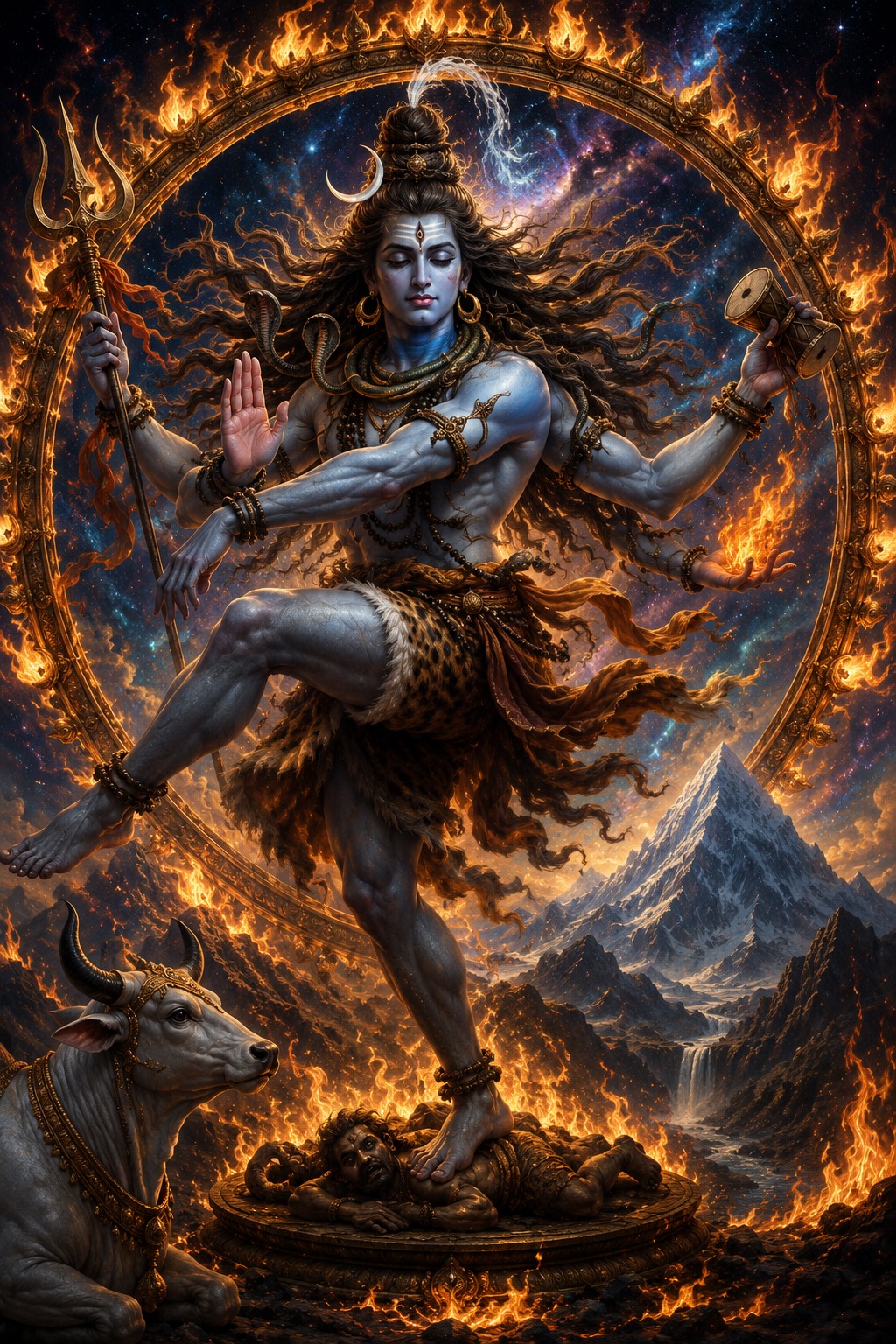
Shiva
Shiva · Hindu God of Destruction and Renewal — Cosmic Dancer
Names in Other Languages
 시바한국어
시바한국어Shiva· 힌두 파괴와 재생의 신 우주의 무용수
 シヴァ日本語
Shiva· ヒンドゥー破壊と再生の神 宇宙の踊り手
 濕婆繁體中文
Shiva· 印度教破壞與再生之神 宇宙之舞者
 ShivaDeutsch
Shiva · Hinduistischer Gott der Zerstörung und Erneuerung — Kosmischer Tänzer
 ShivaFrançais
Shiva · Dieu hindou de la destruction et du renouveau — Danseur cosmique
 ShivaEspañol
Shiva · Dios hindú de la destrucción y la renovación — Danzante cósmico
 ShivaPortuguês
Shiva · Deus hindu da destruição e da renovação — Dançarino cósmico
 ŚiwaPolski
Śiwa · Hinduski bóg zniszczenia i odrodzenia — Kosmiczny tancerz
 ШиваРусский
Shiva · Индуистский бог разрушения и обновления — Космический танцор
Shiva (Sanskrit Śiva, 'the auspicious one') is the god of destruction and regeneration of Hindu mythology — the decisive canon, one of the Trimūrti (Trimūrti) — the decisive canonical iconographic figure. The decisive textual canon is the Rudra (Rudra) hymns 1.43, 1.114, 2.33, and 7.46 of the storm god of the Rigveda (Rigveda) of c. 1500-1200 BCE — the decisive origin canon — and the Shvetashvatara Upanishad (Shvetashvatara Upanishad) 3.4-5 of c. 6th-4th century BCE — the decisive canon of the identification of Rudra and Shiva. The Mahabharata (Mahābhārata) Anushasana Parva 14.4 of c. 4th century BCE-4th century CE — the decisive canon of the Shiva Sahasranama (Shiva Sahasranama, 'Thousand Names of Shiva') — and the Shiva Purana (Śiva Purāṇa) of c. 800 CE — one of the 18 Mahapuranas (Mahāpurāṇa) — and the Natya Shastra (Nāṭya Śāstra) of Bharata Muni of c. 200 CE — the decisive canon of the Tandava (Tāṇḍava, cosmic dance) — and the Kumarasambhava (Kumārasambhava) of Kalidasa (Kālidāsa) of c. 5th century CE — the decisive canon of marriage to Parvati (Pārvatī).
Origin
The iconographic origin is presumed to be the seated horned figure of the 'Pashupati seal (Paśupati seal, c. 2600-1900 BCE Mohenjo-daro)' of the Indus civilisation — the decisive origin canon — and the decisive textual canon is the Rudra hymns 1.43, 1.114, 2.33, and 7.46 of the storm god of the Rigveda of c. 1500-1200 BCE — the decisive canon — in which 'Shiva' was originally the epithet of Rudra meaning 'auspicious'. The Shvetashvatara Upanishad 3.4-5 of c. 6th-4th century BCE — the decisive canon of the identification of Rudra and Shiva — and the Mahabharata Anushasana Parva 14.4 of c. 4th century BCE-4th century CE — the decisive canon of the Shiva Sahasranama. The decisive canon of the death of Sati (Satī) and remarriage to Parvati, the destruction of the triple city Tripura (Tripura) (Tripurantaka Tripurāntaka), the Samudra Manthana (Samudra Manthana, churning of the ocean of milk) in which he drank the halahala (halāhala) poison and became blue-throated (Nilakantha Nīlakaṇṭha) — and the Shiva Purana of c. 800 CE and the Kumarasambhava of Kalidasa — the decisive canon of marriage to Parvati.
Features
- Third eye (forehead) and blue throat (Nilakantha)
- Trident trishula (triśūla) and small drum damaru (ḍamaru)
- Mounted on the bull Nandi (Nandī)
- Ganges (Gaṅgā) flowing from his hair, crescent moon, and serpent (Vasuki Vāsuki) ornaments
- Resides on Mount Kailash (Kailāsa), with wife Parvati (Pārvatī), sons Ganesha (Gaṇeśa) and Skanda (Skanda)
- Dancing Nataraja (Naṭarāja) — Tandava (Tāṇḍava) cosmic dance
Stories
The Vedic Rudra faith is the decisive origin, and the decisive textual canon is the Rudra hymns of the Rigveda of c. 1500-1200 BCE, the Shvetashvatara Upanishad of c. 6th-4th century BCE, the Mahabharata of c. 4th century BCE-4th century CE, and the Shiva Purana of c. 800 CE. The decisive canon called upon as the protector of yoga, meditation, and ascetic practitioners (yogi), and the decisive canon of the Shiva Linga (Liṅga, phallus stone) as the most common object of worship in temples throughout India. The decisive art canon is the bronze Nataraja (Naṭarāja) of the Chola dynasty of India of the 10th-12th centuries CE and the three-faced Shiva Trimurti of the Elephanta Caves (Elephanta Caves, 5th-8th centuries CE) of Karnataka, India. The Shiva of the 1980 TSR D&D Deities & Demigods is the decisive fantasy RPG canon, and the decisive 21st-century canon is the Shiva played by Mohit Raina (Mohit Raina) of the Indian Life OK TV series Devon Ke Dev Mahadev (Devon Ke Dev Mahadev) (820 episodes) of 2011-2014 and the Shiva faith of the film Baahubali (Baahubali, directed by S. S. Rajamouli) released in India on 30 May 2014 — the 21st-century decisive global video canon.
Weakness
Shiva's weaknesses are: (1) the decisive canonical weakness that when his anger explodes, it causes destruction of cosmic scale — the decisive canon in which he destroyed Daksha's (Dakṣa) yajna (yajña) in his anger at Sati's death; (2) the decisive canonical weakness of inability to control passion — the decisive canon of the c. 800 CE Shiva Purana in which he did not recognise his son Ganesha (Gaṇeśa) and beheaded him, then replaced his head with an elephant's; (3) Sati's death — the decisive canon in which Sati, insulted at Daksha's yajna, threw herself into the fire; (4) binding of Kama's (Kāma) arrow — the decisive canon in which he was awakened by Kama's arrow during meditation and burned Kama with his third eye; (5) binding of the halahala poison — the decisive canon in which he became blue-throated (Nilakantha) by drinking the poison during the Samudra Manthana; (6) binding with Parvati — the decisive canon of the family; (7) binding of the sacred domain — the decisive canon of Mount Kailash; (8) binding of the Tandava — the decisive canon of the cosmic dance. The decisive canonical finale is the decisive mythological canon of the c. 800 CE Shiva Purana — after the universe was destroyed by the Tandava dance, a new creation cycle began.
Cultural Significance
Shiva is not merely a destruction-god icon but the canonical iconographic figure of the decisive Hindu canon, traversing the Pashupati seal of the Indus civilisation, the c. 1500-1200 BCE Rigveda Rudra hymns, the c. 6th-4th century BCE Shvetashvatara Upanishad, the c. 4th century BCE-4th century CE Mahabharata, the c. 800 CE Shiva Purana, the c. 5th century CE Kalidasa Kumarasambhava, the 5th-8th centuries CE Elephanta Caves Trimurti, the 10th-12th centuries CE Chola dynasty bronze Nataraja, the 1980 TSR D&D Deities & Demigods, the 2011-2014 Indian Devon Ke Dev Mahadev, and the 2014 Baahubali. The seated horned figure of the 'Pashupati seal' of Mohenjo-daro of the Indus civilisation (c. 2600-1900 BCE) is presumed to be the decisive origin canon, and it settled as the decisive canon in the Rudra hymns of the storm god of the Rigveda of c. 1500-1200 BCE, and in the Shvetashvatara Upanishad of c. 6th-4th century BCE, Rudra and Shiva were identified. The decisive art canon is the about 6 m three-faced Shiva Trimurti (Sadāśiva) statue of the Elephanta Caves of Maharashtra, India of the 5th-8th centuries CE, and the bronze Nataraja of the Chola dynasty of India of the 10th-12th centuries CE. The decisive 21st-century canon is the Shiva played by Mohit Raina (Mohit Raina, born 8 August 1983 in Jammu, India) of the Indian Life OK TV series Devon Ke Dev Mahadev (820 episodes) from 18 December 2011 to 14 December 2014, and the scene of lifting the Shiva Linga of the film Baahubali: The Beginning (Baahubali: The Beginning) (directed by S. S. Rajamouli, worldwide box office about 180 million dollars) released in India on 10 July 2014 — the 21st-century decisive global video canon.
In Popular Culture
- Indus civilisation Pashupati seal (c. 2600-1900 BCE) — decisive origin canon (presumed)
- Rigveda Rudra hymns 1.43, 1.114, 2.33, 7.46 (c. 1500-1200 BCE) — decisive origin canon
- Shvetashvatara Upanishad 3.4-5 (c. 6th-4th century BCE) — decisive Upanishad canon
- Mahabharata Anushasana Parva 14.4 Shiva Sahasranama (c. 4th century BCE-4th century CE) — decisive epic canon
- Shiva Purana 18 Mahapuranas (c. 800 CE) — decisive Purana canon
- Kalidasa Kumarasambhava (c. 5th century CE) — decisive Sanskrit literary canon
- Elephanta Caves three-faced Shiva Trimurti (5th-8th centuries CE) — decisive art canon
- Chola dynasty bronze Nataraja (10th-12th centuries CE) — decisive bronze art canon
- TSR D&D Deities & Demigods, Shiva (1980) — decisive fantasy RPG canon
- Life OK Devon Ke Dev Mahadev Mohit Raina (2011-2014) — 21st-century decisive TV canon
- Film Baahubali Shiva faith (2014) — 21st-century decisive film canon
Trivia
The etymology of Shiva (Sanskrit Śiva) is the decisive canonical vocabulary of 'the auspicious one, the auspicious', and the aliases Mahadeva (Mahādeva, 'great god'), Rudra (Rudra, 'the roarer'), Nataraja (Naṭarāja, 'king of dance'), Pashupati (Paśupati, 'lord of beasts'), Nilakantha (Nīlakaṇṭha, 'blue-throated'), Tripurantaka (Tripurāntaka, 'destroyer of the triple city'), and Adiyogi (Ādiyogī, 'first yogi') are the decisive canonical vocabulary. The decisive textual canon is the Rudra hymns 1.43, 1.114, 2.33, and 7.46 of the storm god of the Rigveda (Rigveda) of c. 1500-1200 BCE — the decisive origin canon — in which 'Shiva' was originally the epithet of Rudra meaning 'auspicious'. The Shvetashvatara Upanishad (Shvetashvatara Upanishad) 3.4-5 of c. 6th-4th century BCE — the decisive canon of the identification of Rudra and Shiva — and the Mahabharata (Mahābhārata) Anushasana Parva 14.4 of c. 4th century BCE-4th century CE — the decisive canon of the Shiva Sahasranama (Shiva Sahasranama, 'Thousand Names of Shiva') — and the Shiva Purana (Śiva Purāṇa) of c. 800 CE — one of the 18 Mahapuranas (Mahāpurāṇa) — the decisive canon. The decisive canon of his anger after Sati's (Satī) death and remarriage to Parvati (Pārvatī), and the c. 5th century CE Kalidasa (Kālidāsa)'s Kumarasambhava (Kumārasambhava) — the decisive canon of marriage to Parvati — and the decisive canon in which he drank the halahala (halāhala) poison during the Samudra Manthana (Samudra Manthana, churning of the ocean of milk) and became blue-throated (Nilakantha Nīlakaṇṭha). The decisive canon in which he resides on Mount Kailash (Kailāsa) (the current Mount Kailash in Tibet, China, 6,638 m above sea level), rides the bull Nandi (Nandī), holds the trident trishula (triśūla) and small drum damaru (ḍamaru), lets the Ganges (Gaṅgā) flow from his hair, and wears the serpent Vasuki (Vāsuki) around his neck. The bronze Nataraja (Naṭarāja) of the Chola dynasty of India of the 10th-12th centuries CE is the decisive art canon, and the Shiva played by Mohit Raina (Mohit Raina) of the Indian Life OK TV series Devon Ke Dev Mahadev of 2011-2014 is the 21st-century decisive global video canon.