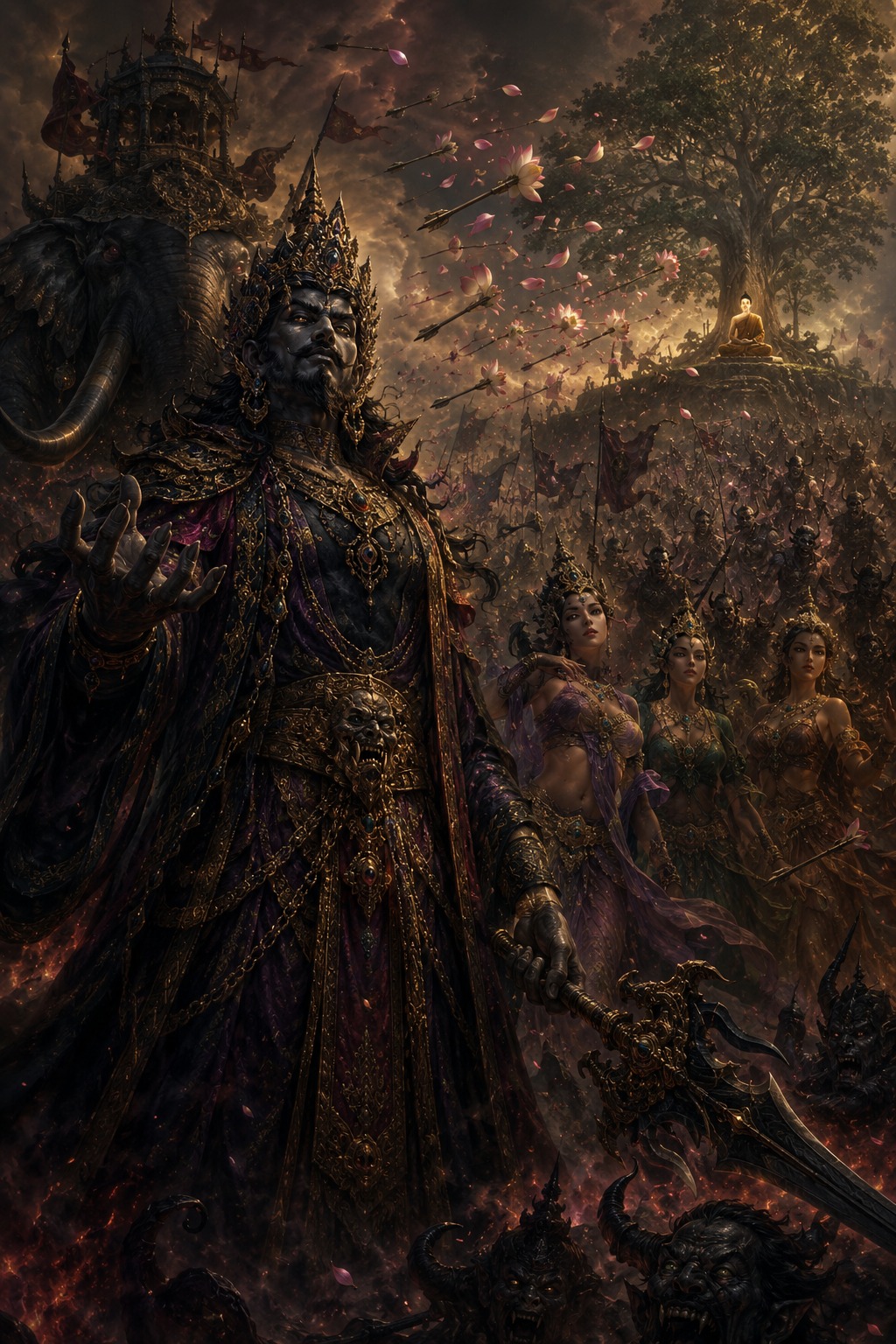
Mara
Mara · Buddhist Demon-King of Desire — Hinderer of Enlightenment
Names in Other Languages
 마라한국어
마라한국어Mara· 불교 욕망의 마왕 깨달음을 방해하는 자
 魔羅日本語
魔羅日本語Mara· 仏教の欲望の魔王 悟りを妨げる者
 魔羅繁體中文
Mara· 佛教欲望魔王 阻悟者
 MaraDeutsch
Mara · Buddhistischer Dämonenkönig der Begierde — Hinderer der Erleuchtung
 MâraFrançais
Mâra · Démon-roi bouddhiste du désir — Entrave de l'éveil
 MaraEspañol
Mara · Demonio-rey budista del deseo — Obstáculo de la iluminación
 MaraPortuguês
Mara · Demônio-rei budista do desejo — Obstáculo da iluminação
 MaraPolski
Mara · Buddyjski król demonów pożądania — Przeszkoda oświecenia
 МараРусский
Mara · Буддийский царь демонов желания — Препятствующий просветлению
Mara (Sanskrit Māra, Pali Māra) is the demon king of Buddhist mythology — the decisive canon — derived from the Sanskrit 'Māra' meaning 'death, destruction' — the decisive canonical vocabulary — the lord of the sixth heaven of the desire realm (Kāmadhātu), Paranirmita-vaśavartin, who tempts humans with desire and illusion to obstruct liberation — the decisive canonical iconographic figure. Aliases — Māra (Māra), Demon King (Demon King), God of Death, Lord of the Desire Realm, Māra Pāpīyas (Māra Pāpīyas, Evil One) — are the decisive canonical vocabulary. The decisive textual canon is the decisive origin canon of the Padhāna Sutta (Padhāna Sutta) of the Pali Sutta Nipāta (Sutta Nipāta) of c. 5th-3rd century BCE — the Buddha defeating the trial of Māra and his three daughters under the Bodhi tree — and the decisive canon of Buddhacarita (Buddhacarita) Canto 13 by Aśvaghoṣa (Aśvaghoṣa) of the 2nd century CE.
Origin
The etymological origin is the decisive canon of the Sanskrit 'Māra' meaning 'death, destruction (death, destruction)' — the decisive canon derived from the Sanskrit root 'mṛ (to die)'. The decisive origin canon is the decisive canon of the Padhāna Sutta (Padhāna Sutta, Sutta on Striving, verses 425-449) of the Pali Sutta Nipāta (Sutta Nipāta) of c. 5th-3rd century BCE — when the Buddha Siddhārtha Gautama (Siddhārtha Gautama) drew near to enlightenment under the Bodhi tree (Bodhi tree), Māra sent his army and three daughters (Taṇhā Taṇhā, craving; Aratī Aratī, discontent; Rāga Rāga, passion) to tempt and threaten him, but all failed — the decisive canon in which Māra's arrows all turned into flower petals. The decisive Sanskrit Buddhacarita canon is the decisive canon of Buddhacarita (Buddhacarita) Canto 13 by Aśvaghoṣa (Aśvaghoṣa, c. 80-150 CE) of the 2nd century CE — the trial of Māra's army and three daughters — and the decisive canon of the defeat of Māra's army in Lalitavistara Sūtra (Lalitavistara Sūtra) Chapter 21 of the 3rd century CE. The decisive art canon is the decisive origin art canon of the Mara-defeat scene at the Bharhut Stupa (Bharhut Stupa) of India of the 2nd century BCE and the Sanchi Stupa (Sanchi Stupa) of the 1st century BCE, and the decisive canon of the Ajanta Caves (Ajanta Caves) of India of the 5th-6th century CE and Borobudur (Borobudur) of Indonesia of the 9th century CE. The decisive East Asian canon is the decisive canon settled as the Chinese character ' (mo)' — the decisive canon in which Kumārajīva (Kumārajīva, 344-413) of the 5th century newly coined the Chinese character '' in his Chinese translations of Buddhist sutras (Lotus Sutra etc.).
Features
- Giant and threatening demon king
- Mounted on an elephant or commanding an army
- Three daughters — Taṇhā (Taṇhā, craving), Aratī (Aratī, discontent), Rāga (Rāga, passion)
- Illusion weapons — the anecdote of arrows thrown at the Buddha turning into flower petals
- Main axis — Lord of the sixth heaven of the desire realm Paranirmita-vaśavartin — the obstructer of enlightenment
- Aliases Māra Pāpīyas (Māra Pāpīyas)
Stories
The Buddha-Māra trial under the Bodhi tree in the Padhāna Sutta of the Pali Sutta Nipāta of c. 5th-3rd century BCE is the decisive origin, and the decisive textual canon is Buddhacarita Canto 13 by Aśvaghoṣa of the 2nd century CE and Lalitavistara Sūtra Chapter 21 of the 3rd century CE. The decisive canon called upon in Buddhist meditation and practice traditions as a metaphor for recognizing and overcoming the 'inner Māra' — one's own desires, laziness, and doubts — and the decisive canon in which the scene of the Buddha's defeat of Māra (Māravijaya) is commonly depicted in paintings and sculptures of temples in Southeast Asia, Tibet, Korea, and Japan. The decisive art canon is the decisive canon of the Mara-defeat scenes at the Bharhut Stupa of the 2nd century BCE, the Sanchi Stupa of the 1st century BCE, the Ajanta Caves of the 5th-6th century CE, and Borobudur of the 9th century CE, and the decisive 20th-century literary canon is the decisive canon of the novel Siddhartha (Siddhartha) of 1922 by the German Hermann Hesse (Hermann Hesse, 1877-1962) — the trial of the Buddha's enlightenment and Māra. The decisive East Asian martial arts/creative canon is the decisive canon as the prototype of the 'Demon King (Maoh)' character in Japanese manga, games, and novels.
Weakness
Māra's weaknesses are: (1) the Buddha's enlightenment — the decisive canonical weakness — powerless before the Buddha's enlightenment (bodhi) and right view, with the decisive canon that Māra's arrows all turned into flower petals at the Bodhi tree trial; (2) compassion — the decisive canonical weakness — powerless before the Buddha's compassion (karuṇā); (3) firm meditation — the decisive canonical weakness — cannot approach those of firm meditation (samādhi) and pure conduct (śīla); (4) the Buddha's finger — the decisive canonical weakness — the decisive canon of Māra retreating after the Buddha called the earth as witness with the 'earth-touching mudra (bhūmisparśa mudrā)'; (5) right view — the decisive canonical weakness — powerless before the right view (samyak-dṛṣṭi) of the Eightfold Path; (6) binding of the desire realm — the decisive canon of being bound as lord of the sixth heaven of the desire realm; (7) binding of the sacred domain — the decisive canon; (8) binding of enlightenment — the decisive canon of his own powerlessness after the Buddha's enlightenment. The decisive canonical finale is the decisive mythological canon of the Padhāna Sutta — 'My arrows all turn into flower petals, so I, Māra, am defeated'.
Cultural Significance
Māra is not merely a demon king icon but the canonical iconographic figure of the decisive Buddhist canon, traversing the Padhāna Sutta of the Pali Sutta Nipāta of c. 5th-3rd century BCE, Buddhacarita Canto 13 by Aśvaghoṣa of the 2nd century CE, Lalitavistara Sūtra Chapter 21 of the 3rd century CE, the Bharhut Stupa of the 2nd century BCE, the Sanchi Stupa of the 1st century BCE, the Ajanta Caves of the 5th-6th century CE, Borobudur of the 9th century CE, Kumārajīva's Chinese translations of Buddhist sutras of the 5th century, and Hesse's Siddhartha of 1922. The etymological origin settled as the decisive canon of the Sanskrit 'Māra' meaning 'death, destruction' — derived from the Sanskrit root 'mṛ (to die)'. The decisive origin canon is the decisive canon of the Padhāna Sutta (Padhāna Sutta, Sutta on Striving, verses 425-449) of the Pali Sutta Nipāta (Sutta Nipāta) of c. 5th-3rd century BCE — when the Buddha Siddhārtha Gautama (Siddhārtha Gautama, c. 563-483 BCE or 480-400 BCE) drew near to enlightenment under the Bodhi tree (Bodhi tree, Bodh Gaya, Bihar state, India) of Uruvelā (Uruvelā), Māra sent his 10-army (desire, discontent, craving, lust, laziness, fear, doubt, hypocrisy, pride, fame) and three daughters (Taṇhā Taṇhā, craving; Aratī Aratī, discontent; Rāga Rāga, passion) to tempt and threaten him, but all failed — the decisive canon in which the Buddha called the earth as witness with the 'earth-touching mudra (bhūmisparśa mudrā)' and Māra's arrows all turned into flower petals. The decisive Sanskrit Buddhacarita canon is the decisive canon of Buddhacarita (Buddhacarita) Canto 13 by the Indian poet and philosopher Aśvaghoṣa (Aśvaghoṣa, c. 80-150 CE) of the 2nd century CE — the trial of Māra's army and three daughters — and the decisive canon of the defeat of Māra's army in Lalitavistara Sūtra (Lalitavistara Sūtra) Chapter 21 of the 3rd century CE. The decisive art canon is the decisive origin art canon of the Mara-defeat (Māravijaya) scene at the Bharhut Stupa (Bharhut Stupa, Madhya Pradesh, India) of the 2nd century BCE and the Sanchi Stupa (Sanchi Stupa) of the 1st century BCE, and the decisive canon of the Ajanta Caves (Ajanta Caves) of India of the 5th-6th century CE and Borobudur (Borobudur) of Indonesia of the 9th century CE. The decisive East Asian canon is the decisive canon of the Chinese character ' (mo)' from Kumārajīva (Kumārajīva, 344-413) of Kucha of the 5th century, and the decisive 20th-century literary canon is the decisive canon of the novel Siddhartha (Siddhartha) of 1922 by the German Hermann Hesse (Hermann Hesse, 1877-1962, 1946 Nobel Prize in Literature) — the trial of the Buddha's enlightenment and Māra — and the decisive East Asian martial arts/creative canon is the decisive canon as the prototype of the 'Demon King (Maoh)' character in Japanese manga, games, and novels.
In Popular Culture
- Pali Sutta Nipāta Padhāna Sutta (Padhāna Sutta) trial of Mara and three daughters (c. 5th-3rd century BCE) — decisive origin canon
- Aśvaghoṣa Buddhacarita (Buddhacarita) Canto 13 Mara's army and three daughters (2nd century CE) — decisive Sanskrit canon
- Lalitavistara Sūtra (Lalitavistara Sūtra) Chapter 21 defeat of Mara's army (3rd century CE) — decisive Mahayana canon
- Bharhut Stupa Mara-defeat scene (2nd century BCE) — decisive origin art canon
- Sanchi Stupa Mara-defeat scene (1st century BCE) — decisive origin art canon
- Ajanta Caves Mara-defeat scene (5th-6th century CE) — decisive art canon
- Borobudur Mara-defeat scene (9th century CE) — decisive art canon
- Kumārajīva Chinese translation of Buddhist sutras Chinese character ' (mo)' (5th century) — decisive East Asian translation canon
- Hermann Hesse novel Siddhartha (1922) — decisive 20th-century literary canon
- Prototype of 'Demon King (Maoh)' character in Japanese manga, games, and novels — decisive East Asian martial arts/creative canon
Trivia
The etymology of Mara (Sanskrit Māra, Pali Māra, Chinese character) is the decisive canonical vocabulary of the Sanskrit 'Māra' meaning 'death, destruction (death, destruction)' — the decisive canon derived from the Sanskrit root 'mṛ (to die)', and aliases Māra (Māra), Demon King (Demon King), God of Death, Lord of the Desire Realm, Māra Pāpīyas (Māra Pāpīyas, Evil One), Kāma-māra (Kāma-māra, Māra of desire), Mṛtyu-māra (Mṛtyu-māra, Māra of death) are the decisive canonical vocabulary. The decisive origin canon is the decisive canon of the Padhāna Sutta (Padhāna Sutta, Sutta on Striving, verses 425-449) of the Pali Sutta Nipāta (Sutta Nipāta) of c. 5th-3rd century BCE — when the Buddha Siddhārtha Gautama (Siddhārtha Gautama, c. 563-483 BCE or 480-400 BCE) drew near to enlightenment at the age of 35 under the Bodhi tree (Bodhi tree, Bodh Gaya, Bihar state, India) of Uruvelā (Uruvelā), Māra sent his 10-army (desire, discontent, craving, lust, laziness, fear, doubt, hypocrisy, pride, fame) and three daughters (Taṇhā Taṇhā, craving; Aratī Aratī, discontent; Rāga Rāga, passion) to tempt and threaten him, but all failed — the decisive canon in which the Buddha touched the earth with the fingers of his right hand in the 'earth-touching mudra (bhūmisparśa mudrā, mara-defeating mudra)', called the earth goddess (Pṛthvī) as witness, and Māra's arrows all turned into flower petals. The decisive Sanskrit Buddhacarita canon is the decisive canon of the Sanskrit epic Buddhacarita (Buddhacarita, Life of the Buddha) Canto 13 by the Indian poet and philosopher Aśvaghoṣa (Aśvaghoṣa, c. 80-150 CE) of the 2nd century CE — the trial of Māra's army and three daughters — and the decisive canon of the Mahayana sutra Lalitavistara Sūtra (Lalitavistara Sūtra, Sutra of the Vast Play of the Buddha) Chapter 21 of the 3rd century CE — the defeat of Māra's army. The decisive art canon is the decisive origin art canon of the 'Māravijaya (Defeat of Mara)' at the Bharhut Stupa (Bharhut Stupa, Satna, Madhya Pradesh, India) of the 2nd century BCE and the Sanchi Stupa (Sanchi Stupa, Madhya Pradesh, India) of the 1st century BCE, and the decisive canon of the Ajanta Caves (Ajanta Caves, Maharashtra, India) of the 5th-6th century CE and the relief of 'Māravijaya' at Borobudur (Borobudur, near Magelang, Java island, world's largest Buddhist temple) of Indonesia of the 9th century CE. The decisive East Asian canon is the decisive canon of the Kuchan translator monk Kumārajīva (Kumārajīva, born 344 in Kucha, died 413 in Chang'an) of the 5th century newly coining the Chinese character ' (mo)' from the Sanskrit 'Māra' (before this, the Chinese characters '' or ' mora' were used) — the decisive canon in which the Chinese term 'Demon King (maoh)' settled in East Asia, and the decisive 20th-century literary canon is the decisive canon of the novel Siddhartha (Siddhartha) of 1922 by the German Hermann Hesse (Hermann Hesse, born 2 July 1877 in Calw, Germany, died 9 August 1962 in Montagnola, Switzerland, 1946 Nobel Prize in Literature) — the trial of the Buddha's enlightenment and Māra — and the decisive East Asian martial arts/creative canon is the decisive canon as the prototype of the 'Demon King (Maoh)' character in the 1986 Japanese game Dragon Quest (Dragon Quest) and Japanese manga, games, and novels.