Tree of Knowledge
Tree of Knowledge · The Forbidden Tree at the Centre of Eden
Names in Other Languages
 선악과 나무한국어
Tree of Knowledge · 에덴동산 중앙의 금단의 나무
 知恵の樹日本語
Tree of Knowledge · エデンの園中央の禁断の樹
 知善惡之樹繁體中文
Tree of Knowledge · 伊甸園中央之禁果樹
 Baum der ErkenntnisDeutsch
Tree of Knowledge · Der verbotene Baum in der Mitte Edens
 Arbre de la connaissanceFrançais
Tree of Knowledge · L arbre defendu au centre de l Eden
 Arbol del conocimientoEspañol
Tree of Knowledge · El arbol prohibido en el centro del Eden
 Arvore do conhecimentoPortuguês
Tree of Knowledge · A arvore proibida no centro do Eden
 Drzewo poznaniaPolski
Tree of Knowledge · Zakazane drzewo posrodku Edenu
 Дерево познанияРусский
Tree of Knowledge · Запретное древо посреди Эдема
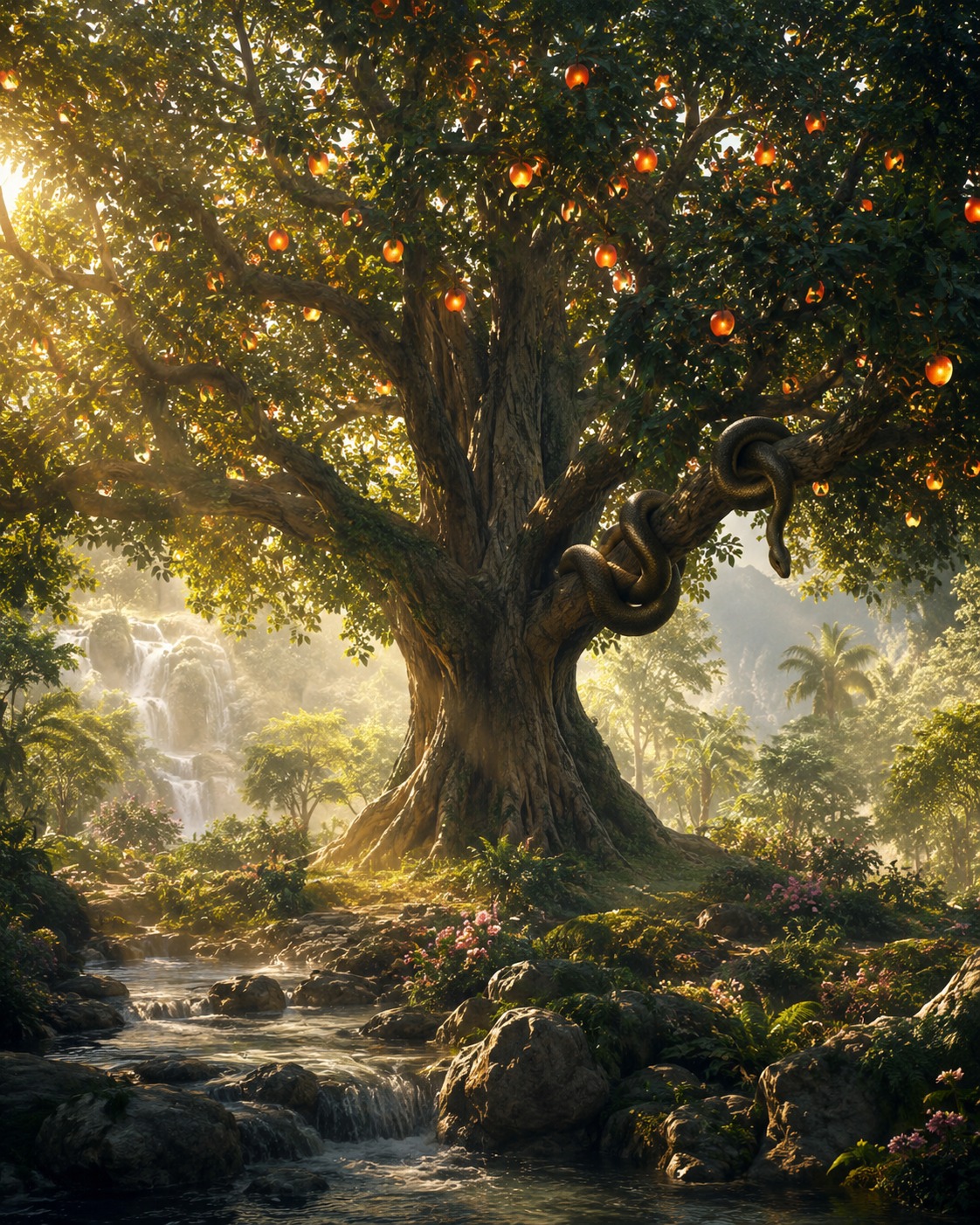
One of the two sacred trees at the centre of the Garden of Eden in Genesis 2:9, called the tree of the knowledge of good and evil. God commanded Adam, "of the fruit of this tree you shall not eat, for in the day you eat of it you shall surely die," Genesis 2:17, but the serpent seduced Eve, who ate and gave to Adam, and at once their eyes were opened and they knew they were naked, sewing fig leaves for cover, Genesis 3:1-7. The later iconography of an apple comes from the Latin pun on malum, evil, and malum, apple.
Origin
The Hebrew of Genesis 2:9 names two trees at the centre of Eden: the tree of life (etz ha-hayyim) and the tree of the knowledge of good and evil (etz ha-da at tov va-ra). In 2:17 God forbids Adam to eat of the latter. In 3:1-7 the serpent tempts Eve with "in the day you eat thereof your eyes shall be opened, and you shall be as God, knowing good and evil," and she takes a fruit that is "good for food, pleasant to the eyes, and to be desired to make one wise," and gives also to her husband. The eyes of both are opened, they know that they are naked, and they sew fig leaves together. In 3:22-24 God says, "now lest he put forth his hand and take also of the tree of life, and live forever," and drives them from Eden, setting cherubim and a flaming sword to guard the way to the tree of life. The iconography of the fruit as an apple begins in the 4th-century Latin Vulgate, where malum carries both evil and apple, and is fixed in medieval Europe.
Features
- Hebrew etz ha-da at tov va-ra, the tree of the knowledge of good and evil
- One of only two sacred trees at the centre of Eden, beside the tree of life
- Its fruit opens the eyes to the knowledge of good and evil
- The biblical text does not specify the species of the tree
- The image of an apple becomes fixed in the 4th century through the Vulgate pun on malum
Stories
In Jewish and Christian theology the tree of knowledge is the starting point of original sin and the test of human free will. Augustine Confessions Book 2, around 397-400, writes "the act became sin only because God had forbidden it," linking law and sin. Thomas Aquinas Summa Theologiae Part 1, Question 102 of 1265-1274, asks whether the tree was a real tree or a figure, and concludes both readings are orthodox. From the Latin Vulgate of 405, completed by Jerome, the pun of malum as both evil and apple settled the apple image. In Michelangelo Fall of Man on the Sistine ceiling of 1509-1512, the tree is painted as a fig. Martin Luther Lectures on Genesis of 1535 reads the event as the pride of wishing to become like God. The Kabbalistic Zohar of the 13th century reads the tree as a figure for the separation of the sefirot.
Weakness
At the heart of the tree of knowledge is the paradox of a knowing that cannot be known before the eating. Eve eats because the serpent says she will become wise, but the wisdom is to know her own nakedness and shame, and that becomes clear only after. The act also cuts humanity from eternal life. In Genesis 3:22-24 God says, "lest he take also of the tree of life and live forever," and drives the pair from Eden, setting cherubim and the flaming sword to guard the way. The price of knowledge was the loss of the tree of life. Since the text does not name the species, later traditions read it variously as apple, fig, grape, pomegranate, or wheat.
Cultural Significance
Michelangelo Fall and Expulsion on the Sistine ceiling of 1509-1512 painted the tree as a fig, while Albrecht Durer engraving Adam and Eve of 1504 and Lucas Cranach the Elder Adam and Eve of 1526 painted it as an apple. The English poet John Milton Paradise Lost of 1667, in Book 9 line 781, has Eve "reaching with eager hand" for the fruit, and made the Fall the foundational image of human free will in English. The phrase of the 1611 King James Bible at Genesis 3:6, "good for food, pleasant to the eyes, and a tree to be desired to make one wise," became one of the most quoted lines of English literature. The English term Adam apple, for the throat protrusion, comes from a medieval legend that a piece of the apple stuck in Adam throat. In Korean Catholic painting of creation, the apple becomes the standard image from the 17th century.
In Popular Culture
- Genesis 2:9 on the tree of the knowledge of good and evil, c. 13th century BCE
- Genesis 2:17 on the commandment not to eat, c. 13th century BCE
- Genesis 3:1-7 on the serpent and the Fall, c. 13th century BCE
- Genesis 3:22-24 on the expulsion from Eden, c. 13th century BCE
- Augustine Confessions Book 2 on the theology of the tree, 397-400
- Latin Vulgate by Jerome and the malum pun, completed 405
- Thomas Aquinas Summa Theologiae Part 1 Question 102, 1265-1274
- Michelangelo Fall of Man on the Sistine ceiling, 1509-1512
- Albrecht Durer Adam and Eve engraving, 1504
- John Milton Paradise Lost, 1667
Trivia
The Latin pun on malum (evil) and malum (apple) was the decisive accident that fixed the apple as the image of the forbidden fruit. Earlier rabbinic readings had identified the fruit variously as fig (because of the leaves of cover), grape (because of Noah drunkenness), wheat (because of bread), and pomegranate (because of Edenic spice). The English Adam apple for the larynx protrusion comes from a medieval legend that a piece of the apple stuck in Adam throat, first set down in 16th-century medical books. The 1456 Gutenberg Bible illustration of Genesis 3:6 leaves the tree of knowledge abstract, not committing to a species.