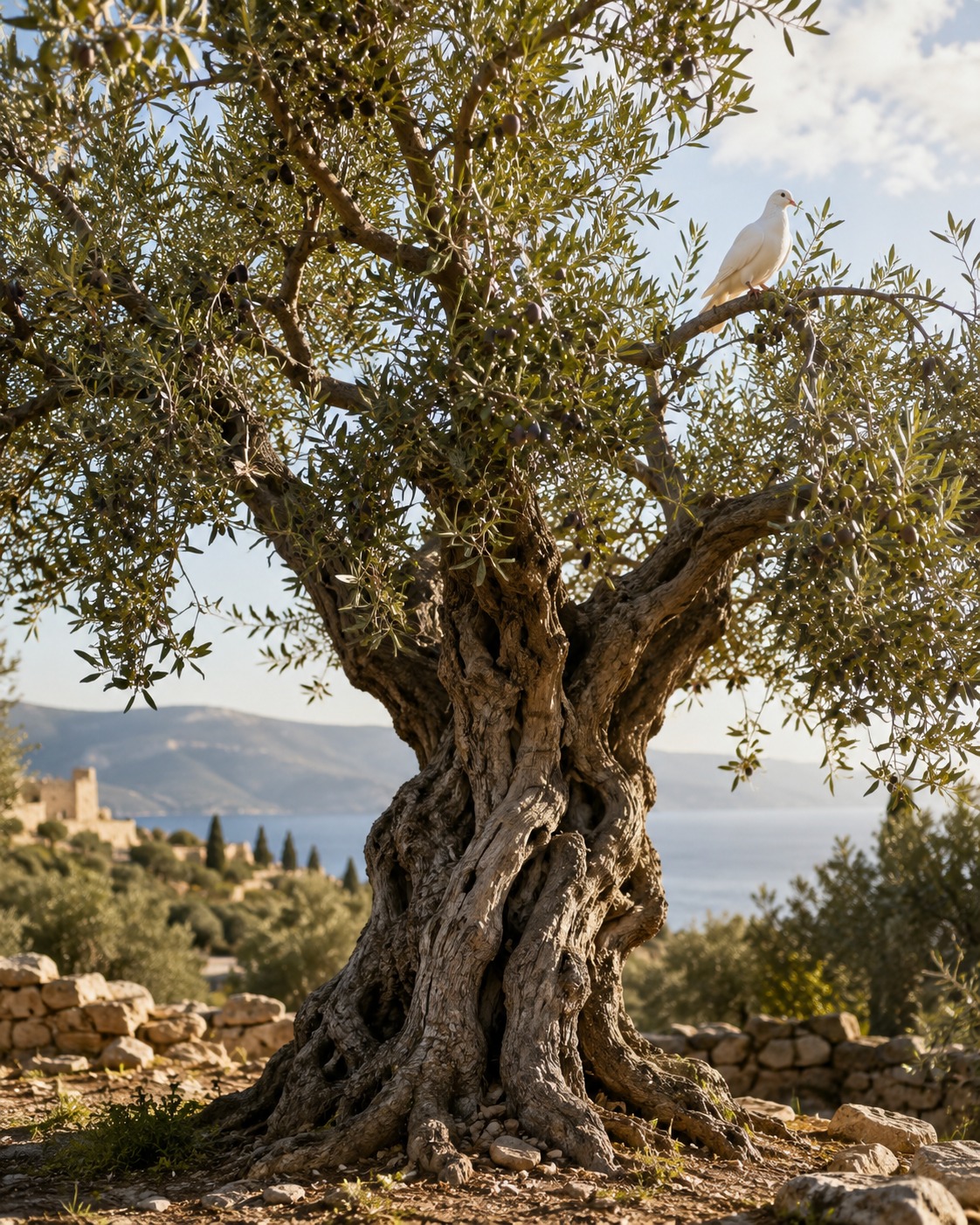
Olive
Olive · The Branch in Noah Dove, the Gift of Athena, the Sign of Peace
Names in Other Languages
 올리브한국어
Olive · 노아 비둘기의 가지, 아테나의 선물, 평화의 상징
 橄欖日本語
橄欖日本語Olive · ノアの鳩の枝, アテナの賜物, 平和の徴
 橄欖繁體中文
Olive · 諾亞之鴿之枝, 雅典娜之贈, 平和之徵
 OliveDeutsch
Olive · Der Zweig der Taube Noahs, das Geschenk Athenas, das Zeichen des Friedens
 OlivierFrançais
Olive · Le rameau de la colombe de Noe, le don d Athena, le signe de paix
 OlivoEspañol
Olive · El ramo de la paloma de Noe, el don de Atenea, la senal de paz
 OliveiraPortuguês
Olive · O ramo da pomba de Noe, o dom de Atena, o sinal de paz
 OliwkaPolski
Olive · Galaz golebicy Noego, dar Ateny, znak pokoju
 ОливаРусский
Olive · Ветвь голубя Ноя, дар Афины, знак мира
The evergreen broadleaf that carried Mediterranean civilization. From Genesis 8:11, where the dove from Noah ark returns with a fresh olive leaf, the olive became the emblem of peace. In Greek myth, Athena won the patronage of Athens by giving the city the olive tree in her contest with Poseidon (Pausanias Description of Greece 1.24.5). And the place where Jesus prayed before his arrest was Gethsemane, in Aramaic gat shemane, the olive press (Matthew 26:36).
Origin
Hebrew zayit, olive, appears in the Old Testament thirty-eight times. In Genesis 8:11 the dove sent out from Noah ark returns with an olive leaf in her mouth, and so Noah knew the waters had abated. Deuteronomy 8:8 calls Canaan a land of olive oil, and Psalm 52:8 sings, I am like a green olive tree in the house of God. In Greek myth, Apollodorus Bibliotheke 3.14 and Pausanias Description of Greece 1.24.5, of the 2nd century, tell the contest between Athena and Poseidon for the patronage of Athens: Poseidon struck the rock with his trident and brought forth a spring of salt water, but Athena made an olive tree grow, promising food, oil, light, and medicine. The citizens chose Athena gift, and the sacred olive grew beside the Erechtheion on the Acropolis. The passion of Christ is also bound to the olive: Matthew 26:36 and Mark 14:32 say that before his arrest Jesus went to Gethsemane, Aramaic gat shemane, the olive press.
Features
- Evergreen broadleaf small tree of the family Oleaceae, Olea europaea
- Narrow silver-grey leaves, small white blossoms, and dark purple drupes (the olive fruit) in autumn
- Lives more than a thousand years; the stump throws up new shoots again and again
- The unfading leaf gave the symbol of unchanging peace and of eternal life
- Almost every civilisation of the Mediterranean rim took it as the measure of civilisation (Pliny Natural History Book 15.1)
Stories
In the Mediterranean world, olive oil served as food, lamp fuel, medicine, soap, and anointing oil. Exodus 27:20 commands that beaten olive oil be used for the light of the sanctuary, and in 1 Samuel 16:13 Samuel anoints David king with olive oil. In Greece the Olympic victor was crowned with the kotinos, a wreath of branches cut from the sacred olive on the Acropolis, and Pindar Olympian Odes of the 5th century BCE sing the rite. In Rome, Cato De Agri Cultura of the 2nd century BCE treats the olive orchard in detail, and Columella De Re Rustica of the 1st century writes, the olive needs a mother hand. In the Christian church, the consecration of the olive oil at the Maundy Thursday liturgy in Jerusalem from the 4th century onward became the Chrism Mass of the Roman and Eastern churches. The Quran Surah of Light 24:35 sings that God light shines from the oil of an olive tree neither of the east nor of the west.
Weakness
The olive needs seven to fifteen years to bear its first fruit, and a tree only comes into its full bounty after thirty years. Columella wrote, the olive is not planted for one generation. The olive is also genetically biennial in fruit, so a year of abundance is followed by a year of scarcity. It cannot bear severe frost; the flower buds die below minus ten degrees Celsius. As Homer Odyssey 23 has Odysseus reveal to Penelope that he built their bed from a living olive stump as its pillar, the unmovable trunk of the olive is, at the same time, the limit it cannot be uprooted. The very meaning of Gethsemane, the olive press, is the figure of the pressing that yields oil, the dark side that complements the olive sign of peace.
Cultural Significance
On the 5th-century BCE Athenian tetradrachm, Athena head and her owl are paired with an olive sprig. The reverse of the modern Greek 1, 2, and 5 euro-cent coins also bears an olive branch. The 1947 flag of the United Nations places a wreath of olive branches around the map of the world as the emblem of peace. In the Roman Catholic Palm Sunday rite, olive branches are blessed alongside palm, an inheritance from the 4th-century Jerusalem liturgy. Vincent van Gogh painted his Olive Trees series in 1889 (the Museum of Modern Art set), and Roberto Rossellini Italian film The Olive Crusher of 1956 made the olive a modern emblem. The eight old olives of the Garden of Gethsemane in Jerusalem were carbon-dated in 2012 to descendants since the 12th century, with roots that go back to the 1st.
In Popular Culture
- Genesis 8:11 on the dove and the olive leaf, c. 13th century BCE
- Exodus 27:20 on the lamp oil of the sanctuary, c. 13th century BCE
- 1 Samuel 16:13 on the anointing of David, c. 10th century BCE
- Psalm 52:8 on the green olive in the house of God, 10th-5th century BCE
- Homer Odyssey Book 23 on the bed of living olive, 8th century BCE
- Pindar Olympian Odes on the kotinos crown, 5th century BCE
- Columella De Re Rustica Book 5, 1st century
- Matthew 26:36 on the Garden of Gethsemane, 1st century
- Pausanias Description of Greece 1.24.5 on Athena and Poseidon, 2nd century
- Quran Surah of Light 24:35 on the oil of the olive tree, 7th century
Trivia
The name Gethsemane comes from Aramaic gat shemane, the olive press. The kotinos crown of the Olympic victor was woven from branches of the sacred olive of the Acropolis, cut with a golden knife, according to Pausanias 5.7. Latin oleum, oil, comes from Greek elaia, olive, and is also the root of English oil. The 1986 book The Secret Life of Trees by Colin Tudge says a single olive lives thirty times longer than a human generation and so carries the identity of a whole village. The oldest single olive in the Garden of Gethsemane was dated in 2012 to about 900 years, and the orchard roots beneath it go back to the 1st century.